1. Search Result
Search Result
Results for "

bovine embryos

" in MedChemExpress (MCE) Product Catalog:

6

Inhibitors & Agonists

1

Fluorescent Dyes

2

Biochemical Assay Reagents

1

Natural
Products

1

GMP Molecules

Cat. No. Product Name Target Research Areas Chemical Structure
  • HY-16658B
    Z-VAD-FMK
    735+ Cited Publications

    Z-VAD(OH)-FMK

    Caspase Apoptosis RIP kinase Glutathione Peroxidase Reactive Oxygen Species (ROS) Inflammation/Immunology Cancer
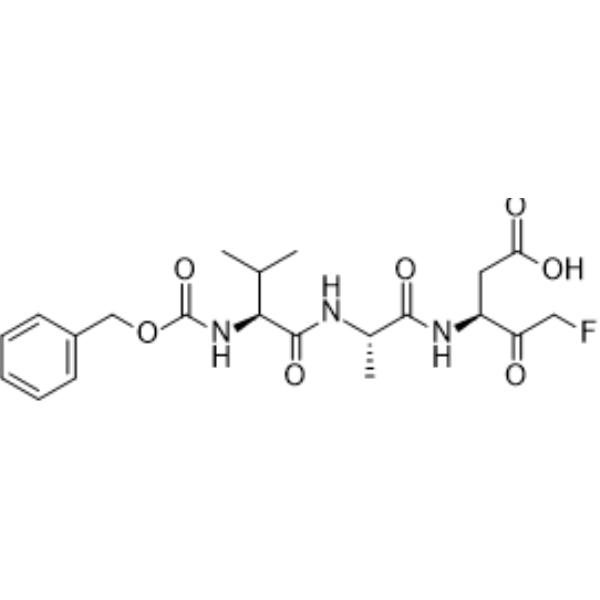
    Z-VAD-FMK is a pan-caspase inhibitor and also an ICE-like protease inhibitor, which inhibits apoptosis by preventing the processing of CPP32 to its active form. Z-VAD-FMK sensitivity varies primarily due to differential expression of receptor-interacting protein 1 (RIP1). Z-VAD-FMK limits the cryopreservation-induced apoptosis by reducing caspase-3 activity of in vitro produced bovine embryos. Z-VAD-FMK is immunosuppressive in vitro and inhibits T cell proliferation without blocking the processing of caspase-8 and caspase-3. Z-VAD-FMK leads to a decrease in intracellular glutathione (GSH) with a concomitant increase in reactive oxygen species (ROS) levels in activated T cells. Z-VAD-FMK is due to oxidative stress via the depletion of GSH. Z-VAD-FMK can be used for the study of acute pancreatitis .
    Z-VAD-FMK
  • HY-D0842A

    Albumin bovine serum (Low Endotoxin,Fatty acid free); BSA (Low Endotoxin,Fatty acid free)

    Biochemical Assay Reagents Nucleoside Antimetabolite/Analog Inflammation/Immunology
    Bovine Serum Albumin (Low Endotoxin,Fatty acid free) (BSA) is a 583 amino acid globular protein and oligonucleotide binding protein composed of three homologous full α domains. Bovine Serum Albumin (Low Endotoxin,Fatty acid free) (BSA) blocks the overall binding of oligonucleotides to cells. Bovine Serum Albumin (Low Endotoxin,Fatty acid free) (BSA) regulates the development of hamster embryos and induces arthritis .
    Bovine Serum Albumin (Low Endotoxin,Fatty acid free)
  • HY-W105310A

    Nacr

    HDAC Sirtuin CDK Bcl-2 Family Apoptosis Others
    Croconic acid disodium (Nacr) is a lysine crotonylation (Kcr) activator and electroactive material. Croconic acid disodium reduces the expression of HDAC2, HDAC3, SIRT1, and SIRT3, and increases the expression of EP300, CITED1, ACSS2, DPF2, CDYL, MLLT3, and YEATS2. Croconic acid disodium elevates intracellular crotonyl-CoA content and global histone lysine crotonylation levels. Croconic acid disodium promotes the growth of bovine fibroblasts, regulates cell cycle progression, and inhibits bovine fibroblast apoptosis (apoptosis). Croconic acid disodium improves the blastocyst development efficiency of bovine somatic cell nuclear transfer embryos. Croconic acid disodium undergoes reversible lithium intercalation/deintercalation reactions via sodium-lithium ion exchange. Croconic acid disodium is applicable to research related to cell growth promotion .
    Croconic acid disodium
  • HY-N1738

    Others Others
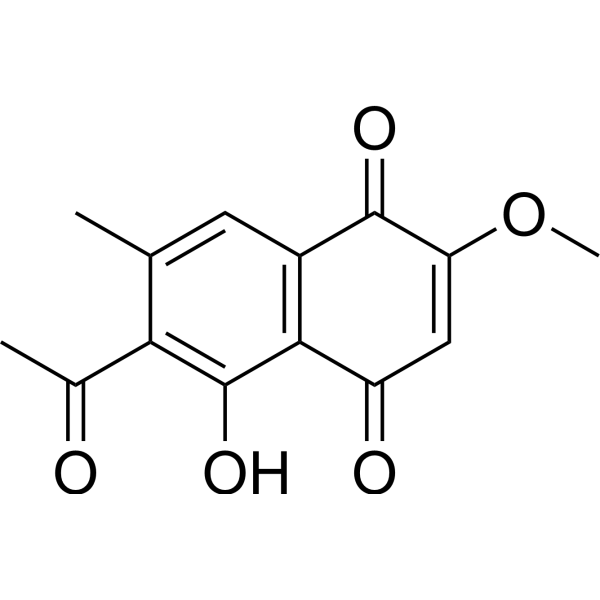
    2-Methoxystypandroneis a naphthoquinonethat can be found inPolygonum cuspidatum. 2-Methoxystypandrone showsantioxidantactivities. 2-Methoxystypandrone improves developmental competence of bovine embryos .
    2-Methoxystypandrone
  • HY-16658BG

    Caspase Apoptosis Cancer
    Z-VAD-FMK is a pan-caspase inhibitor and also an ICE-like protease inhibitor, which inhibits apoptosis by preventing the processing of CPP32 to its active form. Z-VAD-FMK sensitivity varies primarily due to differential expression of receptor-interacting protein 1 (RIP1). Z-VAD-FMK limits the cryopreservation-induced apoptosis by reducing caspase-3 activity of in vitro produced bovine embryos. Z-VAD-FMK is immunosuppressive in vitro and inhibits T cell proliferation without blocking the processing of caspase-8 and caspase-3. Z-VAD-FMK leads to a decrease in intracellular glutathione (GSH) with a concomitant increase in reactive oxygen species (ROS) levels in activated T cells. Z-VAD-FMK is due to oxidative stress via the depletion of GSH. Z-VAD-FMK can be used for the study of acute pancreatitis .
    Z-VAD-FMK
  • HY-182477

    Antibiotic Bacterial Fungal Infection
    Siccayne, found in the marine basidiomycete Halocyphina villosa and deuteromycete Helminthosporium siccans, is an antibiotic. Siccayne interferes with nucleotide incorporation into DNA and RNA, precursor transport enzymatic reactions, and essential macromolecule synthesis. Siccayne inhibits Gram-positive bacteria and some fungi. Siccayne can be used for research on infections caused by bacteria and fungi .
    Siccayne

Inquiry Online

Your information is safe with us. * Required Fields.

Salutation


Country or Region *

Applicant Name *


Organization Name *

Department *


Email Address *


Product Name *

Cat. No.


Requested quantity *

Phone Number *


Remarks

Inquiry Online

Inquiry Information

Product Name:
Cat. No.:
Quantity:
MCE Japan Authorized Agent:

