16 Results for "

carboxylate group

" in MedChemExpress (MCE) Product Catalog:
Products (16)

16 Results for "carboxylate group" in MCE Product Catalog:

28
28 Cited Publications
Cat. No.: HY-W018746
CAS No.: 139-33-3
Synonyms: Ethylenediaminetetraacetic acid disodium
EDTA disodium salt, also known as ethylenediaminetetraacetic acid disodium, belongs to the chelating agent category, which is formed by chelating a central metal ion with four carboxylate groups and two amine groups. This compound, with its ability to bind and chelate metal ions such as calcium, magnesium and iron, is commonly used in a variety of applications, including industrial, medical and research settings. It is used as a preservative in food and beverage, as a stabilizer in medicine, as a chelating agent in water treatment, and as a reagent in biochemical and biomedical research. In addition, EDTA disodium salt has been studied for potential research effects such as improving heavy metal poisoning and cardiovascular disease.
loading...
    loading...
Cat. No.: HY-W013718
CAS No.: 869-52-3
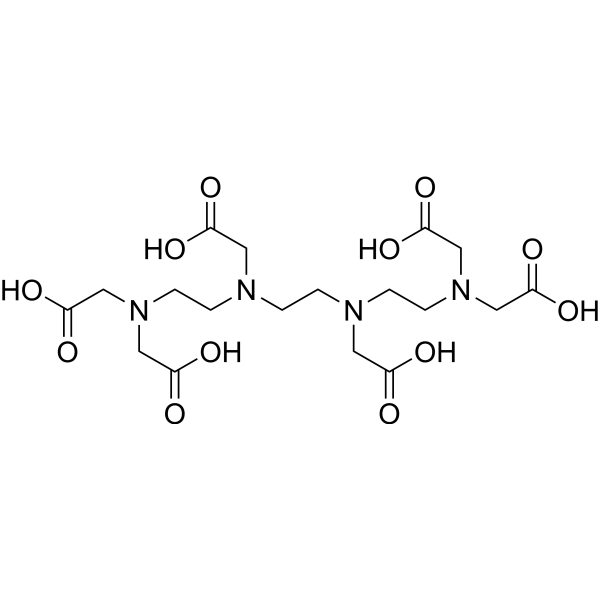
TTHA is an aminopolycarboxylic acid chelating agent with preferential affinity for lighter (lower atomic number) rare earth element (REE) ions. TTHA binds to REE ions through chelation as the primary coordination mechanism .
loading...
    loading...
Cat. No.: HY-W018746R
CAS No.: 139-33-3
Synonyms: Ethylenediaminetetraacetic acid disodium (Standard)
EDTA (disodium) (Standard) is the analytical standard of EDTA (disodium). This product is intended for research and analytical applications. EDTA disodium salt, also known as ethylenediaminetetraacetic acid disodium, belongs to the chelating agent category, which is formed by chelating a central metal ion with four carboxylate groups and two amine groups. This compound, with its ability to bind and chelate metal ions such as calcium, magnesium and iron, is commonly used in a variety of applications, including industrial, medical and research settings. It is used as a preservative in food and beverage, as a stabilizer in medicine, as a chelating agent in water treatment, and as a reagent in biochemical and biomedical research. In addition, EDTA disodium salt has been studied for potential research effects such as improving heavy metal poisoning and cardiovascular disease.
loading...
    loading...
Cat. No.: HY-W004617
CAS No.: 61414-16-2
Synonyms: 4,4',4''-(1,3,5-Triazine-2,4,6-triyl)tribenzoic acid
Target:  

MOFs

Research Areas:  

Others

2,4,6-Tris(4-carboxyphenyl)-1,3,5-triazine (4,4',4''-(1,3,5-Triazine-2,4,6-triyl) tribenzoic acid) is a metal-organic framework. 2,4,6-Tris(4-carboxyphenyl)-1,3,5-triazine is a C3-symmetric organic ligand with temperature-sensitive ratioluminescent properties. Complexes derived from 2,4,6-Tris(4-carboxyphenyl)-1,3,5-triazine exhibit strong emissivity and can be used for highly sensitive ratiometric fluorescent temperature sensing .
loading...
    loading...
Cat. No.: HY-169047
CAS No.: 251970-28-2
Synonyms: PAMAM G1.5 carboxylate sodium
Target:  

SARS-CoV

Research Areas:  

Infection

PAMAM dendrimer G1.5 carboxylate (PAMAM G1.5 carboxylate) sodium is a polyanionic dendrimers comprising the terminal groups sodium carboxylate. PAMAM dendrimer G1.5 carboxylate shows antiviral activity with the MERS‐CoV plaque inhibition assay, with the inhibition rate of 40.5% .
loading...
    loading...
Cat. No.: HY-W345492
CAS No.: 858515-82-9
Synonyms: 1-(Cyclohexylmethyl)-1H-indole-3-carboxylic Acid Methyl Ester
Target:  

Cannabinoid Receptor

Research Areas:  

Neurological Disease

Methyl-1-(cyclohexylmethyl)-1H-indole-3-carboxylate (1-(Cyclohexylmethyl)-1H-indole-3-carboxylic Acid Methyl Ester) is an analog of BB-22 that lacks the quinoline group. BB-22 is an analog of cannabinoid .
loading...
    loading...
Cat. No.: HY-W394551
CAS No.: 1442447-48-4
Research Areas:  

Others

Methyl 3,4-dibromo-2,5-dioxo-2,5-dihydro-1H-pyrrole-1-carboxylate is a small pyrrolidone molecule which features two bromine atoms and a methyl ester. The unsaturated dibromo motif is a covalent ligand for thiol groups, and may be used to label cysteine residues in proteins. The presence of two leaving groups on this molecule allows this linker to bind two thiols at a time. The methyl ester can be saponified to link this molecule to amines to form larger structures.
loading...
    loading...
Cat. No.: HY-E71167
Research Areas:  

Others

1,6-Dihydroxycyclohexa-2,4-diene-1-carboxylate dehydrogenase (EC 1.3.1.25) belongs to the family of oxidoreductases, specifically those acting on the CH-OH group of donor with NAD+ or NADP+ as acceptor.
loading...
    loading...
Cat. No.: HY-184637
DMSA Coated Fe2O3 Nanoparticles (Carboxylated ferric oxide nanoparticles) are magnetic nanomaterials with carboxyl (-COOH) groups modified on their surface. These materials typically consist of ferric oxide (Fe2O3) nanoparticles as a core, with carboxyl functional groups introduced to the surface through chemical modification. The carboxylation of the nanoparticle surface increases its negative surface charge, contributing to improved solubility and stability in water. Carboxylated ferric oxide nanoparticles exhibit good biocompatibility, making them suitable for biomedical applications.
loading...
    loading...
Cat. No.: HY-184627
The core material of carboxylated dextran-modified iron oxide nanoparticles is iron oxide (Fe3O4), which possesses superparamagnetic properties, making it suitable for applications requiring magnetic field response. The surface is coated with carboxylated dextran, a modification that increases the nanoparticles' water solubility and biocompatibility, while also providing carboxyl functional groups, facilitating further chemical modification and biomolecular coupling.
loading...
    loading...
Cat. No.: HY-184640
Carboxylated magnetic microspheres are magnetic microspheres with abundant carboxyl functional groups on their surface. They are usually composed of superparamagnetic materials (such as Fe3O4) and polymer materials, with polystyrene microspheres as the core.
loading...
    loading...
Cat. No.: HY-114065
CAS No.: 191326-92-8
Target:  

MMP

Research Areas:  

Cancer

MMP3-IN-4 is a MMP-3 inhibitor with a pIC50 value of 6.301. MMP3-IN-4 can be used in cancer research .
loading...
    loading...
Cat. No.: HY-184624
Carboxylated iron oxide nanoparticles (high-temperature pyrolysis method) are obtained by modifying DMSA on the basis of XFJ67 to obtain carboxyl groups, which converts oil-soluble nanoparticles into water-soluble nanoparticles, making them more suitable for applications in the biological field.
loading...
    loading...
Cat. No.: HY-184639
Carboxylated magnetic microspheres (low nonspecificity) are functionalized nano- or micron-sized magnetic particles with abundant carboxyl functional groups on their surface. Special chemical treatments reduce the likelihood of nonspecific adsorption. This 1μm carboxylated magnetic microsphere features a core-shell structure: a PS core, an outer layer of iron oxide (Fe3O4), and an outermost encapsulation layer. The carboxyl groups are obtained through polymer modification. Exhibiting low nonspecific adsorption, these microspheres can covalently couple with bioligands such as peptides, proteins, antibodies, and oligonucleotides using specific chemical reagents (e.g., EDC), making them particularly suitable for cell sorting, affinity chromatography, and immunoassay.
loading...
    loading...
Cat. No.: HY-B0368B
CAS No.: 119238-52-7
D-Captopril is a NDM-1 inhibitor and a competitive BlaB inhibitor, with an IC50 value of 21.8 µM against NDM-1 and a Ki of 70-100 µM against BlaB. D-Captopril synergistically reduces the minimum inhibitory concentration of Meropenem (HY-13678) against NDM-1-expressing bacteria. D-Captopril binds to BcII via its thiolate sulfur atom and carboxylate group, altering metal ion occupancy and modulating Cd 2+ binding affinity. D-Captopril can be used in the research of neonatal meningitis, sepsis and bacterial infections .
loading...
    loading...
Cat. No.: HY-184626
Thiol-modified magnetite nanoparticles are prepared via high-temperature pyrolysis and surface-modified with thiol functional groups. Magnetite is widely used in magnetic resonance imaging, magnetic separation, targeted drug delivery, tumor hyperthermia, cell labeling and separation, as a contrast agent, and in retinal detachment repair surgery due to its stable properties, good biocompatibility, high strength, and lack of toxicity. It is also used as a catalyst carrier, microwave absorbing material, and magnetic recording material. Xianfeng has developed numerous derivatives of magnetite, including oleic acid-modified magnetite, magnetite with different PEG ends, DMSA-modified magnetite, polylysine-modified magnetite, carboxylated dextran-modified magnetite nanoparticles, streptavidin-modified magnetite particles, thiol-modified magnetite magnetic nanoparticles, and polyethyleneimine (PEI)-modified magnetic magnetite nanoparticles, among others.
loading...
    loading...
  • 1

