16 Results for "

cortical slices

" in MedChemExpress (MCE) Product Catalog:
Products (16)

16 Results for "cortical slices" in MCE Product Catalog:

8
8 Publications Verification
Cat. No.: HY-12294A
Purity:  ≥98.0%
Synonyms: NVP-AAM077 tetrasodium hydrate
Target:  

Apoptosis Caspase iGluR

Research Areas:  

Neurological Disease

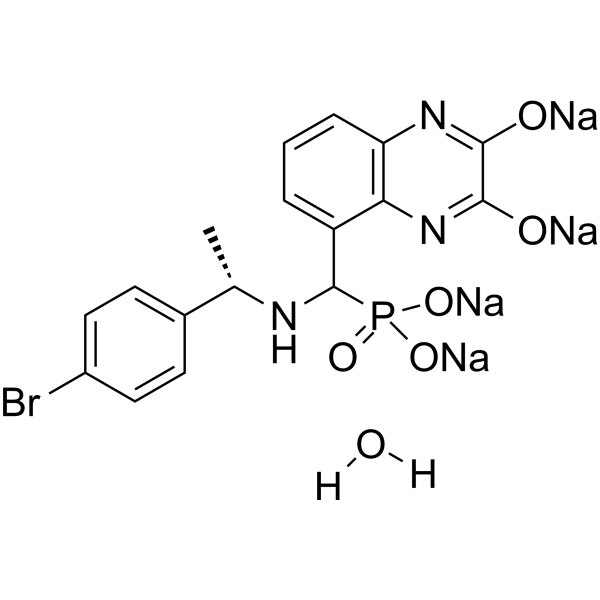
PEAQX tetrasodium hydrate (NVP-AAM077 tetrasodium hydrate) is a tetrasodium hydrate of PEAQX (HY-12294). PEAQX tetrasodium hydrate is an orally active and selective NMDA antagonist, with IC50 values of 270 nM and 29.6 μM for hNMDAR 1A/2A and hNMDAR 1A/2B, respectively. PEAQX tetrasodium hydrate can promote the activation of caspase-3 and induce cell apoptosis in cortical striatal slice cultures .
loading...
    loading...
Cat. No.: HY-D2709
Cy3 Dextran (MW 20000) is a fluorescent labeling reagent that combines Cy3 (HY-D0822) fluorescent dye and Dextran (HY-112624). The Cy3 fluorophore is commonly used in applications such as immunolabeling, nucleic acid labeling, fluorescence microscopy, and flow cytometry. Dextran has an inhibitory effect on thrombocyte aggregation and coagulation factors and is used as a plasma volume expander (Ex/Em = 550/570 nm) .
loading...
    loading...
Cat. No.: HY-12294
CAS No.: 459836-30-7
Synonyms: NVP-AAM077
Target:  

Caspase Apoptosis iGluR

Research Areas:  

Neurological Disease

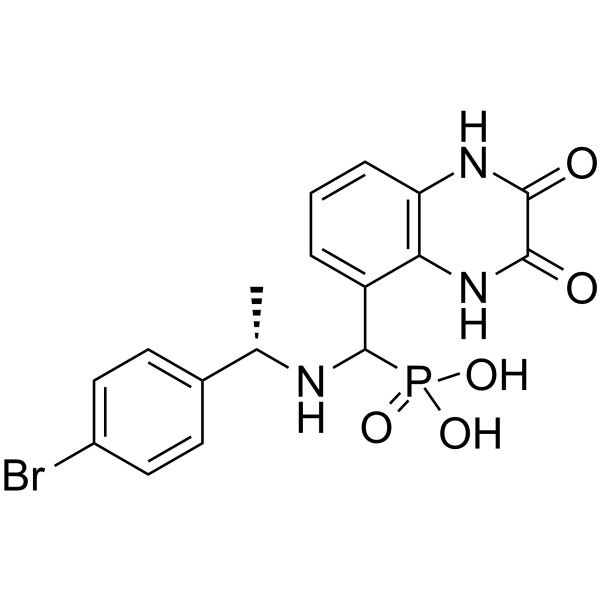
PEAQX (NVP-AAM077) is an orally active and selective NMDA antagonist, with IC50 values of 270 nM and 29.6 μM for hNMDAR 1A/2A and hNMDAR 1A/2B, respectively. PEAQX can promote the activation of caspase-3 and induce cell apoptosis in cortical striatal slice cultures .
loading...
    loading...
Cat. No.: HY-103465
CAS No.: 1004548-96-2
Purity:  99.40%
Target:  

Monoamine Transporter

Research Areas:  

Others

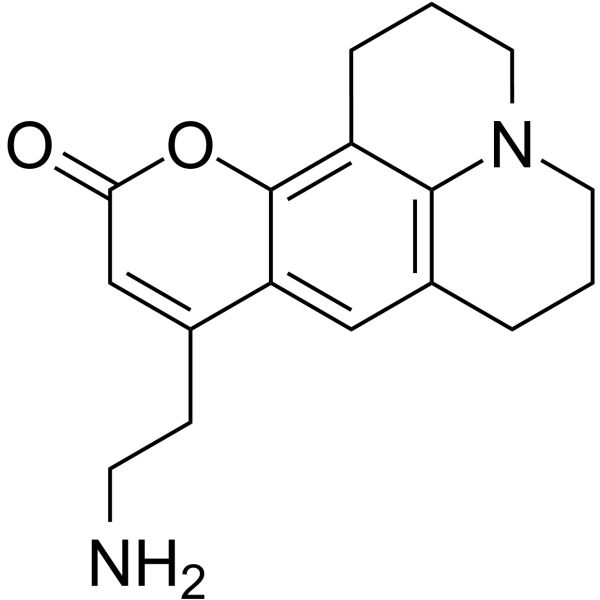
FFN511 is a potent fluorescent false neurotransmitters (FFNs) that targets neuronal vesicular monoamine transporter 2 (VMA T2). FFN511 inhibits serotonin binding to VMA T2-containing membranes with an IC50 of 1 µM. FFN511 directly images the dynamics of release during exocytosis, can be used to label dopamine terminals in live cortical-striatalacute slices .
loading...
    loading...
Cat. No.: HY-121872
CAS No.: 222315-88-0
Purity:  ≥95.0%
Research Areas:  

Neurological Disease

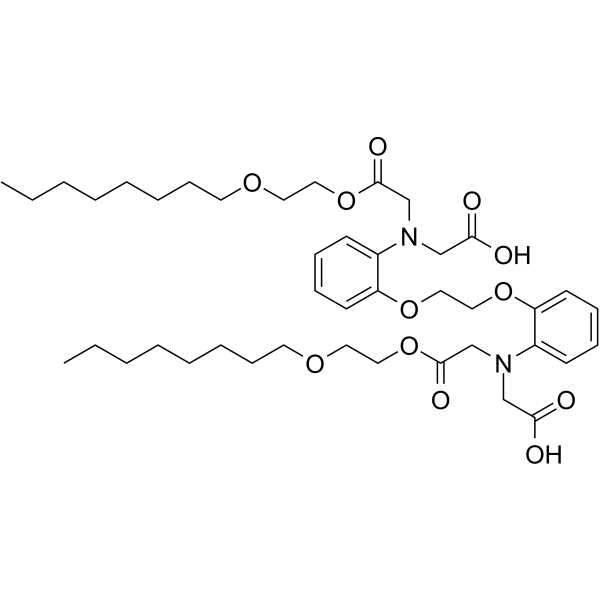
DP-b99 is a blood-brain barrier-permeable inhibitor of CYP2C9 and MMP-9, with a Ki value of 4.655 μM against CYP2C9. DP-b99 inhibits CYP2C9 via apparent non-competitive inhibition, mainly chelates pathological Zn 2+ in the membrane environment, attenuates the elevation of intracellular Zn 2+ and Ca 2+ levels, delays seizure onset and reduces seizure severity, and also prevents MMP-9-dependent dendritic spine remodeling, β-dystroglycan cleavage and gelatinase activity. DP-b99 can be used in the research of acute ischemic stroke, epileptogenesis and stroke .
loading...
    loading...
Cat. No.: HY-119615
CAS No.: 50335-55-2
Target:  

Adrenergic Receptor

Research Areas:  

Neurological Disease Endocrinology

Mezilamine is a potent antidopaminergic agent. Mezilamine induces a concentration dependent increase in the electrically stimulated overflow of 3H-noradrenaline from rat cortical slices, without affecting the basal overflow. Mezilamine acts as a presynaptic α-adrenoceptor antagonist and a postsynaptic α-adrenoceptor agonist .
loading...
    loading...
Cat. No.: HY-B0399A
CAS No.: 406-76-8
Synonyms: DL-Carnitine; DL-Levocarnitine
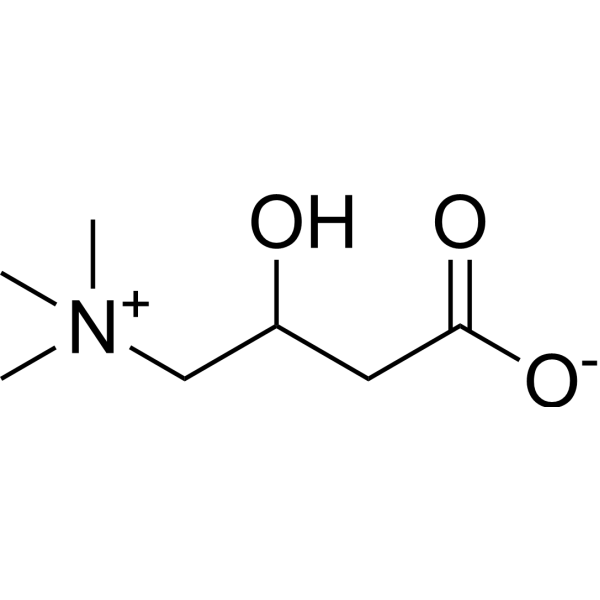
(±)-Carnitine (DL-Carnitine) is an orally effective racemic mixture of L-Carnitine (HY-B0399) and D-Carnitine. (±)-Carnitine elevates the mitochondrial NAD +/NADH ratio in the presence of 1,3-butanediol (HY-77490A). (±)-Carnitine does not increase glucose and urea production from L-glutamine, but stimulates propionate gluconeogenesis in rat renal cortical slices, and significantly reduces hepatic ketone body levels in rats fed a diet containing 30% high fat plus 20% 1,3-butanediol .
loading...
    loading...
Cat. No.: HY-12294B
CAS No.: 2514919-70-9
Synonyms: (Rac)-NVP-AAM077
Target:  

iGluR Caspase Apoptosis

Research Areas:  

Neurological Disease

(Rac)-PEAQX is a NMDA receptor agonist. (Rac)-PEAQX can promote the activation of caspase-3 and induce cell apoptosis in cortical striatal slice cultures .
loading...
    loading...
Cat. No.: HY-113802
CAS No.: 102203-17-8
Target:  

Histamine Receptor

Research Areas:  

Neurological Disease

VUF 8328 is a potent histamine H(3) receptor agonist. VUF 8328 inhibits the electrically-evoked [ 3H]-no-radrenaline release from rat cortical slices. VUF 8328 is promising for research of central nervous system disorders .
loading...
    loading...
Cat. No.: HY-120688
CAS No.: 177947-03-4
Target:  

5-HT Receptor

Research Areas:  

Neurological Disease

L-772405 is a selective 5-HT1D receptor agonist with the Ki values of 318, 29 and > 1000 nM aganist guinea pig 5-HT1B receptor, guinea pig 5-HT1D receptor and rat 5-HT rransporter, respectively. L-772405 decreases the potassium-induced outflow of 5-HT with an IC50 value of 240 nM .
loading...
    loading...
Cat. No.: HY-103465B
CAS No.: 2596358-28-8
Target:  

Monoamine Transporter

Research Areas:  

Others

FFN511 (hydrochloride) is a potent fluorescent false neurotransmitters (FFNs) that targets neuronal vesicular monoamine transporter 2 (VMA T2). FFN511 (hydrochloride) inhibits serotonin binding to VMA T2-containing membranes with an IC50 of 1 µM. FFN511 (hydrochloride) directly images the dynamics of release during exocytosis, can be used to label dopamine terminals in live cortical-striatalacute slices .
loading...
    loading...
Cat. No.: HY-131885
CAS No.: 2417096-44-5
Purity:  82.94%
Target:  

GABA Receptor

Research Areas:  

Neurological Disease

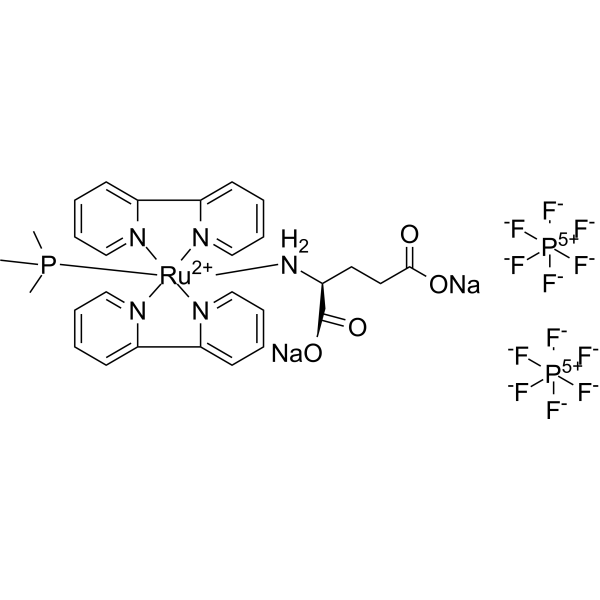
RuBi-Glutamate hexafluorophosphate sodium is a neuronal activator. RuBi-Glutamate hexafluorophosphate sodium photocleaves to release glutamate upon one- or two-photon excitation, activating glutamate receptors in cortical pyramidal neurons. RuBi-Glutamate hexafluorophosphate sodium reduces peak amplitude of evoked GABAergic inhibitory postsynaptic currents in its caged form. RuBi-Glutamate hexafluorophosphate sodium can be used for the research of Huntington's disease .
loading...
    loading...
Cat. No.: HY-149796
CAS No.: 39832-48-9
Target:  

Adrenergic Receptor

Research Areas:  

Cardiovascular Disease

Tazolol is a specific β-adrenergic antagonist (IC50: 700 nM for (-) isoproterenol-elicited accumulation of cyclic AMP in rat cortical slices). Tazolol produces a significant and sustained increase in cardiac output and stroke volume. Tazolol can be used in the research of heart failure .
loading...
    loading...
Cat. No.: HY-103465R
CAS No.: 1004548-96-2
Research Areas:  

Others

FFN511 (Standard) is the analytical standard of FFN511 (HY-103465). This product is intended for research and analytical applications. FFN511 is a potent fluorescent false neurotransmitters (FFNs) that targets neuronal vesicular monoamine transporter 2 (VMA T2). FFN511 inhibits serotonin binding to VMA T2-containing membranes with an IC50 of 1 μM. FFN511 directly images the dynamics of release during exocytosis, can be used to label dopamine terminals in live cortical-striatalacute slices .
loading...
    loading...
Cat. No.: HY-182548
CAS No.: 165383-52-8
BTS 72664 is a broad-spectrum, non-sedating, orally effective anticonvulsant. Its anticonvulsant effect mainly arises from enhancing GABAA receptor (GABAA receptor)-mediated chloride channel currents, while it exerts weak blocking effects on Na + channels (Ki = 350 μM) and NMDA receptors (NMDA receptor) (IC50 = 43 μM). BTS 72664 prevents the elevation of extracellular glutamate, glycine and serine concentrations in neurons, reduces cerebral infarct size, promotes functional recovery, prevents multiple types of epileptic seizures, and has low sedative potential. BTS 72664 can be used for the research of epilepsy, stroke and migraine .
loading...
    loading...
Cat. No.: HY-164295A
CAS No.: 133681-84-2
U-78517 dihydrochloride, a Trolox (HY-101445) analog, is a potent antioxidant. U-78517 dihydrochloride inhibits DCVC (HY-19717)-induced lipid peroxidation, scavenges DPPH, oxygen- and nitrogen-based free radicals. U-78517 dihydrochloride attenuates hypoxic injury in iaolated cardiac myocytes. U-78517 dihydrochloride can be used for the research of hypoxic injury, cerebral ischemia, and cardiovascular disease .
loading...
    loading...
  • 1

