1. Search Result
Search Result
Results for "

fumigant toxicity

" in MedChemExpress (MCE) Product Catalog:

6

Inhibitors & Agonists

5

Natural
Products

Cat. No. Product Name Target Research Areas Chemical Structure
  • HY-W015616

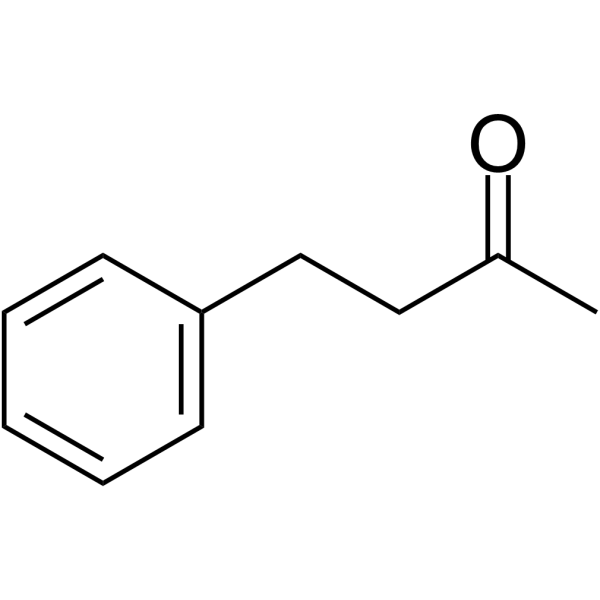
    4-Penylbutan-2-one

    Environmental Pollutants Tyrosinase Infection Metabolic Disease
    Benzylacetone (4-Penylbutan-2-one) is an aromatic compound. Benzylacetone is a mushroom tyrosinase inhibitor with an IC50 of 2.8 mM, a Ki of 1.25 mM for monophenolase and an IC50 of 0.6 mM, a Ki of 0.39 mM for diphenolase. Benzylacetone inhibits free mushroom tyrosinase and enzyme-substrate complex. Benzylacetone acts as an appetite enhancer via olfactory stimulation, reduces spontaneous locomotor activity, induces weight gain. Benzylacetone exhibits repellent, fumigant, and contact toxicity against Tribolium castaneum adults .
    Benzylacetone
  • HY-W010235

    Drug Derivative Infection
    3,5-Dimethoxytoluene, a methylated phenolic derivative, is one of characteristic scent compounds emitted from flowers of most rose varieties. 3,5-Dimethoxytoluene shows significant fumigant toxicity against L. serricorne and L. bostrychophila with LC50 values of 4.99 mg/L air and 0.91 mg/L air, respectively .
    3,5-Dimethoxytoluene
  • HY-W010235R

    Reference Standards Biochemical Assay Reagents Infection
    3,5-Dimethoxytoluene (Standard) is the analytical standard of 3,5-Dimethoxytoluene. This product is intended for research and analytical applications. 3,5-Dimethoxytoluene, a methylated phenolic derivative, is one of characteristic scent compounds emitted from flowers of most rose varieties. 3,5-Dimethoxytoluene shows significant fumigant toxicity against L. serricorne and L. bostrychophila with LC50 values of 4.99 mg/L air and 0.91 mg/L air, respectively[1].
    3,5-Dimethoxytoluene (Standard)
  • HY-W102349

    Parasite Infection
    S-Methyl thioacetate is a toxicant with fumigant activity, can be found in emissions from Bacillus oshimensis, Burkholderia gladioli, Burkholderia cepacia, and Pseudomonas oryzihabitans. S-Methyl thioacetate exerts fumigant toxicity against Caenorhabditis elegans and root-knot nematode Meloidogyne incognita. S-Methyl thioacetate functions as a bacterial volatile organic compound. S-Methyl thioacetate can be used for the research of plant-parasitic nematode infection .
    S-Methyl thioacetate
  • HY-W015616R

    4-Penylbutan-2-one (Standard)

    Tyrosinase Reference Standards Infection Metabolic Disease
    Benzylacetone (4-Penylbutan-2-one) (Standard) is the analytical standard of Benzylacetone (HY-W015616). This product is intended for research and analytical applications. Benzylacetone is an aromatic compound. Benzylacetone is a mushroom tyrosinase inhibitor with an IC50 of 2.8 mM, a Ki of 1.25 mM for monophenolase and an IC50 of 0.6 mM, a Ki of 0.39 mM for diphenolase. Benzylacetone inhibits free mushroom tyrosinase and enzyme-substrate complex. Benzylacetone acts as an appetite enhancer via olfactory stimulation, reduces spontaneous locomotor activity, induces weight gain. Benzylacetone exhibits repellent, fumigant, and contact toxicity against Tribolium castaneum adults .
    Benzylacetone (Standard)
  • HY-W269352

    Insecticide Infection
    2-Dodecanone is an insecticide with repellent activity against specific insect species. 2-Dodecanone exhibits contact toxicity against adult Tribolium castaneum, Lasioderma serricorne and Liposcelis bostrychophila. 2-Dodecanone shows repellent effects against adult Lasioderma serricorne .
    2-Dodecanone

Inquiry Online

Your information is safe with us. * Required Fields.

Salutation


Country or Region *

Applicant Name *


Organization Name *

Department *


Email Address *


Product Name *

Cat. No.


Requested quantity *

Phone Number *


Remarks

Inquiry Online

Inquiry Information

Product Name:
Cat. No.:
Quantity:
MCE Japan Authorized Agent:

