



1. Search Result
Search Result
Results for "

glucagon release

" in MedChemExpress (MCE) Product Catalog:

17

Inhibitors & Agonists

6

Peptides

Targets Recommended:
Cat. No. Product Name Target Research Areas Chemical Structure
  • HY-160734

    GSBR-1290

    GLP Receptor Metabolic Disease
    Aleniglipron (GSBR-1290) is an orally active glucagon-like peptide-1 receptor (GLP-1R) agonist, with an EC50 value of less than 0.1 nM in HDB cell lines in cAMP stimulation assays. Aleniglipron selectively activates the Gαs-cAMP signaling pathway of GLP-1R without β-arrestin recruitment. Aleniglipron induces insulin release, promotes glucose clearance, reduces food intake and decreases body weight. Aleniglipron is applicable to research related to type 2 diabetes and obesity .
    Aleniglipron
  • HY-P1782

    Amylin Receptor Metabolic Disease
    Calcitonin (8-32), salmon is a highly selective Amylin receptor antagonist. Calcitonin (8-32), salmon reverses the Amylin-mediated inhibition of glucose-induced insulin release, but has no effect on either glucagon release or somatostatin release. Calcitonin (8-32), salmon can be used for studies related to β-cell amylin .
    Calcitonin (8-32), salmon
  • HY-107648
    McN-A-343
    2 Publications Verification

    mAChR Neurological Disease Inflammation/Immunology
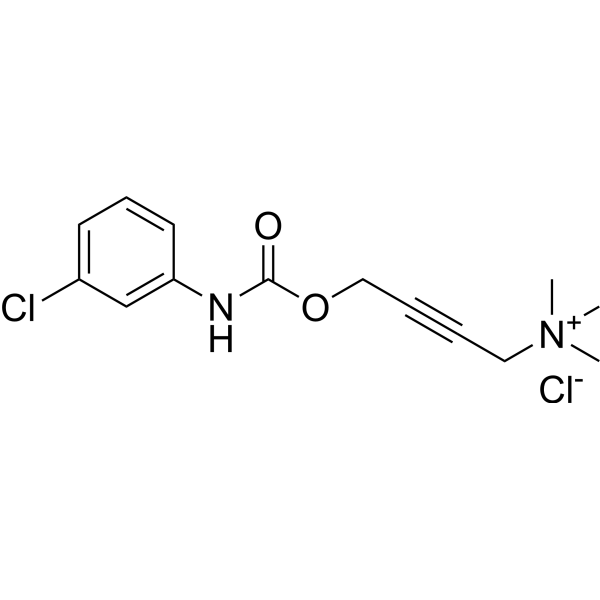
    McN-A-343 is a selective M1 muscarinic agonist that stimulates muscarinic transmission in sympathetic ganglia. McN-A-343 produces a significant inhibitory effect on Muscarine (HY-121404)-evoked catecholamine secretion from the isolated perfused rat adrenal gland. McN-A-343 is involved in the regulation of neuronal firing and activates enteroendocrine L cells to release glucagon-like peptide 1 (GLP-1) and modulates the secretion of α-melanocyte stimulating hormone (α-MSH) from the pituitary gland in the central nervous system. McN-A-343 reduces colonic inflammation and oxidative stress in Acetic acid (HY-Y0319)-induced ulcerative colitis (UC) mice. McN-A-343 can be used for the study of ulcerative colitis .
    McN-A-343
  • HY-P0014B
    Liraglutide TFA
    35+ Cited Publications

    GLP Receptor Metabolic Disease
    Liraglutide (TFA) is an agonist of glucagon-like peptide 1 receptor (GLP-1). Liraglutide (TFA) can activate GLP-1, leading to the release of insulin in the presence of increased glucose concentration. Liraglutide (TFA) also reduces glucagon secretion in a glucose-dependent manner. Liraglutide (TFA) can be studied in research on type 2 diabetes .
    Liraglutide TFA
  • HY-P3622

    GCGR Metabolic Disease
    (Ser8)-GLP-1 (7-36) amide, human is a glucagon-like peptide 1 amide derived from glucagonogen, a cleavage product of the GLP-1 (1-36) amide peptide. (Ser8)-GLP-1 (7-36) amide, human is an entero-insulinotropic hormone that causes glucose-dependent release of insulin from pancreatic β-cells and affects gastrointestinal motility and secretion .
    (Ser8)-GLP-1 (7-36) amide, human
  • HY-117912

    Endogenous Metabolite Cardiovascular Disease
    TRC210258 is a TGR5 agonist with activity to improve diabetes-associated hyperglycemia and dyslipidemia. TRC210258 promotes energy expenditure by enhancing the release of glucagon-like peptide-1. TRC210258 is able to improve glucose metabolic control in high-fat diet-induced obese mice. TRC210258 also showed improvement in lipid parameters in high-fat-fed hamsters, including reductions in plasma triglyceride and low-density lipoprotein cholesterol levels. TRC210258 improved emerging lipid-related cardiovascular risk parameters including remnant cholesterol and triglyceride clearance .
    TRC210258
  • HY-E70397A

    DPP-IV, Porcine Kidney

    Dipeptidyl Peptidase Metabolic Disease
    Dipeptidyl Peptidase IV, Porcine Kidney (DPP-IV, Porcine Kidney) is a serine aminopeptidase with multiple physiological roles. Dipeptidyl Peptidase IV, Porcine Kidney hydrolyses gastric inhibitory peptide (GIP) and glucagon-like peptide 1 (GLP-1), the most important insulin-releasing hormones (incretins) of the enteroinsular axis .
    Dipeptidyl Peptidase IV, Porcine Kidney
  • HY-P10302

    GLP Receptor Insulin Receptor Metabolic Disease
    GLP-1R/GIPR AgonIST-1 is a double-receptor agonist for GLP-1 (glucagon-like peptide-1) and GIP (glucose-dependent insulin releasing peptide). GLP-1R/GIPR agonist-1 lowers blood sugar by mimicking the action of endogenous hormones GLP-1 and GIP, enhancing insulin secretion while inhibiting glucagon secretion. GLP-1R/GIPR agonist-1 can be used in the study of metabolic diseases such as diabetes, obesity, and non-alcoholic steatohepatitis (NASH) .
    GLP-1R/GIPR agonist-1
  • HY-14292

    Dipeptidyl Peptidase Metabolic Disease
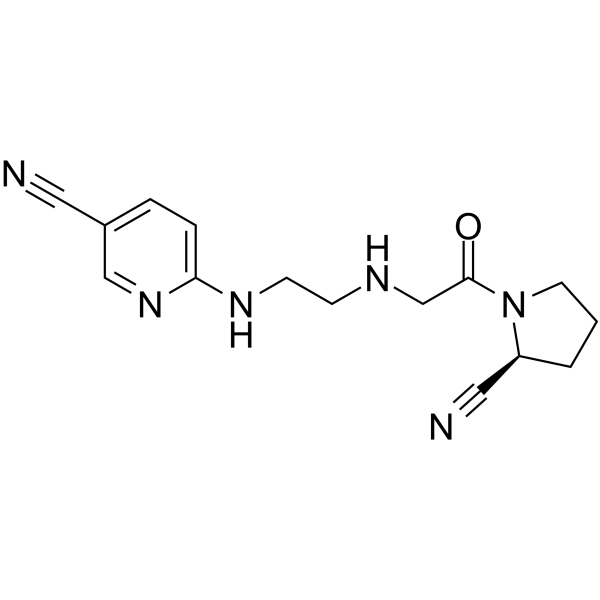
    NVP-DPP728 is a potent, reversible and nitrile-dependent dipeptidyl peptidase IV (DPP-IV) inhibitor. NVP-DPP728 can inhibit human DPP-IV amidolytic activity with a Ki of 11 nM. NVP-DPP728 inhibits degradation of glucagon-like peptide-1 (GLP-1) and thereby potentiates insulin release in response to glucose intake. NVP-DPP728 can be used for researching diabetes .
    NVP-DPP728
  • HY-120287

    Somatostatin Receptor Endocrinology
    L-054522 is an agonist for somatostatin receptor subtype 2 with Kd of 0.01 nM. L-054522 inhibits growth hormone release from rat primary pituitary cell (IC50=0.05 nM) and glucagon and insulin release from isolated mouse pancreatic islet cell (IC50=0.05 nM and 12 nM) .
    L-054522
  • HY-176770

    GLP Receptor Metabolic Disease
    GLP-1R agonist 34 (Compound 1) is an orally active small molecule glucagon-like peptide-1 receptor (GLP-1R) agonist. GLP-1R agonist 34 promotes insulin secretion, inhibits glucagon release, and delays gastric emptying, thereby effectively lowering blood glucose levels. GLP-1R agonist 34 is promising for research of metabolic diseases, including type 2 diabetes, obesity, and non-alcoholic steatohepatitis (NASH) .
    GLP-1R agonist 34
  • HY-171851

    GCGR Metabolic Disease
    GLP-1R agonist 32 (Compound 111) is an orally active and highly potent GLP-1R agonist with an EC50 value of 0.017 nM. GLP-1R agonist 32 exerts glucose-regulating activity by activating GLP-1R to stimulate cAMP production, promoting insulin secretion, inhibiting glucagon release, and delaying gastric emptying. GLP-1R agonist 32 is promising for research of type 2 diabetes, obesity, and related metabolic disorders .
    GLP-1R agonist 32
  • HY-134261

    8-Bromoadenosine-5'-O-diphosphoribose

    TRP Channel CaMK Metabolic Disease Cancer
    8-Br-ADPR (8-Bromoadenosine-5'-O-diphosphoribose) is a TRPM2 inhibitor and ADPR signaling pathway antagonist. 8-Br-ADPR inhibits glucagon-mediated nuclear calcium signaling and downstream CaMKII/CREB phosphorylation by blocking ADPR-induced TRPM2 activation. 8-Br-ADPR significantly reduces gluconeogenic gene expression and blood glucose levels in diabetic models. 8-Br-ADPR effectively blocks ADPR-mediated calcium signal transduction in NK cells, inhibits immune synapse formation, granzyme B release and cytolytic activity against melanoma cells. 8-Br-ADPR is widely used in studies related to diseases such as diabetes, melanoma and lymphoma .
    8-Br-ADPR
  • HY-134261A

    8-Bromoadenosine-5'-O-diphosphoribose disodium

    CaMK TRP Channel Metabolic Disease Inflammation/Immunology Cancer
    8-Br-ADPR disodium (8-Bromoadenosine-5'-O-diphosphoribose) is a TRPM2 inhibitor and ADPR signaling pathway antagonist. 8-Br-ADPR disodium inhibits glucagon-mediated nuclear calcium signaling and downstream CaMKII/CREB phosphorylation by blocking ADPR-induced TRPM2 activation. 8-Br-ADPR disodium significantly reduces gluconeogenic gene expression and blood glucose levels in diabetic models. 8-Br-ADPR disodium effectively blocks ADPR-mediated calcium signal transduction in NK cells, inhibits immune synapse formation, granzyme B release and cytolytic activity against melanoma cells. 8-Br-ADPR disodium is widely used in studies related to diseases such as diabetes, melanoma and lymphoma .
    8-Br-ADPR disodium
  • HY-P3608

    GCGR Metabolic Disease
    [Des-His1,Glu9] Glucagon is a potent glucagon receptor system peptide antagonist. [Des-His1,Glu9] Glucagon enhances the glucose-stimulated release of insulin from pancreatic islet cells. [Des-His1,Glu9] Glucagon can be used to research diabetes .
    [Des-His1,Glu9] Glucagon
  • HY-P3616

    GCGR Metabolic Disease
    Human glucagon-like peptide-1-(7-36)-Lys(Biotin) amide is a biotin labeled glucagon-like peptide-1-(7-36). Glucagon-like peptide-1-(7-36) is a gastrointestinal peptide with antidiabetogenic activity, and can increase the release of insulin .
    Human glucagon-like peptide-1-(7-36)-Lys(Biotin) amide
  • HY-109692

    Free Fatty Acid Receptor Metabolic Disease Inflammation/Immunology
    GPR120 Agonist 5 (compound 12) is an agonist targeting GPR120 (EC50=1.2 μM). GPR120 Agonist 5 promotes the release of glucagon-like 1 (GLP-1) by binding to the GPR120 receptor, which in turn binds to its receptors on pancreatic beta cells, increasing insulin secretion and thereby lowering blood sugar levels. GPR120 Agonist 5 also helps reduce chronic low-grade inflammation, which plays an important role in the pathogenesis of obesity, insulin resistance, and type 2 diabetes. GPR120 Agonist 5 can be used to investigate the mechanism of action of GPR120 in metabolic and inflammatory diseases .
    GPR120 Agonist 5

Inquiry Online

Your information is safe with us. * Required Fields.

Salutation


Country or Region *

Applicant Name *


Organization Name *

Department *


Email Address *


Product Name *

Cat. No.


Requested quantity *

Phone Number *


Remarks

Inquiry Online

Inquiry Information

Product Name:
Cat. No.:
Quantity:
MCE Japan Authorized Agent: