1. Search Result
Search Result
Results for "

hirsutum

" in MedChemExpress (MCE) Product Catalog:

7

Inhibitors & Agonists

2

Biochemical Assay Reagents

4

Natural
Products

1

Oligonucleotides

Cat. No. Product Name Target Research Areas Chemical Structure
  • HY-Y1887

    Environmental Pollutants Biochemical Assay Reagents Insecticide Cardiovascular Disease Infection Inflammation/Immunology
    Cottonseed oil is an edible oil extracted from the seeds of cotton (Gossypium hirsutum). Its fatty acid composition includes 26-35% saturated fatty acids, 42-52% polyunsaturated fatty acids, and 18-24% monounsaturated fatty acids. Cottonseed oil is regarded as an Insecticide, as it is used to protect the trunks of apple trees from damage by the apple clearwing moth. Cottonseed oil possesses anti-inflammatory and cardioprotective properties. It also has extensive applications in many fields such as biofuels, animal husbandry, cosmetics, agriculture, and chemical industry .
    Cottonseed oil
  • HY-W009811

    Environmental Pollutants Insecticide Others
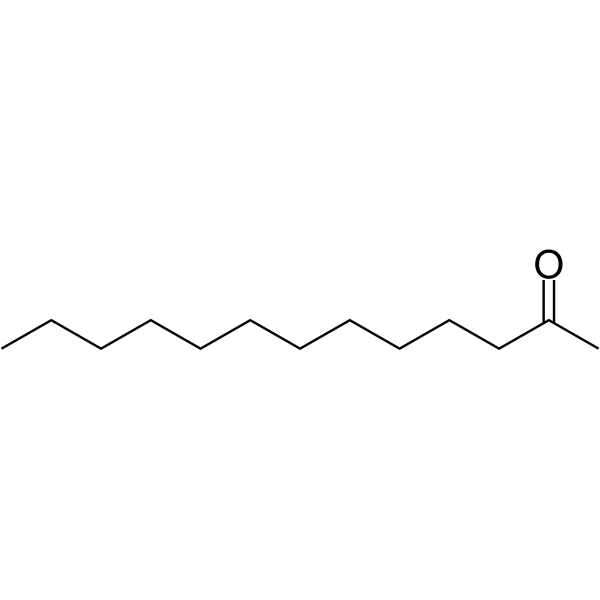
    2-Tridecanone, a nonalkaloid insecticide, is isolated from the wild tomato Lycopersicon hirsutum f. glabratum. 2-Tridecanone is a volatile organic compound .
    2-Tridecanone
  • HY-W017448

    N,N-Dimethylpiperidinium chloride; PIX

    Environmental Pollutants Biochemical Assay Reagents Others
    Mepiquat chloride (N,N-Dimethylpiperidinium chloride) is a systemic plant growth regulator. Mepiquat chloride reduces the activity of RuBP carboxylase. Mepiquat chloride decreases plant height, total length of vegetative and fruiting branches, and total leaf area of cotton. Mepiquat chloride reduces the net photosynthetic rate of cotton leaves. Mepiquat chloride promotes starch accumulation in cotton leaves without altering sucrose content .
    Mepiquat chloride
  • HY-E70425

    Glycosyltransferase Metabolic Disease
    Sucrose synthase belongs to glycosyltransferases and is a reversible catalyst present in plants, which catalyzes the conversion of sucrose into fructose and UDP-G or ADP-G. Sucrose synthase localizes to the cytoplasm, plasma membrane, cell wall, vacuole and mitochondria of plants. Sucrose synthase regulates sugar metabolism, supports the development of taproots, fruits, seeds and vascular tissues, drives the synthesis of starch, cellulose and callose, and enhances nitrogen fixation capacity. Sucrose synthase mediates signal transduction in plant meristems. Sucrose synthase is associated with plant growth, anaerobic stress tolerance, as well as shoot apical meristem and leaf morphology; overexpression of this enzyme promotes plant growth, increases xylem size, and elevates cellulose and starch contents .
    Sucrose synthase
  • HY-N16369

    Thrombin Cardiovascular Disease
    1,2-Di-(9Z-hexadecenoyl)-sn-glycerol (Compound 2e) is a diacylglycerol derivative that can be isolated from the fungus Stereum Hirsutum. 1,2-Di-(9Z-hexadecenoyl)-sn-glycerol has potential thrombin-inhibiting activity and can be used in research related to antithrombotic drugs .
    1,2-Di-(9Z-hexadecenoyl)-sn-glycerol
  • HY-W009811R

    Insecticide Reference Standards Others
    2-Tridecanone, a nonalkaloid insecticide, is isolated from the wild tomato Lycopersicon hirsutum f. glabratum. 2-Tridecanone is a volatile organic compound .
    2-Tridecanone (Standard)
  • HY-W842446

    Glyoxalase (GLO) Infection
    Enzyme-IN-4 is a competitive inhibitor of glyoxalase I that can be found in Stereum hirsutum. Enzyme-IN-4 has a Ki value of 4.6 μM against rat liver glyoxalase I .
    Enzyme-IN-4

Inquiry Online

Your information is safe with us. * Required Fields.

Salutation


Country or Region *

Applicant Name *


Organization Name *

Department *


Email Address *


Product Name *

Cat. No.


Requested quantity *

Phone Number *


Remarks

Inquiry Online

Inquiry Information

Product Name:
Cat. No.:
Quantity:
MCE Japan Authorized Agent:

