
11 Results for "

live mice

" in MedChemExpress (MCE) Product Catalog:
Products (11)

11 Results for "live mice" in MCE Product Catalog:

Cat. No.: HY-149766
CAS No.: 3032970-74-1
Purity:  97.04%
Target:  

HDAC

Research Areas:  

Neurological Disease

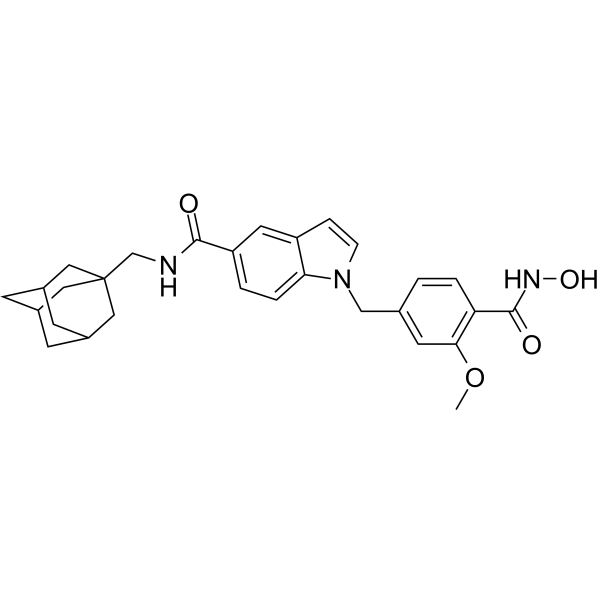
PB94 is a selective HDAC11 inhibitor (IC50=108 nM). PB94 can be radiolabeled as [11C]-PB94 for use in positron emission tomography (PET), as well as brain uptake and metabolic properties in administered live animals. PB94 improves neuropathic pain in mice and could be used to study neurological indications .
loading...
    loading...
Cat. No.: HY-160066
Research Areas:  

Cancer

SYL3C aptamer sodium is a DNA aptamer targeting EpCAM. SYL3C aptamer sodium targets a variety of cancer cell lines. SYL3C aptamer sodium can be used for targeted cancer cell imaging and circulating tumor cell detection .
loading...
    loading...
Cat. No.: HY-126850
CAS No.: 6543-77-7
Target:  

EGFR

Research Areas:  

Cancer

4-Epidoxycycline is a liver metabolite of the antibiotic doxycycline (doxycycline, HY-N0565) and doesn't have antibiotic properties in mice. 4-Epidoxycycline’s ability to regulate HER2 gene expression in vitro and in live mouse models is similar to that of doxycycline, and it shows comparable high efficacy in tumor tissues, achieving over 95% tumor regression rates .
loading...
    loading...
Cat. No.: HY-D2988
CAS No.: 3086791-47-8
BIN-3 is a novel near-infrared fluorescent probe. BIN-3 has excellent biocompatibility, no cytotoxicity, and no hemolysis. BIN-3 can be used for highly sensitive and selective imaging of drug-resistant bacterial infections expressing β-lactam enzymes in live mice .
loading...
    loading...
Cat. No.: HY-W783351
CAS No.: 1416808-87-1
Synonyms: Coppersensor 790 acetoxymethyl ester
Target:  

Fluorescent Dye

Research Areas:  

Metabolic Disease

CS790AM (Coppersensor 790 acetoxymethyl ester) is a cell-permeable, Cu +-targeted near-infrared fluorescent probe (λabs=760 nm, λem=790 nm) applicable to live cells. CS790AM can cross lipophilic cell membranes, and is converted into negatively charged CS790 under the action of intracellular esterases to be retained, thus enabling highly sensitive, reversible "turn-on" detection of labile Cu + pools in live cells and mice. CS790AM possesses excellent biocompatibility and selectivity, avoids interference from other metal ions, shows no obvious toxicity, and can be rapidly cleared. CS790AM allows long-term longitudinal monitoring of individual mice, visualizes copper levels in internal organs and isolated livers, and effectively evaluates abnormal copper accumulation in Wilson's disease models (Atp7b -/-) as well as dynamic changes after chelator treatment. CS790AM can be used for research on Wilson's disease and related copper metabolic disorders .
loading...
    loading...
Cat. No.: HY-D3214
CAS No.: 1895099-34-9
NIR-Cu (Ⅱ) is a near-infrared fluorescent Cu 2+ probe. NIR-Cu (Ⅱ) enables fluorescence imaging of Cu 2+ in living mice. NIR-Cu (Ⅱ) reduces self-absorption and exhibits minimal photobleaching, thus supporting in vivo imaging applications .
loading...
    loading...
Cat. No.: HY-184669
CAS No.: 2740494-38-4
Target:  

SARS-CoV

Research Areas:  

Infection

MERS-CoV-IN-4 is an orally active antiviral inhibitor targeting the MERS-CoV spike (S) protein, with an IC50 of 0.009 μM in Huh-7 cells, and Kd values of 7.72 μM for the full-length S protein and 5.09 μM for S-RBD. MERS-CoV-IN-4 inhibits viral entry, and suppresses MERS-CoV pseudoviruses and live viruses in vitro. MERS-CoV-IN-4 reduces pulmonary viral loads in hDPP4 transgenic mice. MERS-CoV-IN-4 can be used for research on Middle East respiratory syndrome coronavirus infection .
loading...
    loading...
Cat. No.: HY-183710
CAS No.: 3114520-65-6
Research Areas:  

Cancer

CDK9-IN-50 is a selective and orally active CDK9 inhibitor with an IC50 of 2.2 nM. CDK9-IN-50 targets a distinct CDK9-specific subpocket to disrupt RNA polymerase II Ser2 phosphorylation and downregulate short-lived oncoproteins, including AR-V7 and Myc. CDK9-IN-50 exhibits antiproliferative activity against cancer cells, induces apoptosis and induces tumor growth inhibition in CRPC orthotopic mice models. CDK9-IN-50 can be used for the research of cancer, such as prostate cancer .
loading...
    loading...
Cat. No.: HY-D3442
CAS No.: 3121565-89-4
ALDH2 probe 5 is a ALDH2 isoform-selective fluorescent probe with an emission wavelength centered at 494 nm. ALDH2 probe 5 is a turn-on fluorescent substrate for ALDH2; in its unreacted aldehyde form, twisted intramolecular charge transfer (TICT) occurs, resulting in fluorescence quenching. After ALDH2 probe 5 is catalytically oxidized to carboxylate by ALDH2, TICT is inhibited and fluorescence is significantly enhanced. ALDH2 probe 5 enables highly sensitive quantitative imaging of ALDH2 activity in recombinant enzymes, live cells, blood, tissue homogenates, and the brains of living mice. ALDH2 probe 5 can be used for studies related to neuroinflammation .
loading...
    loading...
Cat. No.: HY-D3081
Target:  

Fluorescent Dye

Research Areas:  

Inflammation/Immunology

BTCV-CO is a ratiometric AIE fluorescent probe for the detection and fluorescent imaging of carbon monoxide (CO). BTCV-CO reacts with CO under the mediation of Pd 2+, undergoes allyl cleavage and cyclization to form the highly fluorescent product BTIC, resulting in enhanced fluorescence at 546 nm and weakened fluorescence at 710 nm. Ex/Em = 465/546 nm (λex = 465 nm in spectral experiments; λex = 476 nm in cell imaging) .
loading...
    loading...
Cat. No.: HY-D3132
CAS No.: 1616505-01-1
Target:  

Fluorescent Dye

Research Areas:  

Others

Spring Red is a fluorescent probe for mitochondrial pH detection (Ex/Em = 530/680 nm) that can be taken up by live cells and mitochondria. The detection mechanism of Spring Red depends on pH changes and mitochondrial membrane potential. Fluorescence intensity increases with elevated pH, and a significant pH-dependent fluorescent response is observed in the pH range of 5.0‑8.0. Spring Red is suitable for long-term live-cell imaging and in vivo imaging, and can be used to monitor dynamic mitochondrial pH changes .
loading...
    loading...
  • 1

