1. Search Result
Search Result
Results for "

normal lung fibroblasts

" in MedChemExpress (MCE) Product Catalog:

16

Inhibitors & Agonists

1

Biochemical Assay Reagents

1

Inhibitory Antibodies

1

Natural
Products

1

Click Chemistry

Cat. No. Product Name Target Research Areas Chemical Structure
  • HY-Y0030

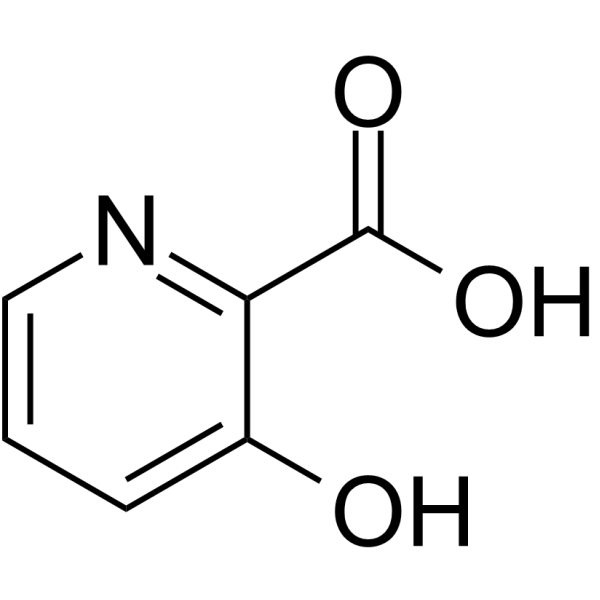
    3-hydroxypyridine-2-carboxylic acid

    Biochemical Assay Reagents Drug Intermediate Infection Cancer
    3-Hydroxypicolinic acid is a heterocyclic carboxylic acid ligand and cytotoxin, with a MIC90 of >25 μg/mL against Mycobacterium tuberculosis H37Rv. 3-Hydroxypicolinic acid inhibits the growth of cancer cells and normal fibroblasts. 3-Hydroxypicolinic acid is applicable to research related to chronic myeloid leukemia, human lung adenocarcinoma, and tuberculosis .
    3-Hydroxypicolinic acid
  • HY-W020955

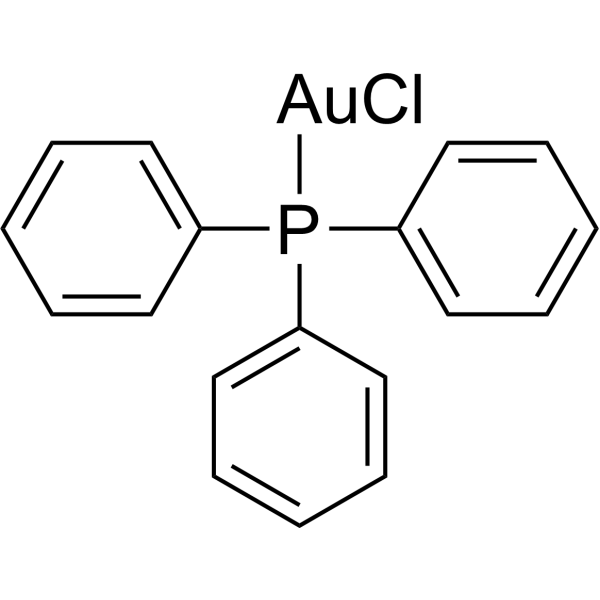
    Chloro(triphenylphosphine)gold(I)

    Biochemical Assay Reagents Apoptosis DNA Alkylator/Crosslinker Lipoxygenase Cancer
    Triphenylphosphinechlorogold (Chloro(triphenylphosphine)gold(I)) is a gold complex, Apoptosis inducer, and catalyst. Triphenylphosphinechlorogold exhibits high LOX inhibitory activity. Triphenylphosphinechlorogold induces cell cycle arrest and apoptosis. Triphenylphosphinechlorogold catalyzes the peroxidation of linoleic acid. A weak interaction exists between Triphenylphosphinechlorogold and DNA. Triphenylphosphinechlorogold displays antiproliferative activity against breast cancer cells .
    Triphenylphosphinechlorogold
  • HY-169259

    HDAC DNA/RNA Synthesis Reactive Oxygen Species (ROS) Apoptosis Caspase p38 MAPK Cancer
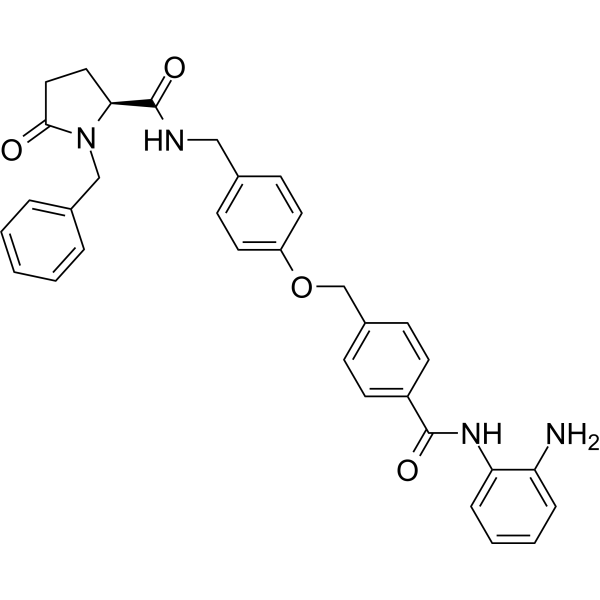
    HDAC9-IN-1 is a selective class IIa HDAC inhibitor that binds to HDAC9 with an IC50 of 40 nM. HDAC9-IN-1 potently inhibits HDACs 4 and 7 while showing weak activity against HDAC6 (IC50 values: 180 nM (HDAC4), 190 nM (HDAC7), 970 nM (HDAC6)). HDAC9-IN-1 significantly inhibits several human cancer cells, induces apoptosis and DNA damage in human cancer cells, and modulates caspase-related proteins and p38 in human cancer cells. HDAC9-IN-1 can be used for the research of oral cancer, breast cancer, gastric cancer .
    HDAC9-IN-1
  • HY-W012985

    ATP Synthase Apoptosis Metabolic Disease Cancer
    Methyl pyruvate is a methyl ester derivative of pyruvic acid. Methyl pyruvate induces insulin release and membrane depolarization. Methyl pyruvate rescues proteasome damage and nuclear localization of TdP-43 caused by overexpression of σ1RE102Q by enhancing ATP synthesis. Methyl pyruvate selectively protects normal lung fibroblasts from cell death induced by Irinotecan (HY-16562). Methyl pyruvate promotes apoptosis and necrosis in cancer cells and downregulates angiogenesis and cell cycle pathways. Methyl pyruvate is an effective substrate for dihydrodihydrogen dehydrogenase.
    Methyl pyruvate
  • HY-155328

    HDAC Inflammation/Immunology
    GK444 (Compound 15a) is a HDAC1/2 inhibitor (IC50: 100 and 92 nM for HDAC1/2 respectively). GK444 inhibits Caco-2 cells with IC50 of 4.1 μM. GK444 also reduces TGF-β1 induced COL1A1 mRNA levels in primary normal human lung fibroblasts. GK444 inhibits Bleomycin (HY-108345)-induced lung fibrosis in mice .
    GK444
  • HY-147802

    EGFR Apoptosis Cancer
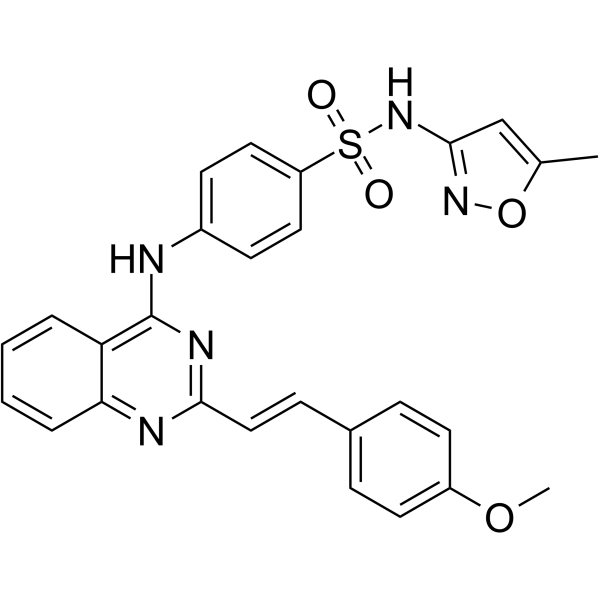
    EGFR-IN-59 (Compound 8c) is a EGFR inhibitor (IC50=190 nM) and apoptosis inducer. EGFR-IN-59 exhibits cytotoxicity against non-small lung cancer cell lines (A549) and normal lung fibroblasts (WI38) with IC50s of 8.62 and 52.6 µM, respectively. EGFR-IN-59 can be used for the research of various cancers such as non-small cell lung cancer (NSCLC), head and neck cancer, breast cancer and colorectal cancer .
    EGFR-IN-59
  • HY-157404

    Pim Cancer
    Pim-1/2 kinase inhibitor 2 (compound 5b) is a competitive PIM-1 and PIM-2 kinase inhibitor with IC50s of 1.31 μM and 0.67 μM, respectively. Pim-1/2 kinase inhibitor 2 shows in-vitro low cytotoxicity against normal human lung fibroblast Wi-38 cell line and potent in-vitro anticancer activity against myeloid leukaemia (NFS-60), liver (HepG-2), prostate (PC-3), and colon (Caco-2) cancer cell lines .
    Pim-1/2 kinase inhibitor 2
  • HY-151872

    HDAC Ferroptosis Cancer
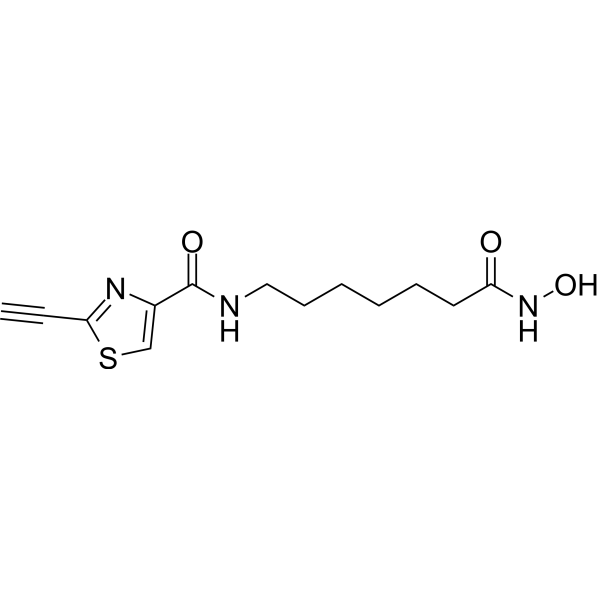
    HDAC-IN-48 is a potent HDAC inhibitor. HDAC-IN-48 is a hybrid molecule with great cytotoxic profile (GI50~20 nM). HDAC-IN-48 consists of harmacophores of SAHA and CETZOLE molecules. HDAC-IN-48 induces ferroptosis and inhibits HDAC proteins . HDAC-IN-48 is a click chemistry reagent, it contains an Alkyne group and can undergo copper-catalyzed azide-alkyne cycloaddition (CuAAc) with molecules containing Azide groups.
    HDAC-IN-48
  • HY-182274

    Acyltransferase STAT Others
    DM245 is an EPAC1 activator and STAT3 phosphorylation inhibitor with a target pIC50 of 4.801. DM245 activates EPAC1 to increase Rap1-GTP levels, with no activation of EPAC2 or PKA. DM245 reduces IL-6/IL-6Rα-evoked STAT3 phosphorylation in endothelial cells. DM245 suppresses TGF-β1-induced fibroblast-to-myofibroblast transition, reducing αSMA and Collagen I levels. DM245 exhibits minimal cytotoxicity in normal human lung fibroblasts, with negligible loss of intact nuclei after 72 h exposure .
    DM245
  • HY-182273

    STAT Acyltransferase Others
    DM243 is an EPAC1 activator and STAT3 modulator with an pIC50 of 4.769 for EPAC1. DM243 increases GTP-bound Rap1 levels in EPAC1-expressing cells. DM243 reduces IL-6/IL-6Rα-evoked STAT3 phosphorylation in endothelial cells. DM243 suppresses TGF-β1-induced fibroblast-to-myofibroblast transition, reducing α-smooth muscle actin and Collagen I levels in lung fibroblasts. DM243 exhibits minimal cytotoxicity in normal human lung fibroblasts .
    DM243
  • HY-180546

    CDK Cancer
    CDK2-IN-53 (compound 9) is a CDK2 inhibitor with anticancer activity. CDK2-IN-53 selectively inhibits the proliferation of HCT-116 and MCF-7cells with IC50 values of 13.89 and 7.65 μM, respectively, while showing lower cytotoxicity toward normal lung fibroblast (WI-38) cells (IC50 = 71.24 μM). CDK2-IN-53 can be used for cancer research, such as colon and breast cancer .
    CDK2-IN-53
  • HY-181174

    SOD Glutathione Peroxidase Caspase Interleukin Related Bcl-2 Family Apoptosis Cancer
    Antioxidant agent-22 is a paraben derivative tetracyclic spermine cyclotriphosphazene compound. Antioxidant agent-22 exhibits antioxidant, anti-Inflammatory, and apoptotic activities. Antioxidant agent-22 significantly upregulates CAT, SOD, caspase-3 and IL-6 expression, suppresses GSH, IL-1β, and reduces BCL-2 and BAX levels. Antioxidant agent-22 can be used for the research of cancer, such as lung cancer .
    Antioxidant agent-22
  • HY-P992410

    PAI-1 TGF-beta/Smad Inflammation/Immunology
    MEDI-579 is a fully human monoclonal antibody against PAI-1, with a KD value of 6 pM for human PAI-1 and 105 pM for rat PAI-1. MEDI-579 restores renal plasmin activity and inhibits PAI-1-mediated intracellular signal transduction. MEDI-579 reduces albuminuria, glomerulosclerosis severity, TGF-β1 expression level, and phosphorylated Smad2 level induced in diabetic mice. MEDI-579 decreases the levels of active PAI-1 in plasma and kidneys, and increases plasma plasmin level in a mouse model of lupus nephritis. MEDI-579 can be used in research related to diabetic nephropathy and lupus nephritis. The recommended isotype control is human IgG1 kappa (HY-P99001) .
    MEDI-579
  • HY-180169

    Photosensitizer Drug Derivative Cancer
    Photosensitizer-8 (Compound 4), 2-anthrol derivative, is an alkaline phosphatase (ALP)-activatable photosensitizer. Photosensitizer-8 undergoes a phosphate ester hydrolysis reaction in the presence of ALP, rapidly converting into the active photosensitizer 2-anthrol. Photosensitizer-8 exhibits cytotoxicity against ALP-overexpressing cancer cells (HeLa, A549, HCT116) after light exposure, with IC50 values of 14.3 μM, 21.6 μM and 17.5 μM, respectively, while showing no significant cytotoxicity against normal lung fibroblasts (WI-38) (IC50 ≥ 30 μM). Photosensitizer-8 can be used in photodynamic therapy research for ALP-overexpression-related cancers .
    Photosensitizer-8
  • HY-182785

    Photosensitizer Cancer
    Photosensitizer-10 is a glutathione (GSH)-activatable photosensitizer. Photosensitizer-10 shows minimal photoactivity in the absence of glutathione, and generates a highly active species upon reaction with glutathione to induce photo-cytotoxicity. Photosensitizer-10 exhibits selective photo-cytotoxicity toward cancer cells with elevated intracellular glutathione levels while sparing normal cells. Photosensitizer-10 can be used for the research of cancer, such as lung carcinoma and skin carcinoma .
    Photosensitizer-10
  • HY-W743094

    Drug Derivative Inflammation/Immunology Cancer
    Methylstenbolone is a steroid and an anti-inflammatory agent. Methylstenbolone inhibits nitric oxide production in macrophages and exhibits cytotoxicity against breast cancer cells and normal fibroblasts. Methylstenbolone can be used for the research of inflammation and breast cancer .
    Methylstenbolone

Inquiry Online

Your information is safe with us. * Required Fields.

Salutation


Country or Region *

Applicant Name *


Organization Name *

Department *


Email Address *


Product Name *

Cat. No.


Requested quantity *

Phone Number *


Remarks

Inquiry Online

Inquiry Information

Product Name:
Cat. No.:
Quantity:
MCE Japan Authorized Agent:

