19 Results for "

p-nitrophenol

" in MedChemExpress (MCE) Product Catalog:
Products (19)

19 Results for "p-nitrophenol" in MCE Product Catalog:

2
2 Cited Publications
Cat. No.: HY-W075707
CAS No.: 55266-17-6
Synonyms: Iron(III) meso-Tetra(4-carboxyphenyl)porphine chloride
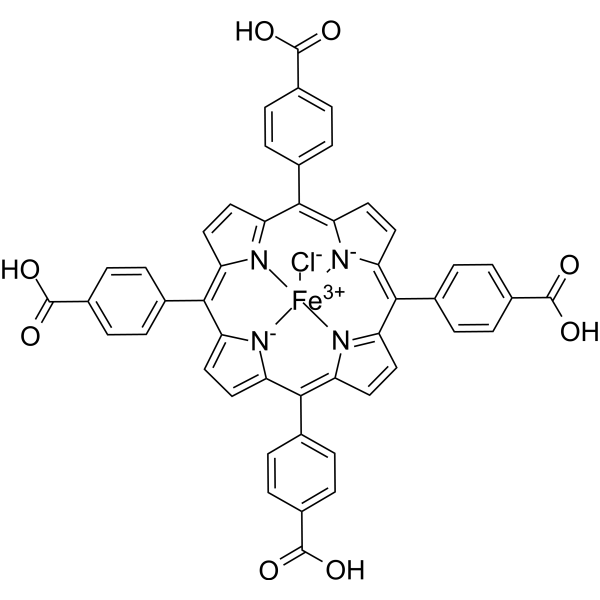
FeTCPP chloride (Iron(III) meso-Tetra(4-carboxyphenyl)porphine chloride) is a metallic porphyrin compound formed by the coordination of a central iron ion (Fe 3+) with four 4-carboxyphenylporphyrins (TCPP). FeTCPP chloride can be used as a catalyst for catalytic, electrochemical, photochemical and biomedical research. FeTCPP chloride has high photocatalytic performance for p-nitrophenol under visible light. FeTCPP chloride also has peroxisase-like activity, which is used in bionic catalysis research .
loading...
    loading...
2
2 Cited Publications
Cat. No.: HY-W013205
CAS No.: 645-15-8
Synonyms: BNPP
Research Areas:  

Others

Bis(4-nitrophenyl) phosphate (BNPP) is an esterase inhibitor, inhibits the activity of esterases such as carboxylesterase. Bis(4-nitrophenyl) phosphate inhibits the degradation of Abiraterone in fresh plasma. Bis(4-nitrophenyl) phosphate can be used as a substrate to determine the enzymatic activity of phosphodiesterase in the roots of wetland plants. Bis(4-nitrophenyl) phosphate also acts as a catalyst for metallomicelles and a catalyst that promotes ring-opening polymerization (ROP) .
loading...
    loading...
2
2 Cited Publications
Cat. No.: HY-W013205B
CAS No.: 4043-96-3
Synonyms: BNPP sodium
Bis(4-nitrophenyl) phosphate sodium (BNPP sodium) is an esterase inhibitor, inhibits the activity of esterases such as carboxylesterase. Bis(4-nitrophenyl) phosphate sodium inhibits the degradation of Abiraterone in fresh plasma. Bis(4-nitrophenyl) phosphate sodium can be used as a substrate to determine the enzymatic activity of phosphodiesterase in the roots of wetland plants. Bis(4-nitrophenyl) phosphate sodium also acts as a catalyst for metallomicelles and a catalyst that promotes ring-opening polymerization (ROP) .
loading...
    loading...
1
1 Cited Publications
Cat. No.: HY-15927
CAS No.: 2492-87-7
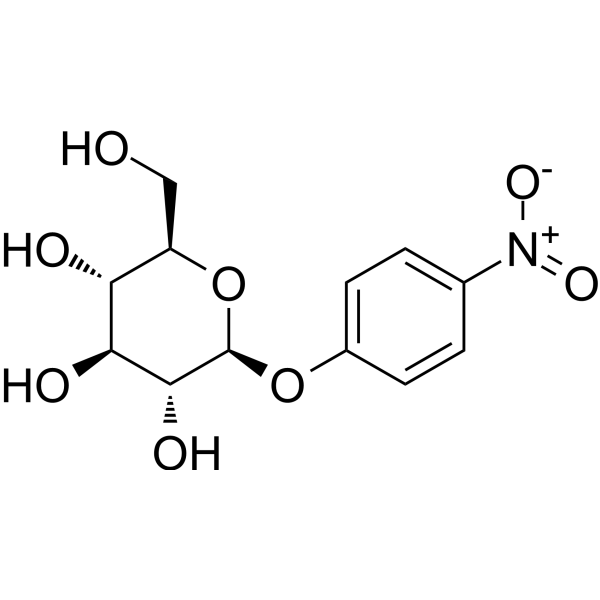
4-Nitrophenyl β-D-glucopyranoside is a chromogenic substrate for β-glucosidase. 4-Nitrophenyl β-D-glucopyranoside is converted to a colored product, p-nitrophenol that is easily detected spectrophotometrically at 405 nm when used in a β-glycosidase assay. 4-Nitrophenyl β-D-glucopyranoside is hydrolysed through intramolecular nucleophilic catalysis by the phosphate group in the 2-position. 4-Nitrophenyl β-D-glucopyranoside is promising for research of postmenopausal osteoporosis .
loading...
    loading...
Cat. No.: HY-W013168
CAS No.: 1492-30-4
Synonyms: 4-Nitrophenyl hexadecanoate; p-Nitrophenyl Palmitate; pNpp
Target:  

Lipase

Research Areas:  

Others

4-Nitrophenyl palmitate (4-Nitrophenyl hexadecanoate) is a chromogenic substrate for lipases and esterases. Upon enzymatic hydrolysis, 4-Nitrophenyl palmitate releases p-nitrophenol, which can be quantified by colorimetric detection at 410 nm as a measure of enzymatic activity. 4-Nitrophenyl palmitate is used to characterize the activity of various bacterial and mammalian enzymes, including those from Burkholderia and porcine pancreatic lipase .
loading...
    loading...
Cat. No.: HY-137822
CAS No.: 10357-27-4
Purity:  99.68%
Synonyms: 4-Nitrophenyl a-D-mannopyranoside
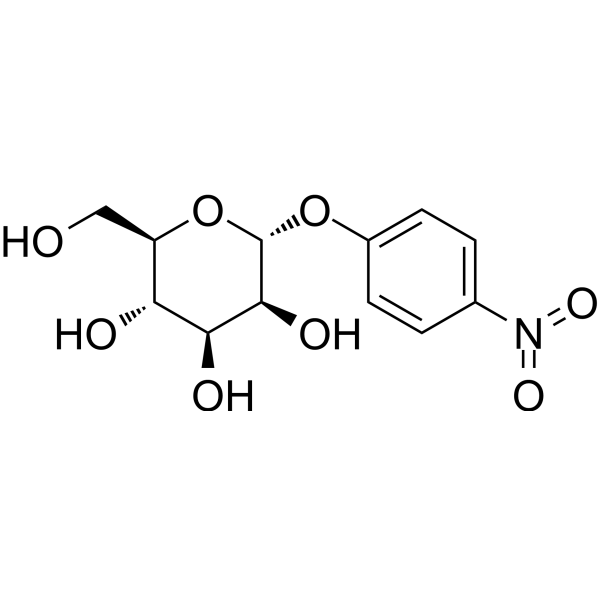
p-Nitrophenyl α-D-mannopyranoside (4-Nitrophenyl α-D-mannopyranoside) is a chromogenic glycosidic ligand. p-Nitrophenyl α-D-mannopyranoside features a sugar moiety (α-D-mannopyranose) with the mannose-characteristic axial hydroxyl group at the C2 position and a ligand portion (p-nitrophenol) that provides ultraviolet-visible light absorption properties. p-Nitrophenyl α-D-mannopyranoside can be used to determine glycosidase activity and characterize the sugar recognition properties of lectins (such as Concanavalin A (HY-P2149)) .
loading...
    loading...
Cat. No.: HY-137878
CAS No.: 26112-88-9
Synonyms: PNP-α-NeuNAc
2-O-(p-Nitrophenyl)-α-D-N-acetylneuraminic acid (PNP-α-NeuNAc) is a classic chromogenic substrate for neuraminidase. 2-O-(p-Nitrophenyl)-α-D-N-acetylneuraminic acid releases p-nitrophenol upon enzymatic hydrolysis, allowing quantification of enzyme activity and inhibitory effects via spectrophotometry. 2-O-(p-Nitrophenyl)-α-D-N-acetylneuraminic acid (PNP-α-NeuNAc) acts as a sialyl donor in the process of enzyme-catalyzed trans-sialylation .
loading...
    loading...
Cat. No.: HY-137827
CAS No.: 3482-57-3
Purity:  99.48%
Synonyms: p-Nitrophenyl β-D-Cellobioside
Target:  

Glycosidase

Research Areas:  

Others

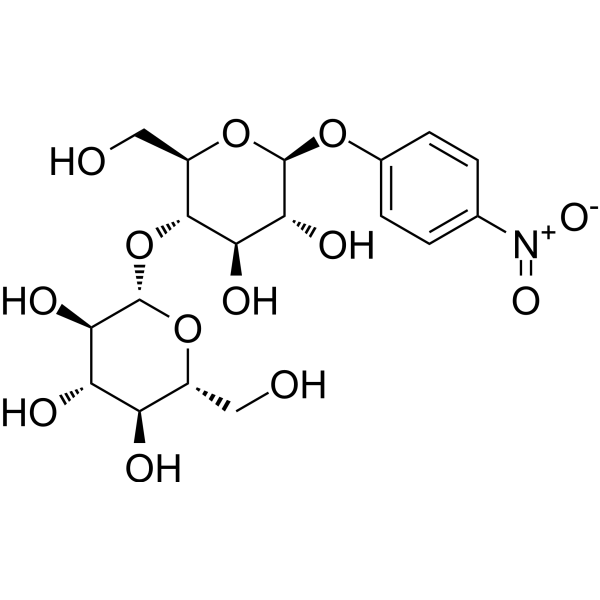
4-Nitrophenyl β-D-Cellobioside (p-Nitrophenyl β-D-cellobioside) is a cellotriose analog. 4-Nitrophenyl β-D-Cellobioside is hydrolyzed by β-glucosidases such as TxGH116 and ThCel7B. 4-Nitrophenyl β-D-Cellobioside can also be hydrolyzed by exoglucanases and endoglucanases to produce p-nitrophenol (PNP). 4-Nitrophenyl β-D-Cellobioside can be used to detect cellulase activity .
loading...
    loading...
Cat. No.: HY-100045
CAS No.: 21064-69-7
Synonyms: 4-Nitrophenylphosphorylcholine; 4-Nitrophenylphosphorylcholine; O-(4-Nitrophenylphosphoryl)choline
p-Nitrophenyl phosphorylcholine (4-Nitrophenylphosphorylcholine) is a chromogenic Phospholipase C substrate. Phospholipase C hydrolyzes p-Nitrophenyl phosphorylcholine to release p-nitrophenol, a yellow chromophore. p-Nitrophenyl phosphorylcholine is used to determine the phospholipase C production of Pseudomonas aeruginosa. It also applies to studies related to Pseudomonas aeruginosa infection .
loading...
    loading...
Cat. No.: HY-134420
CAS No.: 10231-84-2
Synonyms: PNP α-L-Fuc
p-Nitrophenyl α-L-fucoside (PNP α-L-Fuc) is a specific substrate of Pecten maximus α-L-fucosidase, with a Km value of 650 µM. p-Nitrophenyl α-L-fucoside serves as a substrate for ClAgl29A and ClAgl29B. Enzymatic hydrolysis of p-Nitrophenyl α-L-fucoside releases p-nitrophenol and α-L-fucose, where the latter undergoes mutarotation over time to form β-L-fucose. p-Nitrophenyl α-L-fucoside is not the preferred substrate for ClAgl29A and ClAgl29B .
loading...
    loading...
Cat. No.: HY-P4545
CAS No.: 67482-93-3
Target:  

Angiotensin Receptor

Research Areas:  

Others

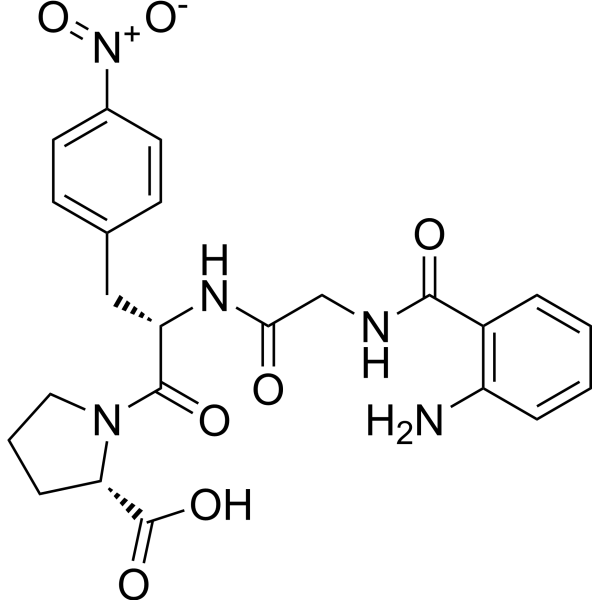
Abz-Gly-p-nitro-Phe-Pro-OH is the fluorescent substrate angiotensin I converting enzyme (ACE-I) with 355 nm excitation and 405 nm emission wavelengths .
loading...
    loading...
Cat. No.: HY-137815
CAS No.: 18918-31-5
Purity:  98.44%
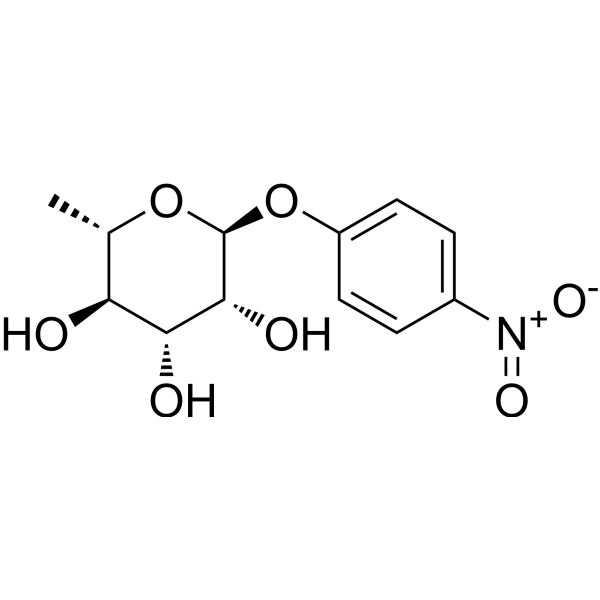
4-Nitrophenyl α-L-rhamnopyranoside is a commonly used substrate in various biochemical assays to measure the activity of enzymes that hydrolyze rhamnose, such as α-L-rhamnosidase. 4-Nitrophenyl α-L-rhamnopyranoside has unique chemical properties that allow it to be hydrolyzed by these enzymes to form a yellow product called p-nitrophenol. This makes it a useful tool for detecting and quantifying rhamnohydrolase activity in biological samples or microbial cultures.
loading...
    loading...
Cat. No.: HY-P4561
CAS No.: 90331-82-1
Target:  

Cathepsin

Research Areas:  

Others

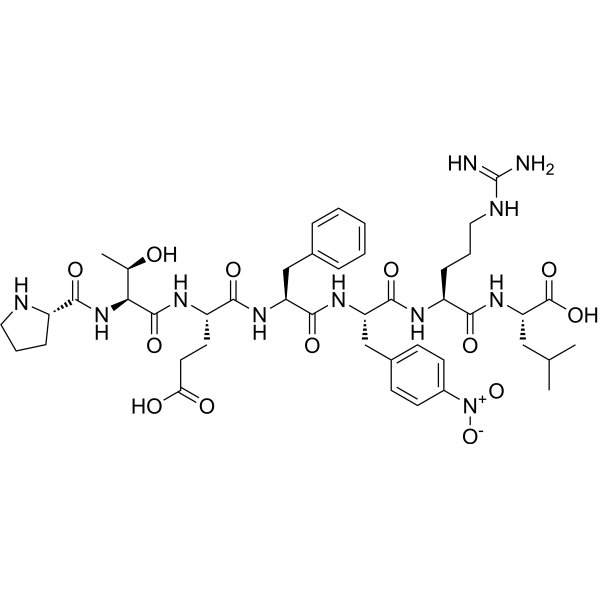
H-Pro-Thr-Glu-Phe-p-nitro-Phe-Arg-Leu-OH is a water-soluble polypeptide that can serve as a substrate for cathepsin D, pepsin and pepsinogen. H-Pro-Thr-Glu-Phe-p-nitro-Phe-Arg-Leu-OH has potential applications in biochemical analysis .
loading...
    loading...
Cat. No.: HY-P4725
CAS No.: 133233-38-2
Target:  

Fluorescent Dye

Research Areas:  

Others

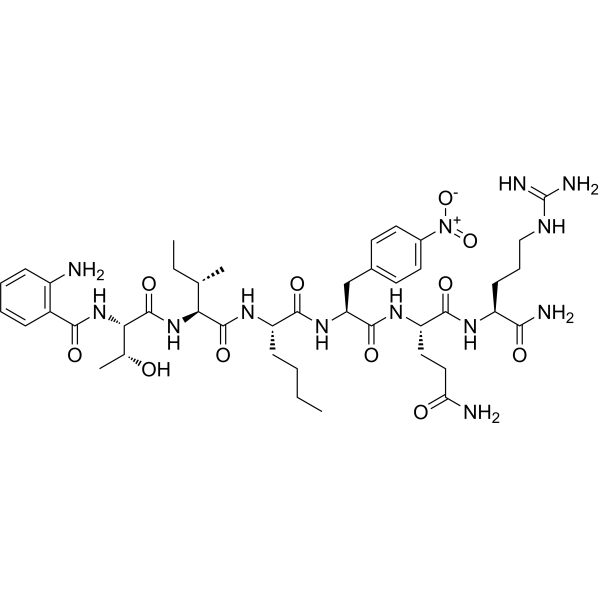
Abz-Thr-Ile-Nle-p-nitro-Phe-Gln-Arg-NH2 is a fluorogenic substrate, that can be used for the fluorescence screening assay .
loading...
    loading...
Cat. No.: HY-138959
CAS No.: 1956-10-1
Synonyms: p-Nitrophenyl caprylate
Target:  

Lipase

Research Areas:  

Others

4-Nitrophenyl octanoate (p-Nitrophenyl caprylate) is an aromatic ester compound which can be used as a substrate for pancreatic lipase. 4-Nitrophenyl octanoate contains an ester bond that can be hydrolyzed under the action of lipase, releasing p-nitrophenol as a yellow product. 4-Nitrophenyl octanoate can be used to assay the activities of lipases and esterases .
loading...
    loading...
Cat. No.: HY-D1510
CAS No.: 77640-21-2
Research Areas:  

Others

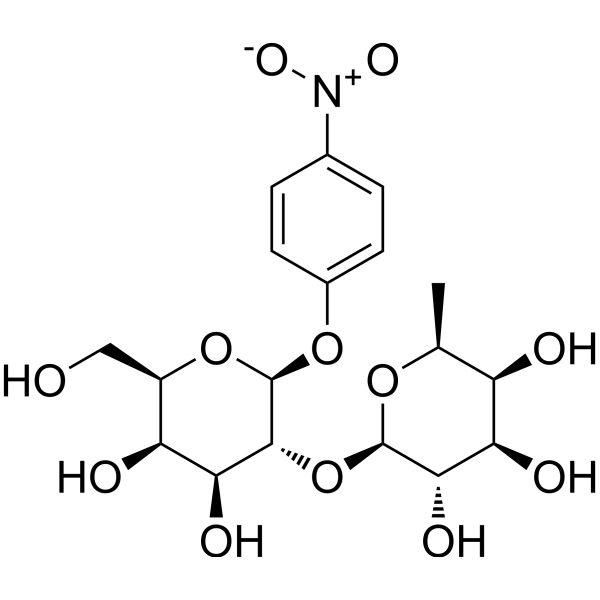
4-Nitrophenyl 2-O-(β-L-Fucopyranosyl)-β-D-Galactopyranoside is a synthetic chromogenic substrate and can be used in the assay of α-fucosidases which hydrolyze the glycosidic linkage Fuc α1-2Gal. The assay is based on the sequential action of α-fucosidase and an exogenously added exo-β-d-galactosidase to release the easily measurable p-nitrophenol moiety .
loading...
    loading...
Cat. No.: HY-P4556
CAS No.: 50572-79-7
Research Areas:  

Others

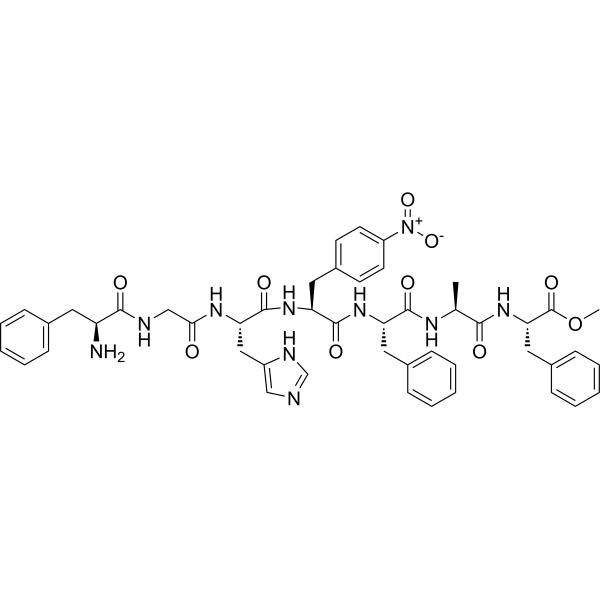
H-Phe-Gly-His-p-nitro-Phe-Phe-Ala-Phe-OMe is a polypeptide that can be hydrolyzed by Rennin (HY-P2810). H-Phe-Gly-His-p-nitro-Phe-Phe-Ala-Phe-OMe is commonly used as a biochemical reaction reagent .
loading...
    loading...
Cat. No.: HY-E71244
Research Areas:  

Others

α-N-Acetylneuraminyl-2,3-β-Galactosyl-1,3-N-acetylgalactosaminide 6-α-sialyltransferase (EC 2.4.99.7) attaches N-acetylneuraminic acid in alpha-2,6-linkage to N-acetyl-galactosamine only when present in the structure, where R may be protein or p-nitrophenol.
loading...
    loading...
Cat. No.: HY-E71324
Research Areas:  

Others

β-Primeverosidase (EC 3.2.1.149) is responsible for the formation of the alcoholic aroma in oolong and black tea. In addition to β-primeverosides [i.e. 6-O-(β-D-xylopyranosyl)-β-D-glucopyranosides], it also hydrolyses 6-O-(β-D-apiofuranosyl)-β-D-glucopyranosides and, less rapidly, β-vicianosides and 6-O-(α-L-arabinofuranosyl)-β-D-glucopyranosides, but not β-glucosides. Geranyl-, linaloyl-, benzyl-and p-nitrophenol glycosides are all hydrolysed.
loading...
    loading...
  • 1

