



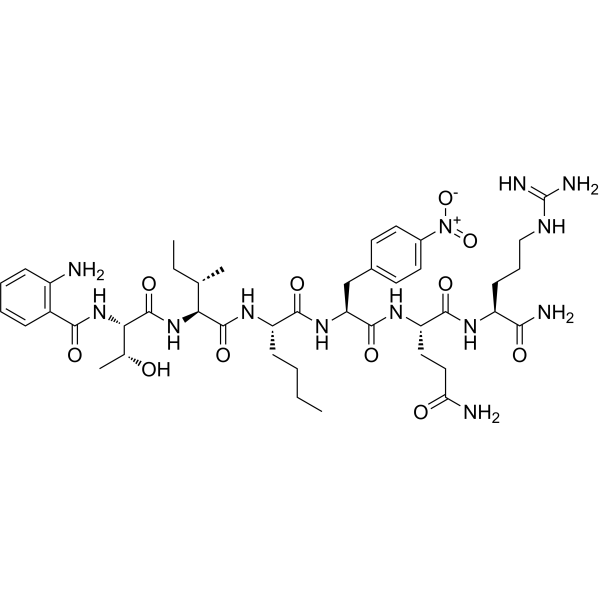
Abz-Thr-Ile-Nle-p-nitro-Phe-Gln-Arg-NH2

Based on 1 Customer Validation
Abz-Thr-Ile-Nle-p-nitro-Phe-Gln-Arg-NH2 is a fluorogenic substrate, that can be used for the fluorescence screening assay.
For research use only. We do not sell to patients.
- Purity : 99.69%
- CAS No.: 133233-38-2
- Formula: C43H65N13O11
- Molecular Weight:940.06
-
Storage:
Sealed storage, away from moisture.
Powder -80°C, 2 years , -20°C, 1 year* In solvent : -80°C, 6 months; -20°C, 1 month (sealed storage, away from moisture)

To place orders, for customer services and technical support, please contact: MedChemExpress USA
Tel: 609-228-6898 E-mail: [email protected] [email protected]


-
 Biological Activity
-
Chemical Information
-
Solvent & Solubility
- Protocols
- Purity & Documentation
- References
-
 Help & FAQs




Biological Activity
Description


Chemical Information
-
CAS No. 133233-38-2
-
Appearance Solid
-
Molecular Weight 940.06
-
Formula C43H65N13O11
-
Color White to off-white
-
Sequence
{Abz}-Thr-Ile-{Nle}-{p-nitro-Phe}-Gln-Arg-NH2
-
Sequence Shortening
{Abz}-TI-{Nle}-{p-nitro-Phe}-QR-NH2
-
Shipping
Room temperature in continental US; may vary elsewhere.
-
Storage
Sealed storage, away from moisture
Powder -80°C 2 years -20°C 1 year * In solvent : -80°C, 6 months; -20°C, 1 month (sealed storage, away from moisture)


Solvent & Solubility
In Vitro
H2O
Peptide Solubility and Storage Guidelines:
1. Calculate the length of the peptide.
2. Calculate the overall charge of the entire peptide according to the following table:
| Contents | Assign value | |
|---|---|---|
| Acidic amino acid | Asp (D), Glu (E), and the C-terminal -COOH. | -1 |
| Basic amino acid | Arg (R), Lys (K), His (H), and the N-terminal -NH2 | +1 |
| Neutral amino acid | Gly (G), Ala (A), Leu (L), Ile (I), Val (V), Cys (C), Met (M), Thr (T), Ser (S), Phe (F), Tyr (Y), Trp (W), Pro (P), Asn (N), Gln (Q) | 0 |
3. Recommended solution:
| Overall charge of peptide | Details |
|---|---|
| Negative (<0) |
1. Try to dissolve the peptide in water first. 2. If water fails, add NH4OH (<50 μL). 3. If the peptide still does not dissolve, add DMSO (50-100 μL) to solubilize the peptide. |
| Positive (>0) |
1. Try to dissolve the peptide in water first. 2. If water fails, try dissolving the peptide in a 10%-30% acetic acid solution. 3. If the peptide still does not dissolve, try dissolving the peptide in a small amount of DMSO. |
| Zero (=0) |
1. Try to dissolve the peptide in organic solvent (acetonitrile, methanol, etc.) first. 2. For very hydrophobic peptides, try dissolving the peptide in a small amount of DMSO, and then dilute the solution with water to the desired concentration. |

Protocols
-
Research Protocol for Drug Screening technologies
Drug screening technologies are experimental and computational strategies used to identify small molecules or chemical probes that modulate a defined molecular target, signaling pathway, cellular phenotype, disease model, or patient-derived response profile. High-throughput screening tests many compounds in miniaturized assay formats, while quantitative high-throughput screening tests compounds across concentration ranges so that potency and efficacy can be inferred from concentration-response behavior rather than from a single-point signal. The core biological function of a drug-screening strategy is to connect compound exposure with measurable pathway activity, target modulation, cell-state change, viability, cytotoxicity, morphology, or disease-relevant phenotype. Assay performance must be evaluated before screening because hit identification depends on the separation between positive and negative controls, control variability, plate effects, outliers, and the statistical framework


Purity & Documentation
-
Data Sheet (257 KB)
-
SDS (252 KB)
- English - EN (252 KB)
- Français - FR (252 KB)
- Deutsch - DE (252 KB)
- Norwegian - NO (252 KB)
- Español - ES (252 KB)
- Swedish - SV (252 KB)
- Italian - IT (252 KB)
- Korean - KR (252 KB)
- Portuguese - PT (252 KB)
-
Handling Instructions (2659 KB)
References

Calculators
Concentration (start) × Volume (start) = Concentration (final) × Volume (final)


Abz-Thr-Ile-Nle-p-nitro-Phe-Gln-Arg-NH2 Related Classifications
HY-P4725 Related Classifications
 Powered by Bioz