




1. Search Result
Search Result
Results for "

polypeptide chain

" in MedChemExpress (MCE) Product Catalog:

26

Inhibitors & Agonists

1

Screening Libraries

15

Peptides

4

Natural
Products

14

Recombinant Proteins

1

Isotope-Labeled Compounds

54

Antibodies

1

Oligonucleotides

Cat. No. Product Name Target Research Areas Chemical Structure
  • HY-P2974
    Elastase, Porcine pancreas
    4 Publications Verification

    EC 3.4.21.36; Pancreatopeptidase E

    Elastase Metabolic Disease
    Elastase, Porcine pancreas (EC 3.4.21.36) is a single polypeptide chain of 240 amino acid residues, derived from pig pancreas. Elastase, Porcine pancreas is a serine protease that can hydrolyze proteins and polypeptide. Elastase from porcine pancreas can induce emphysema in hamsters .
    Elastase, Porcine pancreas
  • HY-P1156
    Insulin(cattle)
    Maximum Cited Publications
    13 Publications Verification

    Insulin Receptor Metabolic Disease Endocrinology
    Insulin cattle is a two-chain polypeptide hormone produced in vivo in the pancreatic β cells. Insulin cattle has often been used as growth supplement in culturing cells.
    Insulin(cattle)
  • HY-A0162
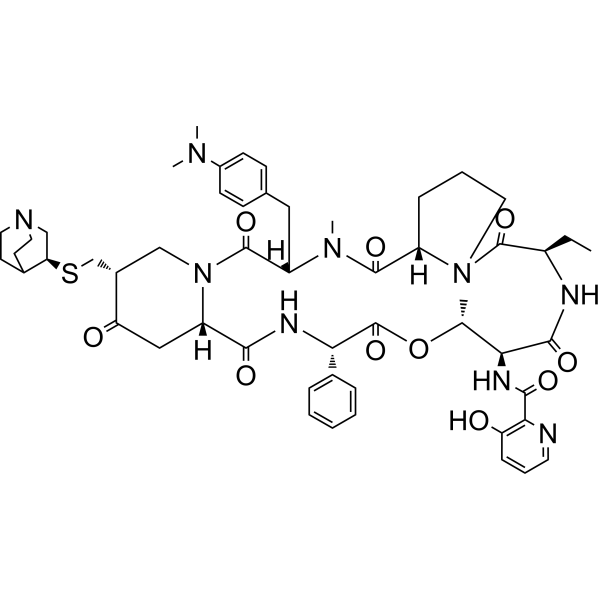
    Quinupristin
    1 Publications Verification

    Bacterial Infection
    Quinupristin is a streptogramin antibiotic. Quinupristin blocks peptide bond synthesis to prevent the extension of polypeptide chains and promote the detachment of incomplete protein chains in the bacterial ribosomal subunits .
    Quinupristin
  • HY-129046C

    Ribonuclease B, Bovine Pancreas

    Endonuclease DNA/RNA Synthesis Endocrinology Cancer
    RNase A (Bovine pancreatic RNase) is a widely used Endonuclease in DNA purification by specifically hydrolyzing cytosine or uracil residues of RNA. RNase A degrades the RNA in the RNA/DNA duplex. RNase A catalyses the breakdown of 3',5'-phosphodiester linkages of single stranded RNA. RNase A family members in organisms are tightly involved in various physiological and pathological processes including cell growth and development, proliferation, differentiation and migration. Dysregulation of RNase A activity or expression level is closely related to pancreatic, ovarian, bladder and thyroid cancer. RNase A has tumor cell-killing ability. RNase B, Bovine Pancreas (Ribonuclease B, Bovine Pancreas) is the N-glycosylated form of RNase A. RNase B, Bovine Pancreas can promote the folding of polypeptide chains and play a role similar to molecular chaperones .
    RNase B, Bovine Pancreas
  • HY-W011819

    Endogenous Metabolite Metabolic Disease
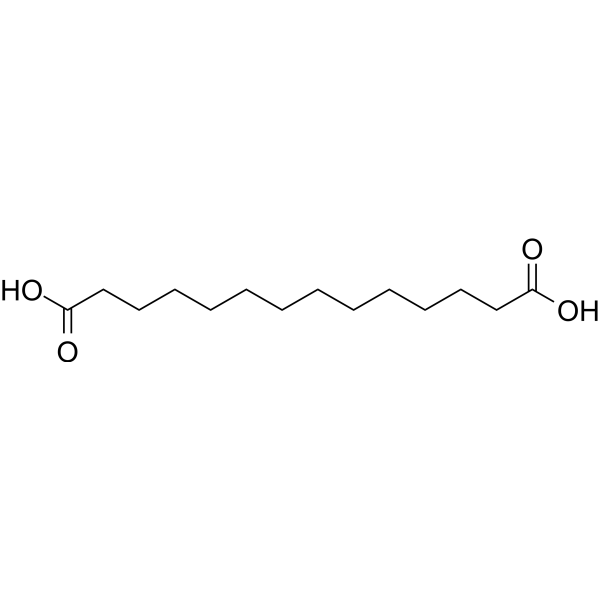
    Tetradecanedioic acid is an endogenous metabolite and belongs to the class of organic compounds known as long-chain fatty acids. Tetradecanedioic acid is an endogenous biomarker for assessing the activity of organic anion transporting polypeptides (OATPs) .
    Tetradecanedioic acid
  • HY-164166

    Biochemical Assay Reagents Drug Intermediate Amino Acid Derivatives Others
    Fmoc-Sar-Sar-Sar-OH is a small molecule polypeptide composed of sarcosine residues, in which the N-terminus of the peptide chain is protected by Fmoc. Fmoc-Sar-Sar-Sar-OH can be used for peptide synthesis or synthesis of agent-peptide ligand conjugates .
    Fmoc-Sar-Sar-Sar-OH
  • HY-P2980

    EC 3.4.2.1

    Endogenous Metabolite Others
    Carboxypeptidase A, Bovine pancreas (EC 3.4.2.1) is a zinc-containing metalloprotease, is often used in biochemical studies. Carboxypeptidase A catalyzes the hydrolysis of the peptide bonds that are adjacent to the C-terminal end of a polypeptide chain. Carboxypeptidase A is a prototypical enzyme for metalloproteases that plays important roles in biological systems .
    Carboxypeptidase A, Bovine pancreas
  • HY-W011819S

    Endogenous Metabolite Metabolic Disease
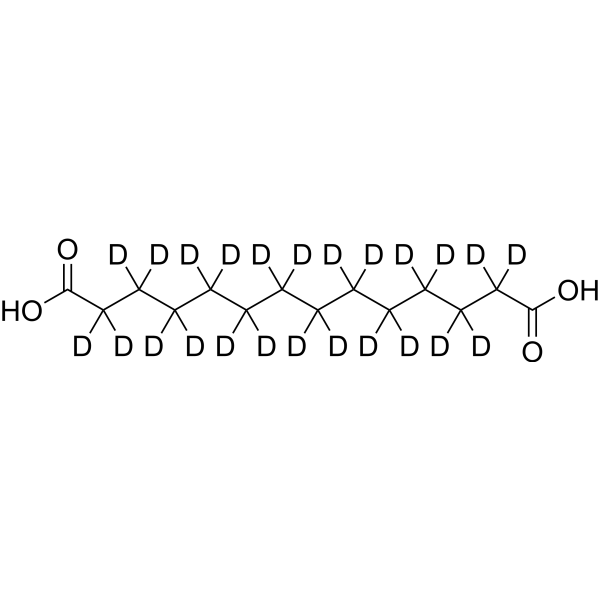
    Tetradecanedioic acid-d24 is the deuterium labeled Tetradecanedioic acid . Tetradecanedioic acid is an endogenous metabolite and belongs to the class of organic compounds known as long-chain fatty acids. Tetradecanedioic acid can act as a candidate biomarker for organic anion-transporting polypeptide mediated agent-agent interactions .
    Tetradecanedioic acid-d24
  • HY-157745

    mPEG40000-SC; mPEG40000-Succinimidyl ester

    Biochemical Assay Reagents Others
    m-PEG-NHS ester (mPEG-SC; mPEG-Succinimidyl ester) (MW 40000) is a polyethylene glycol derivative. m-PEG-NHS ester serves as a modifying agent that reacts with free amino groups on the surface of protein or polypeptide molecules to form stable amide bonds, thereby covalently linking PEG chains to biomacromolecules, improving their antigenicity and immunogenicity, and facilitating the preparation of injectable formulations .
    m-PEG40000-NHS ester
  • HY-W006886

    Amino Acid Derivatives Others
    Fmoc-(R)-2-(7-octenyl) Ala-OH is an unnatural Fmoc-protected amino acid and modification module. Fmoc-(R)-2-(7-octenyl) Ala-OH serves as a key building block for all-hydrocarbon cross-linking modification of antimicrobial peptides, and facilitates the generation of stapled peptide derivatives. When introduced into specific sites of the parent peptide, Fmoc-(R)-2-(7-octenyl) Ala-OH effectively increases the α-helix content of the peptide chain, thereby significantly enhancing its antimicrobial activity and proteolytic stability. Fmoc-(R)-2-(7-octenyl) Ala-OH is widely used in research on bacterial infections and the development of related antimicrobial agents . Stapled peptide is a specially chemically modified polypeptide. It locks the peptide chain into a stable α-helical structure by introducing a "staple"-like chemical bridge (usually an all-carbon backbone) at specific positions of the peptide chain.
    Fmoc-(R)-2-(7-octenyl)Ala-OH
  • HY-W020784

    Biochemical Assay Reagents Others
    3-(N-Maleimidopropionyl)biocytin is a cysteine-specific labeling reagent and non-membrane-permeable probe. 3-(N-Maleimidopropionyl)biocytin covalently modifies the exposed cysteine residues of yeast Tim44, conjugating the biotin moiety to the polypeptide chain. 3-(N-Maleimidopropionyl)biocytin determines the topology of membrane proteins by modifying the exposed cysteine residues on the outer side of the inner mitochondrial membrane .
    3-(N-Maleimidopropionyl)biocytin
  • HY-A0155

    Antibiotic Bacterial Infection
    Viomycin is a potent antibiotic against Mycobacteria. Viomycin rapidly inhibits polypeptide chain elongation when added to purified endogenous Escherichia coli polysomes actively engaged in polypeptide synthesis .
    Viomycin
  • HY-P5723A

    Bacterial Infection
    Api137 TFA is an antimicrobial peptide that interferes with bacterial growth by inhibiting translation. Api137 TFA inhibits protein synthesis by trapping of release factors on the 70S ribosome following hydrolysis of the nascent polypeptide chain .
    Api137 TFA
  • HY-A0155B

    Antibiotic Bacterial Infection
    Viomycin sulfate hydrate is a potent antibiotic against Mycobacteria. Viomycin sulfate hydrate rapidly inhibits polypeptide chain elongation when added to purified endogenous Escherichia coli polysomes actively engaged in polypeptide synthesis .
    Viomycin sulfate hydrate
  • HY-P1537

    Neuropeptide Y Receptor Metabolic Disease Endocrinology
    Pancreatic Polypeptide, bovine, a 36-amino acid, straight chain polypeptide derived primarily from the pancreas, inhibits secretin- and cholecystokinin-stimulated pancreatic secretion; Pancreatic Polypeptide, bovine acts as an agonist of NPY receptor, with high affinity at NPYR4.
    Pancreatic Polypeptide, bovine
  • HY-E70554A

    Biochemical Assay Reagents Cardiovascular Disease
    Bovine Prothrombin is a glycoprotein with a molecular weight of 70 kDa and is composed of a single polypeptide chain. Prothrombin is activated by factors Va, Xa, and phospholipids to produce the serine protease thrombin .
    Bovine Prothrombin
  • HY-P5723

    Bacterial Infection
    Api137 is an antimicrobial peptide that interferes with bacterial growth by inhibiting translation. Api137 inhibits protein synthesis by trapping of release factors on the 70S ribosome following hydrolysis of the nascent polypeptide chain .
    Api137
  • HY-128478

    Fungal Infection
    Sordarin (Compound 1) is an antifungal agent targeting Elongation factor 2 (EF2) with a tetracyclic diterpene core including a norbornene system. Sordarin can be isolated from the fungus Sordaria araneosa. Sordarin has potent antifungal activity against Saccharomyces cerevisiae and Candida albicans. Sordarin prevents the translocation of the ribosome along mRNA during elongation of the emerging polypeptide chain, inhibiting protein synthesis in fungi by stabilizing the ribosome/EF2 complex .
    Sordarin
  • HY-113225B

    GTP tritris

    Endogenous Metabolite Exosomes Cancer
    Guanosine triphosphate tritris (GTP tritris) serves as a vital enhancer of myogenic cell differentiation and plays a critical role in modulating miRNA-myogenic regulator factors. It also facilitates the release of exosomes enriched with guanosine and guanosine-derived molecules, and is regarded as an activated precursor for RNA synthesis. In mitochondrial function, GTP participates in the import of proteins into the matrix, which is essential for various regulated pathways, and is involved in initiating peptide synthesis through the binding of formylmethionyl-tRNA to the ribosome, as well as polypeptide chain elongation. Additionally, GTP acts as a phosphate and pyrophosphate carrier that channels chemical energy into specific biosynthetic pathways. It activates signal transducing G proteins that regulate cellular processes such as proliferation and differentiation, and its hydrolysis by small GTPases, including Ras and Rho, is integral to both proliferation and apoptosis. Furthermore, the small GTPase Rab is instrumental in vesicle docking, fusion, and formation. Beyond signal transduction, GTP is an energy-rich precursor in the enzymatic biosynthesis of DNA and RNA.
    Guanosine triphosphate tritris
  • HY-A0162A

    Bacterial Infection
    Quinupristin mesylate is a streptogramin antibiotic. Quinupristin mesylate blocks peptide bond synthesis to prevent the extension of polypeptide chains and promote the detachment of incomplete protein chains in the bacterial ribosomal subunits .
    Quinupristin mesylate
  • HY-W011819R

    Reference Standards Endogenous Metabolite Metabolic Disease
    Tetradecanedioic acid (Standard) is the analytical standard of Tetradecanedioic acid. This product is intended for research and analytical applications. Tetradecanedioic acid is an endogenous metabolite and belongs to the class of organic compounds known as long-chain fatty acids. Tetradecanedioic acid is an endogenous biomarker for assessing the activity of organic anion transporting polypeptides (OATPs) .
    Tetradecanedioic acid (Standard)
  • HY-B2228B

    Endogenous Metabolite Metabolic Disease
    Proteinase, Aspergillus melleus, is an enzyme that hydrolyzes proteins, that is, it initiates protein catabolism by hydrolyzing the peptide bonds that link amino acids in a polypeptide chain.
    Proteinase, Aspergillus melleus
  • HY-E70017A

    Endogenous Metabolite Metabolic Disease
    Peptidase, Porcine is any enzyme that performs proteolysis, that is, begins protein catabolism by hydrolysis of the peptide bonds that link amino acids together in a polypeptide chain.
    Peptidase, Porcine
  • HY-E70933A

    Endogenous Metabolite Metabolic Disease
    Protease, Rhizopus sp. is any enzyme that performs proteolysis, that is, begins protein catabolism by hydrolysis of the peptide bonds that link amino acids together in a polypeptide chain.
    Protease, Rhizopus sp.
  • HY-P11373

    Myosin Cardiovascular Disease Inflammation/Immunology
    α-Myosin (614-643) is a segment of polypeptide of the heavy chain of cardiac α-myosin. α-Myosin has a strong ability to induce autoimmune myocarditis .
    α-Myosin (614-643)
  • HY-P11777

    MMP SDCBP Cardiovascular Disease Neurological Disease Cancer
    AG73 is a polypeptide. AG73 is derived from the G domain of the Laminin α1 chain. AG73 binds heparin, Syndecan-1 and Syndecan-4. AG73 promotes the adhesion of various cells, induces the differentiation of salivary gland acinar cells, stimulates neurite outgrowth, secretion of matrix metalloproteinases and angiogenesis. AG73 retains its angiogenic activity when conjugated to chitosan membranes. AG73 can be used in the research of melanoma and ischemic injury .
    AG73

Inquiry Online

Your information is safe with us. * Required Fields.

Salutation


Country or Region *

Applicant Name *


Organization Name *

Department *


Email Address *


Product Name *

Cat. No.


Requested quantity *

Phone Number *


Remarks

Inquiry Online

Inquiry Information

Product Name:
Cat. No.:
Quantity:
MCE Japan Authorized Agent:

