



Collagen X Antibody (YA3502)
(Synonyms: COAA1_HUMAN antibody; Col10a 1 antibody; COL10A1 antibody; Collagen alpha 1(X) chain antibody; Collagen alpha-1(X) chain antibody; Collagen type X alpha 1 (Schmid metaphyseal chondrodysplasia) antibody; Collagen type X alpha 1 antibody; Collagen X alpha 1 polypeptide antibody; CollagenX antibody; fa66d11 antibody; fb10c08 antibody; OTTHUMP00000040411 antibody; Procollagen type X alpha 1 antibody; Schmid metaphyseal chondrodysplasia antibody; wu:fa66d11 antibody; wu:fb10c08 antibody; )Based on 1 publication(s) in Google Scholar
Collagen X Antibody (YA3502) is a Rabbit-derived and non-conjugated IgG monoclonal antibody, targeting to Collagen X.
-
Host:
Rabbit
-
Isotype:
IgG
-
Application:
WB
-
Reactivity :
Human, Mouse, Rat
-
Formulation:
Supplied in 50mM Tris-Glycine(pH 7.4), 0.15M NaCl, 40%Glycerol, 0.01% sodium azide and 0.05% BSA.
-
Conjugation:
Non-conjugated


To place orders, for customer services and technical support, please contact: MedChemExpress USA
Tel: 609-228-6898 E-mail: [email protected] [email protected]



Publications Citing Use of MedChemExpress (MCE) Collagen X Antibody (YA3502)
More

Applications
| Application |
WB

WB: Western Blot
|
|---|---|
| Dilution Ratio | 1:500-1:1000 |


Product Details
Collagen X Antibody (YA3502) is a Rabbit-derived and non-conjugated IgG monoclonal antibody, targeting to Collagen X.
-
Host Rabbit

-
Clonality Monoclonal,Recombinant

-
Species ReactivityHuman, Mouse, Rat
-
Observed Molecular WeightObserved band size: 66 kDa
Note: Due to possible protein modifications or aggregation, the molecular weight should be confirmed by actual measurement, and the predicted value is for reference only.

-
Calculated Molecular Weight Predicted band size: 66 kDa

Entrez Gene: 1300 Human ; 12813 Mouse ; 25681 Rat
SwissProt: Q03692 Human ; Q05306 Mouse ;
OMIM: 156500 Human
A synthesized peptide derived from human Collagen X aa527-600.
Endogenous
affinity purified
Non-conjugated
Unmodified
IgG


Product Properties
-
Appearance
Solution
-
Formulation
Supplied in 50mM Tris-Glycine(pH 7.4), 0.15M NaCl, 40%Glycerol, 0.01% sodium azide and 0.05% BSA.
-
Concentration
Batch-dependent, Please check the COA for the concentration of each lot. Check Lot Concentration
-
Storage & Stability
Stored at -20°C for 1 year. Avoid repeated freeze / thaw cycles.
-
Shipping
Shipping with blue ice.


Publications (1)
-
Journal Impact Factor
-
Most Recent


Verification Images
-
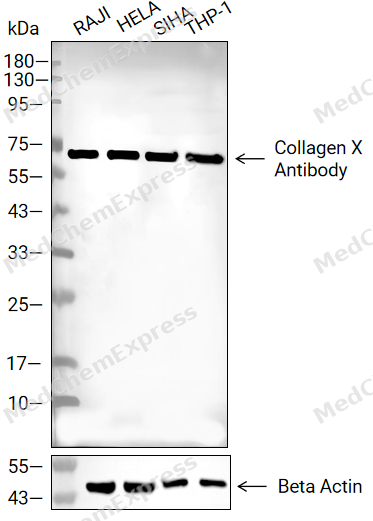 Western blot analysis of extracts from RAJI(lane 2(40μg), HELA(lane 3(40μg), SIHA(lane 4(40μg),THP-1(lane 5(40μg)using Collagen X Antibody (YA3502). Proteins were transferred to a PVDF membrane and blocked with 5% BSA in TBST for 2 hour at room temperature. The primary antibody (1/1000)and Loading control antibody (Beta Actin, HY-P80438, 1/3000) was used in 5% BSA in TBST at 4°C overnight.Goat Anti-Mouse/Rabbit IgG-HRP Secondary Antibody (HY-P8004/HY-P8001, 1/10,000) was used for 1 hour at room tem


Background
-
Function
Collagen X (COL10A1) is a non-fibrillar collagen produced by hypertrophic chondrocytes and used as a specific marker of chondrocyte hypertrophy during endochondral ossification[1]. Mechanistically, RUNX2 directly regulates Col10a1 enhancer activity, while Cox-2-containing and RUNX2-centered regulatory complexes further shape hypertrophic chondrocyte-specific expression[2][3]. In disease models, serum type X collagen fragments increase in osteoarthritis and correlate with cartilage degradation and inflammation biomarkers[4]. Compared with COL2A1, which suppresses chondrocyte hypertrophy through integrin β1-SMAD1 interaction, COL10A1 identifies the hypertrophic phenotype rather than the stable cartilage matrix phenotype[5]. Human COL10A1 loss-of-function iPSC models show that collagen X is dispensable for hypertrophic differentiation and endochondral ossification in vitro, supporting its use as a marker and model readout rather than a standalone driver[1]. COL10A1 mutations also cause Schmid metaphyseal chondrodysplasia, linking collagen X biology to growth-plate skeletal disease[6]. For experimental applications, COL10A1 supports studies of chondrocyte hypertrophy, osteoarthritis biomarker development, skeletal dysplasia mechanisms, and cartilage-to-bone transition models[1][4][6].
-
Subcellular Localization
Secreted, extracellular space, extracellular matrix
-
Subunit
Homotrimer
-
SwissProt ID
-
Synonyms
COAA1_HUMAN antibody; Col10a 1 antibody; COL10A1 antibody; Collagen alpha 1(X) chain antibody; Collagen alpha-1(X) chain antibody; Collagen type X alpha 1 (Schmid metaphyseal chondrodysplasia) antibody; Collagen type X alpha 1 antibody; Collagen X alpha 1 polypeptide antibody; CollagenX antibody; fa66d11 antibody; fb10c08 antibody; OTTHUMP00000040411 antibody; Procollagen type X alpha 1 antibody; Schmid metaphyseal chondrodysplasia antibody; wu:fa66d11 antibody; wu:fb10c08 antibody;
-
Research Field
Cell Biology
Documentation
-
Data Sheet (261 KB)
-
SDS (254 KB)
- English - EN (254 KB)
- Français - FR (254 KB)
- Deutsch - DE (254 KB)
- Norwegian - NO (254 KB)
- Español - ES (254 KB)
- Swedish - SV (254 KB)
- Italian - IT (254 KB)
- Korean - KR (254 KB)
- Portuguese - PT (254 KB)
-
User Guide for Antibodies (1077 KB)
References
[1]. Kamakura T, et al. Collagen X Is Dispensable for Hypertrophic Differentiation and Endochondral Ossification of Human iPSC-Derived Chondrocytes. JBMR Plus. 2023 Mar 29;7(5):e10737. [Content Brief]
[2]. Li F, et al. Runx2 contributes to murine Col10a1 gene regulation through direct interaction with its cis-enhancer. J Bone Miner Res. 2011 Dec;26(12):2899-910. [Content Brief]
[3]. Gu J, et al. Identification and characterization of the novel Col10a1 regulatory mechanism during chondrocyte hypertrophic differentiation. Cell Death Dis. 2014 Oct 16;5(10):e1469. [Content Brief]
[4]. He Y, et al. Type X collagen levels are elevated in serum from human osteoarthritis patients and associated with biomarkers of cartilage degradation and inflammation. BMC Musculoskelet Disord. 2014 Sep 22;15:309. [Content Brief]
[5]. Lian C, et al. Collagen type II suppresses articular chondrocyte hypertrophy and osteoarthritis progression by promoting integrin β1-SMAD1 interaction. Bone Res. 2019 Mar 6;7:8. [Content Brief]
[6]. Warman ML, et al. A type X collagen mutation causes Schmid metaphyseal chondrodysplasia. Nat Genet. 1993 Sep;5(1):79-82. [Content Brief]

 Powered by Bioz
