Search Result
Results for "
primary amine groups
" in MedChemExpress (MCE) Product Catalog:
92
Biochemical Assay Reagents
2
Isotope-Labeled Compounds
| Cat. No. |
Product Name |
Target |
Research Areas |
Chemical Structure |
-
- HY-D0975
-
|
|
ADC Linker
|
Cancer
|
|
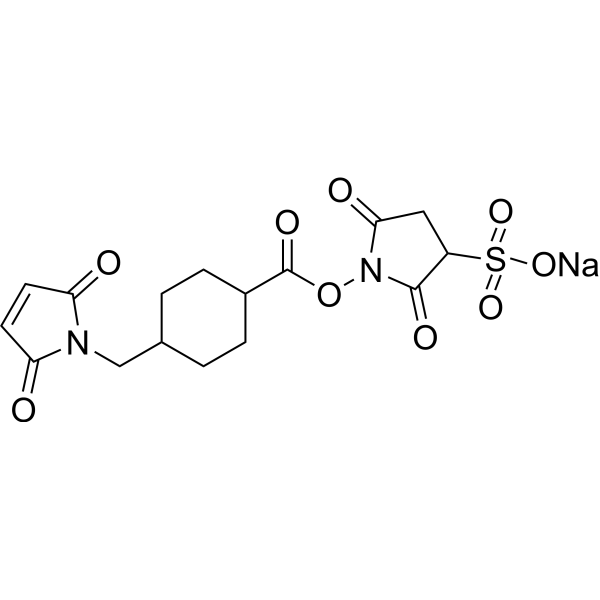
Sulfo-SMCC sodium is a commonly used hetero-bifunctional, noncleavable ADC crosslinker bearing N-hydroxysuccinimide (NHS) ester and maleimide groups to react with primary amines and sulfhydryl groups, respectively.
|
-
-
- HY-D0715
-
|
Ro 20-7234
|
Fluorescent Dye
|
Others
|
|
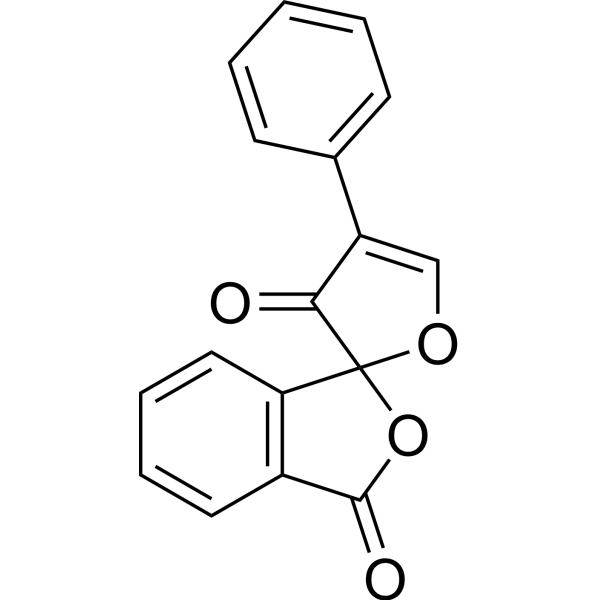
Fluorescamine is a spirocyclic compound that is non-fluorescent. Fluorescamine reacts rapidly with primary amine groups in proteins under alkaline conditions to generate products with strong fluorescence (Ex/Em: 390/475 nm). Fluorescamine can be used to detect amine-containing compounds, including amino acids, peptides, and proteins .
|
-
-
- HY-111377
-
|
|
Fluorescent Dye
|
Others
|
|
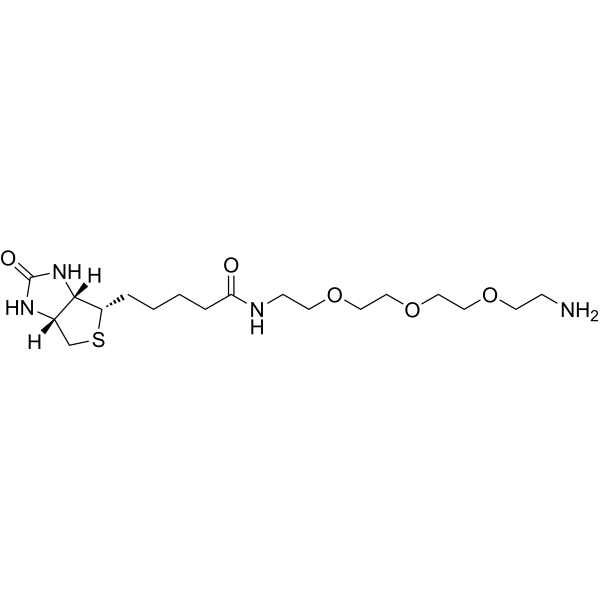
Amine-PEG3-Biotin is a signal amplification label containing a biotin group and a terminal primary amine group .
|
-
-
- HY-153631
-
-
-
- HY-140679
-
|
mPEG20000-NH2
|
Biochemical Assay Reagents
|
Cancer
|
|
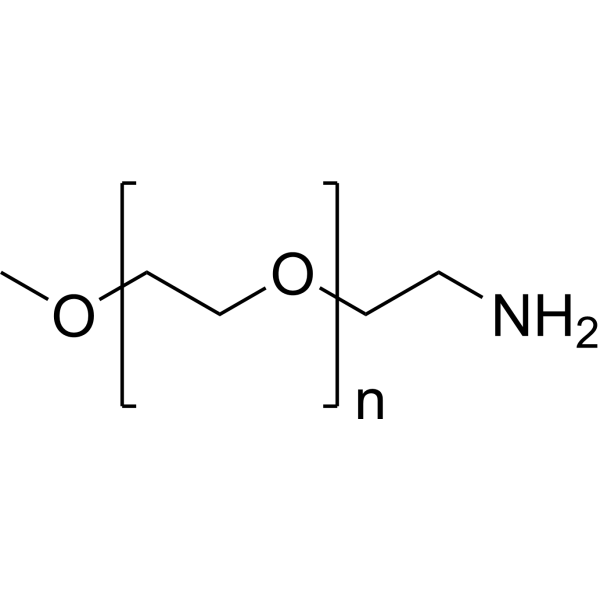
mPEG20000-amine (mPEG20000-NH2) is a class of functionalized polymers composed of a methoxy-terminated polyethylene glycol backbone and a terminal primary amine group. mPEG20000-amine serves as an important intermediate for constructing functionalized nanocarriers, modifying proteins or polypeptides, and developing novel drug delivery systems.
|
-
-
- HY-130086
-
|
|
ADC Linker
|
Cancer
|
|
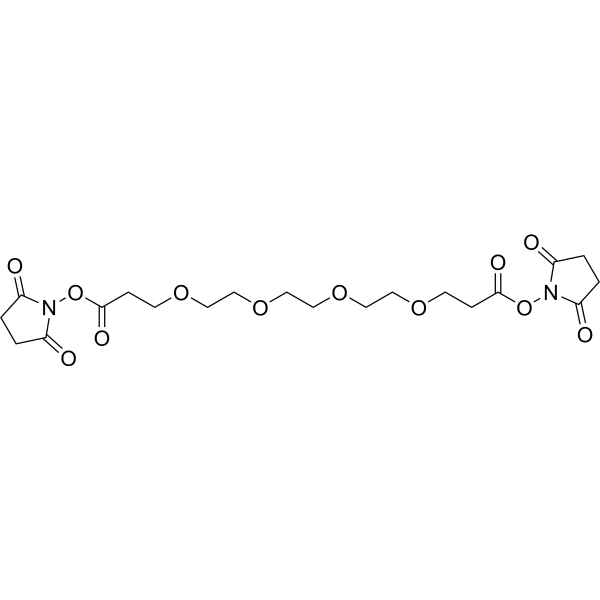
Bis-PEG4-NHS ester is a crosslinking reagent and amine-reactive modulator .Bis-PEG4-NHS ester reacts with primary amine groups on liposome surfaces via amide bond formation to covalently attach dibenzylcyclooctyne groups, with a hydrophilic PEG4 spacer reducing steric hindrance for subsequent click chemistry .Bis-PEG4-NHS ester enables site-specific antibody coupling to liposome surfaces via copper-free strain-promoted alkyne-azide cycloaddition click chemistry without disrupting liposome structure in minimal organic solvent volumes .Bis-PEG4-NHS ester undergoes hydrolysis during annealing to form -COOH groups that interact with PbI and FAI to enhance perovskite structural integrity, passivate defects, and modulate nucleation kinetics to regulate crystal growth .Bis-PEG4-NHS ester enhances device efficiency and long-term stability when used as an antisolvent additive for p-i-n perovskite solar cells .
|
-
-
- HY-140677
-
|
mPEG5000-NH2
|
Biochemical Assay Reagents
|
Cancer
|
|
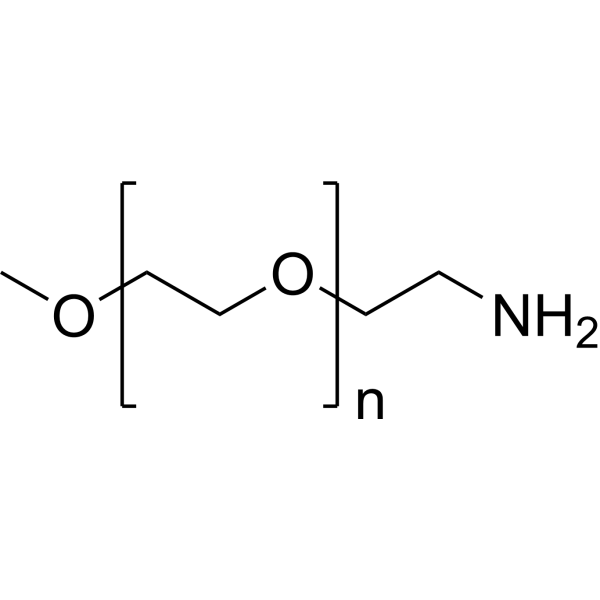
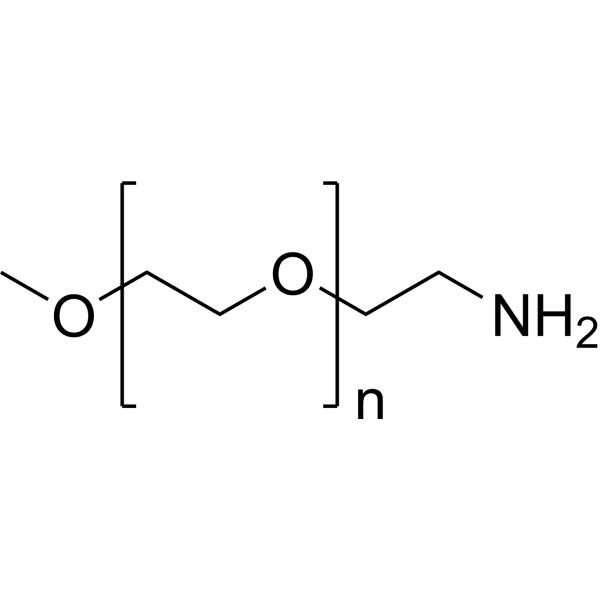
mPEG5000-amine (mPEG5000-NH2) is a class of functionalized polymers composed of a methoxy-terminated polyethylene glycol backbone and a terminal primary amine group. mPEG5000-amine serves as an important intermediate for constructing functionalized nanocarriers, modifying proteins or polypeptides, and developing novel drug delivery systems.
|
-
-
- HY-140676
-
|
mPEG2000-NH2
|
Biochemical Assay Reagents
|
Cancer
|
|
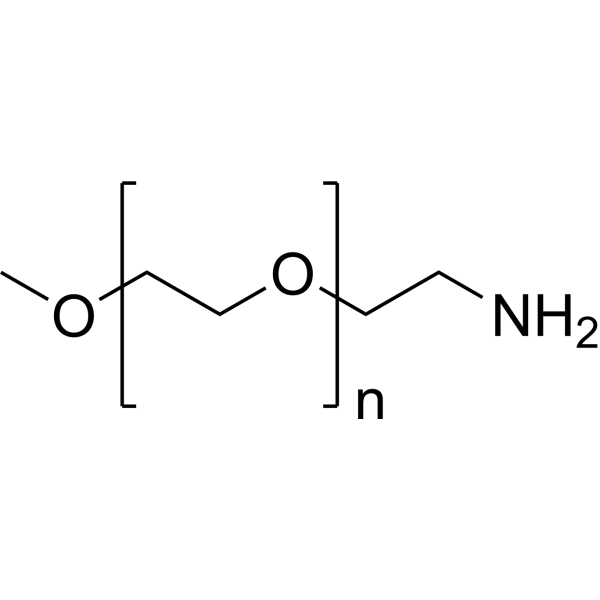
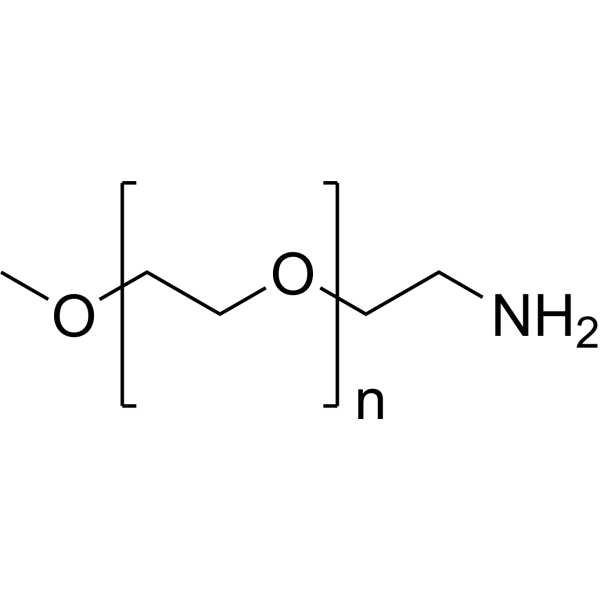
mPEG2000-amine (mPEG2000-NH2) is a class of functionalized polymers composed of a methoxy-terminated polyethylene glycol backbone and a terminal primary amine group. mPEG2000-amine serves as an important intermediate for constructing functionalized nanocarriers, modifying proteins or polypeptides, and developing novel drug delivery systems.
|
-
-
- HY-W040289
-
|
|
ADC Linker
|
Cancer
|
|
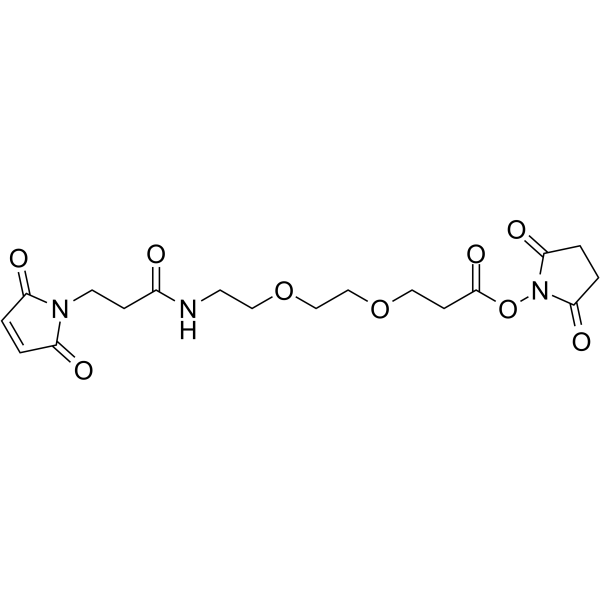
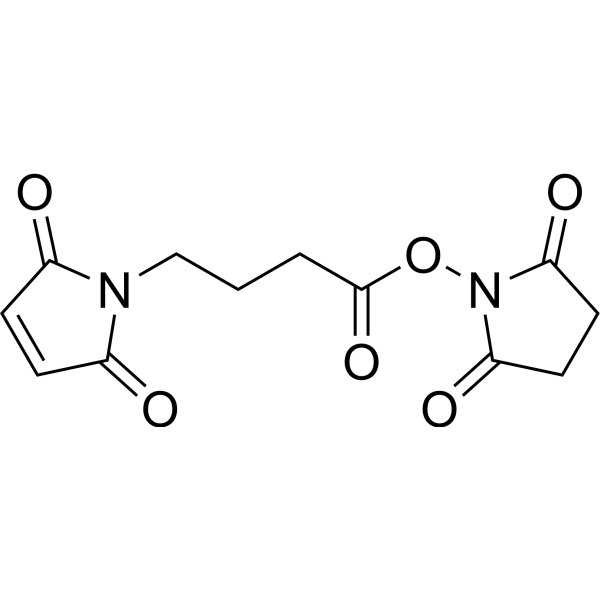
Mal-amido-PEG2-NHS ester is a nonclaevable ADC linker containing a maleimide group and an NHS ester. The NHS ester can be used to label the primary amines (-NH2) of proteins, amine-modified oligonucleotides, and other amine-containing molecules .
|
-
-
- HY-140675
-
|
mPEG1000-NH2
|
Biochemical Assay Reagents
|
Cancer
|
|
mPEG1000-amine (mPEG1000-NH2) is a class of functionalized polymers composed of a methoxy-terminated polyethylene glycol backbone and a terminal primary amine group. mPEG1000-amine serves as an important intermediate for constructing functionalized nanocarriers, modifying proteins or polypeptides, and developing novel drug delivery systems.
|
-
-
- HY-W041994
-
-
-
- HY-W087960
-
|
|
Drug Intermediate
|
Others
|
|
3-Aminopentane is a monoalkylamine compound containing a primary aliphatic amine group. 3-Aminopentane is a building block in the chemical synthesis .
|
-
-
- HY-155881
-
|
mPEG550-NH2
|
Biochemical Assay Reagents
|
Cancer
|
|
mPEG550-amine (mPEG550-NH2) is a class of functionalized polymers composed of a methoxy-terminated polyethylene glycol backbone and a terminal primary amine group. mPEG550-amine serves as an important intermediate for constructing functionalized nanocarriers, modifying proteins or polypeptides, and developing novel drug delivery systems.
|
-
-
- HY-126509
-
|
|
ADC Linker
|
Cancer
|
|
Mal-amido-PEG10-C2-NHS ester is a nonclaevable ADC linker containing a maleimide group and an NHS ester. The NHS ester can be used to label the primary amines (-NH2) of proteins, amine-modified oligonucleotides, and other amine-containing molecules .
|
-
-
- HY-W1048843A
-
|
4-Arm PEG5000-amine
|
Biochemical Assay Reagents
|
Others
|
|
4-Arm PEG5000-NH2 (4-Arm PEG5000-amine) is a multi-arm PEG derivative with amine groups at each end of four arms attached to a pentaerythritol core. The reactive primary amine or NH2 groups can react rapidly with activated carboxylic acids such as NHS esters to form stable amide bonds .
|
-
-
- HY-W1048525
-
|
8-Arm PEG5000-amine
|
Biochemical Assay Reagents
|
Others
|
|
8-Arm PEG5000-NH2 (8-Arm PEG5000-Amine) is a multi-arm PEG derivative with amino groups at each end of the eight arms. The reactive primary amine or NH2 groups can react rapidly with activated carboxylic acids such as NHS esters to form stable amide bonds .
|
-
-
- HY-44249
-
|
|
Ligands for E3 Ligase
|
Cancer
|
|
Thalidomide-CH2NH2 hydrochloride is a Thalidomide analogue featuring a primary amine, which is a versatile group which may participate in many reactions.
|
-
-
- HY-W097128
-
|
|
PROTAC Linkers
|
Cancer
|
|
Fmoc-12-aminododecanoic acid is an alkane chain with terminal Fmoc-protected amine and carboxylic acid groups. The compound can be used as a PROTAC linker in the synthesis of PROTACs. The Fmoc group can be deprotected under basic condition to obtain the free amine which can be used for further conjugations. The terminal carboxylic acid can react with primary amine groups in the presence of activators (e.g. EDC, or HATU) to form a stable amide bond.
|
-
-
- HY-W591461
-
|
|
Liposome
|
Cancer
|
|
DSPE-PEG-COOH, MW 2000 is a phospholipid polyPEG which can be used to prepare liposomes or nanoparticles. The terminal carboxylic acid can react with primary amine groups to form a stable amide bond.
|
-
-
- HY-W105744
-
|
|
PROTAC Linkers
|
Cancer
|
|
10-Aminodecanoic acid is an alkane chain with terminal carboxlic acid and amine groups. 10-Aminodecanoic acid can be used as a PROTAC linker in the synthesis of PROTACs and other conjugation applications. The amino group (NH2) is reactive with carboxylic acids, activated NHS esters, carbonyls (ketone, aldehyde) etc. The terminal carboxylic acid can react with primary amine groups of activated NHS ester to form a stable amide bond.
|
-
-
- HY-D1372
-
|
|
Fluorescent Dye
|
Others
|
|
Cyanine3 amine hydrochloride, an analog of Cyanine3 amine, is a potent green fluorescent dye. Cyanine3 amine hydrochloride has the primary amine group and is covalently coupled with reactive groups such as NHS esters, carboxy groups (after carbodiimide activation), and epoxides. (λex=555 nm, λem=570 nm) .
|
-
-
- HY-D1372A
-
|
|
Fluorescent Dye
|
Others
|
|
Cyanine3 amine (TFA), an analog of Cyanine3 amine, is a potent green fluorescent dye. Cyanine3 amine (TFA) has the primary amine group and is covalently coupled with reactive groups such as NHS esters, carboxy groups (after carbodiimide activation), and epoxides. (λex=555 nm, λem=570 nm) .
|
-
-
- HY-W1048843B
-
|
4-Arm PEG10000-amine
|
Biochemical Assay Reagents
|
Others
|
|
4-Arm PEG10000-NH2 (4-Arm PEG10000-amine) is a multi-arm PEG derivative with amine groups at each end of four arms attached to a pentaerythritol core. The reactive primary amine or NH2 groups can react rapidly with activated carboxylic acids such as NHS esters to form stable amide bonds .
|
-
-
- HY-W105727
-
|
|
PROTAC Linkers
|
Cancer
|
|
9-Aminononanoic acid can be used as a PROTAC linker and other conjugation in the synthesis of PROTACs. 9-Aminononanoic acid is an alkane chain with terminal carboxlic acid and amine groups. The amino group (NH2) is reactive with carboxylic acids, activated NHS esters, carbonyls (ketone, aldehyde) etc. The terminal carboxylic acid can react with primary amine groups of activated NHS ester to form a stable amide bond.
|
-
-
- HY-W009030
-
|
|
PROTAC Linkers
|
Cancer
|
|
N-Fmoc-8-aminooctanoic acid can be used as a PROTAC linker in the synthesis of PROTACs. N-Fmoc-8-aminooctanoic acid is an alkane chain with terminal Fmoc-protected amine and carboxylic acid groups. The Fmoc group can be deprotected under basic condition to obtain the free amine which can be used for further conjugations. The terminal carboxylic acid can react with primary amine groups in the presence of activators (e.g. EDC, or HATU) to form a stable amide bond.
|
-
-
- HY-W009056
-
|
|
PROTAC Linkers
|
Cancer
|
|
Fmoc-7-amino-heptanoic acid is an alkane chain with terminal Fmoc-protected amine and carboxylic acid groups. Fmoc-7-amino-heptanoic acid can be used as a PROTAC linker in the synthesis of PROTACs. The Fmoc group can be deprotected under basic condition to obtain the free amine which can be used for further conjugations. The terminal carboxylic acid can react with primary amine groups in the presence of activators (e.g. EDC, or HATU) to form a stable amide bond.
|
-
-
- HY-W005828
-
|
|
PROTAC Linkers
|
Cancer
|
|
9-(Boc-amino)nonanoic Acid is an alkane chain with terminal carboxlic acid and Boc-protected amino groups. 9-(Boc-amino)nonanoic acid can be used as a PROTAC linker in the synthesis of PROTACs. The terminal carboxylic acid can react with primary amine groups in the presence of activators (e.g. EDC, or HATU) to form a stable amide bond. The Boc group can be deprotected under mild acidic conditions to form the free amine.
|
-
-
- HY-W190926
-
|
|
Biochemical Assay Reagents
|
Others
|
|
2,5 -Dioxo-1-pyrrolidinyl 11-azidoundecanoate is a linker containing an azide group and an NHS ester. The azide group can react with alkyne, BCN, DBCO via Click Chemistry to yield a stable triazole linkage. The NHS ester can be used to label the primary amines (-NH2) of proteins, amine-modified oligonucleotides, and other amine-containing molecules.
|
-
-
- HY-W1048519A
-
|
4-Arm PEG10000-amine HCL salt
|
Biochemical Assay Reagents
|
Others
|
|
4-Arm PEG10000-NH2 (4-Arm PEG100000-amine) hydrochloride is a multi-arm PEG derivative with amine groups at each end of four arms attached to a pentaerythritol core. The reactive primary amine or NH2 groups can react rapidly with activated carboxylic acids such as NHS esters to form stable amide bonds .
|
-
-
- HY-D1376A
-
|
|
Fluorescent Dye
|
Others
|
|
Sulfo-Cyanine5.5 amine consists of four sulfonate groups and has highly hydrophilic. Sulfo-Cyanine5.5 amine is an amine-containing fluorescent dye, the aliphatic primary amine group can be coupled with various electrophiles (activated esters, epoxides, etc). Sulfo-Cyanine5.5 amine can be used for the research of far red/NIR applications (such as in vivo imaging) and also can be used for enzymatic transamination labeling .
|
-
-
- HY-E70453
-
|
Prostate Transglutaminase; TG4; TGase 4
|
Biochemical Assay Reagents
|
Metabolic Disease
|
|
Human prostate transglutaminase (TG4; TGase 4) is an enzyme that mediates the transfer of acyl groups from glutamine residues in proteins or peptides to primary amines and belongs to the prostate transglutaminase protein family. Human prostate transglutaminase forms an ε-(γ-glutamyl)lysine bond between proteins by transferring the acyl group of a peptide-bound glutamine residue to the primary amino group of a peptide-bound lysine residue .
|
-
-
- HY-118431
-
|
|
Biochemical Assay Reagents
|
Others
|
|
DMABA NHS ester can chemically react with the primary amine groups of the major phospholipid component of the cell membrane, Phosphatidylethanolamine (PE). Through precursor ion scanning, all PE subclasses labeled with DMABA can be detected. DMABA NHS ester can be used in combination with isotope-labeled compounds such as DMABA-d6 NHS ester, DMABA-d10 NHS ester, and DMABA-d4 NHS ester to observe changes in the distribution of PE lipids and the formation of novel PE lipid products .
|
-
-
- HY-126507
-
|
|
ADC Linker
|
Cancer
|
|
Mal-amido-PEG1-C2-NHS ester is a nonclaevable ADC linker containing a maleimide group and an NHS ester. The NHS ester can be used to label the primary amines (-NH2) of proteins, amine-modified oligonucleotides, and other amine-containing molecules
|
-
-
- HY-W144703
-
|
9-Aminoheptadecane
|
Biochemical Assay Reagents
|
Others
|
|
Heptadecan-9-amine (9-Aminoheptadecane) is PEG linker containing a maleimide and TFP ester end group. Maleimide groups are reactive with thiols between pH 6.5 and 7.5. The TFP ester can react with primary amine groups and is also less susceptible to undergo hydrolysis compared to NHS ester. The hydrophilic PEG chains increase the water solubility of a compound in aqueous media. Longer PEG chains have improved water solubility relative to shorter PEG chains.
|
-
-
- HY-W800846
-
|
|
Biochemical Assay Reagents
|
Others
|
|
Fmoc-Amido-Tri-(carboxyethoxymethyl)-methane is a multifunctional reagent containing three carboxylic acids and a primary amine that is Fmoc-protected. The carboxylic acids can react with primary amine groups to form stable amide bonds. The Fmoc protecting group can be removed using piperidine, freeing up the amine for a variety of uses such as coupling with carboxylic acids to form amide bonds.
|
-
-
- HY-W591977
-
|
|
Biochemical Assay Reagents
|
Others
|
|
Boc-5-aminopentanoic NHS ester is a linker containing an NHS ester and a t-Boc protected amine group. The t-Boc group can be deprotected under mild acidic conditions to form a free amine. The NHS ester can be used to label the primary amines (-NH2) of proteins, amine-modified oligonucleotides, and other amine-containing molecules.
|
-
-
- HY-W591965
-
|
|
Biochemical Assay Reagents
|
Others
|
|
t-Boc-Aminooxy-pentane-amine is a linker containing an aminooxy group and a primary amine. The aminooxy group can be used in bioconjugation. It reacts with an aldehyde to form an oxime bond. If a reductant is used, it will form a hydroxylamine linkage. The amino group is reactive with carboxylic acids, activated NHS esters, carbonyls (ketone, aldehyde) etc.
|
-
-
- HY-W1048519B
-
|
4-Arm PEG20000-amine HCL salt
|
Biochemical Assay Reagents
|
Others
|
|
4-Arm PEG20000-NH2 (4-Arm PEG20000-amine) hydrochloride is a multi-arm PEG derivative with amine groups at each end of four arms attached to a pentaerythritol core. The reactive primary amine or NH2 groups can react rapidly with activated carboxylic acids such as NHS esters to form stable amide bonds .
|
-
-
- HY-W1048519
-
|
4-Arm PEG5000-amine HCL salt
|
Biochemical Assay Reagents
|
Others
|
|
4-Arm PEG5000-NH2 (4-Arm PEG5000-amine) hydrochloride is a multi-arm PEG derivative with amine groups at each end of four arms attached to a pentaerythritol core. The reactive primary amine or NH2 groups can react rapidly with activated carboxylic acids such as NHS esters to form stable amide bonds .
|
-
-
- HY-126508
-
|
|
ADC Linker
|
Cancer
|
|
Mal-amido-PEG10-C2-NHS ester is a nonclaevable ADC linker containing a maleimide group and an NHS ester. The NHS ester can be used to label the primary amines (-NH2) of proteins, amine-modified oligonucleotides, and other amine-containing molecules
|
-
-
- HY-W190958
-
|
|
Biochemical Assay Reagents
|
Others
|
|
Boc-NH-Tri-(carbonylethoxymethyl)-methane is a branched PEG linker with a Boc-protected amino and three terminal carboxilic acid groups. The Boc group can be deprotected under mild acidic conditions to form the free amine. The terminal carboxylic acid groups can react with primary amine groups in the presence of activators (e.g. EDC, or HATU) to form a stable amide bond.
|
-
-
- HY-W1048526
-
|
8-Arm PEG5000-amine HCL salt
|
Biochemical Assay Reagents
|
Others
|
|
8-Arm PEG5000-NH2 (8-Arm PEG5000-amine) HCL is a multi-arm PEG derivative with amino groups at each end of the eight arms. The reactive primary amine or NH2 groups can react rapidly with activated carboxylic acids such as NHS esters to form stable amide bonds .
|
-
-
- HY-W1048526A
-
|
8-Arm PEG20000-amine HCL salt
|
Biochemical Assay Reagents
|
Others
|
|
8-Arm PEG20000-NH2 (8-Arm PEG20000-amine) HCL is a multi-arm PEG derivative with amino groups at each end of the eight arms. The reactive primary amine or NH2 groups can react rapidly with activated carboxylic acids such as NHS esters to form stable amide bonds .
|
-
-
- HY-W1048525B
-
|
8-Arm PEG40000-amine
|
Biochemical Assay Reagents
|
Others
|
|
8-Arm PEG40000-NH2 (8-Arm PEG40000-Amine) is a multi-arm PEG derivative with amino groups at each end of the eight arms. The reactive primary amine or NH2 groups can react rapidly with activated carboxylic acids such as NHS esters to form stable amide bonds .
|
-
-
- HY-W286613
-
|
|
Biochemical Assay Reagents
|
Others
|
|
N-Boc-Biocytin is a biotin PEG linker containing a carboxylic group and Boc-protected amine. Reaction of carboxylic with primary amino (-NH2) forms stable, irreversible amide bonds. The Boc group can be deprotected under acidic condition to obtain the free amine which can be used for further conjugations.
|
-
-
- HY-D2741
-
|
|
Fluorescent Dye
|
Others
|
|
MB 488 NHS ester is a fluroescent agent with a terminal NHS ester group. MB 488 NHS ester is a green fluorescent, very hydrophilic dye molecule that has a maximal absorption of 501 nm and emission at 524 nm. The NHS ester can be applied to label the primary amines (-NH2) of proteins, amine-modified oligonucleotides, and other amine-containing molecules.
|
-
-
- HY-D2767
-
|
|
Fluorescent Dye
|
Others
|
|
MB 660R NHS Ester is a fluroescent agent with a terminal NHS ester group.MB 660R NHS Ester is a far-red fluorescent dye that has a maximal absorption of 665 nm and emission at 690 nm. The NHS ester can be applied to label the primary amines (-NH2) of proteins, amine-modified oligonucleotides, and other amine-containing molecules.
|
-
-
- HY-W800682
-
|
|
Biochemical Assay Reagents
|
Others
|
|
Bis-Sulfone-PEG4-acid is a reagent with a sulfone and an acid. The sulfone group can be conjugated with thiol groups of proteins. The terminal acid reacts with primary amines with the help of activators (EDC or HATU) to from stable amide bonds.
|
-
-
- HY-23629
-
|
|
PROTAC Linkers
|
Cancer
|
|
16-Aminohexadecanoic acid is an alkane chain with terminal carboxlic acid and amine groups. 16-Aminohexadecanoic acid can be used as a PROTAC linker in the synthesis of PROTACs. The amino group (NH2) is reactive with carboxylic acids, activated NHS esters, carbonyls (ketone, aldehyde) etc. The terminal carboxylic acid can react with primary amine groups of activated NHS ester to form a stable amide bond.
|
-
-
- HY-W401143
-
|
|
PROTAC Linkers
|
Cancer
|
|
15-Aminopentadecanoic Acid can be used as a PROTAC linker in the synthesis of PROTACs. 15-Aminopentadecanoic Acid is an alkane chain with terminal carboxlic acid and amine groups. The amino group (NH2) is reactive with carboxylic acids, activated NHS esters, carbonyls (ketone, aldehyde) etc. The terminal carboxylic acid can react with primary amine groups of activated NHS ester to form a stable amide bond.
|
-
- HY-W111228
-
|
|
PROTAC Linkers
|
Cancer
|
|
Fmoc-9-aminononanoic acid is an alkane chain with terminal Fmoc-protected amine and carboxylic acid groups. The compound can be used as a PROTAC linker in the synthesis of PROTACs and and other conjugation applications. The Fmoc group can be deprotected under basic condition to obtain the free amine which can be used for further conjugations. The terminal carboxylic acid can react with primary amine groups in the presence of activators (e.g. EDC, or HATU) to form a stable amide bond.
|
-
- HY-W097110
-
|
|
PROTAC Linkers
|
Cancer
|
|
Fmoc-11-aminoundecanoic acid can be used as a PROTAC linker in the synthesis of PROTACs and other conjugation applications. Fmoc-11-aminoundecanoic acid is an alkane chain with terminal Fmoc-protected amine and carboxylic acid groups. The Fmoc group can be deprotected under basic condition to obtain the free amine which can be used for further conjugations. The terminal carboxylic acid can react with primary amine groups in the presence of activators (e.g. EDC, or HATU) to form a stable amide bond.
|
-
- HY-W591968
-
|
|
PROTAC Linkers
|
Cancer
|
|
14-(Fmoc-amino)-tetradecanoic acid can be used as a PROTAC linker in the synthesis of PROTACs. 14-(Fmoc-amino)-tetradecanoic acid is an alkane chain with terminal Fmoc-protected amine and carboxylic acid groups. The Fmoc group can be deprotected under basic condition to obtain the free amine which can be used for further conjugations. The terminal carboxylic acid can react with primary amine groups in the presence of activators (e.g. EDC, or HATU) to form a stable amide bond.
|
-
- HY-W800676
-
|
|
Biochemical Assay Reagents
|
Others
|
|
DBCO-N-bis(PEG4-acid) is a branched click chemistry reagent. The DBCO group enables copper-free Click Chemistry reactions. carboxylic acid groups allows for reactions with primary amine groups using activators such as EDC or HATU to form a stable amide bond.
|
-
- HY-W591982
-
|
|
Biochemical Assay Reagents
|
Others
|
|
t-Boc-N-amido-PEG12-acid is a PEG linker containing a terminal carboxylic acid and Boc-protected amino group. The hydrophilic PEG spacer increases solubility in aqueous media. The terminal carboxylic acid can react with primary amine groups in the presence of activators (e.g. EDC, or HATU) to form a stable amide bond. The Boc group can be deprotected under mild acidic conditions to form the free amine.
|
-
- HY-172719
-
|
|
Biochemical Assay Reagents
|
Others
|
|
Fmoc-PEG9-alcohol is a heterobifunctional PEG linker featuring a Fmoc-protected primary amine and an alcohol group. The hydroxy group is a versatile functionality while the Fmoc protecting group can be removed with base to reveal a primary amine.
|
-
- HY-W614180
-
|
|
Biochemical Assay Reagents
|
Others
|
|
3-Amino-2-sulfopropanoic acid is a short molecule featuring a carboxylic acid, a sulfonate group, and a primary amine. The carboxylic acid and the primary amine are free to link this molecule to larger structures while the sulfonate group provides high water solubility to this aliphatic compound.
|
-
- HY-D3051
-
|
|
Fluorescent Dye
|
Others
|
|
5(6)-carbonylated rhodamine 110 amine is a primary amine fluorescent reagent based on 5(6)-carbonylated rhodamine 110. Primary amines can be covalently linked with various functional groups such as carboxylic acids, active esters (e.g., NHS esters), and isothiocyanates to achieve labeling (Ex/Em = 502/527 nm).
|
-
- HY-D3054
-
|
|
Fluorescent Dye
|
Others
|
|
5(6)-Rhodamine 6G amine is a primary amine fluorescent reagent based on Rhodamine 6G (HY-D0309). Primary amines can be covalently linked with various functional groups such as carboxylic acids, active esters (e.g., NHS esters), and isothiocyanates to achieve labeling (Ex/Em = 526/547 nm).
|
-
- HY-W1052298
-
|
DMPE-PEG2000-amine
|
Biochemical Assay Reagents
|
Others
|
|
DMPE-PEG2000-NH2 (DMPE-PEG2000-Amine) is a conjugate composed of DMPE, a PEG chain, and a terminal primary amino group (-NH2). The primary amino group in DMPE-PEG2000-NH2 can be covalently linked to functional groups such as carboxylic acids, NHS esters, and isocyanates for targeted modification of liposomes/nanoparticles.
|
-
- HY-W1052298B
-
|
DMPE-PEG5000-amine
|
Biochemical Assay Reagents
|
Others
|
|
DMPE-PEG5000-NH2 (DMPE-PEG5000-Amine) is a conjugate composed of DMPE, a PEG chain, and a terminal primary amino group (-NH2). The primary amino group in DMPE-PEG5000-NH2 can be covalently linked to functional groups such as carboxylic acids, NHS esters, and isocyanates for targeted modification of liposomes/nanoparticles.
|
-
- HY-W1052298D
-
|
DMPE-PEG10000-amine
|
Biochemical Assay Reagents
|
|
|
DMPE-PEG2000-NH2 (DMPE-PEG2000-Amine) is a conjugate composed of DMPE, a PEG chain, and a terminal primary amino group (-NH2). The primary amino group in DMPE-PEG2000-NH2 can be covalently linked to functional groups such as carboxylic acids, NHS esters, and isocyanates for targeted modification of liposomes/nanoparticles.
|
-
- HY-W1052298A
-
|
DMPE-PEG3400-amine
|
Biochemical Assay Reagents
|
Others
|
|
DMPE-PEG3400-NH2 (DMPE-PEG3400-Amine) is a conjugate composed of DMPE, a PEG chain, and a terminal primary amino group (-NH2). The primary amino group in DMPE-PEG3400-NH2 can be covalently linked to functional groups such as carboxylic acids, NHS esters, and isocyanates for targeted modification of liposomes/nanoparticles.
|
-
- HY-W1052298C
-
|
DMPE-PEG1000-amine
|
Biochemical Assay Reagents
|
Others
|
|
DMPE-PEG1000-NH2 (DMPE-PEG1000-Amine) is a conjugate composed of DMPE, a PEG chain, and a terminal primary amino group (-NH2). The primary amino group in DMPE-PEG1000-NH2 can be covalently linked to functional groups such as carboxylic acids, NHS esters, and isocyanates for targeted modification of liposomes/nanoparticles.
|
-
- HY-D3263
-
|
|
Fluorescent Dye
|
Others
|
|
IR 650 NHS ester is a far-red-fluorescent probe with NHS ester. NHS ester is the most popular amine-reactive group for labeling with the primary amines of proteins (Lys), amine-modified oligonucleotides, and other amine-containing molecules. (Ex=651nm, Em=668 nm)
|
-
- HY-W800650
-
|
|
Biochemical Assay Reagents
|
Others
|
|
Aminooxy-PEG1-amine is a chemical reagent containing an aminooxy group and a primary amine. The aminooxy group is reactive with an aldehyde to form an oxime bond. If a reductant is used, it will form a hydroxylamine linkage. The amino group is reactive withactivated NHS esters, or carboxylic acid in the presence of coupling reagent EDC. Aminooxy compounds are very reactive and sensitive; they cannot be stored for long term.
|
-
- HY-173303
-
|
|
Biochemical Assay Reagents
|
Others
|
|
PEG3-Bis-nitrophenyl carbonate is a PEG linker with two nitrophenyl carbonate groups that can react rapidly with primary amines.
|
-
- HY-W190934
-
|
|
Biochemical Assay Reagents
|
Others
|
|
Fmoc-Ala-Pro-OH is a linker with an Fmoc-protected amine and a terminal carboxylic acid. The Fmoc group can be deprotected under basic condition to obtain the free amine which can be used for further conjugations. The terminal carboxylic acid can be reacted with primary amine groups in the presence of activators (e.g. EDC, or HATU) to form a stable amide bond.
|
-
- HY-W800684
-
|
|
Biochemical Assay Reagents
|
Others
|
|
Benzyloxy carbonyl-PEG4-NHS ester is a reagent with a benzyl protecting group and an NHS ester. The NHS ester reacts with primary amines (-NH2). The benzyl protecting group can be removed by hydrogenolysis.
|
-
- HY-W671472
-
|
|
Biochemical Assay Reagents
|
Others
|
|
10-Oxononadecanedioic acid is a long alkane linker with two terminal carboxylic acid groups. The terminal carboxylic acid groups can react with primary amine groups in the presence of activators (e.g. HATU) to form a stable amide bond.
|
-
- HY-W1048843C
-
|
4-Arm PEG20000-amine
|
Biochemical Assay Reagents
|
Others
|
|
4-Arm PEG20000-NH2 (4-Arm PEG20000-amine) is a multi-arm PEG derivative with amine groups at each end of four arms attached to a pentaerythritol core. The reactive primary amine or NH2 groups can react rapidly with activated carboxylic acids such as NHS esters to form stable amide bonds .
|
-
- HY-W1048519C
-
|
4-Arm PEG40000-amine HCL salt
|
Biochemical Assay Reagents
|
Others
|
|
4-Arm PEG40000-NH2 (4-Arm PEG40000-amine) hydrochloride is a multi-arm PEG derivative with amine groups at each end of four arms attached to a pentaerythritol core. The reactive primary amine or NH2 groups can react rapidly with activated carboxylic acids such as NHS esters to form stable amide bonds .
|
-
- HY-W1048843D
-
|
4-Arm PEG40000-amine
|
Biochemical Assay Reagents
|
Others
|
|
4-Arm PEG40000-NH2 (4-Arm PEG40000-amine) is a multi-arm PEG derivative with amine groups at each end of four arms attached to a pentaerythritol core. The reactive primary amine or NH2 groups can react rapidly with activated carboxylic acids such as NHS esters to form stable amide bonds .
|
-
- HY-W574509
-
|
|
Biochemical Assay Reagents
|
Cancer
|
|
Tos-PEG2-acid (compound 30) is a PEG linker containing a tosyl group and a terminal carboxylic acid. Tos-PEG2-acid can react with primary amine groups .
|
-
- HY-W160298
-
|
|
Biochemical Assay Reagents
|
Others
|
|
N-Cbz-7-Aminoheptanoic acid is a six carbon linker containing an carboxylic acid (CO2H) group and a benzyl (Cbz) protecting group. The terminal carboxylic acid is reactive with primary amine groups in the presence of activators (e.g. EDC, or HATU) forming a stable amide bond. The benzyl protecting group can be removed via hydrogenolysis to form a free amine.
|
-
- HY-W190950
-
|
|
Biochemical Assay Reagents
|
Others
|
|
AZD-PEG5-PFP is a PEG linker containing an AZD group and a PFP ester group, an activated ester that reacts with primary amines to form amide bonds. PFP ester has been found to be more stable than other amine reactive groups because it is less likely to undergo hydrolysis. The hydrophilic PEG spacer increases solubility in aqueous media.
|
-
- HY-W800610
-
|
|
Biochemical Assay Reagents
|
Others
|
|
AZD-PEG13-PFP is a PEG linker containing an AZD group and a PFP ester group, an activated ester that reacts with primary amines to form amide bonds. PFP ester has been found to be more stable than other amine reactive groups because it is less likely to undergo hydrolysis. The hydrophilic PEG spacer increases solubility in aqueous media.
|
-
- HY-W1048526C
-
|
8-Arm PEG10000-amine HCL salt
|
Biochemical Assay Reagents
|
Others
|
|
8-Arm PEG10000-NH2 (8-Arm PEG10000-amine) HCL is a multi-arm PEG derivative with amino groups at each end of the eight arms. The reactive primary amine or NH2 groups can react rapidly with activated carboxylic acids such as NHS esters to form stable amide bonds .
|
-
- HY-W1048525C
-
|
8-Arm PEG10000-amine
|
Biochemical Assay Reagents
|
Others
|
|
8-Arm PEG10000-NH2 (8-Arm PEG10000-Amine) is a multi-arm PEG derivative with amino groups at each end of the eight arms. The reactive primary amine or NH2 groups can react rapidly with activated carboxylic acids such as NHS esters to form stable amide bonds .
|
-
- HY-W1048526B
-
|
8-Arm PEG40000-amine HCL salt
|
Biochemical Assay Reagents
|
Others
|
|
8-Arm PEG40000-NH2 (8-Arm PEG40000-amine) HCL is a multi-arm PEG derivative with amino groups at each end of the eight arms. The reactive primary amine or NH2 groups can react rapidly with activated carboxylic acids such as NHS esters to form stable amide bonds .
|
-
- HY-W1048525A
-
|
8-Arm PEG20000-amine
|
Biochemical Assay Reagents
|
Others
|
|
8-Arm PEG20000-NH2 (8-Arm PEG20000-Amine) is a multi-arm PEG derivative with amino groups at each end of the eight arms. The reactive primary amine or NH2 groups can react rapidly with activated carboxylic acids such as NHS esters to form stable amide bonds .
|
-
- HY-W190912
-
|
|
Biochemical Assay Reagents
|
Others
|
|
AZD-PEG2-PFP is a PEG linker containing an AZD group and a PFP ester group, an activated ester that reacts with primary amines to form amide bonds. The hydrophilic PEG spacer increases solubility in aqueous media.
|
-
- HY-W105737
-
|
|
Biochemical Assay Reagents
|
Others
|
|
18-Methoxy-18-oxooctadecanoic acid is a long alkane linker with a terminal carboxylic acid group. The terminal carboxylic acid group can react with primary amine groups in the presence of activators (e.g. HATU) to form a stable amide bond.
|
-
- HY-W800686
-
|
|
Biochemical Assay Reagents
|
Others
|
|
Acid-PEG4-NHS ester is a PEG linker with a carboxylic acid and an NHS ester. Both functional group can react with primary amine, but the carboxylic acid will need activators such as EDC or HATU.
|
-
- HY-W800653
-
|
|
Biochemical Assay Reagents
|
Others
|
|
N-(Azido-PEG3)-NH-PEG3-t-butyl ester is a click chemistry reagent with a terminal azide group and secondary amine NH group. NH group is reactive with NHS ester, The terminal carboxylic acid can react with primary amine groups in the presence of activators (e.g. EDC, or HATU) to form a stable amide bond. The azide group can participate in Click Chemistry.
|
-
- HY-W800753
-
|
|
Biochemical Assay Reagents
|
Others
|
|
2,5-Dioxopyrrolidin-1-yl 6-bromohexanoate is an alkane linker with a terminal bromide and an NHS ester. The bromide is a very good leaving group for nucleophilic substitution reactions. The NHS ester can be used to label the primary amines (-NH2) of proteins, amine-modified oligonucleotides, and other amine-containing molecules.
|
-
- HY-W190753
-
|
|
Biochemical Assay Reagents
|
Others
|
|
BocNH-PEG8-CH2CH2COONHS is a PEG linker containing an NHS ester and a Boc-protected amino group. The hydrophilic PEG spacer increases the water solubility of a compound in aqueous media. The Boc group can be deprotected under mild acidic conditions to form a free amine. The NHS ester can be used to label the primary amines (-NH2) of proteins, amine-modified oligonucleotides, and other amine-containing molecules.
|
-
- HY-W800681
-
|
|
Biochemical Assay Reagents
|
Others
|
|
Benzyloxy carbonyl-PEG4-acid is a linker with a benzyl protecting group and a carboxylic acid. The carboxylic acid can undergo reactions with primary amines with the help of activators (EDC or HATU). The benzyl protecting group can be removed via hydrogenolysis.
|
-
- HY-W700975
-
|
|
Biochemical Assay Reagents
|
Others
|
|
12-Ketostearic acid sodium is a synthetic membrane probe that binds to the hydrophobic regions in lipid bilayer membranes. The terminal carboxylic acid can react with primary amine groups to form a stable amide bond.
|
-
- HY-W800754
-
|
|
Biochemical Assay Reagents
|
Others
|
|
8-Bromo-octanoic acid 2,5-dioxo-pyrrolidin-1-yl ester is an alkane linker with a terminal bromide and an NHS ester. The bromide is a very good leaving group for nucleophilic substitution reactions. The NHS ester can be used to label the primary amines (-NH2) of proteins, amine-modified oligonucleotides, and other amine-containing molecules.
|
-
- HY-W1052510
-
|
|
Biochemical Assay Reagents
|
Others
|
|
N3-PEG2-CH2CO2-NHS is a PEG derivative containing an azide group and an NHS ester. The azide group can react with alkyne, BCN, DBCO via Click Chemistry to yield a stable triazole linkage. The NHS ester can be used to label the primary amines (-NH2) of proteins, amine-modified oligonucleotides, and other amine-containing molecules.
|
-
- HY-W800713
-
|
|
Biochemical Assay Reagents
|
Others
|
|
SPDP-Gly-Pro-acid is a linker with SPDP and carboxylic acid moieties. The SPDP is an amine and thiol reactive crosslinker. It is also membrane permeable, allowing it to participate in intracellular crosslinking reactions. The terminal carboxylic acid can react with primary amine groups in the presence of activators (e.g. EDC, or HATU) to form a stable amide bond.
|
-
- HY-D3325
-
|
|
Fluorescent Dye
|
Others
|
|
AF 700 NHS ester is a fluorescent dye AF 700 derivative exhibits high fluorescence quantum yield and high photostability. AF 700 NHS ester can form an ester bond with ammonia via the NHS group, and can be used to label proteins, amine-modified oligonucleotides, and other primary amines (R-NH2) containing amine molecules (Ex/Em = 702/723 nm).
|
-
- HY-D3257
-
|
|
Fluorescent Dye
|
Others
|
|
AF 546 NHS ester is a fluorescent dye AF 546 derivative exhibits high fluorescence quantum yield and high photostability. AF 546 NHS ester can form an ester bond with ammonia via the NHS group, and can be used to label proteins, amine-modified oligonucleotides, and other primary amines (R-NH2) containing amine molecules (Ex/Em = 554/570 nm).
|
-
- HY-D3259
-
|
|
Fluorescent Dye
|
Others
|
|
AF 680 NHS ester is a fluorescent dye AF 680 derivative exhibits high fluorescence quantum yield and high photostability. AF 680 NHS ester can form an ester bond with ammonia via the NHS group, and can be used to label proteins, amine-modified oligonucleotides, and other primary amines (R-NH2) containing amine molecules (Ex/Em = 684/707 nm).
|
-
- HY-D3326
-
|
|
Fluorescent Dye
|
Others
|
|
AF 750 NHS ester is a fluorescent dye AF 750 derivative exhibits high fluorescence quantum yield and high photostability. AF 750 NHS ester can form an ester bond with ammonia via the NHS group, and can be used to label proteins, amine-modified oligonucleotides, and other primary amines (R-NH2) containing amine molecules (Ex/Em = 753/782 nm).
|
-
- HY-D3323
-
|
|
Fluorescent Dye
|
Others
|
|
AF 350 NHS ester is a fluorescent dye AF 350 derivative exhibits high fluorescence quantum yield and high photostability. AF 350 NHS ester can form an ester bond with ammonia via the NHS group, and can be used to label proteins, amine-modified oligonucleotides, and other primary amines (R-NH2) containing amine molecules (Ex/Em = 346/445 nm) .
|
-
- HY-D3258
-
|
|
Fluorescent Dye
|
Others
|
|
AF 660 NHS ester is a fluorescent dye AF 660 derivative exhibits high fluorescence quantum yield and high photostability. AF 660 NHS ester can form an ester bond with ammonia via the NHS group, and can be used to label proteins, amine-modified oligonucleotides, and other primary amines (R-NH2) containing amine molecules (Ex/Em = 668/698 nm).
|
-
- HY-D3256
-
|
|
Fluorescent Dye
|
Others
|
|
AF 532 NHS ester is a fluorescent dye AF 532 derivative exhibits high fluorescence quantum yield and high photostability. AF 532 NHS ester can form an ester bond with ammonia via the NHS group, and can be used to label proteins, amine-modified oligonucleotides, and other primary amines (R-NH2) containing amine molecules (Ex/Em = 530/555 nm).
|
-
- HY-W800813
-
|
|
Biochemical Assay Reagents
|
Others
|
|
Carboxy-Amido-PEG5-N-Boc is a PEG linker containing a terminal carboxylic acid and Boc-protected amino group. The hydrophilic PEG spacer increases solubility in aqueous media. The terminal carboxylic acid can react with primary amine groups in the presence of activators (e.g. EDC, HATU) to form a stable amide bond. The Boc group can be deprotected under mild acidic conditions to form the free amine.
|
-
- HY-W403327
-
|
|
Biochemical Assay Reagents
|
Others
|
|
CbzNH-PEG4-CH2COOH is a PEG linker containing an carboxylic acid (CO2H) group and a benzyl (Cbz) protecting group. The hydrophilic PEG spacer increases the water solubility of a compound in aqueous media. The terminal carboxylic acid is reactive with primary amine groups in the presence of activators (e.g. HATU) forming a stable amide bond. The benzyl protecting group can be removed via hydrogenolysis to form a free amine.
|
-
- HY-W190904
-
|
|
Biochemical Assay Reagents
|
Others
|
|
2-Amino-1,3-bis(tert-butyldimethylsilanoxy)propane has a TBDMS, acid labile protecting group. TBDMS is used for the protection of alcohol groups. The primary amine is able to react with carboxylic acids, active NHS esters and other carbonyl compounds.
|
-
- HY-W190947
-
|
|
Biochemical Assay Reagents
|
Others
|
|
Iodoacetamido-PEG8-acid is a PEG reagent containing an Iodoacetamide group and a carboxlic acid moiety. The terminal carboxylic acid can react with primary amine groups in the presence of activators (e.g. EDC, or HATU) to form a stable amide bond. The iodoacetamide group is an alkylating agent that can be used to bind covalently with the thiol group.
|
-
- HY-D0017
-
|
DNSCl
|
Fluorescent Dye
|
Others
|
|
Dansyl chloride is a reagent that produces stable blue or blue-green fluorescent sulfonamide adducts in the reaction of aliphatic and aromatic amines with primary amino groups, and is widely used for modified amino acids, protein sequencing and amino acid analysis .
|
-
- HY-W591967
-
|
|
PROTAC Linkers
|
Cancer
|
|
N-Boc-15-aminopentadecanoic acid is an alkane chain with terminal carboxlic acid and Boc-protected amino groups. N-Boc-15-aminopentadecanoic acid can be used as a PROTAC linker in the synthesis of PROTACs. The terminal carboxylic acid can react with primary amine groups in the presence of activators (e.g. EDC, or HATU) to form a stable amide bond. The Boc group can be deprotected under mild acidic conditions to form the free amine.
|
-
- HY-W089232
-
|
|
PROTAC Linkers
|
Cancer
|
|
Boc-10-Aminodecanoic acid can be used as a PROTAC linker in the synthesis of PROTACs and other conjugation applications. Boc-10-Aminodecanoic acid is an alkane chain with terminal carboxlic acid and Boc-protected amino groups. The terminal carboxylic acid can react with primary amine groups in the presence of activators (e.g. EDC, or HATU) to form a stable amide bond. The Boc group can be deprotected under mild acidic conditions to form the free amine.
|
-
- HY-W101723
-
|
|
PROTAC Linkers
|
Cancer
|
|
Boc-12-Ado-OH can be used as a PROTAC linker in the synthesis of PROTACs. Boc-12-Ado-OH is an alkane chain with terminal carboxlic acid and Boc-protected amino groups. The terminal carboxylic acid can react with primary amine groups in the presence of activators (e.g. EDC, or HATU) to form a stable amide bond. The Boc group can be deprotected under mild acidic conditions to form the free amine.
|
-
- HY-W012001
-
|
|
PROTAC Linkers
|
Cancer
|
|
Boc-7-Aminoheptanoic acid can be used as a PROTAC linker in the synthesis of PROTACs and other conjugation applications. Boc-7-Aminoheptanoic acid is an alkane chain with terminal carboxlic acid and Boc-protected amino groups. The terminal carboxylic acid can react with primary amine groups in the presence of activators (e.g. EDC, or HATU) to form a stable amide bond. The Boc group can be deprotected under mild acidic conditions to form the free amine.
|
-
- HY-400361
-
|
|
Biochemical Assay Reagents
|
Others
|
|
BocNH-PEG2-CH2COONHS ester is a PEG linker containing a terminal carboxylic acid and Boc-protected amino group. The hydrophilic PEG spacer increases solubility in aqueous media. The terminal carboxylic acid can react with primary amine groups in the presence of activators (e.g. EDC, HATU) to form a stable amide bond. The Boc group can be deprotected under mild acidic conditions to form the free amine.
|
-
- HY-D1085
-
|
|
Fluorescent Dye
|
Others
|
|
AMCA-X-SE is a coumarin derivative that generates fixed blue fluorescence and an NHS-activated ester that forms stable amide bonds with primary amine groups. It is used as a reactive dye for labeling amino groups of peptides, proteins, and oligonucleotides. Maximum excitation/emission wavelength: 354/442 nm .
|
-
- HY-D1376
-
|
|
Fluorescent Dye
|
|
|
Sulfo-Cyanine5.5 amine potassium is a water-soluble cyanine dye suitable for far-red/near-infrared applications such as in vivo imaging. The dye has four sulfonate groups, making it highly hydrophilic and water-soluble. Like other cyanines, sulfo-Cyanine5.5 has an excellent extinction coefficient, making it a bright fluorescent marker in the far-red region. This is an amine-containing fluorescent dye. The amine group is separated from the fluorophore by a relatively long linker that facilitates conjugation. Aliphatic primary amine groups can be coupled with various electrophiles (activated esters, epoxides, etc.) and can also be used for enzymatic transamination labeling.
|
-
- HY-D1366A
-
|
|
Fluorescent Dye
|
Others
|
|
Sulfo-Cyanine5.5 carboxylic acid potassium is a fluorescent dye with excitation/emission wavelengths at 673/707 nm. The introduction of the sulfite group enhances the hydrophilic properties of the compound. The terminal carboxylic acid can react with primary amine groups in the presence of activators such as EDC and HATU, to form stable amide bonds.
|
-
- HY-140531A
-
|
|
Biochemical Assay Reagents
|
Others
|
|
N-(Biotin-PEG4)-N-bis(PEG4-acid) hydrochloride is a branched biotinylation reagent for labeling. The carboxylic acid groups can react with primary amines in the presence of EDC and HATU to form stable amide bonds.
|
-
- HY-W190910
-
|
|
Biochemical Assay Reagents
|
Others
|
|
AZD-PEG2-acid is a PEG linker containing an AZD group and a terminal carboxylic acid. The hydrophilic PEG spacer increases solubility in aqueous media. The terminal carboxylic acid can react with primary amine groups in the presence of activators (e.g. EDC, or HATU) to form a stable amide bond.
|
-
- HY-W143822
-
|
|
Biochemical Assay Reagents
|
Others
|
|
6-(Tritylthio)hexanoic acid is a linker with a Tst group and a terminal carboxylic acid. The Tst group can be deprotected under acidic conditions to obtain the free thiol which can be used for further conjugations. The terminal carboxylic acid can react with primary amine groups in the presence of activators (e.g. EDC, or HATU) to form a stable amide bond.
|
-
- HY-W572763
-
|
|
Biochemical Assay Reagents
|
Others
|
|
Tos-PEG6-acid is a PEG linker containing a tosyl group and a terminal carboxylic acid. The hydrophilic PEG spacer increases solubility in aqueous media. The tosyl group is a very good leaving group for nucleophilic substitution reactions. The terminal carboxylic acid can react with primary amine groups in the presence of activators (e.g. HATU) to form a stable amide bond.
|
-
- HY-W800618
-
|
|
ADC Linker
|
Others
|
|
NH2-PEG3-Val-Cit-PAB-OH is a cleavable ADC linker featuring a primary amine, a hydrophilic PEG spacer, a Val-Cit dipeptide, and a PAB group. The benzylic alcohol on the PAB can be used to attach with reactive groups such as PNP for conjugation with drug payloads. The primary amine is free to perform a wide variety of reactions such as coupling with carboxylic acids, reductive aminations with ketones or aldehydes, or other more specialized uses such as in SNAr reactions or heterocyclic chemistry. The Val-Cit dipeptide is cleaved by cellular proteases within the cell to allow for efficient payload delivery via an elimination mechanism within the PAB structure.
|
-
- HY-W800617
-
|
|
ADC Linker
|
Cancer
|
|
NH2-PEG1-Val-Cit-PAB-OH is a cleavable ADC linker intermediate featuring a primary amine, a hydrophilic PEG spacer, a Val-Cit dipeptide, and a PAB group. The benzylic alcohol on the PAB can be used to attach with reactive groups such as PNP for conjugation with drug payloads. The primary amine is free to perform a wide variety of reactions such as coupling with carboxylic acids, reductive aminations with ketones or aldehydes, or other more specialized uses such as in SNAr reactions or heterocyclic chemistry. The Val-Cit dipeptide is cleaved by cellular proteases within the cell to allow for efficient payload delivery via an elimination mechanism within the PAB structure.
|
-
- HY-W800619
-
|
|
ADC Linker
|
Others
|
|
NH2-PEG4-Val-Cit-PAB-OH is a cleavable ADC linker featuring a primary amine, a hydrophilic PEG spacer, a Val-Cit dipeptide, and a PAB group. The benzylic alcohol on the PAB can be used to attach with reactive groups such as PNP for conjugation with drug payloads. The primary amine is free to perform a wide variety of reactions such as coupling with carboxylic acids, reductive aminations with ketones or aldehydes, or other more specialized uses such as in SNAr reactions or heterocyclic chemistry. The Val-Cit dipeptide is cleaved by cellular proteases within the cell to allow for efficient payload delivery via an elimination mechanism within the PAB structure.
|
-
- HY-W800620
-
|
|
ADC Linker
|
Others
|
|
NH2-PEG6-Val-Cit-PAB-OH is a cleavable ADC linker featuring a primary amine, a hydrophilic PEG spacer, a Val-Cit dipeptide, and a PAB group. The benzylic alcohol on the PAB can be used to attach with reactive groups such as PNP for conjugation with drug payloads. The primary amine is free to perform a wide variety of reactions such as coupling with carboxylic acids, reductive aminations with ketones or aldehydes, or other more specialized uses such as in SNAr reactions or heterocyclic chemistry. The Val-Cit dipeptide is cleaved by cellular proteases within the cell to allow for efficient payload delivery via an elimination mechanism within the PAB structure.
|
-
- HY-D2735
-
|
|
Fluorescent Dye
|
Others
|
|
QSY-9-succinimidyl ester is a nonfluorescent acceptor molecule with a terminal NHS ester group. QSY-9-succinimidyl ester has a wide and intense quenching range from 500-600 nm that makes it useful as an acceptor in fluorescence resonance energy transfer (FRET) applications in conjunction with fluorescent dyes at 500 nm to 600 nm. The NHS ester can be applied to label the primary amines (-NH2) of proteins, amine-modified oligonucleotides, and other amine-containing molecules.
|
-
- HY-200288B
-
|
|
Biochemical Assay Reagents
|
Others
|
|
DMG-PEG3400-COOH is a conjugate composed of DMG, a PEG chain, and a terminal carboxyl group (-COOH). The carboxyl group in DMG-PEG3400-COOH can form an amide bond with a primary amine via EDC/NHS activation, enabling targeted modification of liposomes/nanoparticles.
|
-
- HY-W1052117A
-
|
|
Biochemical Assay Reagents
|
Others
|
|
DMPE-PEG3400-COOH is a conjugate composed of DMPE, a PEG chain, and a terminal carboxyl group (-COOH). The carboxyl group in DMPE-PEG3400-COOH can form an amide bond with a primary amine via EDC/NHS activation, enabling targeted modification of liposomes/nanoparticles.
|
-
- HY-W1052873C
-
|
|
Biochemical Assay Reagents
|
Others
|
|
DPPE-PEG1000-COOH is a conjugate composed of DPPE, a PEG chain, and a terminal carboxyl group (-COOH). The carboxyl group in DPPE-PEG1000-COOH can form an amide bond with a primary amine via EDC/NHS activation, enabling targeted modification of liposomes/nanoparticles.
|
-
- HY-W1052117
-
|
|
Biochemical Assay Reagents
|
Others
|
|
DMPE-PEG2000-COOH is a conjugate composed of DMPE, a PEG chain, and a terminal carboxyl group (-COOH). The carboxyl group in DMPE-PEG2000-COOH can form an amide bond with a primary amine via EDC/NHS activation, enabling targeted modification of liposomes/nanoparticles.
|
-
- HY-183173B
-
|
|
Biochemical Assay Reagents
|
Others
|
|
DSG-PEG3400-COOH is a conjugate composed of DSG, a PEG chain, and a terminal carboxyl group (-COOH). The carboxyl group in DSG-PEG3400-COOH can form an amide bond with a primary amine via EDC/NHS activation, enabling targeted modification of liposomes/nanoparticles.
|
-
- HY-183173
-
|
|
Biochemical Assay Reagents
|
Others
|
|
DSG-PEG1000-COOH is a conjugate composed of DSG, a PEG chain, and a terminal carboxyl group (-COOH). The carboxyl group in DSG-PEG1000-COOH can form an amide bond with a primary amine via EDC/NHS activation, enabling targeted modification of liposomes/nanoparticles.
|
-
- HY-W1052873D
-
|
|
Biochemical Assay Reagents
|
Others
|
|
DPPE-PEG10000-COOH is a conjugate composed of DPPE, a PEG chain, and a terminal carboxyl group (-COOH). The carboxyl group in DPPE-PEG10000-COOH can form an amide bond with a primary amine via EDC/NHS activation, enabling targeted modification of liposomes/nanoparticles.
|
-
- HY-200288
-
|
|
Biochemical Assay Reagents
|
Others
|
|
DMG-PEG2000-COOH is a conjugate composed of DMG, a PEG chain, and a terminal carboxyl group (-COOH). The carboxyl group in DMG-PEG2000-COOH can form an amide bond with a primary amine via EDC/NHS activation, enabling targeted modification of liposomes/nanoparticles.
|
-
- HY-183173A
-
|
|
Biochemical Assay Reagents
|
Others
|
|
DSG-PEG2000-COOH is a conjugate composed of DSG, a PEG chain, and a terminal carboxyl group (-COOH). The carboxyl group in DSG-PEG2000-COOH can form an amide bond with a primary amine via EDC/NHS activation, enabling targeted modification of liposomes/nanoparticles.
|
-
- HY-200288A
-
|
|
Biochemical Assay Reagents
|
Others
|
|
DMG-PEG1000-COOH is a conjugate composed of DMG, a PEG chain, and a terminal carboxyl group (-COOH). The carboxyl group in DMG-PEG1000-COOH can form an amide bond with a primary amine via EDC/NHS activation, enabling targeted modification of liposomes/nanoparticles.
|
-
- HY-W1052873
-
|
|
Biochemical Assay Reagents
|
Others
|
|
DPPE-PEG2000-COOH is a conjugate composed of DPPE, a PEG chain, and a terminal carboxyl group (-COOH). The carboxyl group in DPPE-PEG2000-COOH can form an amide bond with a primary amine via EDC/NHS activation, enabling targeted modification of liposomes/nanoparticles.
|
-
- HY-W1052117D
-
|
|
Biochemical Assay Reagents
|
Others
|
|
DMPE-PEG1000-COOH is a conjugate composed of DMPE, a PEG chain, and a terminal carboxyl group (-COOH). The carboxyl group in DMPE-PEG1000-COOH can form an amide bond with a primary amine via EDC/NHS activation, enabling targeted modification of liposomes/nanoparticles.
|
-
- HY-183173D
-
|
|
Biochemical Assay Reagents
|
Others
|
|
DSG-PEG10000-COOH is a conjugate composed of DSG, a PEG chain, and a terminal carboxyl group (-COOH). The carboxyl group in DSG-PEG10000-COOH can form an amide bond with a primary amine via EDC/NHS activation, enabling targeted modification of liposomes/nanoparticles.
|
-
- HY-200288D
-
|
|
Biochemical Assay Reagents
|
Others
|
|
DMG-PEG10000-COOH is a conjugate composed of DMG, a PEG chain, and a terminal carboxyl group (-COOH). The carboxyl group in DMG-PEG10000-COOH can form an amide bond with a primary amine via EDC/NHS activation, enabling targeted modification of liposomes/nanoparticles.
|
-
- HY-W1052873B
-
|
|
Biochemical Assay Reagents
|
Others
|
|
DPPE-PEG5000-COOH is a conjugate composed of DPPE, a PEG chain, and a terminal carboxyl group (-COOH). The carboxyl group in DPPE-PEG5000-COOH can form an amide bond with a primary amine via EDC/NHS activation, enabling targeted modification of liposomes/nanoparticles.
|
-
- HY-W1052873A
-
|
|
Biochemical Assay Reagents
|
Others
|
|
DPPE-PEG3400-COOH is a conjugate composed of DPPE, a PEG chain, and a terminal carboxyl group (-COOH). The carboxyl group in DPPE-PEG3400-COOH can form an amide bond with a primary amine via EDC/NHS activation, enabling targeted modification of liposomes/nanoparticles.
|
-
- HY-W1052117C
-
|
|
Biochemical Assay Reagents
|
Others
|
|
DMPE-PEG1000-COOH is a conjugate composed of DMPE, a PEG chain, and a terminal carboxyl group (-COOH). The carboxyl group in DMPE-PEG1000-COOH can form an amide bond with a primary amine via EDC/NHS activation, enabling targeted modification of liposomes/nanoparticles.
|
-
- HY-183173C
-
|
|
Biochemical Assay Reagents
|
Others
|
|
DSG-PEG5000-COOH is a conjugate composed of DSG, a PEG chain, and a terminal carboxyl group (-COOH). The carboxyl group in DSG-PEG5000-COOH can form an amide bond with a primary amine via EDC/NHS activation, enabling targeted modification of liposomes/nanoparticles.
|
-
- HY-200288C
-
|
|
Biochemical Assay Reagents
|
Others
|
|
DMG-PEG5000-COOH is a conjugate composed of DMG, a PEG chain, and a terminal carboxyl group (-COOH). The carboxyl group in DMG-PEG5000-COOH can form an amide bond with a primary amine via EDC/NHS activation, enabling targeted modification of liposomes/nanoparticles.
|
-
- HY-W1052117B
-
|
|
Biochemical Assay Reagents
|
Others
|
|
DMPE-PEG5000-COOH is a conjugate composed of DMPE, a PEG chain, and a terminal carboxyl group (-COOH). The carboxyl group in DMPE-PEG5000-COOH can form an amide bond with a primary amine via EDC/NHS activation, enabling targeted modification of liposomes/nanoparticles.
|
-
- HY-W041856
-
|
Boc-8-aminooctanoic acid
|
PROTAC Linkers
|
Cancer
|
|
N-Boc-8-amino-octanoic acid (Boc-8-aminooctanoic acid) can be used as a PROTAC linker in the synthesis of PROTACs. N-Boc-8-amino-octanoic acid is an alkane chain with terminal carboxlic acid and Boc-protected amino groups. The terminal carboxylic acid can react with primary amine groups in the presence of activators (e.g. EDC, or HATU) to form a stable amide bond. The Boc group can be deprotected under mild acidic conditions to form the free amine.
|
-
- HY-W800825
-
|
|
Liposome
|
Cancer
|
|
Octadecanedioic Acid Mono-L-carnitine ester is a cationic lipid which may be used in combination with other lipids in the formation of lipid nanoparticles (LNPs). Its terminal carboxylic acid can react with primary amine groups in the presence of activators (e.g. HATU) to form a stable amide bond.
|
-
- HY-W591390
-
|
|
Biochemical Assay Reagents
|
Others
|
|
6-Azidohexanoic Acid STP Ester is an amine-reactive, water-soluble labeling reagent with an azide group and a terminal 4-Sulfo-2,3,5,6-tetrafluorophenyl (STP) group. 6-Azidohexanoic Acid STP Ester is used to modify proteins, antibodies, and other amine-containing biopolymers in aqueous media. The azide group can react with alkyne, BCN, DBCO via Click Chemistry to yield a stable triazole linkage. STP esters can react with primary amines, forming covalent amide bonds, and typically display much better stability toward hydrolysis in aqueous media, resulting in more efficiency and better reproducible labeling of biopolymers.
|
-
- HY-133053
-
|
Hydroxy-PEG8-acid
|
Biochemical Assay Reagents
|
Others
|
|
HO-PEG8-CH2CH2COOH (Hydroxy-PEG8-acid) is a PEG derivative containing a hydroxyl group with a terminal carboxylic acid. The terminal carboxylic acid can be reacted with primary amine groups in the presence of activators to form a stable amide bond .
|
-
- HY-W510032
-
|
Monoethyl nonanedioate; Ethyl hydrogen azelaate
|
Biochemical Assay Reagents
|
Infection
|
|
9-Ethoxy-9-oxononanoic acid is a C-11 fatty acid that has an ethyl ester group at the end of the saturated tail. The carboxylic acid can react with primary amine groups in the presence of activators (e.g. EDC, or HATU) to form a stable amide bond. Azelaic Acid Monoethyl Ester has antifungal activity against Cladosporium herbarum.
|
-
- HY-W190752
-
|
|
Biochemical Assay Reagents
|
Others
|
|
m-PEG13-acid is a PEG linker containing a terminal carboxylic acid. The terminal carboxylic acid can react with primary amine groups in the presence of activators (e.g. EDC, or HATU) to form a stable amide bond. The hydrophilic PEG spacer increases solubility in aqueous media.
|
-
- HY-W591402
-
|
|
ADC Linker
|
Cancer
|
|
3,4-Dibromo-Mal-PEG4-acid is a site specific ADC linker with a dibromomaleimide group and an acid group. The dibromomaleimide group allows for two points of substitution due to the two bromine atoms. The carboxylic acid can react with primary amines in the presence of EDC and HATU to form a stable amide bond. The hydrophilic PEG linker increases the water solubility of compounds in aqueous media.
|
-
- HY-W800706
-
|
|
Biochemical Assay Reagents
|
Others
|
|
Azidobutanamide-tri-(carboxyethoxymethyl)-methane is a aqueous soluble PEG linker with an azide group with three terminal carboxylic acids. The azide group can react with alkyne, BCN, DBCO via Click Chemistry to yield a stable triazole linkage. The terminal carboxylic acids can react with primary amine groups in the presence of activators (e.g. EDC, or HATU) to form a stable amide bond.
|
-
- HY-140015A
-
|
|
PROTAC Linkers
|
Cancer
|
|
(S)-TCO-PEG3-acid is a click chemistry PEG linker with a terminal carboxylic acid(COOH) group. The terminal carboxylic acid is reactive with primary amine groups to form a stable amide bond. (S)-TCO-PEG3-acid is a PEG-based PROTAC linker can be used in the synthesis of PROTACs.
|
-
- HY-W800722
-
|
|
Biochemical Assay Reagents
|
Others
|
|
N-(PEG1-acid)-L-Lysine-amido-Mal is a PEG based linker with terminal malimide and carboxylic acid groups. The hydrophilic PEG spacer increases solubility in aqueous media. The maleimide group will react with a thiol group to form a covalent bond, enabling the connection of biomolecule with a thiol. The terminal carboxylic acid can react with primary amine groups in the presence of activators (e.g. EDC, or HATU) to form a stable amide bond.
|
-
- HY-W800625
-
|
|
ADC Linker
|
Cancer
|
|
Boc-PEG4-Val-Cit-PAB-OH is an enzyme-cleavable ADC linker featuring a Boc-protected amine, a hydrophilic PEG spacer, and a Val-Cit-PAB dipeptide. The benzylic alcohol on the PAB can be used to attach with reactive groups such as PNP for conjugation with drug payloads. The Boc protecting group may be removed with acid to reveal a primary amine which may be used in coupling reactions to form amides. The Val-Cit-PAB is cleaved by cellular proteases for efficient release of payloads to the cell.
|
-
- HY-W800621
-
|
|
ADC Linker
|
Cancer
|
|
Fmoc-PEG2-Val-Cit-PAB-OH is an enzyme-cleavable ADC linker featuring a Boc-protected amine, a hydrophilic PEG spacer, and a Val-Cit-PAB dipeptide. The benzylic alcohol on the PAB can be used to attach with reactive groups such as PNP for conjugation with drug payloads. The Fmoc protecting group may be removed with piperidine to reveal a primary amine for use in coupling reactions to form amides. The Val-Cit-PAB is cleaved by cellular proteases for efficient release of payloads to the cell.
|
-
- HY-W800623
-
|
|
ADC Linker
|
Cancer
|
|
Fmoc-PEG6-Val-Cit-PAB-OH is an enzyme-cleavable ADC linker featuring a Boc-protected amine, a hydrophilic PEG spacer, and a Val-Cit-PAB dipeptide. The benzylic alcohol on the PAB can be used to attach with reactive groups such as PNP for conjugation with drug payloads. The Fmoc protecting group may be removed with piperidine to reveal a primary amine which may be used in coupling reactions to form amides. The Val-Cit-PAB is cleaved by cellular proteases for efficient release of payloads to the cell.
|
-
- HY-W800622
-
|
|
ADC Linker
|
Cancer
|
|
Fmoc-PEG4-Val-Cit-PAB-OH is an enzyme-cleavable ADC linker featuring a Boc-protected amine, a hydrophilic PEG spacer, and a Val-Cit-PAB dipeptide. The benzylic alcohol on the PAB can be used to attach with reactive groups such as PNP for conjugation with drug payloads. The Fmoc protecting group may be removed with piperidine to reveal a primary amine which may be used in coupling reactions to form amides. The Val-Cit-PAB is cleaved by cellular proteases for efficient release of payloads to the cell.
|
-
- HY-W800624
-
|
|
ADC Linker
|
Cancer
|
|
Boc-PEG2-Val-Cit-PAB-OH is an enzyme-cleavable ADC linker featuring a Boc-protected amine, a hydrophilic PEG spacer, and a Val-Cit-PAB dipeptide. The benzylic alcohol on the PAB can be used to attach with reactive groups such as PNP for conjugation with drug payloads. The Boc protecting group may be removed with acid to reveal a primary amine which may be used in coupling reactions to form amides. The Val-Cit-PAB is cleaved by cellular proteases for efficient release of payloads to the cell.
|
-
- HY-D0715R
-
|
Ro 20-7234 (Standard)
|
Fluorescent Dye
Reference Standards
|
Others
|
|
Fluorescamine (Standard) is the analytical standard of Fluorescamine (HY-D0715). This product is intended for research and analytical applications. Fluorescamine is a spirocyclic compound that is non-fluorescent. Fluorescamine reacts rapidly with primary amine groups in proteins under alkaline conditions to generate products with strong fluorescence (Ex/Em : 390/475 nm). Fluorescamine can be used to detect amine-containing compounds, including amino acids, peptides, and proteins .
|
-
- HY-W1048843AG
-
|
4-Arm PEG5000-amine
|
Biochemical Assay Reagents
|
Others
|
|
4-Arm PEG5000-NH2 (GMP) (4-Arm PEG5000-amine (GMP)) is 4-Arm PEG-NH2 (HY-W1048843A) produced by using GMP guidelines. GMP small molecules works appropriately as an auxiliary reagent for cell therapy manufacture. 4-Arm PEG5000-NH2 is a multi-arm PEG derivative with amine groups at each end of four arms attached to a pentaerythritol core. The reactive primary amine or NH2 groups can react rapidly with activated carboxylic acids such as NHS esters to form stable amide bonds .
|
-
- HY-404548
-
|
|
Biochemical Assay Reagents
|
Others
|
|
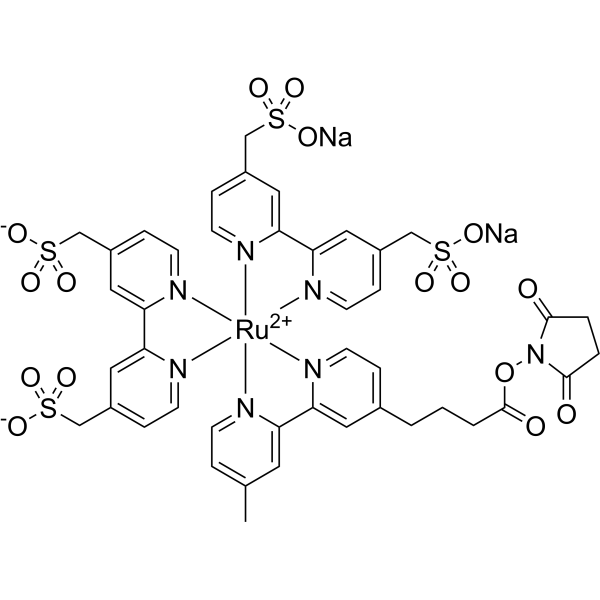
Sulfo-TAG TFP ester disodium is a tetrafluorophenyl (TFP) ester that can be coupled to proteins via primary amine groups. Sulfo-TAG TFP ester disodium is more hydrophobic than NHS esters and exhibits higher hydrolytic stability in aqueous solutions. Sulfo-TAG TFP ester disodium can be used for antibody labeling.
|
-
- HY-W190948
-
|
|
Biochemical Assay Reagents
|
Others
|
|
10-(tert-Butoxy)-10-oxodecanoic NHS ester has a t-butyl ester group and an NHS ester moiety. The t-butyl group can be deprotected under acidic conditions. NHS ester can react specifically and efficiently with primary amines such as the side chain of lysine residues or aminosilane-coated surfaces at neutral or slightly basic condition to form a covalent bond.
|
-
- HY-W190906
-
|
|
Biochemical Assay Reagents
|
Others
|
|
6-(tert-Butoxy)-6-oxohexanoic NHS ester has a t-butyl ester group and an NHS ester moiety. The t-butyl group can be deprotected under acidic conditions. NHS ester can react specifically and efficiently with primary amines such as the side chain of lysine residues or aminosilane-coated surfaces at neutral or slightly basic condition to form a covalent bond.
|
-
- HY-172309
-
|
|
Fluorescent Dye
|
Others
|
|
UBQ-3 NHS Ester is a fluroescent agent with a terminal NHS ester group. UBQ-3 NHS Ester has a wide quenching range from 620-730 nm, which makes the compound useful as an acceptor in fluorescence resonance energy transfer (FRET) applications in conjunction with far-red to near-IR emitting dyes such as Cy5, Cy5.5, Alexa Fluor 633, 647, 700. The NHS ester can be applied to label the primary amines (-NH2) of proteins, amine-modified oligonucleotides, and other amine-containing molecules.
|
-
- HY-131699
-
|
|
Biochemical Assay Reagents
|
Others
|
|
t-Butyl ester-PEG4-CH2COOH is a PEG linker containing a t-butyl group with a terminal carboxylic acid. The terminal carboxylic acid can react with primary amine groups in the presence of activators (e.g. HATU) to form a stable amide bond. The hydrophilic PEG spacer increases solubility in aqueous media. The t-butyl group can be deprotected under acidic conditions.
|
-
- HY-W1048843AGL
-
|
4-Arm PEG5000-amine (GMP Like)
|
Biochemical Assay Reagents
|
Others
|
|
4-Arm PEG5000-NH2 (GMP Like) (4-Arm PEG5000-amine (GMP Like)) is 4-Arm PEG-NH2 (HY-W1048843A) produced by using GMP like guidelines. GMP like small molecules works appropriately as an auxiliary reagent for cell therapy manufacture. 4-Arm PEG5000-NH2 is a multi-arm PEG derivative with amine groups at each end of four arms attached to a pentaerythritol core. The reactive primary amine or NH2 groups can react rapidly with activated carboxylic acids such as NHS esters to form stable amide bonds .
|
-
- HY-W190951
-
|
|
Biochemical Assay Reagents
|
Others
|
|
3-((2-(2,2,2-Trifluoroacetamido)ethyl)disulfanyl)propanoic acid is a cleavable linker containing a carboxylic acid. The terminal carboxylic acid can be reacted with primary amine groups in the presence of activators (e.g. EDC, or HATU) to form a stable amide bond. The disulfide bond can be cleaved via reduction reactions.
|
-
- HY-D0017S1
-
|
DNSCl-13C2
|
Fluorescent Dye
Isotope-Labeled Compounds
|
Others
|
|
Dansyl chloride- 13C2 is the 13C labeled Dansyl chloride (HY-D0017) . Dansyl chloride is a reagent that produces stable blue or blue-green fluorescent sulfonamide adducts in the reaction of aliphatic and aromatic amines with primary amino groups, and is widely used for modified amino acids, protein sequencing and amino acid analysis.
|
-
- HY-D0017S
-
|
DNSCl-d6
|
Biochemical Assay Reagents
|
Others
|
|
Dansyl chloride-d6 is the deuterium labeled Dansyl chloride (HY-D0017). Dansyl chloride is a reagent that produces stable blue or blue-green fluorescent sulfonamide adducts in the reaction of aliphatic and aromatic amines with primary amino groups, and is widely used for modified amino acids, protein sequencing and amino acid analysis .
|
-
- HY-W800667
-
|
|
Biochemical Assay Reagents
|
Others
|
|
Hydroxy-PEG4-acid sodium is a PEG linker containing a hydroxyl group with a terminal carboxylic acid (as sodium salt form). The free acid form is not stable due to the reaction of OH with PEG-COOH group to form polymer. The sodium salt form is stable for storage and shipping. The terminal carboxylic acid can react with primary amine groups in the presence of activators (e.g. EDC, or HATU) to form a stable amide bond. The hydrophilic PEG spacer increases solubility in aqueous media. The hydroxyl group enables further derivatization or replacement with other reactive functional groups.
|
-
- HY-D3049
-
|
|
Fluorescent Dye
|
Others
|
|
5(6)-carbonylated rhodamine 110 NHS ester is a reactive ester fluorescent reagent based on 5(6)-carbonylated rhodamine 110. NHS ester is a highly reactive ester capable of covalently coupling with primary amine groups in molecules such as proteins, peptides, amino sugars, and nucleic acids to form stable amide bonds (Ex/Em = 502/527 nm).
|
-
- HY-140339
-
|
|
Biochemical Assay Reagents
|
Others
Cancer
|
|
ANB-NOS is a heterobifunctional crosslinker with lipophilic, uncharged properties suitable for intracellular conjugation. ANB-NOS contains an amine-reactive Nhydroxysuccinimide (NHS) ester and a photoactivatable nitrophenyl azide. ANB-NOS can be used for the research of fibrosarcoma and mammary adenocarcinoma .
|
-
- HY-183168B
-
|
|
Biochemical Assay Reagents
|
Others
|
|
C18-PEG5000-COOH is a conjugate composed of an octadecyl group (C18 aliphatic chain), a PEG chain, and a carboxyl group (-COOH). C18-PEG5000-COOH combines the membrane compatibility of lipids with the carboxyl group, which can form amide bonds with primary amines via EDC/NHS activation, making it suitable for research in biomaterial construction and drug delivery.
|
-
- HY-183168A
-
|
|
Biochemical Assay Reagents
|
Others
|
|
C18-PEG3400-COOH is a conjugate composed of an octadecyl group (C18 aliphatic chain), a PEG chain, and a carboxyl group (-COOH). C18-PEG3400-COOH combines the membrane compatibility of lipids with the carboxyl group, which can form amide bonds with primary amines via EDC/NHS activation, making it suitable for research in biomaterial construction and drug delivery.
|
-
- HY-183168
-
|
|
Biochemical Assay Reagents
|
Others
|
|
C18-PEG2000-COOH is a conjugate composed of an octadecyl group (C18 aliphatic chain), a PEG chain, and a carboxyl group (-COOH). C18-PEG2000-COOH combines the membrane compatibility of lipids with the carboxyl group, which can form amide bonds with primary amines via EDC/NHS activation, making it suitable for research in biomaterial construction and drug delivery.
|
-
- HY-W451406C
-
|
|
PROTAC Linkers
|
Others
|
|
NH2-PEG2000-NH2 is a polyethylene glycol derivative containing two primary amine groups. The amino group can react quickly with activated carboxylic acid or carboxyl groups such as NHS esters to form stable amide bonds. The PEGylation of NH2-PEG-NH2 can increase solubility and stability, and reduce the immunogenicity of peptides and proteins, so it is mostly used to modify proteins, peptides and other substances.
|
-
- HY-W451406D
-
|
|
PROTAC Linkers
|
Others
|
|
NH2-PEG10000-NH2 is a polyethylene glycol derivative containing two primary amine groups. The amino group can react quickly with activated carboxylic acid or carboxyl groups such as NHS esters to form stable amide bonds. The PEGylation of NH2-PEG-NH2 can increase solubility and stability, and reduce the immunogenicity of peptides and proteins, so it is mostly used to modify proteins, peptides and other substances.
|
-
- HY-W451406A
-
|
|
PROTAC Linkers
|
Others
|
|
NH2-PEG5000-NH2 is a polyethylene glycol derivative containing two primary amine groups. The amino group can react quickly with activated carboxylic acid or carboxyl groups such as NHS esters to form stable amide bonds. The PEGylation of NH2-PEG-NH2 can increase solubility and stability, and reduce the immunogenicity of peptides and proteins, so it is mostly used to modify proteins, peptides and other substances.
|
-
- HY-176206H
-
|
|
Biochemical Assay Reagents
|
Others
|
|
Biotin-PEG40000-COOH is a linear heterobifunctional PEG compound with biotin and carboxylic acid functional groups. Biotin can bind to avidin and streptavidin with high specificity and affinity. Biotin-PEG40000-COOH can be used to biotin-label antibodies, proteins and other macromolecules containing primary amines in the presence of a condensing agent .
|
-
- HY-176206
-
|
|
Biochemical Assay Reagents
|
Others
|
|
Biotin-PEG1000-COOH is a linear heterobifunctional PEG compound with biotin and carboxylic acid functional groups. Biotin can bind to avidin and streptavidin with high specificity and affinity. Biotin-PEG1000-COOH can be used to biotin-label antibodies, proteins and other macromolecules containing primary amines in the presence of a condensing agent .
|
-
- HY-176206A
-
|
|
Biochemical Assay Reagents
|
Others
|
|
Biotin-PEG2000-COOH is a linear heterobifunctional PEG compound with biotin and carboxylic acid functional groups. Biotin can bind to avidin and streptavidin with high specificity and affinity. Biotin-PEG2000-COOH can be used to biotin-label antibodies, proteins and other macromolecules containing primary amines in the presence of a condensing agent .
|
-
- HY-176206B
-
|
|
Biochemical Assay Reagents
|
Others
|
|
Biotin-PEG3400-COOH is a linear heterobifunctional PEG compound with biotin and carboxylic acid functional groups. Biotin can bind to avidin and streptavidin with high specificity and affinity. Biotin-PEG3400-COOH can be used to biotin-label antibodies, proteins and other macromolecules containing primary amines in the presence of a condensing agent .
|
-
- HY-176206C
-
|
|
Biochemical Assay Reagents
|
Others
|
|
Biotin-PEG5000-COOH is a linear heterobifunctional PEG compound with biotin and carboxylic acid functional groups. Biotin can bind to avidin and streptavidin with high specificity and affinity. Biotin-PEG5000-COOH can be used to biotin-label antibodies, proteins and other macromolecules containing primary amines in the presence of a condensing agent .
|
-
- HY-D3050
-
|
|
Fluorescent Dye
|
Others
|
|
5(6)-carbonylated rhodamine 110 X NHS ester is a reactive ester fluorescent reagent based on 5(6)-carbonylated rhodamine 110 X. NHS ester is a highly reactive ester capable of covalently coupling with primary amine groups in molecules such as proteins, peptides, amino sugars, and nucleic acids to form stable amide bonds (Ex/Em = 496/522 nm).
|
-
- HY-176206E
-
|
|
Biochemical Assay Reagents
|
Others
|
|
Biotin-PEG20000-COOH is a linear heterobifunctional PEG compound with biotin and carboxylic acid functional groups. Biotin can bind to avidin and streptavidin with high specificity and affinity. Biotin-PEG20000-COOH can be used to biotin-label antibodies, proteins and other macromolecules containing primary amines in the presence of a condensing agent .
|
-
- HY-176206D
-
|
|
Biochemical Assay Reagents
|
Others
|
|
Biotin-PEG10000-COOH is a linear heterobifunctional PEG compound with biotin and carboxylic acid functional groups. Biotin can bind to avidin and streptavidin with high specificity and affinity. Biotin-PEG10000-COOH can be used to biotin-label antibodies, proteins and other macromolecules containing primary amines in the presence of a condensing agent .
|
-
- HY-D3053
-
|
|
Fluorescent Dye
|
Others
|
|
5(6)-Rhodamine 6G NHS ester is a reactive ester fluorescent reagent based on Rhodamine 6G (HY-D0309). NHS ester is a highly reactive ester capable of covalently coupling with primary amine groups in molecules such as proteins, peptides, amino sugars, and nucleic acids to form stable amide bonds (Ex/Em = 526/547 nm).
|
-
- HY-130736
-
|
JF549, SE; JF549, NHS
|
Fluorescent Dye
|
Others
|
|
Janelia Fluor® 549, SE (JF549, SE) is a cell-permeable fluorescent dye with an NHS ester (succinimidyl ester (SE)) reactive group. NHS esters react with primary amines and are commonly used to conjugate dyes to proteins, antibodies, amine-modified oligonucleotides, and other molecules. Janelia Fluor® 549, SE also acts as a ligand for self-labeling tags such as HaloTag and SNAP-tag, and can be used in live-cell imaging studies (Ex/Em = 549 nm/571 nm) .\n
|
-
- HY-D2895E
-
|
Rhodamine B-PEG5000-NH2
|
Fluorescent Dye
|
Others
|
|
RB-PEG5000-NH2 (Rhodamine B-PEG5000-NH2) is a fluorescent dye composed of Rhodamine B (HY-Y0016), PEG and an amino group. The reactive primary amine or NH2 groups can react rapidly with activated carboxylic acids such as NHS esters to form stable amide bonds (Ex/Em=546/610 nm) .
|
-
- HY-W190920
-
|
|
Biochemical Assay Reagents
|
Others
|
|
t-Butoxycarbonyl-PEG2-NHS ester has a t-Boc protecting group and an NHS ester moiety. The t-butyl group can be deprotected under acidic conditions. NHS ester can react specifically and efficiently with primary amines such as the side chain of lysine residues or aminosilane-coated surfaces at neutral or slightly basic condition to form a covalent bond. The hydrophilic PEG linker increases the water solubility of the compound in aqueous media.
|
-
- HY-D2895A
-
|
Rhodamine B-PEG600-NH2
|
Fluorescent Dye
|
Others
|
|
RB-PEG600-NH2 (Rhodamine B-PEG600-NH2) is a fluorescent dye composed of Rhodamine B (HY-Y0016), PEG and an amino group. The reactive primary amine or NH2 groups can react rapidly with activated carboxylic acids such as NHS esters to form stable amide bonds (Ex/Em=546/610 nm) .
|
-
- HY-D2895C
-
|
Rhodamine B-PEG2000-NH2
|
Fluorescent Dye
|
Others
|
|
RB-PEG2000-NH2 (Rhodamine B-PEG2000-NH2) is a fluorescent dye composed of Rhodamine B (HY-Y0016), PEG and an amino group. The reactive primary amine or NH2 groups can react rapidly with activated carboxylic acids such as NHS esters to form stable amide bonds (Ex/Em=546/610 nm) .
|
-
- HY-D2895H
-
|
Rhodamine B-PEG10000-NH2
|
Fluorescent Dye
|
Others
|
|
RB-PEG10000-NH2 (Rhodamine B-PEG10000-NH2) is a fluorescent dye composed of Rhodamine B (HY-Y0016), PEG and an amino group. The reactive primary amine or NH2 groups can react rapidly with activated carboxylic acids such as NHS esters to form stable amide bonds (Ex/Em=546/610 nm) .
|
-
- HY-D2895D
-
|
Rhodamine B-PEG3400-NH2
|
Fluorescent Dye
|
Others
|
|
RB-PEG3400-NH2 (Rhodamine B-PEG3400-NH2) is a fluorescent dye composed of Rhodamine B (HY-Y0016), PEG and an amino group. The reactive primary amine or NH2 groups can react rapidly with activated carboxylic acids such as NHS esters to form stable amide bonds (Ex/Em=546/610 nm) .
|
-
- HY-D2895B
-
|
Rhodamine B-PEG1000-NH2
|
Fluorescent Dye
|
Others
|
|
RB-PEG1000-NH2 (Rhodamine B-PEG1000-NH2) is a fluorescent dye composed of Rhodamine B (HY-Y0016), PEG and an amino group. The reactive primary amine or NH2 groups can react rapidly with activated carboxylic acids such as NHS esters to form stable amide bonds (Ex/Em=546/610 nm) .
|
-
- HY-D2895
-
|
Rhodamine B-PEG400-NH2
|
Fluorescent Dye
|
Others
|
|
RB-PEG400-NH2 (Rhodamine B-PEG400-NH2) is a fluorescent dye composed of Rhodamine B (HY-Y0016), PEG and an amino group. The reactive primary amine or NH2 groups can react rapidly with activated carboxylic acids such as NHS esters to form stable amide bonds (Ex/Em=546/610 nm) .
|
-
- HY-D2768
-
|
|
Fluorescent Dye
|
Others
|
|
BP Fluor 430 NHS Ester is a water-soluble, green-fluorescent dye that is often used in multi-color applications, including flow cytometry and super-resolution microscopy using STORM. Its excitation is ideally suited for the 407 nm spectral line of the krypton laser or the 408 nm violet laser diode. BP Fluor 405 conjugates are pH-insensitive from pH 4 to pH 10.
The NHS ester (or succinimidyl ester) is the most popular amine reactive group for labeling the primary amines of proteins (Lys), amine-modified oligonucleotides, and other amine-containing molecules. Proteins can be labeled with BP Fluor 430 NHS Ester at high molar ratios without significant self-quenching, leading to brighter conjugates and more sensitive detection.
|
-
- HY-141161A
-
|
|
PROTAC Linkers
|
Cancer
|
|
(S)-TCO-PEG8-acid is a click chemistry PEG linker with a terminal carboxylic acid(COOH) group. The terminal carboxylic acid is reactive with primary amine groups to form a stable amide bond. (S)-TCO-PEG8-acid is a PEG-based PROTAC linker can be used in the synthesis of PROTACs. (S)-TCO-PEG8-acid is longer than (S)-TCO-PEG3-acid .
|
-
- HY-183133B
-
|
|
Biochemical Assay Reagents
|
Others
|
|
C16-PEG5000-COOH is a conjugate composed of a hexadecyl (C16 aliphatic chain), a PEG chain, and a carboxyl group (-COOH). C16-PEG5000-COOH combines the membrane compatibility of lipids with the carboxyl group, which can form amide bonds with primary amines via EDC/NHS activation, making it suitable for research in biomaterial construction and drug delivery.
|
-
- HY-183133
-
|
|
Biochemical Assay Reagents
|
Others
|
|
C16-PEG2000-COOH is a conjugate composed of a hexadecyl (C16 aliphatic chain), a PEG chain, and a carboxyl group (-COOH). C16-PEG2000-COOH combines the membrane compatibility of lipids with the carboxyl group, which can form amide bonds with primary amines via EDC/NHS activation, making it suitable for research in biomaterial construction and drug delivery.
|
-
- HY-183133A
-
|
|
Biochemical Assay Reagents
|
Others
|
|
C16-PEG3400-COOH is a conjugate composed of a hexadecyl (C16 aliphatic chain), a PEG chain, and a carboxyl group (-COOH). C16-PEG3400-COOH combines the membrane compatibility of lipids with the carboxyl group, which can form amide bonds with primary amines via EDC/NHS activation, making it suitable for research in biomaterial construction and drug delivery.
|
-
- HY-130695
-
|
|
ADC Linker
|
Cancer
|
|
N-(Amino-PEG5)-N-bis(PEG4-acid) is a PEG derivative containing an amino group with two terminal carboxylic acids. The amino group is reactive with carboxylic acids, activated NHS esters. The terminal carboxylic acids can react with primary amine groups in the presence of activators to form a stable amide bond. N-(Amino-PEG5)-N-bis(PEG4-acid) can be useful in the development of antibody drug conjugates (ADCs) .
|
-
- HY-W800721
-
|
|
Biochemical Assay Reagents
|
Others
|
|
Methyltetrazine-amido-bis-(carboxyethoxymethyl)-methane is a click chemistry PEG reagent which contains three carboxylic acid groups and a methyltetrazine group. This reagent can react with TCO-containing compounds to form a stable covalent bond without the catalysis of Cu or elevated temperatures. The inverse-electron demand Diels-Alder cycloaddition reaction of TCO with tetrazines is the fastest bioorthogonal reaction with exceptional selectivity. The terminal carboxylic acid can react with primary amine groups in the presence of activators (e.g. EDC, or HATU) to form a stable amide bond.
|
-
- HY-W800709
-
|
|
Biochemical Assay Reagents
|
Others
|
|
N-(acid-PEG10)-N-bis(PEG10-azide) is a very popular PEG reagent containing a terminal carboxylic acid and two azide groups. The hydrophilic PEG spacer increases solubility in aqueous media. The azide groups can react with alkyne, BCN, DBCO via Click Chemistry to yield a stable triazole linkage. The terminal carboxylic acid can react with primary amine groups in the presence of activators (e.g. EDC, or HATU) to form a stable amide bond.
|
-
- HY-D2771
-
|
|
Fluorescent Dye
|
Others
|
|
BP Fluor 405 NHS Ester is a water-soluble, blue-fluorescent dye that is often used in multi-color applications, including flow cytometry and super-resolution microscopy using STORM. Its excitation is ideally suited for the 407 nm spectral line of the krypton laser or the 408 nm violet laser diode. BP Fluor 405 conjugates are pH-insensitive from pH 4 to pH 10.
The NHS ester (or succinimidyl ester) is the most popular amine reactive group for labeling with the primary amines of proteins (Lys), amine-modified oligonucleotides, and other amine-containing molecules. Proteins can be labeled with BP Fluor 405 NHS Ester at high molar ratios without significant self-quenching, leading to brighter conjugates and more sensitive detection. BP Fluor 405 conjugates can also be used for the detection of abundance targets.
|
-
- HY-151821
-
|
|
ADC Linker
|
Others
|
|
Sulfo DBCO-PEG3-acid is a click chemistry reagent containing an azide group. Sulfo DBCO-PEG3-acid is an analog of DBCO-Acid with PEG linker and a DBCO group. The DBCO groups is commonly used for copper-free Click Chemistry reactions due to its strain promoted high energy. The hydrophilic PEG chain and sulfo group increase water solubility. The terminal carboxylic acid can react with primary amine groups in the presence of activators (e.g. EDC, or HATU) to form a stable amide bond. Reagent grade, for research use only .
|
-
- HY-182833A
-
|
|
Biochemical Assay Reagents
|
Others
|
|
DPPE-PEG2000-NHS is a conjugate composed of DPPE, PEG chains, and terminal active esters (NHS). The NHS ester in DMPE-PEG2000-NHS can rapidly covalently react with molecules containing primary amines (such as proteins, peptides, and small molecules modified with amino groups) to form stable amide bonds, enabling targeted modification of liposomes/nanoparticles.
|
-
- HY-183104D
-
|
|
Biochemical Assay Reagents
|
Others
|
|
DSG-PEG10000-NHS is a conjugate composed of DSG, PEG chains, and terminal active esters (NHS). The NHS ester in DSG-PEG10000-NHS can rapidly covalently react with molecules containing primary amines (such as proteins, peptides, and small molecules modified with amino groups) to form stable amide bonds, enabling targeted modification of liposomes/nanoparticles.
|
-
- HY-183104
-
|
|
Biochemical Assay Reagents
|
Others
|
|
DSG-PEG1000-NHS is a conjugate composed of DSG, PEG chains, and terminal active esters (NHS). The NHS ester in DSG-PEG1000-NHS can rapidly covalently react with molecules containing primary amines (such as proteins, peptides, and small molecules modified with amino groups) to form stable amide bonds, enabling targeted modification of liposomes/nanoparticles.
|
-
- HY-W800750
-
|
|
Biochemical Assay Reagents
|
Others
|
|
TCO-PEG2-acid is a click chemistry linker containing a TCO (trans-cycloctene) and a terminal carboxylic acid. The terminal carboxylic acid can react with primary amine groups in the presence of activators such as EDC. TCO reagent is highly reactive with tetrazine in an inverse electron demand Diels Alder (IEDDA) reaction followed by a retro-DA reaction. The hydrophilic PEG spacer increases solubility in aqueous media.
|
-
- HY-183016
-
|
|
Biochemical Assay Reagents
|
Others
|
|
DMPE-PEG1000-NHS is a conjugate composed of DMPE, PEG chains, and terminal active esters (NHS). The NHS ester in DMPE-PEG1000-NHS can rapidly covalently react with molecules containing primary amines (such as proteins, peptides, and small molecules modified with amino groups) to form stable amide bonds, enabling targeted modification of liposomes/nanoparticles.
|
-
- HY-W440807
-
|
|
Liposome
|
Others
|
|
Oleoyl-Gly-Lys-(m-PEG11)-NH2 is a PEG-lipid molecule featuring an oleoyl amide linked to a Gly-Lys dipeptide and a methoxy PEG11 chain on the C-terminus of the lysine. The lysine primary amine may be used in a wide variety of reactions with carboxylic acids, NHS esters, and carbonyl groups. The PEG linker provides aqueous solubility.
|
-
- HY-183104B
-
|
|
Biochemical Assay Reagents
|
Others
|
|
DSG-PEG3400-NHS is a conjugate composed of DSG, PEG chains, and terminal active esters (NHS). The NHS ester in DSG-PEG3400-NHS can rapidly covalently react with molecules containing primary amines (such as proteins, peptides, and small molecules modified with amino groups) to form stable amide bonds, enabling targeted modification of liposomes/nanoparticles.
|
-
- HY-183104A
-
|
|
Biochemical Assay Reagents
|
Others
|
|
DSG-PEG2000-NHS is a conjugate composed of DSG, PEG chains, and terminal active esters (NHS). The NHS ester in DSG-PEG2000-NHS can rapidly covalently react with molecules containing primary amines (such as proteins, peptides, and small molecules modified with amino groups) to form stable amide bonds, enabling targeted modification of liposomes/nanoparticles.
|
-
- HY-183016C
-
|
|
Biochemical Assay Reagents
|
Others
|
|
DMPE-PEG5000-NHS is a conjugate composed of DMPE, PEG chains, and terminal active esters (NHS). The NHS ester in DMPE-PEG5000-NHS can rapidly covalently react with molecules containing primary amines (such as proteins, peptides, and small molecules modified with amino groups) to form stable amide bonds, enabling targeted modification of liposomes/nanoparticles.
|
-
- HY-183016B
-
|
|
Biochemical Assay Reagents
|
Others
|
|
DMPE-PEG3400-NHS is a conjugate composed of DMPE, PEG chains, and terminal active esters (NHS). The NHS ester in DMPE-PEG3400-NHS can rapidly covalently react with molecules containing primary amines (such as proteins, peptides, and small molecules modified with amino groups) to form stable amide bonds, enabling targeted modification of liposomes/nanoparticles.
|
-
- HY-182833D
-
|
|
Biochemical Assay Reagents
|
Others
|
|
DPPE-PEG10000-NHS is a conjugate composed of DPPE, PEG chains, and terminal active esters (NHS). The NHS ester in DMPE-PEG10000-NHS can rapidly covalently react with molecules containing primary amines (such as proteins, peptides, and small molecules modified with amino groups) to form stable amide bonds, enabling targeted modification of liposomes/nanoparticles.
|
-
- HY-182833B
-
|
|
Biochemical Assay Reagents
|
Others
|
|
DPPE-PEG3400-NHS is a conjugate composed of DPPE, PEG chains, and terminal active esters (NHS). The NHS ester in DMPE-PEG3400-NHS can rapidly covalently react with molecules containing primary amines (such as proteins, peptides, and small molecules modified with amino groups) to form stable amide bonds, enabling targeted modification of liposomes/nanoparticles.
|
-
- HY-182833
-
|
|
Biochemical Assay Reagents
|
Others
|
|
DPPE-PEG1000-NHS is a conjugate composed of DPPE, PEG chains, and terminal active esters (NHS). The NHS ester in DMPE-PEG1000-NHS can rapidly covalently react with molecules containing primary amines (such as proteins, peptides, and small molecules modified with amino groups) to form stable amide bonds, enabling targeted modification of liposomes/nanoparticles.
|
-
- HY-183104C
-
|
|
Biochemical Assay Reagents
|
Others
|
|
DSG-PEG5000-NHS is a conjugate composed of DSG, PEG chains, and terminal active esters (NHS). The NHS ester in DSG-PEG5000-NHS can rapidly covalently react with molecules containing primary amines (such as proteins, peptides, and small molecules modified with amino groups) to form stable amide bonds, enabling targeted modification of liposomes/nanoparticles.
|
-
- HY-182833C
-
|
|
Biochemical Assay Reagents
|
Others
|
|
DPPE-PEG5000-NHS is a conjugate composed of DPPE, PEG chains, and terminal active esters (NHS). The NHS ester in DMPE-PEG5000-NHS can rapidly covalently react with molecules containing primary amines (such as proteins, peptides, and small molecules modified with amino groups) to form stable amide bonds, enabling targeted modification of liposomes/nanoparticles.
|
-
- HY-183016A
-
|
|
Biochemical Assay Reagents
|
Others
|
|
DMPE-PEG2000-NHS is a conjugate composed of DMPE, PEG chains, and terminal active esters (NHS). The NHS ester in DMPE-PEG2000-NHS can rapidly covalently react with molecules containing primary amines (such as proteins, peptides, and small molecules modified with amino groups) to form stable amide bonds, enabling targeted modification of liposomes/nanoparticles.
|
-
- HY-183016D
-
|
|
Biochemical Assay Reagents
|
Others
|
|
DMPE-PEG10000-NHS is a conjugate composed of DMPE, PEG chains, and terminal active esters (NHS). The NHS ester in DMPE-PEG10000-NHS can rapidly covalently react with molecules containing primary amines (such as proteins, peptides, and small molecules modified with amino groups) to form stable amide bonds, enabling targeted modification of liposomes/nanoparticles.
|
-
- HY-160773
-
|
|
Biochemical Assay Reagents
|
Others
|
|
DBCO-PEG6-NHS ester is a click chemistry PEG reagent containing an NHS ester that reacts specifically with primary amines, such as side chains of lysine residues or aminosilane-coated surfaces, under neutral or slightly alkaline conditions. , efficient reaction to form covalent bonds. DBCO-PEG6-NHS ester also contains a DBCO group that can undergo strain-promoted alkyne-azide cycloaddition (SPAAC) with molecules containing Azide groups .
|
-
- HY-118112
-
|
|
Biochemical Assay Reagents
|
Others
|
|
4-N-Maleimidobenzoicacid-NHS is a PEG linker that finds utility in bioconjugation endeavors and protein labeling ventures. Specifically designed for selective reaction with thiol groups, the maleimide group establishes covalent linkages, thereby facilitating the coupling of proteins, peptides, or diverse molecules to thiol-bearing biomolecules. The NHS ester is able to react specifically and efficiently with primary amines (e.g. the side chain of lysine residues or aminosilane-coated surfaces) at neutral or slightly basic conditions to form a covalent bond.
|
-
- HY-148840
-
|
|
Biochemical Assay Reagents
|
Others
|
|
Sulfo DBCO-PEG3-NHS ester is a click chemistry reagent containing an azide group. Sulfo DBCO-PEG3-NHS ester is an analog of DBCO-Acid with PEG linker and a DBCO group. The DBCO group is commonly used for copper-free Click Chemistry reactions due to its strain promoted high energy. The hydrophilic PEG chain and sulfo group increase water solubility. The terminal carboxylic acid can react with primary amine groups in the presence of activators (e.g. EDC, or HATU) to form a stable amide bond. Reagent grade, for research use only .
|
-
- HY-148840A
-
|
|
Biochemical Assay Reagents
|
Others
|
|
Sulfo DBCO-PEG3-NHS ester TEA is a click chemistry reagent containing an azide group. Sulfo DBCO-PEG3-NHS ester (TEA) is an analog of DBCO-Acid with PEG linker and a DBCO group. The DBCO group is commonly used for copper-free Click Chemistry reactions due to its strain promoted high energy. The hydrophilic PEG chain and sulfo group increase water solubility. The terminal carboxylic acid can react with primary amine groups in the presence of activators (e.g. EDC, or HATU) to form a stable amide bond. Reagent grade, for research use only .
|
-
- HY-W800718
-
|
|
Biochemical Assay Reagents
|
Others
|
|
Methyltetrazine-amido-Tri-(acid-PEG1-ethoxymethyl)-methane is a click chemistry PEG reagent which contains three carboxylic acid groups and a methyltetrazine group. This reagent can react with TCO-containing compounds to form a stable covalent bond without the catalysis of Cu or elevated temperatures. The inverse-electron demand Diels-Alder cycloaddition reaction of TCO with tetrazines is the fastest bioorthogonal reaction with exceptional selectivity. The terminal carboxylic acid can react with primary amine groups in the presence of activators (e.g. EDC, or HATU) to form a stable amide bond.
|
-
- HY-151820
-
|
|
ADC Linker
|
Others
|
|
DBCO-PEG24-acid is a click chemistry reagent. DBCO-PEG24-acid is an analog of DBCO-Acid with PEG linker and a DBCO group. The DBCO groups is commonly used for copper-free Click Chemistry reactions due to its strain promoted high energy. The hydrophilic PEG chain allows for increased water solubility. The terminal carboxylic acid can react with primary amine groups in the presence of activators (e.g. EDC, or HATU) to form a stable amide bond. Reagent grade, for research use only .
|
-
- HY-137383
-
|
|
Biochemical Assay Reagents
Reactive Oxygen Species (ROS)
|
Others
|
|
Sulfo-SANPAH is a primary amine-nitrobenzene azide cross-linker. Sulfo-SANPAH improves the functionalization process of PDMS surfaces, is covalently bound to the PAAm gel surface. Sulfo-SANPAH is widely used to crosslink ECM proteins to various substrates, including acrylic-based hydrogels, such as polyacrylamide hydrogels. Sulfo-SANPAH facilitates covalent binding through its negatively charged sulfonate group on its N-hydroxysuccinimide ester ring and a photoactivated phenyl azide group that is highly reactive with nucleophiles and free radicals .
|
-
- HY-W1048555B
-
|
|
Biochemical Assay Reagents
|
Others
|
|
Mal-PEG3400-SCM is a linear hetero-bifunctional PEG product with maleimide and succinimidyl NHS ester groups. Mal-PEG3400-SCM is an important cross-linker with PEG chains. Maleimide reacts with thiols, SH, sulfhydryls or sulfhydryls, and SCM stands for succinimidyl carboxymethyl ester, which reacts with primary amines. Maleimide contains a reactive C=C double bond and is sensitive to light or oxygen .
|
-
- HY-W1048555D
-
|
|
Biochemical Assay Reagents
|
Others
|
|
Mal-PEG10000-SCM is a linear hetero-bifunctional PEG product with maleimide and succinimidyl NHS ester groups. Mal-PEG10000-SCM is an important cross-linker with PEG chains. Maleimide reacts with thiols, SH, sulfhydryls or sulfhydryls, and SCM stands for succinimidyl carboxymethyl ester, which reacts with primary amines. Maleimide contains a reactive C=C double bond and is sensitive to light or oxygen .
|
-
- HY-W1048555H
-
|
|
Biochemical Assay Reagents
|
Others
|
|
Mal-PEG40000-SCM is a linear hetero-bifunctional PEG product with maleimide and succinimidyl NHS ester groups. Mal-PEG40000-SCM is an important cross-linker with PEG chains. Maleimide reacts with thiols, SH, sulfhydryls or sulfhydryls, and SCM stands for succinimidyl carboxymethyl ester, which reacts with primary amines. Maleimide contains a reactive C=C double bond and is sensitive to light or oxygen .
|
-
- HY-W1048555C
-
|
|
Biochemical Assay Reagents
|
Others
|
|
Mal-PEG5000-SCM is a linear hetero-bifunctional PEG product with maleimide and succinimidyl NHS ester groups. Mal-PEG5000-SCM is an important cross-linker with PEG chains. Maleimide reacts with thiols, SH, sulfhydryls or sulfhydryls, and SCM stands for succinimidyl carboxymethyl ester, which reacts with primary amines. Maleimide contains a reactive C=C double bond and is sensitive to light or oxygen .
|
-
- HY-W1048555E
-
|
|
Biochemical Assay Reagents
|
Others
|
|
Mal-PEG20000-SCM is a linear hetero-bifunctional PEG product with maleimide and succinimidyl NHS ester groups. Mal-PEG20000-SCM is an important cross-linker with PEG chains. Maleimide reacts with thiols, SH, sulfhydryls or sulfhydryls, and SCM stands for succinimidyl carboxymethyl ester, which reacts with primary amines. Maleimide contains a reactive C=C double bond and is sensitive to light or oxygen .
|
-
- HY-W1048555
-
|
|
Biochemical Assay Reagents
|
Others
|
|
Mal-PEG1000-SCM is a linear hetero-bifunctional PEG product with maleimide and succinimidyl NHS ester groups. Mal-PEG1000-SCM is an important cross-linker with PEG chains. Maleimide reacts with thiols, SH, sulfhydryls or sulfhydryls, and SCM stands for succinimidyl carboxymethyl ester, which reacts with primary amines. Maleimide contains a reactive C=C double bond and is sensitive to light or oxygen .
|
-
- HY-79647
-
|
N-(Fmoc-oxy)succinimide
|
Biochemical Assay Reagents
|
Others
|
|
Fmoc-OSu (N-(Fmoc-oxy)succinimide) is an acylating agent that targets amino groups (-NH2). It can selectively protect the amino groups of amino acids by covalently binding with primary or secondary amines through nucleophilic substitution reactions. Fmoc-OSu forms a stable amide bond with the amino group to avoid side reactions of the amino group in peptide synthesis. It can also be used as a fluorescent labeling reagent to react with glycosylamines for efficient labeling of N-sugar chains. Fmoc-OSu can be used as an Fmoc protection strategy in peptide synthesis, and as a fluorescent labeling and analysis method for N-sugar chains .
|
-
- HY-131026
-
|
JF635, SE; JF635, NHS
|
Fluorescent Dye
|
Others
|
|
Janelia Fluor 635, SE (JF635, SE) is a red fluorogenic fluorescent dye containing an NHS ester that can be conjugated with primary amine groups. JF635, SE can be used for live cell imaging . Janelia Fluor products are licensed under U.S. Pat. Nos. 9,933,417, 10,018,624 and 10,161,932 and other patents from Howard Hughes Medical Institute.
|
-
- HY-160773A
-
|
|
Biochemical Assay Reagents
|
Others
|
|
DBCO-C3-amide-PEG6-NHS ester is a click chemistry PEG reagent containing an NHS ester that reacts specifically with primary amines, such as side chains of lysine residues or aminosilane-coated surfaces, under neutral or slightly alkaline conditions. , efficient reaction to form covalent bonds. DBCO-C3-amide-PEG6-NHS ester also contains a DBCO group that can undergo strain-promoted alkyne-azide cycloaddition (SPAAC) with molecules containing Azide groups .
|
-
- HY-203300D
-
|
|
Biochemical Assay Reagents
|
Others
|
|
DOPE-PEG1000-NHS is a conjugate composed of DOPE, PEG chains, and terminal active ester (NHS). The NHS ester in DOPE-PEG1000-NHS can rapidly covalently react with molecules containing primary amines (such as proteins, peptide chains, and small molecules modified with amino groups) to form stable amide bonds, suitable for the construction of carriers requiring membrane fusion properties or pH-sensitive release (such as gene delivery systems).
|
-
- HY-NP001
-
|
CBSA
|
Biochemical Assay Reagents
|
Neurological Disease
|
|
Cationic Bovine Serum Albumin is a bovine serum albumin (BSA) modified with excess ethylenediamine, which has enhanced immunogenicity compared to native BSA. Positively charged primary amines block all negatively charged carboxyl groups, making Cationic Bovine Serum Albumin a cationic protein. Cationic Bovine Serum Albumin has remarkable neuroprotective effects on ischemic stroke when in combination with Tanshinone IIA (HY-N0135) .
|
-
- HY-203300B
-
|
|
Biochemical Assay Reagents
|
Others
|
|
DOPE-PEG3400-NHS is a conjugate composed of DOPE, PEG chains, and terminal active ester (NHS). The NHS ester in DOPE-PEG3400-NHS can rapidly covalently react with molecules containing primary amines (such as proteins, peptide chains, and small molecules modified with amino groups) to form stable amide bonds, suitable for the construction of carriers requiring membrane fusion properties or pH-sensitive release (such as gene delivery systems).
|
-
- HY-203300A
-
|
|
Biochemical Assay Reagents
|
Others
|
|
DOPE-PEG1000-NHS is a conjugate composed of DOPE, PEG chains, and terminal active ester (NHS). The NHS ester in DOPE-PEG1000-NHS can rapidly covalently react with molecules containing primary amines (such as proteins, peptide chains, and small molecules modified with amino groups) to form stable amide bonds, suitable for the construction of carriers requiring membrane fusion properties or pH-sensitive release (such as gene delivery systems).
|
-
- HY-203300C
-
|
|
Biochemical Assay Reagents
|
Others
|
|
DOPE-PEG5000-NHS is a conjugate composed of DOPE, PEG chains, and terminal active ester (NHS). The NHS ester in DOPE-PEG5000-NHS can rapidly covalently react with molecules containing primary amines (such as proteins, peptide chains, and small molecules modified with amino groups) to form stable amide bonds, suitable for the construction of carriers requiring membrane fusion properties or pH-sensitive release (such as gene delivery systems).
|
-
- HY-203300
-
|
|
Biochemical Assay Reagents
|
Others
|
|
DOPE-PEG2000-NHS is a conjugate composed of DOPE, PEG chains, and terminal active ester (NHS). The NHS ester in DOPE-PEG2000-NHS can rapidly covalently react with molecules containing primary amines (such as proteins, peptide chains, and small molecules modified with amino groups) to form stable amide bonds, suitable for the construction of carriers requiring membrane fusion properties or pH-sensitive release (such as gene delivery systems).
|
-
- HY-150014
-
|
|
Others
|
Others
|
|
AMT-NHS is an RNA-protein crosslinker. AMT-NHS is composed of a psoralen derivative and an N-hydroxysuccinimide ester group which react with RNA bases and primary amines of protein, respectively. AMT-NHS can penetrate into living yeast cells and crosslink Cbf5 to H/ACA snoRNAs with high specificity. AMT-NHS induces different crosslinking patterns and targets both single- and double-stranded regions of RNA. AMT-NHS can be used for capturing diverse RNA-protein interactions in cells .
|
-
- HY-151769
-
|
|
ADC Linker
|
Others
|
|
TCO-PEG2-Sulfo-NHS ester-EDC Urea is a click chemistry reagent containing an azide group. TCO-PEG2-Sulfo-NHS ester is a PEG linker containing a TCO moiety and a sulfo-NHS ester moiety. The sulfo group makes this molecule soluble in waqueous buffer. This reagent can be used to label antibodies, proteins and other primary amine-containing macromolecules with TCO moiety. Reagent grade, for research use only . TCO-PEG2-Sulfo-NHS ester-EDC Urea is a click chemistry reagent, it contains a TCO group that can undergo an inverse electron demand Diels-Alder reaction (iEDDA) with molecules containing Tetrazine groups.
|
-
- HY-Y0623
-
|
HOSu; 1-Hydroxy-2,5-pyrrolidinedione
|
Biochemical Assay Reagents
|
Others
|
|
N-Hydroxysuccinimide (HOSu; 1-Hydroxy-2,5-pyrrolidinedione) is a covalent crosslinker commonly used in bioconjugation technology with a primary amine group. N-Hydroxysuccinimide reacts with amino groups (-NH2) to form a stable amide bond, which can modify amino-containing biomolecules. N-Hydroxysuccinimide can be used, for example, for protein labeling with fluorescent dyes and enzymes, surface activation of chromatography supports, microbeads, nanoparticles and microarray slides, and chemical synthesis of peptides. N-Hydroxysuccinimide has a wide range of applications in biomaterial synthesis (such as collagen, chitosan crosslinking), drug delivery systems (such as hydrogel preparation) and tissue engineering .
|
-
- HY-131025
-
|
JF585, SE; JF585, NHS
|
Fluorescent Dye
|
Others
|
|
Janelia Fluor 585, SE (JF585, SE) is an orange fluorescent dye containing an NHS ester that can be conjugated with primary amine groups. Janelia Fluor 585, SE can be used immediately for structured illumination (SIM) and stimulated emission depletion (STED) imaging and could be converted to photoactivatable derivative for single-molecule localization microscopy (SMLM) experiments . Janelia Fluor products are licensed under U.S. Pat. Nos. 9,933,417, 10,018,624 and 10,161,932 and other patents from Howard Hughes Medical Institute.
|
-
- HY-151833
-
|
|
ADC Linker
|
Others
|
|
Methyltetrazine-amido-N-bis(PEG4-acid) is a click chemistry reagent containing an azide group. Methyltetrazine-amido-N-bis(PEG4-acid) is a PEG derivative that contains a methyltetrazine group and two acid groups. This reagent can react with TCO-containing compounds to form a stable covalent bond without the catalysis of Cu or elevated temperatures. The inverse-electron demand Diels-Alder cycloaddition reaction of TCO with tetrazines is the fastest bioorthogonal reaction with exceptional selectivity. The terminal carboxylic acid can react with primary amine groups in the presence of activators (e.g. EDC, or HATU) to form a stable amide bond. PEG linker increases the water solubility of the compound. Reagent grade, for research use only . Methyltetrazine-amido-N-bis(PEG4-acid) is a click chemistry reagent, it contains a Tetrazine group that can undergo an inverse electron demand Diels-Alder reaction (iEDDA) with molecules containing TCO groups.
|
-
- HY-151827
-
|
|
ADC Linker
|
Others
|
|
DBCO-PEG2-NHS ester is a click chemistry reagent containing an azide group. DBCO-PEG2-NHS ester is a click chemistry PEG reagent containing NHS ester that is able to react specifically and efficiently with primary amines (e.g. the side chain of lysine residues or aminosilane-coated surfaces) at neutral or slightly basic condition to form a covalent bond. The hydrophilic PEG spacer arm improves water solubility and provides a long and flexible connection that minimizes steric hindrance involved with ligation. DBCO is commonly used for copper-free Click Chemistry reactions. Reagent grade, for research use only .
|
-
- HY-W591424
-
|
mPEG2000-SC; mPEG2000-Succinimidyl ester
|
Biochemical Assay Reagents
MMP
|
Cancer
|
|
m-PEG2000-NHS ester (mPEG2000-SC) is a reagent with both cell adhesion inhibition and peptide conjugation functions. The NHS ester group of m-PEG2000-NHS ester forms stable amide bonds with primary amine-containing molecules (e.g., the N-terminus of MMP-2-cleavable octapeptide) to generate mPEG-peptide intermediates for liposome surface modification. When m-PEG2000-NHS ester is immobilized on a cystamine-modified gold surface, it can construct an in vitro model for cell adhesion kinetic studies, and higher PEG density and thicker layers correlate with lower cell adhesion rates. m-PEG2000-NHS ester can synthesize MMP-2-responsive PEGylated lipid conjugates to achieve MMP-triggered dePEGylation in the tumor microenvironment. m-PEG2000-NHS ester can be used in studies related to colon cancer and other conditions .
|
-
-
-
HY-L0101V
-
|
|
2,244,487 compounds
|
|
FCH Group Screening Library Collection contains about 2,244,487 lead-like compounds for biological screening. This brand new collection comprises polar molecules with pharmacologically important groups such as free carboxylic and amino groups.
|
| Cat. No. |
Product Name |
Type |
-
- HY-D0017
-
|
DNSCl
|
Fluorescent Dyes
|
|
Dansyl chloride is a reagent that produces stable blue or blue-green fluorescent sulfonamide adducts in the reaction of aliphatic and aromatic amines with primary amino groups, and is widely used for modified amino acids, protein sequencing and amino acid analysis .
|
-
- HY-D0715
-
|
Ro 20-7234
|
Fluorescent Dyes
|
|
Fluorescamine is a spirocyclic compound that is non-fluorescent. Fluorescamine reacts rapidly with primary amine groups in proteins under alkaline conditions to generate products with strong fluorescence (Ex/Em: 390/475 nm). Fluorescamine can be used to detect amine-containing compounds, including amino acids, peptides, and proteins .
|
-
- HY-111377
-
|
|
Fluorescent Dyes
|
|
Amine-PEG3-Biotin is a signal amplification label containing a biotin group and a terminal primary amine group .
|
-
- HY-D1085
-
|
|
Fluorescent Dyes
|
|
AMCA-X-SE is a coumarin derivative that generates fixed blue fluorescence and an NHS-activated ester that forms stable amide bonds with primary amine groups. It is used as a reactive dye for labeling amino groups of peptides, proteins, and oligonucleotides. Maximum excitation/emission wavelength: 354/442 nm .
|
-
- HY-131026
-
|
JF635, SE; JF635, NHS
|
Fluorescent Dyes
|
|
Janelia Fluor 635, SE (JF635, SE) is a red fluorogenic fluorescent dye containing an NHS ester that can be conjugated with primary amine groups. JF635, SE can be used for live cell imaging . Janelia Fluor products are licensed under U.S. Pat. Nos. 9,933,417, 10,018,624 and 10,161,932 and other patents from Howard Hughes Medical Institute.
|
-
- HY-D1372
-
|
|
Fluorescent Dyes
|
|
Cyanine3 amine hydrochloride, an analog of Cyanine3 amine, is a potent green fluorescent dye. Cyanine3 amine hydrochloride has the primary amine group and is covalently coupled with reactive groups such as NHS esters, carboxy groups (after carbodiimide activation), and epoxides. (λex=555 nm, λem=570 nm) .
|
-
- HY-D1372A
-
|
|
Fluorescent Dyes
|
|
Cyanine3 amine (TFA), an analog of Cyanine3 amine, is a potent green fluorescent dye. Cyanine3 amine (TFA) has the primary amine group and is covalently coupled with reactive groups such as NHS esters, carboxy groups (after carbodiimide activation), and epoxides. (λex=555 nm, λem=570 nm) .
|
-
- HY-130736
-
|
JF549, SE; JF549, NHS
|
Fluorescent Dyes
|
|
Janelia Fluor® 549, SE (JF549, SE) is a cell-permeable fluorescent dye with an NHS ester (succinimidyl ester (SE)) reactive group. NHS esters react with primary amines and are commonly used to conjugate dyes to proteins, antibodies, amine-modified oligonucleotides, and other molecules. Janelia Fluor® 549, SE also acts as a ligand for self-labeling tags such as HaloTag and SNAP-tag, and can be used in live-cell imaging studies (Ex/Em = 549 nm/571 nm) .\n
|
-
- HY-D1376
-
|
|
Fluorescent Dyes
|
|
Sulfo-Cyanine5.5 amine potassium is a water-soluble cyanine dye suitable for far-red/near-infrared applications such as in vivo imaging. The dye has four sulfonate groups, making it highly hydrophilic and water-soluble. Like other cyanines, sulfo-Cyanine5.5 has an excellent extinction coefficient, making it a bright fluorescent marker in the far-red region. This is an amine-containing fluorescent dye. The amine group is separated from the fluorophore by a relatively long linker that facilitates conjugation. Aliphatic primary amine groups can be coupled with various electrophiles (activated esters, epoxides, etc.) and can also be used for enzymatic transamination labeling.
|
-
- HY-D1376A
-
|
|
Fluorescent Dyes
|
|
Sulfo-Cyanine5.5 amine consists of four sulfonate groups and has highly hydrophilic. Sulfo-Cyanine5.5 amine is an amine-containing fluorescent dye, the aliphatic primary amine group can be coupled with various electrophiles (activated esters, epoxides, etc). Sulfo-Cyanine5.5 amine can be used for the research of far red/NIR applications (such as in vivo imaging) and also can be used for enzymatic transamination labeling .
|
-
- HY-D2771
-
|
|
Fluorescent Dyes
|
|
BP Fluor 405 NHS Ester is a water-soluble, blue-fluorescent dye that is often used in multi-color applications, including flow cytometry and super-resolution microscopy using STORM. Its excitation is ideally suited for the 407 nm spectral line of the krypton laser or the 408 nm violet laser diode. BP Fluor 405 conjugates are pH-insensitive from pH 4 to pH 10.
The NHS ester (or succinimidyl ester) is the most popular amine reactive group for labeling with the primary amines of proteins (Lys), amine-modified oligonucleotides, and other amine-containing molecules. Proteins can be labeled with BP Fluor 405 NHS Ester at high molar ratios without significant self-quenching, leading to brighter conjugates and more sensitive detection. BP Fluor 405 conjugates can also be used for the detection of abundance targets.
|
-
- HY-131025
-
|
JF585, SE; JF585, NHS
|
Fluorescent Dyes
|
|
Janelia Fluor 585, SE (JF585, SE) is an orange fluorescent dye containing an NHS ester that can be conjugated with primary amine groups. Janelia Fluor 585, SE can be used immediately for structured illumination (SIM) and stimulated emission depletion (STED) imaging and could be converted to photoactivatable derivative for single-molecule localization microscopy (SMLM) experiments . Janelia Fluor products are licensed under U.S. Pat. Nos. 9,933,417, 10,018,624 and 10,161,932 and other patents from Howard Hughes Medical Institute.
|
-
- HY-D2735
-
|
|
Fluorescent Dyes
|
|
QSY-9-succinimidyl ester is a nonfluorescent acceptor molecule with a terminal NHS ester group. QSY-9-succinimidyl ester has a wide and intense quenching range from 500-600 nm that makes it useful as an acceptor in fluorescence resonance energy transfer (FRET) applications in conjunction with fluorescent dyes at 500 nm to 600 nm. The NHS ester can be applied to label the primary amines (-NH2) of proteins, amine-modified oligonucleotides, and other amine-containing molecules.
|
-
- HY-W1048843AGL
-
|
4-Arm PEG5000-amine (GMP Like)
|
Fluorescent Dyes
|
|
4-Arm PEG5000-NH2 (GMP Like) (4-Arm PEG5000-amine (GMP Like)) is 4-Arm PEG-NH2 (HY-W1048843A) produced by using GMP like guidelines. GMP like small molecules works appropriately as an auxiliary reagent for cell therapy manufacture. 4-Arm PEG5000-NH2 is a multi-arm PEG derivative with amine groups at each end of four arms attached to a pentaerythritol core. The reactive primary amine or NH2 groups can react rapidly with activated carboxylic acids such as NHS esters to form stable amide bonds .
|
-
- HY-D2741
-
|
|
Fluorescent Dyes
|
|
MB 488 NHS ester is a fluroescent agent with a terminal NHS ester group. MB 488 NHS ester is a green fluorescent, very hydrophilic dye molecule that has a maximal absorption of 501 nm and emission at 524 nm. The NHS ester can be applied to label the primary amines (-NH2) of proteins, amine-modified oligonucleotides, and other amine-containing molecules.
|
-
- HY-D2767
-
|
|
Fluorescent Dyes
|
|
MB 660R NHS Ester is a fluroescent agent with a terminal NHS ester group.MB 660R NHS Ester is a far-red fluorescent dye that has a maximal absorption of 665 nm and emission at 690 nm. The NHS ester can be applied to label the primary amines (-NH2) of proteins, amine-modified oligonucleotides, and other amine-containing molecules.
|
-
- HY-D1366A
-
|
|
Fluorescent Dyes
|
|
Sulfo-Cyanine5.5 carboxylic acid potassium is a fluorescent dye with excitation/emission wavelengths at 673/707 nm. The introduction of the sulfite group enhances the hydrophilic properties of the compound. The terminal carboxylic acid can react with primary amine groups in the presence of activators such as EDC and HATU, to form stable amide bonds.
|
-
- HY-D0715R
-
|
Ro 20-7234 (Standard)
|
Fluorescent Dyes
|
|
Fluorescamine (Standard) is the analytical standard of Fluorescamine (HY-D0715). This product is intended for research and analytical applications. Fluorescamine is a spirocyclic compound that is non-fluorescent. Fluorescamine reacts rapidly with primary amine groups in proteins under alkaline conditions to generate products with strong fluorescence (Ex/Em : 390/475 nm). Fluorescamine can be used to detect amine-containing compounds, including amino acids, peptides, and proteins .
|
-
- HY-D2895A
-
|
Rhodamine B-PEG600-NH2
|
Fluorescent Dyes
|
|
RB-PEG600-NH2 (Rhodamine B-PEG600-NH2) is a fluorescent dye composed of Rhodamine B (HY-Y0016), PEG and an amino group. The reactive primary amine or NH2 groups can react rapidly with activated carboxylic acids such as NHS esters to form stable amide bonds (Ex/Em=546/610 nm) .
|
-
- HY-D2895H
-
|
Rhodamine B-PEG10000-NH2
|
Fluorescent Dyes
|
|
RB-PEG10000-NH2 (Rhodamine B-PEG10000-NH2) is a fluorescent dye composed of Rhodamine B (HY-Y0016), PEG and an amino group. The reactive primary amine or NH2 groups can react rapidly with activated carboxylic acids such as NHS esters to form stable amide bonds (Ex/Em=546/610 nm) .
|
-
- HY-D2895D
-
|
Rhodamine B-PEG3400-NH2
|
Fluorescent Dyes
|
|
RB-PEG3400-NH2 (Rhodamine B-PEG3400-NH2) is a fluorescent dye composed of Rhodamine B (HY-Y0016), PEG and an amino group. The reactive primary amine or NH2 groups can react rapidly with activated carboxylic acids such as NHS esters to form stable amide bonds (Ex/Em=546/610 nm) .
|
-
- HY-D2895B
-
|
Rhodamine B-PEG1000-NH2
|
Fluorescent Dyes
|
|
RB-PEG1000-NH2 (Rhodamine B-PEG1000-NH2) is a fluorescent dye composed of Rhodamine B (HY-Y0016), PEG and an amino group. The reactive primary amine or NH2 groups can react rapidly with activated carboxylic acids such as NHS esters to form stable amide bonds (Ex/Em=546/610 nm) .
|
-
- HY-D2895
-
|
Rhodamine B-PEG400-NH2
|
Fluorescent Dyes
|
|
RB-PEG400-NH2 (Rhodamine B-PEG400-NH2) is a fluorescent dye composed of Rhodamine B (HY-Y0016), PEG and an amino group. The reactive primary amine or NH2 groups can react rapidly with activated carboxylic acids such as NHS esters to form stable amide bonds (Ex/Em=546/610 nm) .
|
-
- HY-D2768
-
|
|
Fluorescent Dyes
|
|
BP Fluor 430 NHS Ester is a water-soluble, green-fluorescent dye that is often used in multi-color applications, including flow cytometry and super-resolution microscopy using STORM. Its excitation is ideally suited for the 407 nm spectral line of the krypton laser or the 408 nm violet laser diode. BP Fluor 405 conjugates are pH-insensitive from pH 4 to pH 10.
The NHS ester (or succinimidyl ester) is the most popular amine reactive group for labeling the primary amines of proteins (Lys), amine-modified oligonucleotides, and other amine-containing molecules. Proteins can be labeled with BP Fluor 430 NHS Ester at high molar ratios without significant self-quenching, leading to brighter conjugates and more sensitive detection.
|
-
- HY-D3051
-
|
|
Fluorescent Dyes
|
|
5(6)-carbonylated rhodamine 110 amine is a primary amine fluorescent reagent based on 5(6)-carbonylated rhodamine 110. Primary amines can be covalently linked with various functional groups such as carboxylic acids, active esters (e.g., NHS esters), and isothiocyanates to achieve labeling (Ex/Em = 502/527 nm).
|
-
- HY-D3054
-
|
|
Fluorescent Dyes
|
|
5(6)-Rhodamine 6G amine is a primary amine fluorescent reagent based on Rhodamine 6G (HY-D0309). Primary amines can be covalently linked with various functional groups such as carboxylic acids, active esters (e.g., NHS esters), and isothiocyanates to achieve labeling (Ex/Em = 526/547 nm).
|
-
- HY-D3263
-
|
|
Fluorescent Dyes
|
|
IR 650 NHS ester is a far-red-fluorescent probe with NHS ester. NHS ester is the most popular amine-reactive group for labeling with the primary amines of proteins (Lys), amine-modified oligonucleotides, and other amine-containing molecules. (Ex=651nm, Em=668 nm)
|
-
- HY-D3325
-
|
|
Fluorescent Dyes
|
|
AF 700 NHS ester is a fluorescent dye AF 700 derivative exhibits high fluorescence quantum yield and high photostability. AF 700 NHS ester can form an ester bond with ammonia via the NHS group, and can be used to label proteins, amine-modified oligonucleotides, and other primary amines (R-NH2) containing amine molecules (Ex/Em = 702/723 nm).
|
-
- HY-D3257
-
|
|
Fluorescent Dyes
|
|
AF 546 NHS ester is a fluorescent dye AF 546 derivative exhibits high fluorescence quantum yield and high photostability. AF 546 NHS ester can form an ester bond with ammonia via the NHS group, and can be used to label proteins, amine-modified oligonucleotides, and other primary amines (R-NH2) containing amine molecules (Ex/Em = 554/570 nm).
|
-
- HY-D3259
-
|
|
Fluorescent Dyes
|
|
AF 680 NHS ester is a fluorescent dye AF 680 derivative exhibits high fluorescence quantum yield and high photostability. AF 680 NHS ester can form an ester bond with ammonia via the NHS group, and can be used to label proteins, amine-modified oligonucleotides, and other primary amines (R-NH2) containing amine molecules (Ex/Em = 684/707 nm).
|
-
- HY-D3326
-
|
|
Fluorescent Dyes
|
|
AF 750 NHS ester is a fluorescent dye AF 750 derivative exhibits high fluorescence quantum yield and high photostability. AF 750 NHS ester can form an ester bond with ammonia via the NHS group, and can be used to label proteins, amine-modified oligonucleotides, and other primary amines (R-NH2) containing amine molecules (Ex/Em = 753/782 nm).
|
-
- HY-D3323
-
|
|
Fluorescent Dyes
|
|
AF 350 NHS ester is a fluorescent dye AF 350 derivative exhibits high fluorescence quantum yield and high photostability. AF 350 NHS ester can form an ester bond with ammonia via the NHS group, and can be used to label proteins, amine-modified oligonucleotides, and other primary amines (R-NH2) containing amine molecules (Ex/Em = 346/445 nm) .
|
-
- HY-D3258
-
|
|
Fluorescent Dyes
|
|
AF 660 NHS ester is a fluorescent dye AF 660 derivative exhibits high fluorescence quantum yield and high photostability. AF 660 NHS ester can form an ester bond with ammonia via the NHS group, and can be used to label proteins, amine-modified oligonucleotides, and other primary amines (R-NH2) containing amine molecules (Ex/Em = 668/698 nm).
|
-
- HY-D3256
-
|
|
Fluorescent Dyes
|
|
AF 532 NHS ester is a fluorescent dye AF 532 derivative exhibits high fluorescence quantum yield and high photostability. AF 532 NHS ester can form an ester bond with ammonia via the NHS group, and can be used to label proteins, amine-modified oligonucleotides, and other primary amines (R-NH2) containing amine molecules (Ex/Em = 530/555 nm).
|
-
- HY-W1048843AG
-
|
4-Arm PEG5000-amine
|
Fluorescent Dyes
|
|
4-Arm PEG5000-NH2 (GMP) (4-Arm PEG5000-amine (GMP)) is 4-Arm PEG-NH2 (HY-W1048843A) produced by using GMP guidelines. GMP small molecules works appropriately as an auxiliary reagent for cell therapy manufacture. 4-Arm PEG5000-NH2 is a multi-arm PEG derivative with amine groups at each end of four arms attached to a pentaerythritol core. The reactive primary amine or NH2 groups can react rapidly with activated carboxylic acids such as NHS esters to form stable amide bonds .
|
-
- HY-D3049
-
|
|
Fluorescent Dyes
|
|
5(6)-carbonylated rhodamine 110 NHS ester is a reactive ester fluorescent reagent based on 5(6)-carbonylated rhodamine 110. NHS ester is a highly reactive ester capable of covalently coupling with primary amine groups in molecules such as proteins, peptides, amino sugars, and nucleic acids to form stable amide bonds (Ex/Em = 502/527 nm).
|
-
- HY-D3050
-
|
|
Fluorescent Dyes
|
|
5(6)-carbonylated rhodamine 110 X NHS ester is a reactive ester fluorescent reagent based on 5(6)-carbonylated rhodamine 110 X. NHS ester is a highly reactive ester capable of covalently coupling with primary amine groups in molecules such as proteins, peptides, amino sugars, and nucleic acids to form stable amide bonds (Ex/Em = 496/522 nm).
|
-
- HY-D3053
-
|
|
Fluorescent Dyes
|
|
5(6)-Rhodamine 6G NHS ester is a reactive ester fluorescent reagent based on Rhodamine 6G (HY-D0309). NHS ester is a highly reactive ester capable of covalently coupling with primary amine groups in molecules such as proteins, peptides, amino sugars, and nucleic acids to form stable amide bonds (Ex/Em = 526/547 nm).
|
-
- HY-D2895E
-
|
Rhodamine B-PEG5000-NH2
|
Fluorescent Dyes
|
|
RB-PEG5000-NH2 (Rhodamine B-PEG5000-NH2) is a fluorescent dye composed of Rhodamine B (HY-Y0016), PEG and an amino group. The reactive primary amine or NH2 groups can react rapidly with activated carboxylic acids such as NHS esters to form stable amide bonds (Ex/Em=546/610 nm) .
|
-
- HY-D2895C
-
|
Rhodamine B-PEG2000-NH2
|
Fluorescent Dyes
|
|
RB-PEG2000-NH2 (Rhodamine B-PEG2000-NH2) is a fluorescent dye composed of Rhodamine B (HY-Y0016), PEG and an amino group. The reactive primary amine or NH2 groups can react rapidly with activated carboxylic acids such as NHS esters to form stable amide bonds (Ex/Em=546/610 nm) .
|
| Cat. No. |
Product Name |
Type |
-
- HY-D0975
-
|
|
Biochemical Assay Reagents
|
|
Sulfo-SMCC sodium is a commonly used hetero-bifunctional, noncleavable ADC crosslinker bearing N-hydroxysuccinimide (NHS) ester and maleimide groups to react with primary amines and sulfhydryl groups, respectively.
|
-
- HY-Y0623
-
|
HOSu; 1-Hydroxy-2,5-pyrrolidinedione
|
Biochemical Assay Reagents
|
|
N-Hydroxysuccinimide (HOSu; 1-Hydroxy-2,5-pyrrolidinedione) is a covalent crosslinker commonly used in bioconjugation technology with a primary amine group. N-Hydroxysuccinimide reacts with amino groups (-NH2) to form a stable amide bond, which can modify amino-containing biomolecules. N-Hydroxysuccinimide can be used, for example, for protein labeling with fluorescent dyes and enzymes, surface activation of chromatography supports, microbeads, nanoparticles and microarray slides, and chemical synthesis of peptides. N-Hydroxysuccinimide has a wide range of applications in biomaterial synthesis (such as collagen, chitosan crosslinking), drug delivery systems (such as hydrogel preparation) and tissue engineering .
|
-
- HY-79647
-
|
N-(Fmoc-oxy)succinimide
|
Biochemical Assay Reagents
|
|
Fmoc-OSu (N-(Fmoc-oxy)succinimide) is an acylating agent that targets amino groups (-NH2). It can selectively protect the amino groups of amino acids by covalently binding with primary or secondary amines through nucleophilic substitution reactions. Fmoc-OSu forms a stable amide bond with the amino group to avoid side reactions of the amino group in peptide synthesis. It can also be used as a fluorescent labeling reagent to react with glycosylamines for efficient labeling of N-sugar chains. Fmoc-OSu can be used as an Fmoc protection strategy in peptide synthesis, and as a fluorescent labeling and analysis method for N-sugar chains .
|
-
- HY-140679
-
|
mPEG20000-NH2
|
Biochemical Assay Reagents
|
|
mPEG20000-amine (mPEG20000-NH2) is a class of functionalized polymers composed of a methoxy-terminated polyethylene glycol backbone and a terminal primary amine group. mPEG20000-amine serves as an important intermediate for constructing functionalized nanocarriers, modifying proteins or polypeptides, and developing novel drug delivery systems.
|
-
- HY-140677
-
|
mPEG5000-NH2
|
Biochemical Assay Reagents
|
|
mPEG5000-amine (mPEG5000-NH2) is a class of functionalized polymers composed of a methoxy-terminated polyethylene glycol backbone and a terminal primary amine group. mPEG5000-amine serves as an important intermediate for constructing functionalized nanocarriers, modifying proteins or polypeptides, and developing novel drug delivery systems.
|
-
- HY-140676
-
|
mPEG2000-NH2
|
Biochemical Assay Reagents
|
|
mPEG2000-amine (mPEG2000-NH2) is a class of functionalized polymers composed of a methoxy-terminated polyethylene glycol backbone and a terminal primary amine group. mPEG2000-amine serves as an important intermediate for constructing functionalized nanocarriers, modifying proteins or polypeptides, and developing novel drug delivery systems.
|
-
- HY-W591424
-
|
mPEG2000-SC; mPEG2000-Succinimidyl ester
|
Biochemical Assay Reagents
|
|
m-PEG2000-NHS ester (mPEG2000-SC) is a reagent with both cell adhesion inhibition and peptide conjugation functions. The NHS ester group of m-PEG2000-NHS ester forms stable amide bonds with primary amine-containing molecules (e.g., the N-terminus of MMP-2-cleavable octapeptide) to generate mPEG-peptide intermediates for liposome surface modification. When m-PEG2000-NHS ester is immobilized on a cystamine-modified gold surface, it can construct an in vitro model for cell adhesion kinetic studies, and higher PEG density and thicker layers correlate with lower cell adhesion rates. m-PEG2000-NHS ester can synthesize MMP-2-responsive PEGylated lipid conjugates to achieve MMP-triggered dePEGylation in the tumor microenvironment. m-PEG2000-NHS ester can be used in studies related to colon cancer and other conditions .
|
-
- HY-140675
-
|
mPEG1000-NH2
|
Biochemical Assay Reagents
|
|
mPEG1000-amine (mPEG1000-NH2) is a class of functionalized polymers composed of a methoxy-terminated polyethylene glycol backbone and a terminal primary amine group. mPEG1000-amine serves as an important intermediate for constructing functionalized nanocarriers, modifying proteins or polypeptides, and developing novel drug delivery systems.
|
-
- HY-NP001
-
|
CBSA
|
Biochemical Assay Reagents
|
|
Cationic Bovine Serum Albumin is a bovine serum albumin (BSA) modified with excess ethylenediamine, which has enhanced immunogenicity compared to native BSA. Positively charged primary amines block all negatively charged carboxyl groups, making Cationic Bovine Serum Albumin a cationic protein. Cationic Bovine Serum Albumin has remarkable neuroprotective effects on ischemic stroke when in combination with Tanshinone IIA (HY-N0135) .
|
-
- HY-155881
-
|
mPEG550-NH2
|
Biochemical Assay Reagents
|
|
mPEG550-amine (mPEG550-NH2) is a class of functionalized polymers composed of a methoxy-terminated polyethylene glycol backbone and a terminal primary amine group. mPEG550-amine serves as an important intermediate for constructing functionalized nanocarriers, modifying proteins or polypeptides, and developing novel drug delivery systems.
|
-
- HY-W1048843A
-
|
4-Arm PEG5000-amine
|
Biochemical Assay Reagents
|
|
4-Arm PEG5000-NH2 (4-Arm PEG5000-amine) is a multi-arm PEG derivative with amine groups at each end of four arms attached to a pentaerythritol core. The reactive primary amine or NH2 groups can react rapidly with activated carboxylic acids such as NHS esters to form stable amide bonds .
|
-
- HY-W1048525
-
|
8-Arm PEG5000-amine
|
Biochemical Assay Reagents
|
|
8-Arm PEG5000-NH2 (8-Arm PEG5000-Amine) is a multi-arm PEG derivative with amino groups at each end of the eight arms. The reactive primary amine or NH2 groups can react rapidly with activated carboxylic acids such as NHS esters to form stable amide bonds .
|
-
- HY-W1048843B
-
|
4-Arm PEG10000-amine
|
Biochemical Assay Reagents
|
|
4-Arm PEG10000-NH2 (4-Arm PEG10000-amine) is a multi-arm PEG derivative with amine groups at each end of four arms attached to a pentaerythritol core. The reactive primary amine or NH2 groups can react rapidly with activated carboxylic acids such as NHS esters to form stable amide bonds .
|
-
- HY-W1048519A
-
|
4-Arm PEG10000-amine HCL salt
|
Biochemical Assay Reagents
|
|
4-Arm PEG10000-NH2 (4-Arm PEG100000-amine) hydrochloride is a multi-arm PEG derivative with amine groups at each end of four arms attached to a pentaerythritol core. The reactive primary amine or NH2 groups can react rapidly with activated carboxylic acids such as NHS esters to form stable amide bonds .
|
-
- HY-176206H
-
|
|
Biochemical Assay Reagents
|
|
Biotin-PEG40000-COOH is a linear heterobifunctional PEG compound with biotin and carboxylic acid functional groups. Biotin can bind to avidin and streptavidin with high specificity and affinity. Biotin-PEG40000-COOH can be used to biotin-label antibodies, proteins and other macromolecules containing primary amines in the presence of a condensing agent .
|
-
- HY-W1048843AGL
-
|
4-Arm PEG5000-amine (GMP Like)
|
Biochemical Assay Reagents
|
|
4-Arm PEG5000-NH2 (GMP Like) (4-Arm PEG5000-amine (GMP Like)) is 4-Arm PEG-NH2 (HY-W1048843A) produced by using GMP like guidelines. GMP like small molecules works appropriately as an auxiliary reagent for cell therapy manufacture. 4-Arm PEG5000-NH2 is a multi-arm PEG derivative with amine groups at each end of four arms attached to a pentaerythritol core. The reactive primary amine or NH2 groups can react rapidly with activated carboxylic acids such as NHS esters to form stable amide bonds .
|
-
- HY-W1048555B
-
|
|
Biochemical Assay Reagents
|
|
Mal-PEG3400-SCM is a linear hetero-bifunctional PEG product with maleimide and succinimidyl NHS ester groups. Mal-PEG3400-SCM is an important cross-linker with PEG chains. Maleimide reacts with thiols, SH, sulfhydryls or sulfhydryls, and SCM stands for succinimidyl carboxymethyl ester, which reacts with primary amines. Maleimide contains a reactive C=C double bond and is sensitive to light or oxygen .
|
-
- HY-W1048519B
-
|
4-Arm PEG20000-amine HCL salt
|
Biochemical Assay Reagents
|
|
4-Arm PEG20000-NH2 (4-Arm PEG20000-amine) hydrochloride is a multi-arm PEG derivative with amine groups at each end of four arms attached to a pentaerythritol core. The reactive primary amine or NH2 groups can react rapidly with activated carboxylic acids such as NHS esters to form stable amide bonds .
|
-
- HY-W1048519
-
|
4-Arm PEG5000-amine HCL salt
|
Biochemical Assay Reagents
|
|
4-Arm PEG5000-NH2 (4-Arm PEG5000-amine) hydrochloride is a multi-arm PEG derivative with amine groups at each end of four arms attached to a pentaerythritol core. The reactive primary amine or NH2 groups can react rapidly with activated carboxylic acids such as NHS esters to form stable amide bonds .
|
-
- HY-W1048526
-
|
8-Arm PEG5000-amine HCL salt
|
Biochemical Assay Reagents
|
|
8-Arm PEG5000-NH2 (8-Arm PEG5000-amine) HCL is a multi-arm PEG derivative with amino groups at each end of the eight arms. The reactive primary amine or NH2 groups can react rapidly with activated carboxylic acids such as NHS esters to form stable amide bonds .
|
-
- HY-W1048526A
-
|
8-Arm PEG20000-amine HCL salt
|
Biochemical Assay Reagents
|
|
8-Arm PEG20000-NH2 (8-Arm PEG20000-amine) HCL is a multi-arm PEG derivative with amino groups at each end of the eight arms. The reactive primary amine or NH2 groups can react rapidly with activated carboxylic acids such as NHS esters to form stable amide bonds .
|
-
- HY-W1048525B
-
|
8-Arm PEG40000-amine
|
Biochemical Assay Reagents
|
|
8-Arm PEG40000-NH2 (8-Arm PEG40000-Amine) is a multi-arm PEG derivative with amino groups at each end of the eight arms. The reactive primary amine or NH2 groups can react rapidly with activated carboxylic acids such as NHS esters to form stable amide bonds .
|
-
- HY-176206A
-
|
|
Biochemical Assay Reagents
|
|
Biotin-PEG2000-COOH is a linear heterobifunctional PEG compound with biotin and carboxylic acid functional groups. Biotin can bind to avidin and streptavidin with high specificity and affinity. Biotin-PEG2000-COOH can be used to biotin-label antibodies, proteins and other macromolecules containing primary amines in the presence of a condensing agent .
|
-
- HY-176206D
-
|
|
Biochemical Assay Reagents
|
|
Biotin-PEG10000-COOH is a linear heterobifunctional PEG compound with biotin and carboxylic acid functional groups. Biotin can bind to avidin and streptavidin with high specificity and affinity. Biotin-PEG10000-COOH can be used to biotin-label antibodies, proteins and other macromolecules containing primary amines in the presence of a condensing agent .
|
-
- HY-W1048555D
-
|
|
Biochemical Assay Reagents
|
|
Mal-PEG10000-SCM is a linear hetero-bifunctional PEG product with maleimide and succinimidyl NHS ester groups. Mal-PEG10000-SCM is an important cross-linker with PEG chains. Maleimide reacts with thiols, SH, sulfhydryls or sulfhydryls, and SCM stands for succinimidyl carboxymethyl ester, which reacts with primary amines. Maleimide contains a reactive C=C double bond and is sensitive to light or oxygen .
|
-
- HY-W1048555
-
|
|
Biochemical Assay Reagents
|
|
Mal-PEG1000-SCM is a linear hetero-bifunctional PEG product with maleimide and succinimidyl NHS ester groups. Mal-PEG1000-SCM is an important cross-linker with PEG chains. Maleimide reacts with thiols, SH, sulfhydryls or sulfhydryls, and SCM stands for succinimidyl carboxymethyl ester, which reacts with primary amines. Maleimide contains a reactive C=C double bond and is sensitive to light or oxygen .
|
-
- HY-W1052298
-
|
DMPE-PEG2000-amine
|
Biochemical Assay Reagents
|
|
DMPE-PEG2000-NH2 (DMPE-PEG2000-Amine) is a conjugate composed of DMPE, a PEG chain, and a terminal primary amino group (-NH2). The primary amino group in DMPE-PEG2000-NH2 can be covalently linked to functional groups such as carboxylic acids, NHS esters, and isocyanates for targeted modification of liposomes/nanoparticles.
|
-
- HY-W1052298B
-
|
DMPE-PEG5000-amine
|
Biochemical Assay Reagents
|
|
DMPE-PEG5000-NH2 (DMPE-PEG5000-Amine) is a conjugate composed of DMPE, a PEG chain, and a terminal primary amino group (-NH2). The primary amino group in DMPE-PEG5000-NH2 can be covalently linked to functional groups such as carboxylic acids, NHS esters, and isocyanates for targeted modification of liposomes/nanoparticles.
|
-
- HY-W1052298D
-
|
DMPE-PEG10000-amine
|
Biochemical Assay Reagents
|
|
DMPE-PEG2000-NH2 (DMPE-PEG2000-Amine) is a conjugate composed of DMPE, a PEG chain, and a terminal primary amino group (-NH2). The primary amino group in DMPE-PEG2000-NH2 can be covalently linked to functional groups such as carboxylic acids, NHS esters, and isocyanates for targeted modification of liposomes/nanoparticles.
|
-
- HY-W1052298A
-
|
DMPE-PEG3400-amine
|
Biochemical Assay Reagents
|
|
DMPE-PEG3400-NH2 (DMPE-PEG3400-Amine) is a conjugate composed of DMPE, a PEG chain, and a terminal primary amino group (-NH2). The primary amino group in DMPE-PEG3400-NH2 can be covalently linked to functional groups such as carboxylic acids, NHS esters, and isocyanates for targeted modification of liposomes/nanoparticles.
|
-
- HY-W1052298C
-
|
DMPE-PEG1000-amine
|
Biochemical Assay Reagents
|
|
DMPE-PEG1000-NH2 (DMPE-PEG1000-Amine) is a conjugate composed of DMPE, a PEG chain, and a terminal primary amino group (-NH2). The primary amino group in DMPE-PEG1000-NH2 can be covalently linked to functional groups such as carboxylic acids, NHS esters, and isocyanates for targeted modification of liposomes/nanoparticles.
|
-
- HY-W1048843C
-
|
4-Arm PEG20000-amine
|
Biochemical Assay Reagents
|
|
4-Arm PEG20000-NH2 (4-Arm PEG20000-amine) is a multi-arm PEG derivative with amine groups at each end of four arms attached to a pentaerythritol core. The reactive primary amine or NH2 groups can react rapidly with activated carboxylic acids such as NHS esters to form stable amide bonds .
|
-
- HY-W1048519C
-
|
4-Arm PEG40000-amine HCL salt
|
Biochemical Assay Reagents
|
|
4-Arm PEG40000-NH2 (4-Arm PEG40000-amine) hydrochloride is a multi-arm PEG derivative with amine groups at each end of four arms attached to a pentaerythritol core. The reactive primary amine or NH2 groups can react rapidly with activated carboxylic acids such as NHS esters to form stable amide bonds .
|
-
- HY-W1048843D
-
|
4-Arm PEG40000-amine
|
Biochemical Assay Reagents
|
|
4-Arm PEG40000-NH2 (4-Arm PEG40000-amine) is a multi-arm PEG derivative with amine groups at each end of four arms attached to a pentaerythritol core. The reactive primary amine or NH2 groups can react rapidly with activated carboxylic acids such as NHS esters to form stable amide bonds .
|
-
- HY-W1048526C
-
|
8-Arm PEG10000-amine HCL salt
|
Biochemical Assay Reagents
|
|
8-Arm PEG10000-NH2 (8-Arm PEG10000-amine) HCL is a multi-arm PEG derivative with amino groups at each end of the eight arms. The reactive primary amine or NH2 groups can react rapidly with activated carboxylic acids such as NHS esters to form stable amide bonds .
|
-
- HY-W1048525C
-
|
8-Arm PEG10000-amine
|
Biochemical Assay Reagents
|
|
8-Arm PEG10000-NH2 (8-Arm PEG10000-Amine) is a multi-arm PEG derivative with amino groups at each end of the eight arms. The reactive primary amine or NH2 groups can react rapidly with activated carboxylic acids such as NHS esters to form stable amide bonds .
|
-
- HY-W1048526B
-
|
8-Arm PEG40000-amine HCL salt
|
Biochemical Assay Reagents
|
|
8-Arm PEG40000-NH2 (8-Arm PEG40000-amine) HCL is a multi-arm PEG derivative with amino groups at each end of the eight arms. The reactive primary amine or NH2 groups can react rapidly with activated carboxylic acids such as NHS esters to form stable amide bonds .
|
-
- HY-W1048525A
-
|
8-Arm PEG20000-amine
|
Biochemical Assay Reagents
|
|
8-Arm PEG20000-NH2 (8-Arm PEG20000-Amine) is a multi-arm PEG derivative with amino groups at each end of the eight arms. The reactive primary amine or NH2 groups can react rapidly with activated carboxylic acids such as NHS esters to form stable amide bonds .
|
-
- HY-200288B
-
|
|
Biochemical Assay Reagents
|
|
DMG-PEG3400-COOH is a conjugate composed of DMG, a PEG chain, and a terminal carboxyl group (-COOH). The carboxyl group in DMG-PEG3400-COOH can form an amide bond with a primary amine via EDC/NHS activation, enabling targeted modification of liposomes/nanoparticles.
|
-
- HY-W1052117A
-
|
|
Biochemical Assay Reagents
|
|
DMPE-PEG3400-COOH is a conjugate composed of DMPE, a PEG chain, and a terminal carboxyl group (-COOH). The carboxyl group in DMPE-PEG3400-COOH can form an amide bond with a primary amine via EDC/NHS activation, enabling targeted modification of liposomes/nanoparticles.
|
-
- HY-W1052873C
-
|
|
Biochemical Assay Reagents
|
|
DPPE-PEG1000-COOH is a conjugate composed of DPPE, a PEG chain, and a terminal carboxyl group (-COOH). The carboxyl group in DPPE-PEG1000-COOH can form an amide bond with a primary amine via EDC/NHS activation, enabling targeted modification of liposomes/nanoparticles.
|
-
- HY-W1052117
-
|
|
Biochemical Assay Reagents
|
|
DMPE-PEG2000-COOH is a conjugate composed of DMPE, a PEG chain, and a terminal carboxyl group (-COOH). The carboxyl group in DMPE-PEG2000-COOH can form an amide bond with a primary amine via EDC/NHS activation, enabling targeted modification of liposomes/nanoparticles.
|
-
- HY-183173B
-
|
|
Biochemical Assay Reagents
|
|
DSG-PEG3400-COOH is a conjugate composed of DSG, a PEG chain, and a terminal carboxyl group (-COOH). The carboxyl group in DSG-PEG3400-COOH can form an amide bond with a primary amine via EDC/NHS activation, enabling targeted modification of liposomes/nanoparticles.
|
-
- HY-183173
-
|
|
Biochemical Assay Reagents
|
|
DSG-PEG1000-COOH is a conjugate composed of DSG, a PEG chain, and a terminal carboxyl group (-COOH). The carboxyl group in DSG-PEG1000-COOH can form an amide bond with a primary amine via EDC/NHS activation, enabling targeted modification of liposomes/nanoparticles.
|
-
- HY-W1052873D
-
|
|
Biochemical Assay Reagents
|
|
DPPE-PEG10000-COOH is a conjugate composed of DPPE, a PEG chain, and a terminal carboxyl group (-COOH). The carboxyl group in DPPE-PEG10000-COOH can form an amide bond with a primary amine via EDC/NHS activation, enabling targeted modification of liposomes/nanoparticles.
|
-
- HY-200288
-
|
|
Biochemical Assay Reagents
|
|
DMG-PEG2000-COOH is a conjugate composed of DMG, a PEG chain, and a terminal carboxyl group (-COOH). The carboxyl group in DMG-PEG2000-COOH can form an amide bond with a primary amine via EDC/NHS activation, enabling targeted modification of liposomes/nanoparticles.
|
-
- HY-183173A
-
|
|
Biochemical Assay Reagents
|
|
DSG-PEG2000-COOH is a conjugate composed of DSG, a PEG chain, and a terminal carboxyl group (-COOH). The carboxyl group in DSG-PEG2000-COOH can form an amide bond with a primary amine via EDC/NHS activation, enabling targeted modification of liposomes/nanoparticles.
|
-
- HY-200288A
-
|
|
Biochemical Assay Reagents
|
|
DMG-PEG1000-COOH is a conjugate composed of DMG, a PEG chain, and a terminal carboxyl group (-COOH). The carboxyl group in DMG-PEG1000-COOH can form an amide bond with a primary amine via EDC/NHS activation, enabling targeted modification of liposomes/nanoparticles.
|
-
- HY-W1052873
-
|
|
Biochemical Assay Reagents
|
|
DPPE-PEG2000-COOH is a conjugate composed of DPPE, a PEG chain, and a terminal carboxyl group (-COOH). The carboxyl group in DPPE-PEG2000-COOH can form an amide bond with a primary amine via EDC/NHS activation, enabling targeted modification of liposomes/nanoparticles.
|
-
- HY-W1052117D
-
|
|
Biochemical Assay Reagents
|
|
DMPE-PEG1000-COOH is a conjugate composed of DMPE, a PEG chain, and a terminal carboxyl group (-COOH). The carboxyl group in DMPE-PEG1000-COOH can form an amide bond with a primary amine via EDC/NHS activation, enabling targeted modification of liposomes/nanoparticles.
|
- HY-183173D
-
|
|
Biochemical Assay Reagents
|
|
DSG-PEG10000-COOH is a conjugate composed of DSG, a PEG chain, and a terminal carboxyl group (-COOH). The carboxyl group in DSG-PEG10000-COOH can form an amide bond with a primary amine via EDC/NHS activation, enabling targeted modification of liposomes/nanoparticles.
|
- HY-200288D
-
|
|
Biochemical Assay Reagents
|
|
DMG-PEG10000-COOH is a conjugate composed of DMG, a PEG chain, and a terminal carboxyl group (-COOH). The carboxyl group in DMG-PEG10000-COOH can form an amide bond with a primary amine via EDC/NHS activation, enabling targeted modification of liposomes/nanoparticles.
|
- HY-W1052873B
-
|
|
Biochemical Assay Reagents
|
|
DPPE-PEG5000-COOH is a conjugate composed of DPPE, a PEG chain, and a terminal carboxyl group (-COOH). The carboxyl group in DPPE-PEG5000-COOH can form an amide bond with a primary amine via EDC/NHS activation, enabling targeted modification of liposomes/nanoparticles.
|
- HY-W1052873A
-
|
|
Biochemical Assay Reagents
|
|
DPPE-PEG3400-COOH is a conjugate composed of DPPE, a PEG chain, and a terminal carboxyl group (-COOH). The carboxyl group in DPPE-PEG3400-COOH can form an amide bond with a primary amine via EDC/NHS activation, enabling targeted modification of liposomes/nanoparticles.
|
- HY-W1052117C
-
|
|
Biochemical Assay Reagents
|
|
DMPE-PEG1000-COOH is a conjugate composed of DMPE, a PEG chain, and a terminal carboxyl group (-COOH). The carboxyl group in DMPE-PEG1000-COOH can form an amide bond with a primary amine via EDC/NHS activation, enabling targeted modification of liposomes/nanoparticles.
|
- HY-183173C
-
|
|
Biochemical Assay Reagents
|
|
DSG-PEG5000-COOH is a conjugate composed of DSG, a PEG chain, and a terminal carboxyl group (-COOH). The carboxyl group in DSG-PEG5000-COOH can form an amide bond with a primary amine via EDC/NHS activation, enabling targeted modification of liposomes/nanoparticles.
|
- HY-200288C
-
|
|
Biochemical Assay Reagents
|
|
DMG-PEG5000-COOH is a conjugate composed of DMG, a PEG chain, and a terminal carboxyl group (-COOH). The carboxyl group in DMG-PEG5000-COOH can form an amide bond with a primary amine via EDC/NHS activation, enabling targeted modification of liposomes/nanoparticles.
|
- HY-W1052117B
-
|
|
Biochemical Assay Reagents
|
|
DMPE-PEG5000-COOH is a conjugate composed of DMPE, a PEG chain, and a terminal carboxyl group (-COOH). The carboxyl group in DMPE-PEG5000-COOH can form an amide bond with a primary amine via EDC/NHS activation, enabling targeted modification of liposomes/nanoparticles.
|
- HY-W1048843AG
-
|
4-Arm PEG5000-amine
|
Biochemical Assay Reagents
|
|
4-Arm PEG5000-NH2 (GMP) (4-Arm PEG5000-amine (GMP)) is 4-Arm PEG-NH2 (HY-W1048843A) produced by using GMP guidelines. GMP small molecules works appropriately as an auxiliary reagent for cell therapy manufacture. 4-Arm PEG5000-NH2 is a multi-arm PEG derivative with amine groups at each end of four arms attached to a pentaerythritol core. The reactive primary amine or NH2 groups can react rapidly with activated carboxylic acids such as NHS esters to form stable amide bonds .
|
- HY-183168B
-
|
|
Biochemical Assay Reagents
|
|
C18-PEG5000-COOH is a conjugate composed of an octadecyl group (C18 aliphatic chain), a PEG chain, and a carboxyl group (-COOH). C18-PEG5000-COOH combines the membrane compatibility of lipids with the carboxyl group, which can form amide bonds with primary amines via EDC/NHS activation, making it suitable for research in biomaterial construction and drug delivery.
|
- HY-183168A
-
|
|
Biochemical Assay Reagents
|
|
C18-PEG3400-COOH is a conjugate composed of an octadecyl group (C18 aliphatic chain), a PEG chain, and a carboxyl group (-COOH). C18-PEG3400-COOH combines the membrane compatibility of lipids with the carboxyl group, which can form amide bonds with primary amines via EDC/NHS activation, making it suitable for research in biomaterial construction and drug delivery.
|
- HY-183168
-
|
|
Biochemical Assay Reagents
|
|
C18-PEG2000-COOH is a conjugate composed of an octadecyl group (C18 aliphatic chain), a PEG chain, and a carboxyl group (-COOH). C18-PEG2000-COOH combines the membrane compatibility of lipids with the carboxyl group, which can form amide bonds with primary amines via EDC/NHS activation, making it suitable for research in biomaterial construction and drug delivery.
|
- HY-176206
-
|
|
Biochemical Assay Reagents
|
|
Biotin-PEG1000-COOH is a linear heterobifunctional PEG compound with biotin and carboxylic acid functional groups. Biotin can bind to avidin and streptavidin with high specificity and affinity. Biotin-PEG1000-COOH can be used to biotin-label antibodies, proteins and other macromolecules containing primary amines in the presence of a condensing agent .
|
- HY-176206B
-
|
|
Biochemical Assay Reagents
|
|
Biotin-PEG3400-COOH is a linear heterobifunctional PEG compound with biotin and carboxylic acid functional groups. Biotin can bind to avidin and streptavidin with high specificity and affinity. Biotin-PEG3400-COOH can be used to biotin-label antibodies, proteins and other macromolecules containing primary amines in the presence of a condensing agent .
|
- HY-176206C
-
|
|
Biochemical Assay Reagents
|
|
Biotin-PEG5000-COOH is a linear heterobifunctional PEG compound with biotin and carboxylic acid functional groups. Biotin can bind to avidin and streptavidin with high specificity and affinity. Biotin-PEG5000-COOH can be used to biotin-label antibodies, proteins and other macromolecules containing primary amines in the presence of a condensing agent .
|
- HY-176206E
-
|
|
Biochemical Assay Reagents
|
|
Biotin-PEG20000-COOH is a linear heterobifunctional PEG compound with biotin and carboxylic acid functional groups. Biotin can bind to avidin and streptavidin with high specificity and affinity. Biotin-PEG20000-COOH can be used to biotin-label antibodies, proteins and other macromolecules containing primary amines in the presence of a condensing agent .
|
- HY-183133B
-
|
|
Biochemical Assay Reagents
|
|
C16-PEG5000-COOH is a conjugate composed of a hexadecyl (C16 aliphatic chain), a PEG chain, and a carboxyl group (-COOH). C16-PEG5000-COOH combines the membrane compatibility of lipids with the carboxyl group, which can form amide bonds with primary amines via EDC/NHS activation, making it suitable for research in biomaterial construction and drug delivery.
|
- HY-183133
-
|
|
Biochemical Assay Reagents
|
|
C16-PEG2000-COOH is a conjugate composed of a hexadecyl (C16 aliphatic chain), a PEG chain, and a carboxyl group (-COOH). C16-PEG2000-COOH combines the membrane compatibility of lipids with the carboxyl group, which can form amide bonds with primary amines via EDC/NHS activation, making it suitable for research in biomaterial construction and drug delivery.
|
- HY-183133A
-
|
|
Biochemical Assay Reagents
|
|
C16-PEG3400-COOH is a conjugate composed of a hexadecyl (C16 aliphatic chain), a PEG chain, and a carboxyl group (-COOH). C16-PEG3400-COOH combines the membrane compatibility of lipids with the carboxyl group, which can form amide bonds with primary amines via EDC/NHS activation, making it suitable for research in biomaterial construction and drug delivery.
|
- HY-182833A
-
|
|
Biochemical Assay Reagents
|
|
DPPE-PEG2000-NHS is a conjugate composed of DPPE, PEG chains, and terminal active esters (NHS). The NHS ester in DMPE-PEG2000-NHS can rapidly covalently react with molecules containing primary amines (such as proteins, peptides, and small molecules modified with amino groups) to form stable amide bonds, enabling targeted modification of liposomes/nanoparticles.
|
- HY-183104D
-
|
|
Biochemical Assay Reagents
|
|
DSG-PEG10000-NHS is a conjugate composed of DSG, PEG chains, and terminal active esters (NHS). The NHS ester in DSG-PEG10000-NHS can rapidly covalently react with molecules containing primary amines (such as proteins, peptides, and small molecules modified with amino groups) to form stable amide bonds, enabling targeted modification of liposomes/nanoparticles.
|
- HY-183104
-
|
|
Biochemical Assay Reagents
|
|
DSG-PEG1000-NHS is a conjugate composed of DSG, PEG chains, and terminal active esters (NHS). The NHS ester in DSG-PEG1000-NHS can rapidly covalently react with molecules containing primary amines (such as proteins, peptides, and small molecules modified with amino groups) to form stable amide bonds, enabling targeted modification of liposomes/nanoparticles.
|
- HY-183016
-
|
|
Biochemical Assay Reagents
|
|
DMPE-PEG1000-NHS is a conjugate composed of DMPE, PEG chains, and terminal active esters (NHS). The NHS ester in DMPE-PEG1000-NHS can rapidly covalently react with molecules containing primary amines (such as proteins, peptides, and small molecules modified with amino groups) to form stable amide bonds, enabling targeted modification of liposomes/nanoparticles.
|
- HY-183104B
-
|
|
Biochemical Assay Reagents
|
|
DSG-PEG3400-NHS is a conjugate composed of DSG, PEG chains, and terminal active esters (NHS). The NHS ester in DSG-PEG3400-NHS can rapidly covalently react with molecules containing primary amines (such as proteins, peptides, and small molecules modified with amino groups) to form stable amide bonds, enabling targeted modification of liposomes/nanoparticles.
|
- HY-183104A
-
|
|
Biochemical Assay Reagents
|
|
DSG-PEG2000-NHS is a conjugate composed of DSG, PEG chains, and terminal active esters (NHS). The NHS ester in DSG-PEG2000-NHS can rapidly covalently react with molecules containing primary amines (such as proteins, peptides, and small molecules modified with amino groups) to form stable amide bonds, enabling targeted modification of liposomes/nanoparticles.
|
- HY-183016C
-
|
|
Biochemical Assay Reagents
|
|
DMPE-PEG5000-NHS is a conjugate composed of DMPE, PEG chains, and terminal active esters (NHS). The NHS ester in DMPE-PEG5000-NHS can rapidly covalently react with molecules containing primary amines (such as proteins, peptides, and small molecules modified with amino groups) to form stable amide bonds, enabling targeted modification of liposomes/nanoparticles.
|
- HY-183016B
-
|
|
Biochemical Assay Reagents
|
|
DMPE-PEG3400-NHS is a conjugate composed of DMPE, PEG chains, and terminal active esters (NHS). The NHS ester in DMPE-PEG3400-NHS can rapidly covalently react with molecules containing primary amines (such as proteins, peptides, and small molecules modified with amino groups) to form stable amide bonds, enabling targeted modification of liposomes/nanoparticles.
|
- HY-182833D
-
|
|
Biochemical Assay Reagents
|
|
DPPE-PEG10000-NHS is a conjugate composed of DPPE, PEG chains, and terminal active esters (NHS). The NHS ester in DMPE-PEG10000-NHS can rapidly covalently react with molecules containing primary amines (such as proteins, peptides, and small molecules modified with amino groups) to form stable amide bonds, enabling targeted modification of liposomes/nanoparticles.
|
- HY-182833B
-
|
|
Biochemical Assay Reagents
|
|
DPPE-PEG3400-NHS is a conjugate composed of DPPE, PEG chains, and terminal active esters (NHS). The NHS ester in DMPE-PEG3400-NHS can rapidly covalently react with molecules containing primary amines (such as proteins, peptides, and small molecules modified with amino groups) to form stable amide bonds, enabling targeted modification of liposomes/nanoparticles.
|
- HY-182833
-
|
|
Biochemical Assay Reagents
|
|
DPPE-PEG1000-NHS is a conjugate composed of DPPE, PEG chains, and terminal active esters (NHS). The NHS ester in DMPE-PEG1000-NHS can rapidly covalently react with molecules containing primary amines (such as proteins, peptides, and small molecules modified with amino groups) to form stable amide bonds, enabling targeted modification of liposomes/nanoparticles.
|
- HY-183104C
-
|
|
Biochemical Assay Reagents
|
|
DSG-PEG5000-NHS is a conjugate composed of DSG, PEG chains, and terminal active esters (NHS). The NHS ester in DSG-PEG5000-NHS can rapidly covalently react with molecules containing primary amines (such as proteins, peptides, and small molecules modified with amino groups) to form stable amide bonds, enabling targeted modification of liposomes/nanoparticles.
|
- HY-182833C
-
|
|
Biochemical Assay Reagents
|
|
DPPE-PEG5000-NHS is a conjugate composed of DPPE, PEG chains, and terminal active esters (NHS). The NHS ester in DMPE-PEG5000-NHS can rapidly covalently react with molecules containing primary amines (such as proteins, peptides, and small molecules modified with amino groups) to form stable amide bonds, enabling targeted modification of liposomes/nanoparticles.
|
- HY-183016A
-
|
|
Biochemical Assay Reagents
|
|
DMPE-PEG2000-NHS is a conjugate composed of DMPE, PEG chains, and terminal active esters (NHS). The NHS ester in DMPE-PEG2000-NHS can rapidly covalently react with molecules containing primary amines (such as proteins, peptides, and small molecules modified with amino groups) to form stable amide bonds, enabling targeted modification of liposomes/nanoparticles.
|
- HY-183016D
-
|
|
Biochemical Assay Reagents
|
|
DMPE-PEG10000-NHS is a conjugate composed of DMPE, PEG chains, and terminal active esters (NHS). The NHS ester in DMPE-PEG10000-NHS can rapidly covalently react with molecules containing primary amines (such as proteins, peptides, and small molecules modified with amino groups) to form stable amide bonds, enabling targeted modification of liposomes/nanoparticles.
|
- HY-W1048555H
-
|
|
Biochemical Assay Reagents
|
|
Mal-PEG40000-SCM is a linear hetero-bifunctional PEG product with maleimide and succinimidyl NHS ester groups. Mal-PEG40000-SCM is an important cross-linker with PEG chains. Maleimide reacts with thiols, SH, sulfhydryls or sulfhydryls, and SCM stands for succinimidyl carboxymethyl ester, which reacts with primary amines. Maleimide contains a reactive C=C double bond and is sensitive to light or oxygen .
|
- HY-W1048555C
-
|
|
Biochemical Assay Reagents
|
|
Mal-PEG5000-SCM is a linear hetero-bifunctional PEG product with maleimide and succinimidyl NHS ester groups. Mal-PEG5000-SCM is an important cross-linker with PEG chains. Maleimide reacts with thiols, SH, sulfhydryls or sulfhydryls, and SCM stands for succinimidyl carboxymethyl ester, which reacts with primary amines. Maleimide contains a reactive C=C double bond and is sensitive to light or oxygen .
|
- HY-W1048555E
-
|
|
Biochemical Assay Reagents
|
|
Mal-PEG20000-SCM is a linear hetero-bifunctional PEG product with maleimide and succinimidyl NHS ester groups. Mal-PEG20000-SCM is an important cross-linker with PEG chains. Maleimide reacts with thiols, SH, sulfhydryls or sulfhydryls, and SCM stands for succinimidyl carboxymethyl ester, which reacts with primary amines. Maleimide contains a reactive C=C double bond and is sensitive to light or oxygen .
|
- HY-203300D
-
|
|
Biochemical Assay Reagents
|
|
DOPE-PEG1000-NHS is a conjugate composed of DOPE, PEG chains, and terminal active ester (NHS). The NHS ester in DOPE-PEG1000-NHS can rapidly covalently react with molecules containing primary amines (such as proteins, peptide chains, and small molecules modified with amino groups) to form stable amide bonds, suitable for the construction of carriers requiring membrane fusion properties or pH-sensitive release (such as gene delivery systems).
|
- HY-203300B
-
|
|
Biochemical Assay Reagents
|
|
DOPE-PEG3400-NHS is a conjugate composed of DOPE, PEG chains, and terminal active ester (NHS). The NHS ester in DOPE-PEG3400-NHS can rapidly covalently react with molecules containing primary amines (such as proteins, peptide chains, and small molecules modified with amino groups) to form stable amide bonds, suitable for the construction of carriers requiring membrane fusion properties or pH-sensitive release (such as gene delivery systems).
|
- HY-203300A
-
|
|
Biochemical Assay Reagents
|
|
DOPE-PEG1000-NHS is a conjugate composed of DOPE, PEG chains, and terminal active ester (NHS). The NHS ester in DOPE-PEG1000-NHS can rapidly covalently react with molecules containing primary amines (such as proteins, peptide chains, and small molecules modified with amino groups) to form stable amide bonds, suitable for the construction of carriers requiring membrane fusion properties or pH-sensitive release (such as gene delivery systems).
|
- HY-203300C
-
|
|
Biochemical Assay Reagents
|
|
DOPE-PEG5000-NHS is a conjugate composed of DOPE, PEG chains, and terminal active ester (NHS). The NHS ester in DOPE-PEG5000-NHS can rapidly covalently react with molecules containing primary amines (such as proteins, peptide chains, and small molecules modified with amino groups) to form stable amide bonds, suitable for the construction of carriers requiring membrane fusion properties or pH-sensitive release (such as gene delivery systems).
|
- HY-203300
-
|
|
Biochemical Assay Reagents
|
|
DOPE-PEG2000-NHS is a conjugate composed of DOPE, PEG chains, and terminal active ester (NHS). The NHS ester in DOPE-PEG2000-NHS can rapidly covalently react with molecules containing primary amines (such as proteins, peptide chains, and small molecules modified with amino groups) to form stable amide bonds, suitable for the construction of carriers requiring membrane fusion properties or pH-sensitive release (such as gene delivery systems).
|
-
- HY-K0226
-
|
|
|
MCE CHO Magnetic Beads (200 nm, 10 mg/mL) contain CHO functional groups, which react with primary amines on proteins or other molecules to form stable amide linkages,can covalently immobilize proteins for the affinity purification of antibodies, antigens and other biomolecules.
|
-
- HY-K0227
-
|
|
|
MCE NHS Magnetic Beads (200 nm, 10 mg/mL) contain N-hydroxysuccinimide (NHS) functional groups, which react with primary amines on proteins or
other molecules to form stable amide linkages,can covalently immobilize proteins for the affinity purification of antibodies, antigens and other
biomolecules.
|
| Cat. No. |
Product Name |
Chemical Structure |
-
- HY-D0017S
-
|
|
|
Dansyl chloride-d6 is the deuterium labeled Dansyl chloride (HY-D0017). Dansyl chloride is a reagent that produces stable blue or blue-green fluorescent sulfonamide adducts in the reaction of aliphatic and aromatic amines with primary amino groups, and is widely used for modified amino acids, protein sequencing and amino acid analysis .
|
-
-
- HY-D0017S1
-
|
|
|
Dansyl chloride- 13C2 is the 13C labeled Dansyl chloride (HY-D0017) . Dansyl chloride is a reagent that produces stable blue or blue-green fluorescent sulfonamide adducts in the reaction of aliphatic and aromatic amines with primary amino groups, and is widely used for modified amino acids, protein sequencing and amino acid analysis.
|
-
| Cat. No. |
Product Name |
|
Classification |
-
- HY-151827
-
|
|
|
DBCO
|
|
DBCO-PEG2-NHS ester is a click chemistry reagent containing an azide group. DBCO-PEG2-NHS ester is a click chemistry PEG reagent containing NHS ester that is able to react specifically and efficiently with primary amines (e.g. the side chain of lysine residues or aminosilane-coated surfaces) at neutral or slightly basic condition to form a covalent bond. The hydrophilic PEG spacer arm improves water solubility and provides a long and flexible connection that minimizes steric hindrance involved with ligation. DBCO is commonly used for copper-free Click Chemistry reactions. Reagent grade, for research use only .
|
-
- HY-160773
-
|
|
|
DBCO
|
|
DBCO-PEG6-NHS ester is a click chemistry PEG reagent containing an NHS ester that reacts specifically with primary amines, such as side chains of lysine residues or aminosilane-coated surfaces, under neutral or slightly alkaline conditions. , efficient reaction to form covalent bonds. DBCO-PEG6-NHS ester also contains a DBCO group that can undergo strain-promoted alkyne-azide cycloaddition (SPAAC) with molecules containing Azide groups .
|
-
- HY-140339
-
|
|
|
PROTAC Synthesis
Azide
|
|
ANB-NOS is a heterobifunctional crosslinker with lipophilic, uncharged properties suitable for intracellular conjugation. ANB-NOS contains an amine-reactive Nhydroxysuccinimide (NHS) ester and a photoactivatable nitrophenyl azide. ANB-NOS can be used for the research of fibrosarcoma and mammary adenocarcinoma .
|
-
- HY-151821
-
|
|
|
DBCO
|
|
Sulfo DBCO-PEG3-acid is a click chemistry reagent containing an azide group. Sulfo DBCO-PEG3-acid is an analog of DBCO-Acid with PEG linker and a DBCO group. The DBCO groups is commonly used for copper-free Click Chemistry reactions due to its strain promoted high energy. The hydrophilic PEG chain and sulfo group increase water solubility. The terminal carboxylic acid can react with primary amine groups in the presence of activators (e.g. EDC, or HATU) to form a stable amide bond. Reagent grade, for research use only .
|
-
- HY-151769
-
|
|
|
Labeling and Fluorescence Imaging
TCO
|
|
TCO-PEG2-Sulfo-NHS ester-EDC Urea is a click chemistry reagent containing an azide group. TCO-PEG2-Sulfo-NHS ester is a PEG linker containing a TCO moiety and a sulfo-NHS ester moiety. The sulfo group makes this molecule soluble in waqueous buffer. This reagent can be used to label antibodies, proteins and other primary amine-containing macromolecules with TCO moiety. Reagent grade, for research use only . TCO-PEG2-Sulfo-NHS ester-EDC Urea is a click chemistry reagent, it contains a TCO group that can undergo an inverse electron demand Diels-Alder reaction (iEDDA) with molecules containing Tetrazine groups.
|
-
- HY-148840
-
|
|
|
DBCO
|
|
Sulfo DBCO-PEG3-NHS ester is a click chemistry reagent containing an azide group. Sulfo DBCO-PEG3-NHS ester is an analog of DBCO-Acid with PEG linker and a DBCO group. The DBCO group is commonly used for copper-free Click Chemistry reactions due to its strain promoted high energy. The hydrophilic PEG chain and sulfo group increase water solubility. The terminal carboxylic acid can react with primary amine groups in the presence of activators (e.g. EDC, or HATU) to form a stable amide bond. Reagent grade, for research use only .
|
-
- HY-151820
-
|
|
|
DBCO
|
|
DBCO-PEG24-acid is a click chemistry reagent. DBCO-PEG24-acid is an analog of DBCO-Acid with PEG linker and a DBCO group. The DBCO groups is commonly used for copper-free Click Chemistry reactions due to its strain promoted high energy. The hydrophilic PEG chain allows for increased water solubility. The terminal carboxylic acid can react with primary amine groups in the presence of activators (e.g. EDC, or HATU) to form a stable amide bond. Reagent grade, for research use only .
|
-
- HY-W800676
-
|
|
|
DBCO
|
|
DBCO-N-bis(PEG4-acid) is a branched click chemistry reagent. The DBCO group enables copper-free Click Chemistry reactions. carboxylic acid groups allows for reactions with primary amine groups using activators such as EDC or HATU to form a stable amide bond.
|
-
- HY-W591390
-
|
|
|
Azide
|
|
6-Azidohexanoic Acid STP Ester is an amine-reactive, water-soluble labeling reagent with an azide group and a terminal 4-Sulfo-2,3,5,6-tetrafluorophenyl (STP) group. 6-Azidohexanoic Acid STP Ester is used to modify proteins, antibodies, and other amine-containing biopolymers in aqueous media. The azide group can react with alkyne, BCN, DBCO via Click Chemistry to yield a stable triazole linkage. STP esters can react with primary amines, forming covalent amide bonds, and typically display much better stability toward hydrolysis in aqueous media, resulting in more efficiency and better reproducible labeling of biopolymers.
|
-
- HY-148840A
-
|
|
|
DBCO
|
|
Sulfo DBCO-PEG3-NHS ester TEA is a click chemistry reagent containing an azide group. Sulfo DBCO-PEG3-NHS ester (TEA) is an analog of DBCO-Acid with PEG linker and a DBCO group. The DBCO group is commonly used for copper-free Click Chemistry reactions due to its strain promoted high energy. The hydrophilic PEG chain and sulfo group increase water solubility. The terminal carboxylic acid can react with primary amine groups in the presence of activators (e.g. EDC, or HATU) to form a stable amide bond. Reagent grade, for research use only .
|
-
- HY-160773A
-
|
|
|
DBCO
|
|
DBCO-C3-amide-PEG6-NHS ester is a click chemistry PEG reagent containing an NHS ester that reacts specifically with primary amines, such as side chains of lysine residues or aminosilane-coated surfaces, under neutral or slightly alkaline conditions. , efficient reaction to form covalent bonds. DBCO-C3-amide-PEG6-NHS ester also contains a DBCO group that can undergo strain-promoted alkyne-azide cycloaddition (SPAAC) with molecules containing Azide groups .
|
-
- HY-151833
-
|
|
|
Tetrazine
|
|
Methyltetrazine-amido-N-bis(PEG4-acid) is a click chemistry reagent containing an azide group. Methyltetrazine-amido-N-bis(PEG4-acid) is a PEG derivative that contains a methyltetrazine group and two acid groups. This reagent can react with TCO-containing compounds to form a stable covalent bond without the catalysis of Cu or elevated temperatures. The inverse-electron demand Diels-Alder cycloaddition reaction of TCO with tetrazines is the fastest bioorthogonal reaction with exceptional selectivity. The terminal carboxylic acid can react with primary amine groups in the presence of activators (e.g. EDC, or HATU) to form a stable amide bond. PEG linker increases the water solubility of the compound. Reagent grade, for research use only . Methyltetrazine-amido-N-bis(PEG4-acid) is a click chemistry reagent, it contains a Tetrazine group that can undergo an inverse electron demand Diels-Alder reaction (iEDDA) with molecules containing TCO groups.
|
-
- HY-W800653
-
|
|
|
Azide
|
|
N-(Azido-PEG3)-NH-PEG3-t-butyl ester is a click chemistry reagent with a terminal azide group and secondary amine NH group. NH group is reactive with NHS ester, The terminal carboxylic acid can react with primary amine groups in the presence of activators (e.g. EDC, or HATU) to form a stable amide bond. The azide group can participate in Click Chemistry.
|
-
- HY-W1052510
-
|
|
|
Azide
|
|
N3-PEG2-CH2CO2-NHS is a PEG derivative containing an azide group and an NHS ester. The azide group can react with alkyne, BCN, DBCO via Click Chemistry to yield a stable triazole linkage. The NHS ester can be used to label the primary amines (-NH2) of proteins, amine-modified oligonucleotides, and other amine-containing molecules.
|
| Cat. No. |
Product Name |
|
Classification |
-
- HY-W591424
-
|
mPEG2000-SC; mPEG2000-Succinimidyl ester
|
|
Polymers
|
|
m-PEG2000-NHS ester (mPEG2000-SC) is a reagent with both cell adhesion inhibition and peptide conjugation functions. The NHS ester group of m-PEG2000-NHS ester forms stable amide bonds with primary amine-containing molecules (e.g., the N-terminus of MMP-2-cleavable octapeptide) to generate mPEG-peptide intermediates for liposome surface modification. When m-PEG2000-NHS ester is immobilized on a cystamine-modified gold surface, it can construct an in vitro model for cell adhesion kinetic studies, and higher PEG density and thicker layers correlate with lower cell adhesion rates. m-PEG2000-NHS ester can synthesize MMP-2-responsive PEGylated lipid conjugates to achieve MMP-triggered dePEGylation in the tumor microenvironment. m-PEG2000-NHS ester can be used in studies related to colon cancer and other conditions .
|
-
- HY-155881
-
|
mPEG550-NH2
|
|
Polymers
|
|
mPEG550-amine (mPEG550-NH2) is a class of functionalized polymers composed of a methoxy-terminated polyethylene glycol backbone and a terminal primary amine group. mPEG550-amine serves as an important intermediate for constructing functionalized nanocarriers, modifying proteins or polypeptides, and developing novel drug delivery systems.
|
-
- HY-W591461
-
|
|
|
Pegylated Lipids
|
|
DSPE-PEG-COOH, MW 2000 is a phospholipid polyPEG which can be used to prepare liposomes or nanoparticles. The terminal carboxylic acid can react with primary amine groups to form a stable amide bond.
|
-
- HY-W800825
-
|
|
|
Cationic Lipids
|
|
Octadecanedioic Acid Mono-L-carnitine ester is a cationic lipid which may be used in combination with other lipids in the formation of lipid nanoparticles (LNPs). Its terminal carboxylic acid can react with primary amine groups in the presence of activators (e.g. HATU) to form a stable amide bond.
|
-
- HY-W440807
-
|
|
|
Pegylated Lipids
|
|
Oleoyl-Gly-Lys-(m-PEG11)-NH2 is a PEG-lipid molecule featuring an oleoyl amide linked to a Gly-Lys dipeptide and a methoxy PEG11 chain on the C-terminus of the lysine. The lysine primary amine may be used in a wide variety of reactions with carboxylic acids, NHS esters, and carbonyl groups. The PEG linker provides aqueous solubility.
|
| Cat. No. |
Product Name |
Target |
Research Areas |
Chemical Structure |
-
- HY-W1048843AG
-
|
4-Arm PEG5000-amine
|
Biochemical Assay Reagents
|
Others
|
|
4-Arm PEG5000-NH2 (GMP) (4-Arm PEG5000-amine (GMP)) is 4-Arm PEG-NH2 (HY-W1048843A) produced by using GMP guidelines. GMP small molecules works appropriately as an auxiliary reagent for cell therapy manufacture. 4-Arm PEG5000-NH2 is a multi-arm PEG derivative with amine groups at each end of four arms attached to a pentaerythritol core. The reactive primary amine or NH2 groups can react rapidly with activated carboxylic acids such as NHS esters to form stable amide bonds .
|
-
-
- HY-W1048843AGL
-
|
4-Arm PEG5000-amine (GMP Like)
|
Biochemical Assay Reagents
|
Others
|
|
4-Arm PEG5000-NH2 (GMP Like) (4-Arm PEG5000-amine (GMP Like)) is 4-Arm PEG-NH2 (HY-W1048843A) produced by using GMP like guidelines. GMP like small molecules works appropriately as an auxiliary reagent for cell therapy manufacture. 4-Arm PEG5000-NH2 is a multi-arm PEG derivative with amine groups at each end of four arms attached to a pentaerythritol core. The reactive primary amine or NH2 groups can react rapidly with activated carboxylic acids such as NHS esters to form stable amide bonds .
|
-
Your information is safe with us. * Required Fields.
Inquiry Information
- Product Name:
- Cat. No.:
- Quantity:
- MCE Japan Authorized Agent:

