5 Results for "

pupatation rate

" in MedChemExpress (MCE) Product Catalog:
Products (5)

5 Results for "pupatation rate" in MCE Product Catalog:

Cat. No.: HY-W017423
CAS No.: 6485-40-1
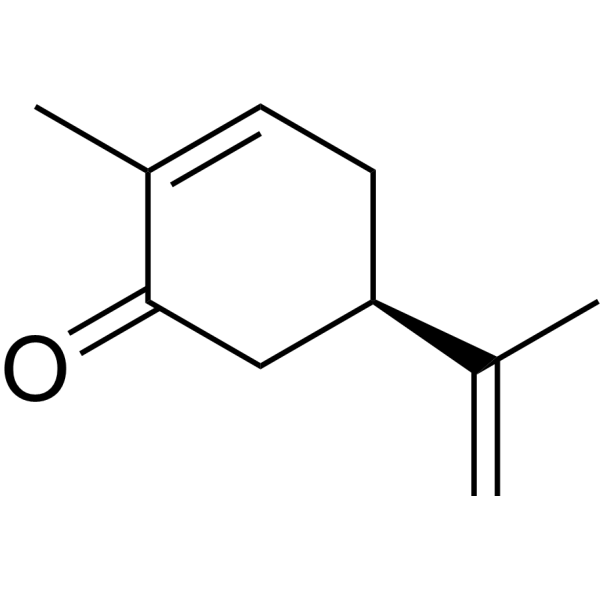
(-)-Carvone is an insect neurotoxin and a irreversible acetylcholinesterase (AChE) inhibitor. (-)-Carvone can be used as a bird repellent, inhibits larval growth, decreases pupatation rate, and increases mortality of larvae .
loading...
    loading...
Cat. No.: HY-W017423R
CAS No.: 6485-40-1
(-)-Carvone (Standard) is the analytical standard of (-)-Carvone. This product is intended for research and analytical applications. (-)-Carvone is an insect neurotoxin and a irreversible acetylcholinesterase (AChE) inhibitor. (-)-Carvone can be used as a bird repellent, inhibits larval growth, decreases pupatation rate, and increases mortality of larvae .
loading...
    loading...
Cat. No.: HY-W750404
(-)-Carvone-d4 is the deuterium labeled (-)-Carvone (HY-W017423). (-)-Carvone is an insect neurotoxin and a irreversible acetylcholinesterase (AChE) inhibitor. (-)-Carvone can be used as a bird repellent, inhibits larval growth, decreases pupatation rate, and increases mortality of larvae .
loading...
    loading...
Cat. No.: HY-117901
CAS No.: 133585-55-4
Sandoricin is a limonoid compound that can be extracted from the seeds of Sandoricum koetjape. Sandoricin exhibits strong antifeedant properties in larvae of Fall Armyworm (Spodoptera frugiperda) and European Corn Borer (Ostrinia nubilalis) fed on artificial diets. Sandoricin induces reduced growth rate and delayed pupation at lower doses, while higher doses cause massive mortality of larvae. Sandoricin is a potential field insecticide .
loading...
    loading...
Cat. No.: HY-171722
CAS No.: 1355681-08-1
Synonyms: Asc-C9
Target:  

Insecticide PGC-1α

Research Areas:  

Infection Cancer

Ascr#10 (Asc-C9) is an orally active thermogenesis inducer and insecticide that can be obtained from Monochamus alternatus. Ascr#10 binds to the insect adipokinetic hormone (AKH) receptor (Ka=272 µM) and stimulates mitochondrial biogenesis via the PGC1α-UCP4 axis. Consequently, Ascr#10 induces UCP4-mediated uncoupled respiration, reduces the ATP/ADP ratio and accelerates lipid mobilization, thereby driving the thermogenesis process. Ascr#10 delays pupation and exerts specific chemotaxis toward dispersive fourth-stage pinewood nematode LIV larvae. Ascr#10 promotes cold acclimation of Monochamus alternatus larvae through metabolic inhibition and cryoprotectant accumulation, enhancing their survival rate under cold stress. Ascr#10 also induces browning of white adipose tissue and activates brown adipose tissue in mice, thereby helping the body resist cold and tumor growth. Ascr#10 can be widely applied to research related to pine wilt disease, lung tumors and cold stress .
loading...
    loading...

