
14 Results for "

serum iron

" in MedChemExpress (MCE) Product Catalog:
Products (14)

14 Results for "serum iron" in MCE Product Catalog:

Cat. No.: HY-P10272
CAS No.: 1628323-80-7
Synonyms: PTG-300
Target:  

Ferroportin

Research Areas:  

Others

Rusfertide is a peptide mimetic of natural hepcidin, which targets and degrades ferroportin, reduces serum iron and transferrin-saturation, and thus regulates the production of red blood cells. Rusfertide ameliorates the polycythemia vera, β-thalassemia and hereditary hemochromatosis .
loading...
    loading...
Cat. No.: HY-131926
CAS No.: 15708-41-5
Synonyms: Ethylenediaminetetraacetic acid (iron sodium)
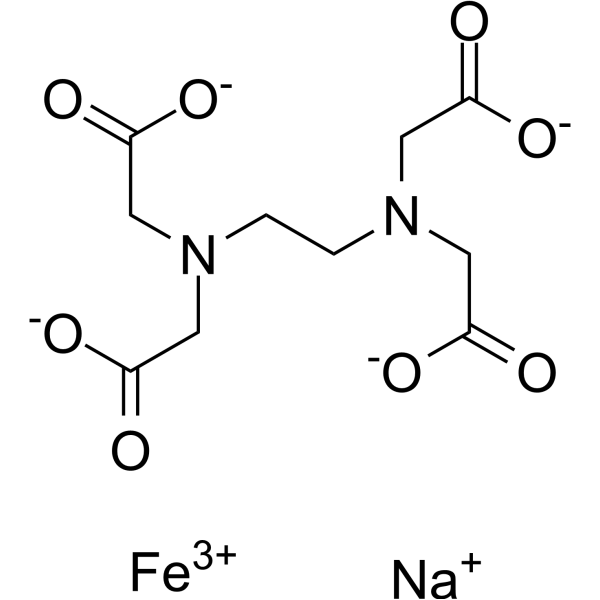
EDTA iron sodium (Ethylenediaminetetraacetic acid iron sodium) is an orally active food fortifier and iron chelate. EDTA iron sodium provides absorbable iron during consumption of fortified soy sauce, rice-based meals, or complementary foods made from high-phytate grains. EDTA iron sodium increases serum iron levels for up to 4 h, and total non-heme iron levels in the liver also rise with increasing doses. EDTA iron sodium is applicable to research on iron deficiency anemia and lymphoma .
loading...
    loading...
Cat. No.: HY-W423191
CAS No.: 534-42-9
Synonyms: 4-O-α-D-Glucopyranosyl-D-gluconic acid
Maltobionic acid (4-O-α-D-Glucopyranosyl-D-gluconic acid) is an orally active oligosaccharide and iron chelator with antibacterial activity. Maltobionic acid inhibits the expression of NFATc1, suppresses osteoclast differentiation, inhibits bone resorption, and increases serum calcitonin levels. Maltobionic acid protects mammalian cells from hydrogen peroxide (H2O2)-induced oxidative damage; resists fermentation by the gut microbiota; and exhibits anti-digestive and anti-fermentative properties. Maltobionic acid can be used in research related to osteoporosis, bacterial infections, and constipation .
loading...
    loading...
Cat. No.: HY-P3494
CAS No.: 1356390-47-0
Target:  

Hepcidin Bacterial

Research Areas:  

Infection Inflammation/Immunology

Hepcidin-25 (human) is an iron metabolism regulator and Antimicrobial agent. Hepcidin-25 (human) exerts anti-inflammatory and antimicrobial activities by regulating iron-mediated oxidative damage .
loading...
    loading...
Cat. No.: HY-W581820
CAS No.: 10030-90-7
Synonyms: Ferrous succinate
Research Areas:  

Cardiovascular Disease

Iron(II) succinate (Ferrous succinate) is an orally active and organic acid iron supplement (ferrous salt). Iron(II) succinate improves hematological parameters in iron-deficiency anemia rats, including hemoglobin, red blood cells, hematocrit, mean corpuscular volume, mean corpuscular hemoglobin, and mean corpuscular hemoglobin concentration. Iron(II) succinate increases serum ferritin, serum iron levels, and transferrin saturation, while decreasing total iron-binding capacity in iron-deficiency anemia rats. Iron(II) succinate reduces the elevated heart, spleen, and kidney coefficients, and increases the decreased liver coefficient in iron-deficiency anemia rats. Iron(II) succinate replenishes the depleted iron content in the liver and spleen of iron-deficiency anemia rats. Iron(II) succinate can be used for the research of iron-deficiency anemia .
loading...
    loading...
Cat. No.: HY-W767164
Research Areas:  

Cardiovascular Disease

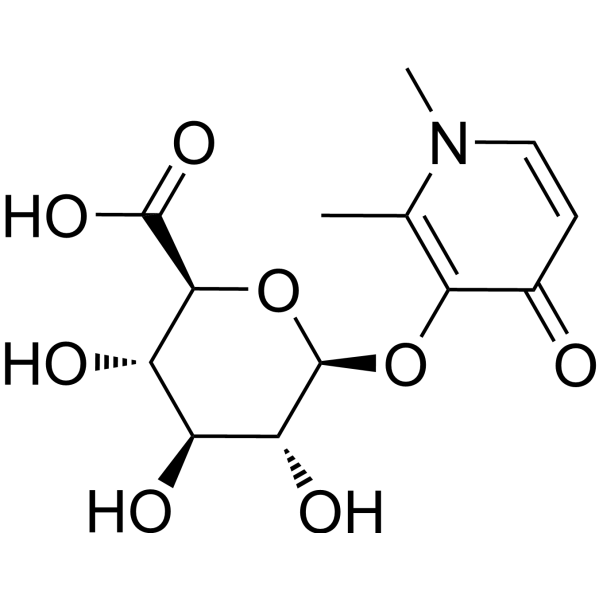
Deferiprone O-β-D-glucuronide sodium is a novel orally active iron chelator. Deferiprone O-β-D-glucuronide sodium can be used to investigate its ability to reduce iron burden in patients with β-thalassemia .
loading...
    loading...
Cat. No.: HY-NP0208
Synonyms: Chicken serum Transferrin
Chicken Transferrin (Chicken Serum Transferrin) is a major serum protein in chicken serum. Chicken Transferrin is primarily responsible for transporting iron .
loading...
    loading...
Cat. No.: HY-125288
CAS No.: 2247168-13-2
Target:  

Ferroportin

Research Areas:  

Metabolic Disease

DS42450411 is an orally active hepcidin production inhibitor with an IC50 of 32 nM. DS42450411 in an acute inflammatory mouse model induced by IL-6, DS42450411 significantly reduces serum hepcidin levels. DS42450411 can be used for studying iron homeostasis .
loading...
    loading...
Cat. No.: HY-P991637
CAS No.: 2996101-49-4
Synonyms: REGN7999

Target:  

Ser/Thr Protease

Research Areas:  

Metabolic Disease

REGN7999 is a monoclonal antibody that inhibits TMPRSS6. REGN7999 inhibits TMPRSS6 activity, preventing Hemojuvelin (HJV) lysis, thereby enhancing BMP6-HJV signaling and increasing serum hepcidin. REGN7999 ameliorates iron overload and impaired erythropoiesis in a β-thalassemia mouse model by inhibiting TMPRSS6 activity. REGN7999 is indicated for research in β-thalassemia .
loading...
    loading...
Cat. No.: HY-160078
CAS No.: 141675-48-1
Research Areas:  

Metabolic Disease

Deferiprone O-β-D-glucuronide is a novel orally active iron chelator. Deferiprone O-β-D-glucuronide can be used to investigate its ability to reduce iron burden in patients with β-thalassemia .
loading...
    loading...
Cat. No.: HY-108194
CAS No.: 115900-75-9
Research Areas:  

Others

CGP 46700 (Compound 49) is an orally active iron chelator, that exhibits high affinity for iron, removes iron from ferritin and human serum transferrin. CGP 46700 promotes iron excretion in a mouse iron overload model .
loading...
    loading...
Cat. No.: HY-112414
CAS No.: 216661-57-3
Target:  

TGF-β Receptor

Research Areas:  

Metabolic Disease Cancer

ALK2-IN-7 is a ALK2 (ACVR1) inhibitor. ALK2-IN-7 is applicable to studies related to BMP/ALK2 signaling, anemia associated with iron homeostasis imbalance, and multiple osteochondromas .
loading...
    loading...
Cat. No.: HY-184607
Nanoclusters are essentially ultrasmall nanomaterials, typically with diameters between 1 and 10 nm, composed of a specific number of metal atoms (approximately 10 to several hundred) and ligands. This structure places their size between that of small molecules and traditional nanoparticles, exhibiting quantum effects. When the size of the metal core approaches the Fermi wavelength of electrons, its band structure transitions from a continuous state to discrete energy levels, thus exhibiting molecular-like properties such as single-electron transitions, multiple absorption bands, and strong photoluminescence. Iron nanoclusters (FeNCs) are a class of ultrasmall fluorescent nanomaterials composed of several to tens of iron atoms. Synthesized using bovine serum albumin (BSA) as a template and protectant via a chemical reduction method, these materials possess excellent optical properties and biocompatibility. Furthermore, they can be functionalized through surface modification, leading to their wide application in fields such as bioanalysis, environmental monitoring, and disease diagnosis.
loading...
    loading...
Cat. No.: HY-W1143867
CAS No.: 2226-71-3
4’-Phosphopantetheine is an orally active coenzyme A (CoA) precursor. 4’-Phosphopantetheine is membrane-permeable and acts as a CoA precursor, a prosthetic group, and a reactive oxygen species (ROS) inhibitor. 4’-Phosphopantetheine binds covalently to rat liver fatty acid synthase, modifies the conserved serine residue in the PKS/NRPS carrier protein domain, and serves as a substrate for CoA synthase and PPAT. 4’-Phosphopantetheine undergoes non-catalytic exchange on rat liver fatty acid synthase, with a faster turnover rate than that of the enzyme complex, and restores intracellular CoA levels in cells with impaired de novo biosynthesis. 4’-Phosphopantetheine rescues phenotypes induced by CoA deficiency, normalizes PKAN-related biomarkers, restores mitochondrial enzyme activity, and alleviates vascular endothelial damage. 4’-Phosphopantetheine shows biological stability in serum, acts as a prosthetic group and degradation product of ACP, and inhibits the formation of atherosclerotic plaques. 4’-Phosphopantetheine can be used in the research of brain iron accumulation neurodegenerative diseases, pantothenate kinase-associated neurodegeneration, CoASY protein-associated neurodegenerative diseases, coronary heart disease, and atherosclerosis .
loading...
    loading...
  • 1

