Others
-
Others Related Products (76528)
Related Products (76528)

-
Hydrocinnamic acid-d5
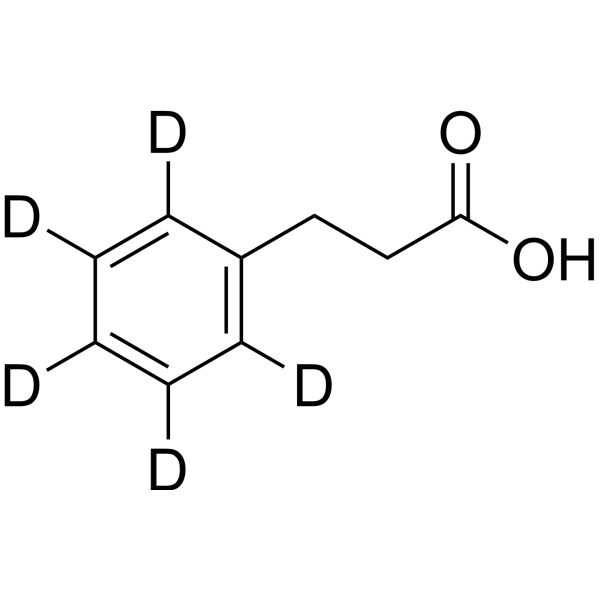 0 ImagesSynonyms: 3-Phenylpropionic acid-d5; 3-Phenylpropanoic acid-d5; 3-Phenyl-n-propionic acid-d5
Hydrocinnamic acid-d5 is the deuterium labeled Hydrocinnamic acid. Hydrocinnamic acid is the major rhizospheric compound with known growth regulatory activities.

-
3-Methyl-2H-indazol-6-amine
 0 Images
3-Methyl-2H-indazol-6-amine is a drug impurity.
-
7-Deazapurine impurity 1
 0 ImagesCat. No.: HY-Z0610CAS No.: 876343-10-1
7-Deazapurine impurity 1 is a drug impurity.

-
Sildenafil impurity 1
 0 ImagesSynonyms: Sildenafil N-Oxide Impurity
Sildenafil Impurity 1 is an impurity of Sildenafil (HY-15025).
-
Linoleoyl chloride
 0 ImagesCat. No.: HY-W127574CAS No.: 7459-33-8Synonyms: Linoleic acid chloride
Linoleoyl chloride (Linoleic acid chloride) is a fatty acid chloride found in kiwifruit (Actinidia deliciosa) oil.
-
Zineb
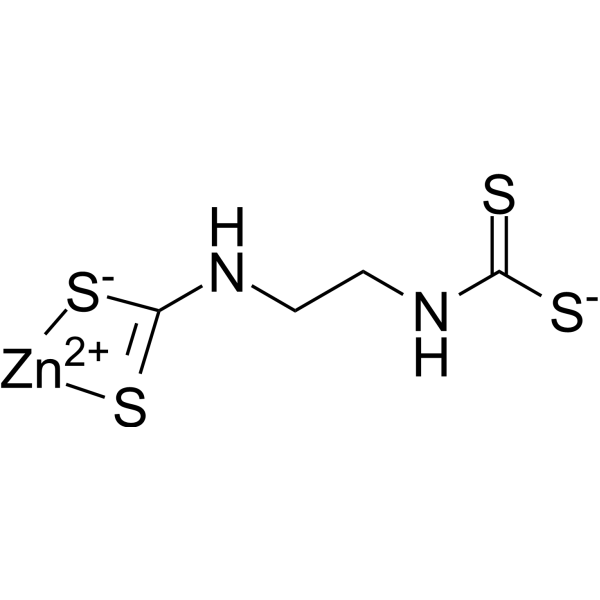 0 ImagesCat. No.: HY-W127739CAS No.: 12122-67-7Synonyms: Zinc ethylene-1, 2-bisdithiocarbamate
Zineb is an agricultural fungicide of the dithiocarbamate class. Its toxicity is relatively low, and there is little evidence of human harm from exposure. Oxidative stress is one of the main factors contributing to diseases caused by Zineb. Zineb does not alter the activity of any superoxide dismutase enzymes. Catalase (CAT) activity was reduced only by Zineb.
-
4-(Dimethylamino)phenacyl bromide-d6
 0 ImagesCat. No.: HY-W128417S1Purity: 98.75%Synonyms: DmPABr-d6
4-(Dimethylamino)phenacyl bromide-d6 is deuterated labeled 4-(Dimethylamino)phenacyl bromide (HY-W128417).
-
Pentachloroaniline
 0 ImagesSynonyms: 2,3,4,5,6-Pentachloroaniline
Pentachloroaniline (2,3,4,5,6-Pentachloroaniline) is a pentachlorinated aromatic amine pesticide that serves as a substrate for reductive dehalogenation reactions and a metabolite of quintozene. Pentachloroaniline can be converted into different trichloroanilines and dichloroanilines via reduction. Pentachloroaniline cannot induce its own dehalogenation activity in Desulfitobacterium frappieri PCP-1, and its conversion process must rely on induction by 3,5-dichlorophenol.
-
Aniline blue (alcohol soluble)
 0 ImagesCat. No.: HY-W133919ACAS No.: 8004-91-9
Aniline blue (alcohol soluble) is a biological material or organic compound that can be used in life science research.
-
L-Valyl-L-isoleucine
 0 Images
L-Valyl-L-isoleucine is a biochemical reagent that can be used as a biological material or organic compound for life science related research.
-
Tetrabromophenol blue, IND
 0 ImagesCat. No.: HY-W140928CAS No.: 4430-25-5Synonyms: TBPB, IND
Tetrabromophenol blue, IND is a biochemical reagent.
-
3-[(2,6-Dimethylphenoxy)methyl]-4-methoxybenzaldehyde
![3-[(2,6-Dimethylphenoxy)methyl]-4-methoxybenzaldehyde](https://file.medchemexpress.com/product_pic/hy-w157719.gif "Click to View 3-[(2,6-Dimethylphenoxy)methyl]-4-methoxybenzaldehyde Product Detail") 0 ImagesCat. No.: HY-W157719CAS No.: 438530-82-6
0 ImagesCat. No.: HY-W157719CAS No.: 438530-82-63-[(2,6-Dimethylphenoxy)methyl]-4-methoxybenzaldehyde is a drug intermediate for synthesis of various active compounds.
-
7-Hydroxy-2,2-dimethyl-4-chromanone
 0 ImagesCat. No.: HY-W159303CAS No.: 17771-33-4
7-Hydroxy-2,2-dimethyl-4-chromanone (compound 41) is an inhibitor of DC-SIGN (Dendritic Cell-Specific Intercellular Adhesion Molecule 3 grabbing non-integrin), with an IC50 of 4.66 mM. DC-SIGN is the C-type lectin receptor presenting on the surface of both macrophages and dendritic cells.
-
9-Decenoic acid
 0 ImagesSynonyms: Δ9-Decenoic acid
9-Decenoic acid (Δ9-Decenoic acid) is a lactone formation precursor and unsaturated glyceride component. 9-Decenoic acid can be identified in milk fat.
-
Acetazolamide impurity 2
 0 ImagesSynonyms: NSC 231656
Acetazolamide impurity 2 (NSC 231656) is an impurity of Acetazolamide.
-
5-Deazaflavin
 0 ImagesCat. No.: HY-W174480CAS No.: 26908-38-3
5-deazaflavin is a flavin analogue with redox activity. 5-deazaflavin is a photocatalyst in biological redox systems.
-
m-PEG13-acid
 0 ImagesCat. No.: HY-W190752CAS No.: 2170098-33-4
m-PEG13-acid is a PEG linker containing a terminal carboxylic acid. The terminal carboxylic acid can react with primary amine groups in the presence of activators (e.g. EDC, or HATU) to form a stable amide bond. The hydrophilic PEG spacer increases solubility in aqueous media.
-
N3-PEG2-Tos
 0 ImagesCat. No.: HY-W190836CAS No.: 182347-24-6