



Setiptiline

Based on 1 Customer Validation
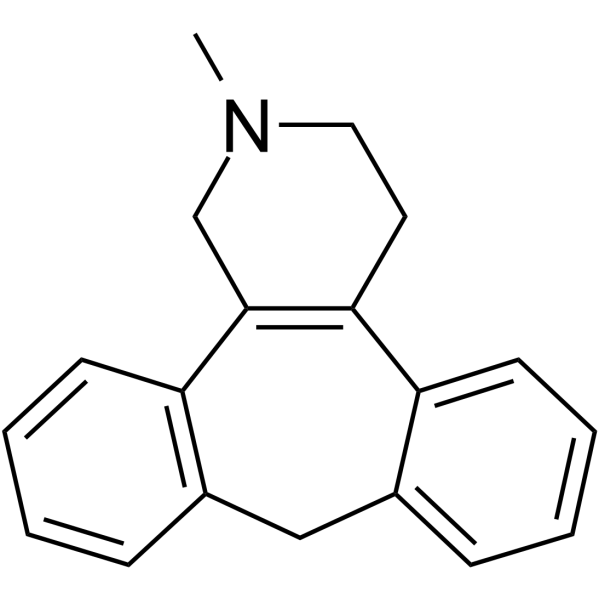
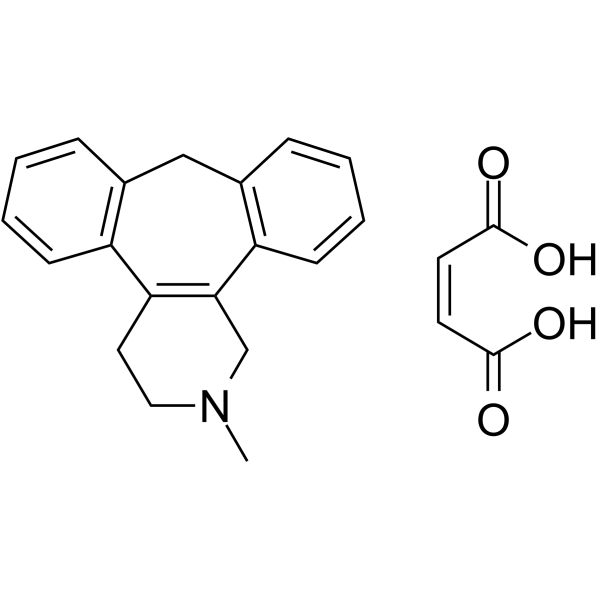
Setiptiline (Org-8282) is a serotonin receptor antagonist. Setiptiline is a tetracyclic antidepressant (TeCA) which acts as a noradrenergic and specific serotonergic antidepressant (NaSSA). Setiptiline acts as a norepinephrine reuptake inhibitor, α2-adrenergic receptor antagonist, and serotonin receptor antagonist, likely at the 5-HT2A, 5-HT2C, and/or 5-HT3 subtypes, as well as an H1 receptor inverse agonist/antihistamine.
연구목적의 판매만을 진행합니다. 환자를 대상으로 한 판매는 하지 않습니다.
- Purity : 98.03%
- CAS No.: 57262-94-9
- 화학식: C19H19N
- 분자량:261.37
-
보관:Powder -20°C, 3 years , 4°C, 2 years ; In solvent -80°C, 2 years , -20°C, 1 year

To place orders, for customer services and technical support, please contact: MedChemExpress USA
Tel: 609-228-6898 E-mail: [email protected] [email protected]


-
 Biological Activity
-
Chemical Information
-
용액&용해도
- 순도&문서
- References
-
 Help & FAQs




Biological Activity
제품 설명
IC50 & Target
|
α adrenergic receptor |
5-HT2A Receptor |
5-HT2C Receptor |
5-HT3 Receptor |


Chemical Information
-
CAS No. 57262-94-9
-
Appearance Solid
-
분자량 261.37
-
화학식 C19H19N
-
Color White to off-white
-
SMILES
CN1CC2=C(CC1)C3=CC=CC=C3CC4=C2C=CC=C4
-
Synonyms
Org-8282
-
선적
Room temperature in continental US; may vary elsewhere.
-
보관
Powder -20°C 3 years 4°C 2 years In solvent -80°C 2 years -20°C 1 year


용액&용해도
In Vitro:
DMSO : 25 mg/mL (95.65 mM; Need ultrasonic; Hygroscopic DMSO has a significant impact on the solubility of product, please use newly opened DMSO)
Please refer to the solubility information to select the appropriate solvent. Once prepared, please aliquot and store the solution to prevent product inactivation from repeated freeze-thaw cycles.
Storage method and period of stock solution: -80°C, 2 years; -20°C, 1 year. When stored at -80°C, please use it within 2 years. When stored at -20°C, please use it within 1 year.
Please refer to the solubility information to select the appropriate solvent. Once prepared, please aliquot and store the solution to prevent product inactivation from repeated freeze-thaw cycles.
Storage method and period of stock solution: -80°C, 2 years; -20°C, 1 year. When stored at -80°C, please use it within 2 years. When stored at -20°C, please use it within 1 year.
Concentration (start) × Volume (start) = Concentration (final) × Volume (final)
In Vivo:
Select the appropriate dissolution method based on your experimental animal and administration route.
- For the following dissolution methods, please ensure to first prepare a clear stock solution using an In Vitro approach and then sequentially add co-solvents:
- To ensure reliable experimental results, the clarified stock solution can be appropriately stored based on storage conditions. As for the working solution for In Vivo experiments, it is recommended to prepare freshly and use it on the same day.
- The percentages shown for the solvents indicate their volumetric ratio in the final prepared solution. If precipitation or phase separation occurs during preparation, heat and/or sonication can be used to aid dissolution.
In Vivo Dissolution Calculator
Please enter the basic information of animal experiments:
-
-
-
-
Recommended: Prepare an additional quantity of animals to account for potential losses during experiments.
Please enter your animal formula composition:
-
%DMSO +
Recommended: Keep the proportion of DMSO in working solution below 2% if your animal is weak.
-
%+
-
+%Tween-80 + +
-
%Saline +
The co-solvents required include: DMSO, . All of co-solvents are available by MedChemExpress (MCE). , Tween 80. All of co-solvents are available by MedChemExpress (MCE).
Working solution concentration: 0.22 mg/mL
Method for preparing stock solution: mg drug dissolved in μL DMSO. Stock solution concentration: mg/mL.
1. Take μL DMSO stock solution;
2. Add μL .
μL , mix evenly;
3. Then add μL Tween 80, mix evenly;
4. Then add μL
Please ensure that the stock solution in the first step is dissolved to a clear state, and add co-solvents in sequence. You can use ultrasonic heating (ultrasonic cleaner, recommended frequency 20-40 kHz), vortexing, etc. to assist dissolution.


순도&문서
-
Data Sheet (280 KB)
-
SDS (396 KB)
- English - EN (396 KB)
- Français - FR (396 KB)
- Deutsch - DE (396 KB)
- Norwegian - NO (396 KB)
- Español - ES (396 KB)
- Swedish - SV (396 KB)
- Italian - IT (396 KB)
- Korean - KR (396 KB)
- Portuguese - PT (396 KB)
-
Handling Instructions (2659 KB)
References
[1]. Yamada K, Furukawa T. [Behavioral effects of a new antidepressant, setiptiline]. Nihon Yakurigaku Zasshi. 1991 Jan;97(1):31-9. [Content Brief]
[2]. Kamimura M, Aoba A, Yamaguchi N et al. The effect of age on plasma level of setiptiline maleate in depressed patients. Prog Neuropsychopharmacol Biol Psychiatry. 1994 Oct;18(6):1015-26. [Content Brief]
[3]. Kuniyoshi M, Nakamura J, Miura C, Inanaga K. Effectiveness of concomitant setiptiline maleate (Tecipul) on negative symptoms of schizophrenia. Prog Neuropsychopharmacol Biol Psychiatry. 1994 Mar;18(2):339-46. [Content Brief]
[4]. Niho T, Ito C, Shibutani Y, Hashizume H, Yamaguchi K. [Pharmacological properties of MO-8282, a novel antidepressant]. Nihon Yakurigaku Zasshi. 1986 Oct;88(4):309-20. [Content Brief]


Complete Stock Solution Preparation Table
Please refer to the solubility information to select the appropriate solvent. Once prepared, please aliquot and store the solution to prevent product inactivation from repeated freeze-thaw cycles.
Storage method and period of stock solution: -80°C, 2 years; -20°C, 1 year. When stored at -80°C, please use it within 2 years. When stored at -20°C, please use it within 1 year.
| Optional Solvent | Concentration Solvent Mass | 1 mg | 5 mg | 10 mg | 25 mg |
|---|---|---|---|---|---|
| DMSO | 1 mM | 3.8260 mL | 19.1301 mL | 38.2602 mL | 95.6506 mL |
| 5 mM | 0.7652 mL | 3.8260 mL | 7.6520 mL | 19.1301 mL | |
| 10 mM | 0.3826 mL | 1.9130 mL | 3.8260 mL | 9.5651 mL | |
| 15 mM | 0.2551 mL | 1.2753 mL | 2.5507 mL | 6.3767 mL | |
| 20 mM | 0.1913 mL | 0.9565 mL | 1.9130 mL | 4.7825 mL | |
| 25 mM | 0.1530 mL | 0.7652 mL | 1.5304 mL | 3.8260 mL | |
| 30 mM | 0.1275 mL | 0.6377 mL | 1.2753 mL | 3.1884 mL | |
| 40 mM | 0.0957 mL | 0.4783 mL | 0.9565 mL | 2.3913 mL | |
| 50 mM | 0.0765 mL | 0.3826 mL | 0.7652 mL | 1.9130 mL | |
| 60 mM | 0.0638 mL | 0.3188 mL | 0.6377 mL | 1.5942 mL | |
| 80 mM | 0.0478 mL | 0.2391 mL | 0.4783 mL | 1.1956 mL |


Setiptiline Related Classifications
HY-32329 Related Classifications
 Powered by Bioz