



EBOV
EBOV studies focus on viral proteins that control nucleocapsid transport, vascular injury, and interferon evasion[1]. GP induces cytotoxicity in human endothelial cells, and this pathogenic effect maps to its mucin-like domain[2]. Mechanistically, VP35 binds double-stranded RNA and inhibits RIG-I-induced IFN-α/β production. Structural data show that VP35 recognizes dsRNA backbone and blunt ends, preventing RIG-I-like receptor sensing[3]. VP35 also inhibits IRF-3 activation, and the R312A mutation impaired this antagonist function in mouse-adapted EBOV[4]. Compared with VP35, VP24 acts downstream by binding karyopherin α1 and blocking nuclear accumulation of tyrosine-phosphorylated STAT1[5]. This distinction separates VP35 as an interferon-production antagonist from VP24 as an interferon-signaling antagonist[5]. Compared with Bundibugyo virus VP24, EBOV VP24 binds karyopherin α proteins with higher affinity and correlates with stronger IFN-I inhibition[6]. For inhibitor studies, myricetin inhibited recombinant VP35-dsRNA interaction in a fluorescence-based assay[7]. - VP35 assays should measure dsRNA binding, IRF-3 activation, RIG-I signaling, and polymerase-complex activity[3][4]. - VP24 studies should compare STAT1 transport, KPNA binding, and EBOV versus BDBV interfaces[5][6].
References:
- [1]. Takamatsu Y, et al. Ebola virus proteins NP, VP35, and VP24 are essential and sufficient to mediate nucleocapsid transport. Proc Natl Acad Sci U S A. 2018 Jan 30;115(5):1075-1080. [Content Brief]
- [2]. Yang ZY, et al. Identification of the Ebola virus glycoprotein as the main viral determinant of vascular cell cytotoxicity and injury. Nat Med. 2000 Aug;6(8):886-9. [Content Brief]
- [3]. Leung DW, et al. Structural basis for dsRNA recognition and interferon antagonism by Ebola VP35. Nat Struct Mol Biol. 2010 Feb;17(2):165-72. [Content Brief]
- [4]. Son KN, et al. Theiler's virus-induced intrinsic apoptosis in M1-D macrophages is Bax mediated and restricts virus infectivity: a mechanism for persistence of a cytolytic virus. J Virol. 2008 May;82(9):4502-10. [Content Brief]
- [5]. Reid SP, et al. Ebola virus VP24 binds karyopherin alpha1 and blocks STAT1 nuclear accumulation. J Virol. 2006 Jun;80(11):5156-67. [Content Brief]
- [6]. Schwarz TM, et al. VP24-Karyopherin Alpha Binding Affinities Differ between Ebolavirus Species, Influencing Interferon Inhibition and VP24 Stability. J Virol. 2017 Jan 31;91(4):e01715-16. [Content Brief]
- [7]. Daino GL, et al. Identification of Myricetin as an Ebola Virus VP35-Double-Stranded RNA Interaction Inhibitor through a Novel Fluorescence-Based Assay. Biochemistry. 2018 Nov 6;57(44):6367-6378. [Content Brief]
All Product Categories
-
EBOV Related Products (21)
Related Products (21)

- 1
- 2
-
EBOV-GP-IN-1
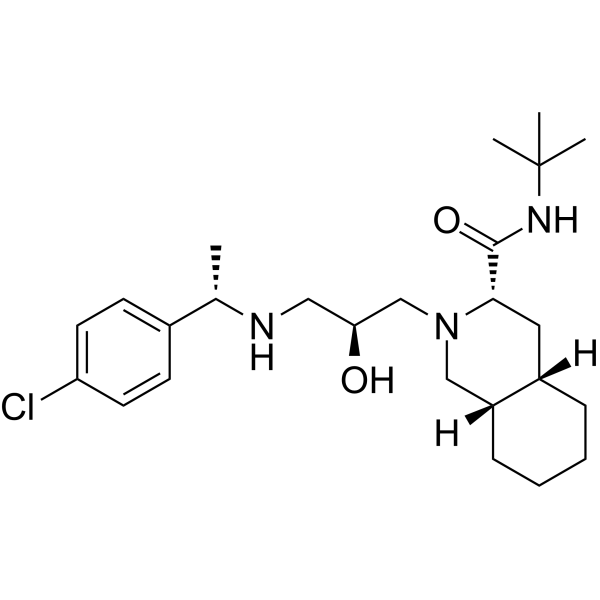 0 ImagesCat. No.: HY-150756CAS No.: 3032283-85-2EBOV-GP-IN-1 (Compound 28) is a potent Ebola entry inhibitor with an IC50 of 0.05 μM against Ebola virus envelope glycoprotein (EBOV-GP).
- 1
- 2



