



Fluorescent Dye
Fluorescence is a phenomenon of photoluminescence in luminescence. When an atom is irradiated by light, some electrons around the nucleus jump from their original orbitals to higher energy orbitals under the influence of light energy, i.e., from the ground state to the first or second excited single-line state, etc. Due to the instability of the first or second excited singlet state, the electron returns from the excited singlet state to the ground state accompanied by released energy, resulting in fluorescence.
Fluorescent dyes can be covalently bound or physically adsorbed in the structure of the substance. The fluorescence properties allow for the characterization, localization and quantitative analysis of the labeled object. Fluorescent dyes have shown great potential for the detection of proteins, nucleic acids, cells, and immunoassays, attributed to the advantages in non-radioactive contamination, simple experimental operation and easy observation.
Fluorescent dyes have penetrated many fields such as pharmacology, physiology, environmental science, and information science, as well as functional studies of proteins and drug screening.
All Product Categories
-
Fluorescent Dye Related Products (4851)
Related Products (4851)

-
Antibodies (4)
-
Thionin perchlorate
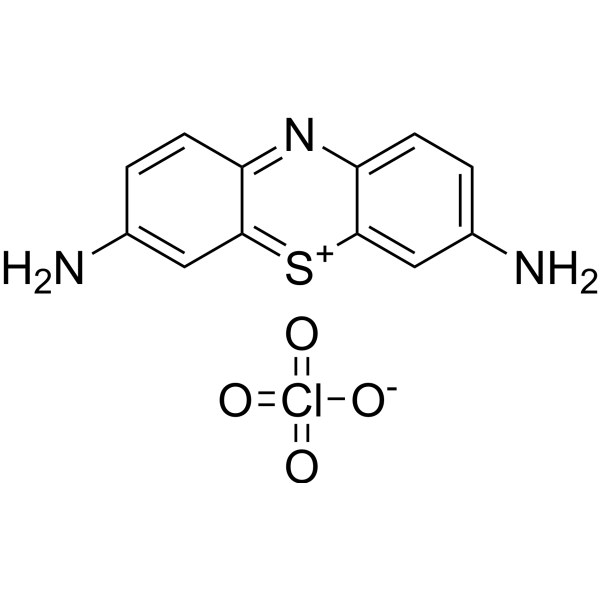 0 ImagesCat. No.: HY-D1771CAS No.: 25137-58-0Thionin perchlorate is a general nuclear stain for chromatin and mucin.
-
C6 NBD Phytoceramide
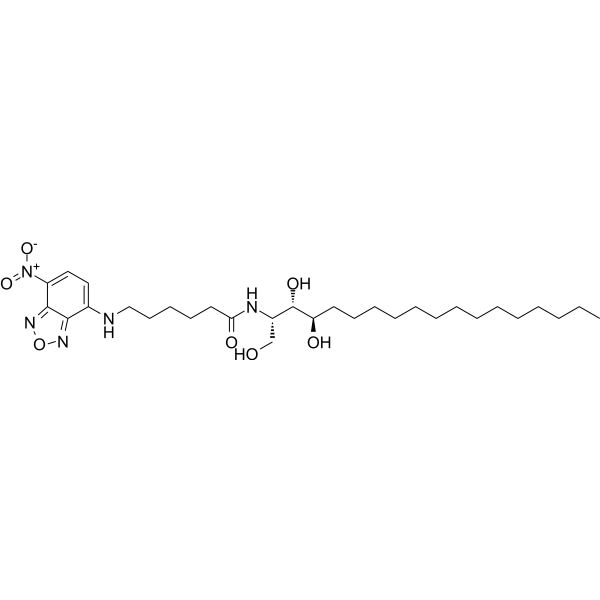 0 ImagesCat. No.: HY-D1573CAS No.: 114301-99-4C6 NBD Phytoceramide is a fluorescently labeled short-chain ceramide analog that can be recognized by mammalian GlcCer synthase (GCS).
-
RB-PEG3400-RB
 0 ImagesCat. No.: HY-D2893CSynonyms: Rhodamine B-PEG3400-Rhodamine BRB-PEG3400-RB (Rhodamine B-PEG3400-Rhodamine B) a fluorescent dye composed of two Rhodamine B (HY-Y0016) and PEG. RB-PEG3400-RB can be used for fluorescent labeling and imaging (Ex/Em=546/610 nm).
-
FAM labled Avacincaptad pegol sodium
 0 ImagesCat. No.: HY-147080CFAM labled Avacincaptad pegol sodiumis a FAM labled Avacincaptad pegol sodium.
-
FDOCl-22
 0 ImagesCat. No.: HY-D3235CAS No.: 2540586-21-6FDOCl-22 is a HOCl-responsive probe. FDOCl-22 reacts with hypochlorous acid to significantly enhance near-infrared emission and absorption signals, enabling the detection of HOCl levels associated with reagent-induced acute kidney injury. FDOCl-22 can be used in studies related to reagent-induced acute kidney injury.
-
SY-21 NHS ester
 0 ImagesCat. No.: HY-D1294CAS No.: 788146-37-2SY-21 NHS ester is a QSY-21 analog. QSY-21 is a specific quencher against A647. QSY-21 labels polymer. QSY-21 can be used in colon cancer research.

-
FAM labled Bevasiranib sodium
 0 ImagesCat. No.: HY-153484DFAM labled Bevasiranib sodiumis a FAM labled Bevasiranib sodium.
-
Ac-WVAD-AMC
 0 ImagesCat. No.: HY-P10240CAS No.: 219661-33-3Ac-WVAD-AMC is a fluorogenic substrate for caspase 1.
-
1,3-Diphenylisobenzofuran (solution)
 0 Images1,3-Diphenylisobenzofuran (DPBF) (solution) has been developed as a selective probe for the detection and quantitative determination of hydrogen peroxide in samples containing different reactive nitrogen and oxygen species (RNOS). DPBF is a fluorescent probe which, for almost 20 years, was believed to react in a highly specific manner toward some reactive oxygen species such as singlet oxygen and hydroxy, alkyloxy or alkylperoxy radicals.
Solvent and concentration: DMSO: 10 mM
The 1 mL volume is defined as the base specification. All larger sizes correspond to incremental volumes of this base.
-
FAM labled Lexaptepid Pegol sodium
 0 ImagesCat. No.: HY-177641CFAM labled Lexaptepid Pegol sodiumis a FAM labled Lexaptepid Pegol sodium.
-
Cy3 labled IONIS-MAPTRx sodium
 0 ImagesCat. No.: HY-132582KCy3 labled IONIS-MAPTRx sodium is a Cy3 labled IONIS-MAPTRx sodium.
-
Endoplasmic reticulum dye 1 (solution)
 0 ImagesCat. No.: HY-DY1113CAS No.: 1404104-40-0Endoplasmic reticulum dye 1 (solution) is a rhenium (I)-based luminescent, membrane-permeable cell imaging reagent with low cytotoxicity, photobleaching resistance, and suitability for multicolor imaging. Endoplasmic reticulum dye 1 (solution) localizes to the nuclear membrane, endoplasmic reticulum, and nucleoplasmic reticulum in live cells. Endoplasmic reticulum dye 1 (solution) enables detection of exocytosis events, dynamic changes in nuclear membrane-derived phagosomes, and vesicle trafficking processes.
-
Sulfo-Cyanine7 carboxylic acid potassium
 0 ImagesCat. No.: HY-130921Sulfo-Cyanine7 carboxylic acid potassium is a near-infrared fluorescent dye. Sulfo-Cyanine7 carboxylic acid potassium is applicable to ex vivo histological imaging of the trigeminal nerve in rats as well as studies on the distribution and retention in brain tissues. Sulfo-Cyanine7 carboxylic acid potassium can serve as a model hydrophilic probe for multiplex biomedical fluorescence imaging (Ex=750 nm, Em=773 nm).
-
LysoSR-549
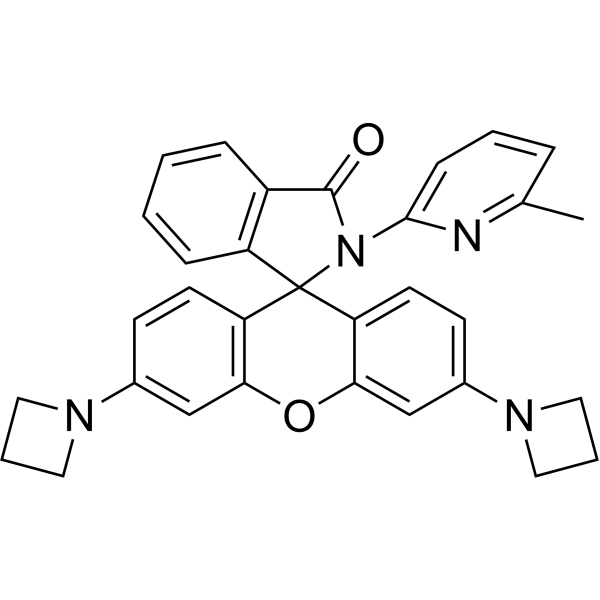 0 ImagesCat. No.: HY-D1680LysoSR-549 is a multifunctional dye. Dyes are important tools in biological experiments. They can help researchers observe and analyze cell structures, track biomolecules, evaluate cell functions, distinguish cell types, detect biomolecules, study tissue pathology and monitor microorganisms. Their applications range from basic scientific research to clinical A wide range of diagnostics. Dyes are also widely used in traditional fields such as textile dyeing, as well as in emerging fields such as functional textile processing, food pigments and dye-sensitized solar cells.
-
Methyl Green Staining Solution (Chloroform-Extracted, 1%)
 0 ImagesCat. No.: HY-DY2032Methyl Green Staining Solution (Chloroform-Extracted, 1%) is a basic dye stock solution with differential nucleic acid binding activity that distinguishes double-stranded DNA from RNA, and it can be used for assays related to nucleic acid distribution and DNA localization. Methyl Green Staining Solution (Chloroform-Extracted, 1%) functions by competitively binding to the phosphate groups of nucleic acids and stably binds to intact double-stranded DNA; RNA within the oocyte-specific ribonucleoprotein complex specifically binds to this dye, and RNase completely blocks this binding reaction. The nucleic acid recognition of Methyl Green Staining Solution (Chloroform-Extracted, 1%) depends on the size of the dye cation and the intact double-helical structure of DNA.
-
FAM labled Zotresiran sodium
 0 ImagesCat. No.: HY-177672CFAM labled Zotresiran sodiumis a FAM labled Zotresiran sodium.
-
DiSBAC10
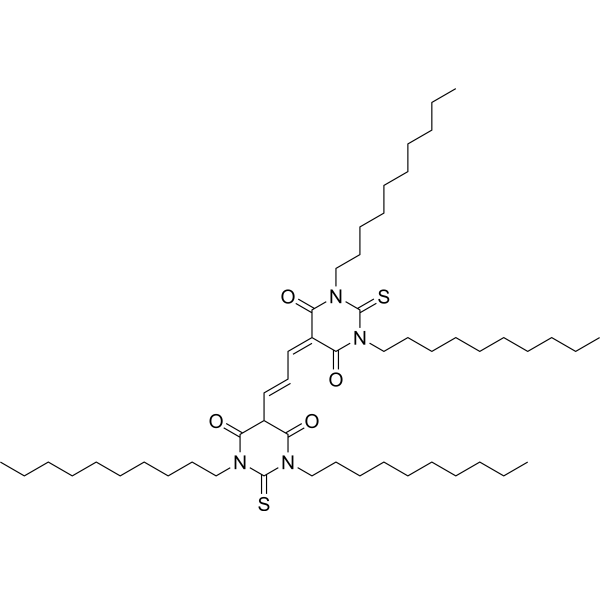 0 ImagesCat. No.: HY-125452CAS No.: 169211-45-4DiSBAC10 is a voltage-sensitive fluorescent probe used to study cell membrane electrical activity in FRET assays. In a resting polarized cell, DiSBAC10 resides on the outer leaflet of the membrane where it accepts photons from excited fluorescein-labeled proteins and re-emits the photons at a higher wavelength. Depolarization of the cell causes rapid translocation of DiSBAC10 to the inner leaflet of the membrane, thereby increasing the distance between fluorophores and reducing the FRET signal.
-
ATTO 390 maleimide
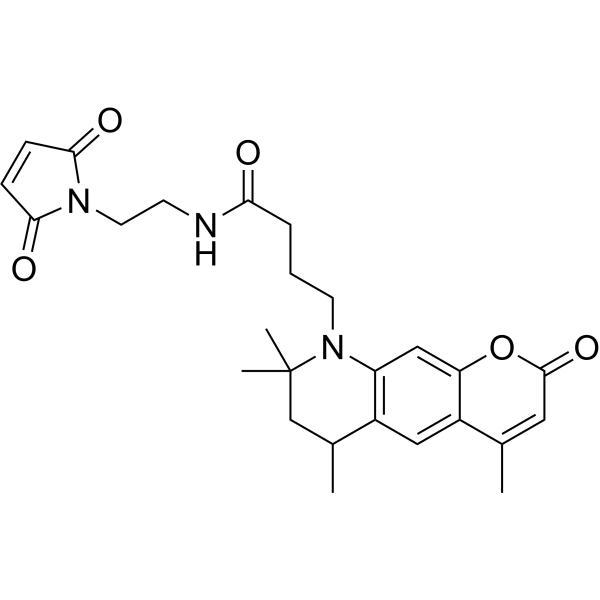 0 ImagesCat. No.: HY-D1918CAS No.: 914203-50-2ATTO 390 maleimide is a maleimide ester derivative of ATTO 390, which can be used to label proteins or antibodies. The maximum excitation/emission wavelength: 390/476 nm.




