



Actinine

Based on 1 Customer Validation
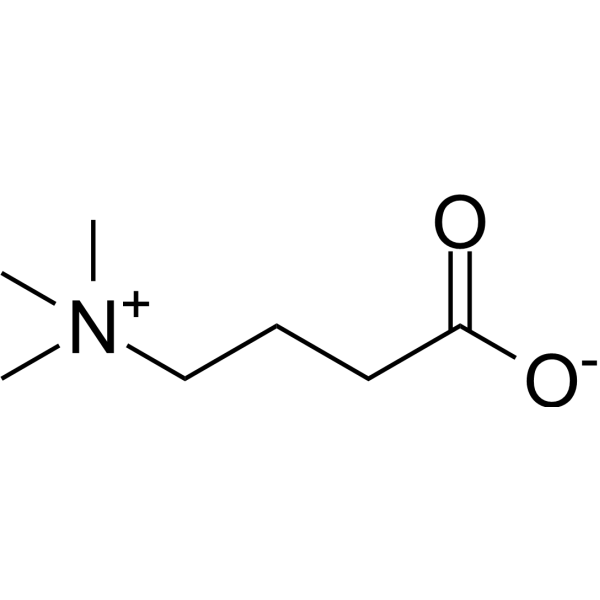
Actinine is a metabolic and pro-atherogenic intermediate with oral activity. Actinine acts as a substrate for the yeaW/X microbial enzyme complex to generate trimethylamine (TMA). Actinine accelerates atherosclerosis development in a gut microbe-dependent manner. Actinine can be used for the research of atherosclerosis.
For research use only. We do not sell to patients.
- Purity : 99.91%
- CAS No.: 407-64-7
- Formula: C7H15NO2
- Molecular Weight:145.20
-
Storage:
-20°C, stored under nitrogen
* In solvent : -80°C, 6 months; -20°C, 1 month (stored under nitrogen)

To place orders, for customer services and technical support, please contact: MedChemExpress USA
Tel: 609-228-6898 E-mail: [email protected] [email protected]


-
 Biological Activity
-
Chemical Information
-
Solvent & Solubility
- Protocols
- Purity & Documentation
- References
-
 Help & FAQs


All Endogenous Metabolite Isoforms
More

Biological Activity
Description
In Vitro
Actinine (γBB) served as a substrate for the microbial enzyme complex yeaW/X from E. coli, which exhibited TMA lyase activity[1].
MedChemExpress (MCE) has not independently confirmed the accuracy of these methods. They are for reference only.
In Vivo
Chronic dietary supplementation with γBB (1.3% gm/gm; dietary supplementation; from weaning until 10 weeks of age) induces gut microbial functional capacity to produce TMA and TMAO from γBB but not from L-carnitine[1].
Gut microbial colonization is required for γBB (gastric gavage) conversion to TMA and TMAO, while γBB conversion to carnitine occurs via the host endogenous pathway[1].
MedChemExpress (MCE) has not independently confirmed the accuracy of these methods. They are for reference only.
-
Animal Model:C57BL/6J, Apoe−/− (female)[1]
-
Dosage:1.3% (gm/gm, dietary supplementation)
-
Administration:dietary supplementation; from weaning until 19 weeks of age
-
Result:Increased total aortic root plaque area by 50% compared to chow-fed controls; Eliminated plaque area increase when gut microbes were suppressed by antibiotics.
-
Animal Model:C57BL/6J, Apoe−/− (female)[1]
-
Dosage:1.3% (gm/gm, dietary supplementation)
-
Administration:dietary supplementation; from weaning until 10 weeks of age; gastric gavage (d9-γBB or d3-carnitine challenge)
-
Result:Markedly increased production of d9-TMA and d9-TMAO from d9-γBB challenge compared to chow-fed controls; Modestly increased d3-TMA and d3-γBB production from d3-carnitine challenge; Showed no enhanced d3-TMAO production from d3-carnitine challenge.
-
Animal Model:Swiss Webster (female, germ-free)[1]
-
Dosage:Not specified
-
Administration:gastric gavage
-
Result:Produced no detectable d9-TMA or d9-TMAO from d9-γBB challenge; Produced d9-carnitine from d9-γBB challenge; Acquired capacity to produce d9-TMA and d9-TMAO from d9-γBB challenge after conventionalization.


Chemical Information
-
CAS No. 407-64-7
-
Appearance Solid
-
Molecular Weight 145.20
-
Formula C7H15NO2
-
Color White to off-white
-
SMILES
C[N+](C)(C)CCCC([O-])=O
-
Synonyms
γ-Butyrobetaine; Deoxycarnitine
-
Structure Classification
-
Initial Source
-
Shipping
Room temperature in continental US; may vary elsewhere.
-
Storage
-20°C, stored under nitrogen
* In solvent : -80°C, 6 months; -20°C, 1 month (stored under nitrogen)


Solvent & Solubility
In Vitro:
H2O : ≥ 100 mg/mL (688.71 mM)
DMSO : 50 mg/mL (344.35 mM; ultrasonic and adjust pH to 3 with HCL; Hygroscopic DMSO has a significant impact on the solubility of product, please use newly opened DMSO)
* "≥" means soluble, but saturation unknown.
Please refer to the solubility information to select the appropriate solvent. Once prepared, please aliquot and store the solution to prevent product inactivation from repeated freeze-thaw cycles.
Storage method and period of stock solution: -80°C, 6 months; -20°C, 1 month (stored under nitrogen). When stored at -80°C, please use it within 6 months. When stored at -20°C, please use it within 1 month.
* Note: If you choose water as the stock solution, please dilute it to the working solution, then filter and sterilize it with a 0.22 μm filter before use.
Please refer to the solubility information to select the appropriate solvent. Once prepared, please aliquot and store the solution to prevent product inactivation from repeated freeze-thaw cycles.
Storage method and period of stock solution: -80°C, 6 months; -20°C, 1 month (stored under nitrogen). When stored at -80°C, please use it within 6 months. When stored at -20°C, please use it within 1 month.
* Note: If you choose water as the stock solution, please dilute it to the working solution, then filter and sterilize it with a 0.22 μm filter before use.
Concentration (start) × Volume (start) = Concentration (final) × Volume (final)


Purity & Documentation
-
Data Sheet (269 KB)
-
SDS (252 KB)
- English - EN (252 KB)
- Français - FR (252 KB)
- Deutsch - DE (252 KB)
- Norwegian - NO (252 KB)
- Español - ES (252 KB)
- Swedish - SV (252 KB)
- Italian - IT (252 KB)
- Korean - KR (252 KB)
- Portuguese - PT (252 KB)
-
Handling Instructions (2659 KB)
References
[1]. HY-113270.pdf


Complete Stock Solution Preparation Table
Please refer to the solubility information to select the appropriate solvent. Once prepared, please aliquot and store the solution to prevent product inactivation from repeated freeze-thaw cycles.
Storage method and period of stock solution: -80°C, 6 months; -20°C, 1 month (stored under nitrogen). When stored at -80°C, please use it within 6 months. When stored at -20°C, please use it within 1 month.
| Optional Solvent | Concentration Solvent Mass | 1 mg | 5 mg | 10 mg | 25 mg |
|---|---|---|---|---|---|
| DMSO / H2O | 1 mM | 6.8871 mL | 34.4353 mL | 68.8705 mL | 172.1763 mL |
| 5 mM | 1.3774 mL | 6.8871 mL | 13.7741 mL | 34.4353 mL | |
| 10 mM | 0.6887 mL | 3.4435 mL | 6.8871 mL | 17.2176 mL | |
| 15 mM | 0.4591 mL | 2.2957 mL | 4.5914 mL | 11.4784 mL | |
| 20 mM | 0.3444 mL | 1.7218 mL | 3.4435 mL | 8.6088 mL | |
| 25 mM | 0.2755 mL | 1.3774 mL | 2.7548 mL | 6.8871 mL | |
| 30 mM | 0.2296 mL | 1.1478 mL | 2.2957 mL | 5.7392 mL | |
| 40 mM | 0.1722 mL | 0.8609 mL | 1.7218 mL | 4.3044 mL | |
| 50 mM | 0.1377 mL | 0.6887 mL | 1.3774 mL | 3.4435 mL | |
| 60 mM | 0.1148 mL | 0.5739 mL | 1.1478 mL | 2.8696 mL | |
| 80 mM | 0.0861 mL | 0.4304 mL | 0.8609 mL | 2.1522 mL | |
| 100 mM | 0.0689 mL | 0.3444 mL | 0.6887 mL | 1.7218 mL |
* Note: If you choose water as the stock solution, please dilute it to the working solution, then filter and sterilize it with a 0.22 μm filter before use.


Actinine Related Classifications
HY-113270 Related Classifications
 Powered by Bioz
Keywords
- Actinine
- 407-64-7
- γ-Butyrobetaine
- Deoxycarnitine
- Endogenous Metabolite
- E. coli
- atherosclerosis
- trimethylamine-N-oxide (TMAO)
- L-carnitine
- trimethylamine (TMA)
- host hepatic
- host endogenous carnitine biosynthesis pathway
- gut microbial communities
- yeaW/X microbial enzyme complex
- flavin monooxygenase 3 (FMO3)
- Inhibitor
- inhibitor
- inhibit