



BANF1 Antibody (YA1740)
(Synonyms: BAF; BANF1; BCRG1; BCRP1; NGPS)
Based on 1 Customer Validation
BANF1 Antibody (YA1740) is a Rabbit-derived and non-conjugated IgG monoclonal antibody, targeting to BANF1.
-
Host:
Rabbit
-
Isotype:
IgG
-
Application:
WB
-
Reactivity :
Human
-
Formulation:
Supplied in 50mM Tris-Glycine(pH 7.4), 0.15M NaCl, 40% Glycerol, 0.01% Sodium azide and 0.05% BSA
-
Conjugation:
Non-conjugated


To place orders, for customer services and technical support, please contact: MedChemExpress USA
Tel: 609-228-6898 E-mail: [email protected] [email protected]





Applications
| Application |
WB

WB: Western Blot
|
|---|---|
| Dilution Ratio | 1:500-1:1000 |


Product Details
BANF1 Antibody (YA1740) is a Rabbit-derived and non-conjugated IgG monoclonal antibody, targeting to BANF1.
-
Host Rabbit

-
Clonality Recombinant, Monoclonal

-
Species ReactivityHuman
-
Observed Molecular WeightObserved band size: 10 kDa
Note: Due to possible protein modifications or aggregation, the molecular weight should be confirmed by actual measurement, and the predicted value is for reference only.

-
Calculated Molecular Weight Predicted band size: 10 kDa

A synthetic peptide of human BANF1 aa 6-19.
Endogenous
Affinity Purified
Non-conjugated
Unmodified
IgG


Product Properties
-
Appearance
Liquid
-
Formulation
Supplied in 50mM Tris-Glycine(pH 7.4), 0.15M NaCl, 40% Glycerol, 0.01% Sodium azide and 0.05% BSA
-
Concentration
Batch-dependent, Please check the COA for the concentration of each lot. Check Lot Concentration
-
Storage & Stability
Stored at -20°C for 1 year. Avoid repeated freeze / thaw cycles.
-
Shipping
Shipping with blue ice.


Verification Images
-
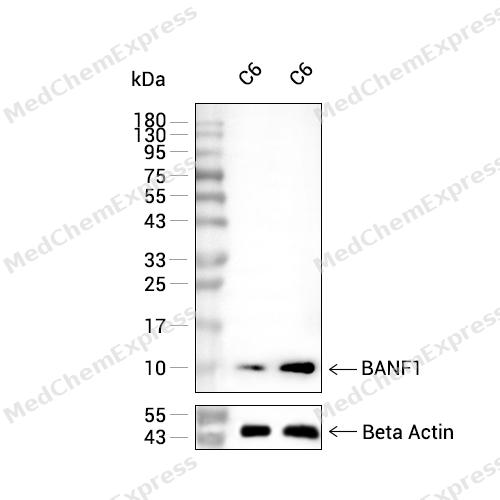 Western blot analysis of extracts from C6 (lane 2(20μg), C6 (lane 3(40μg), using BANF1 Antibody. Proteins were transferred to a PVDF membrane and blocked with 5% BSA in TBST for 2 hour at room temperature. The primary antibody and Loading con-trol antibody (Beta Actin, HY-P80438, 1/3000) was used in 5% BSA in TBST at 4°C overnight. Goat Anti-Mouse/Rabbit IgG-HRP Secondary Antibody (HY-P8004/HY-P8001, 1/10,000) was used for 1 hour at room temperature.


Background
-
Function
BANF1 is a Non-specific DNA-binding protein that plays key roles in mitotic nuclear reassembly, chromatin organization, DNA damage response, gene expression and intrinsic immunity against foreign DNA. Contains two non-specific double-stranded DNA (dsDNA)-binding sites which promote DNA cross-bridging. Plays a key role in nuclear membrane reformation at the end of mitosis by driving formation of a single nucleus in a spindle-independent manner. Transiently cross-bridges anaphase chromosomes via its ability to bridge distant DNA sites, leading to the formation of a dense chromatin network at the chromosome ensemble surface that limits membranes to the surface. Also acts as a negative regulator of innate immune activation by restricting CGAS activity toward self-DNA upon acute loss of nuclear membrane integrity. Outcompetes CGAS for DNA-binding, thereby preventing CGAS activation and subsequent damaging autoinflammatory responses. Also involved in DNA damage response: interacts with PARP1 in response to oxidative stress, thereby inhibiting the ADP-ribosyltransferase activity of PARP1. Involved in the recognition of exogenous dsDNA in the cytosol: associates with exogenous dsDNA immediately after its appearance in the cytosol at endosome breakdown and is required to avoid autophagy. In case of poxvirus infection, has an antiviral activity by blocking viral DNA replication; (Microbial infection) Exploited by retroviruses for inhibiting self-destructing autointegration of retroviral DNA, thereby promoting integration of viral DNA into the host chromosome. EMD and BAF are cooperative cofactors of HIV-1 infection. Association of EMD with the viral DNA requires the presence of BAF and viral integrase. The association of viral DNA with chromatin requires the presence of BAF and EMD[1][2][3][4][5][6][7][8][9][10][11].
-
Subcellular Localization
Nucleus; Chromosome; Nucleus envelope; Cytoplasm
-
Expression
Tissue_specificity:Widely expressed. Expressed in colon, brain, heart, kidney, liver, lung, ovary, pancreas, placenta, prostate, skeletal muscle, small intestine, spleen and testis. Not detected in thymus and peripheral blood leukocytes -
Subunit
Homodimer (PubMed:16337940, PubMed:22399800, PubMed:28841419). Heterodimerizes with BANF2 (PubMed:16337940). Interacts with ANKLE2/LEM4, leading to decreased phosphorylation by VRK1 and promoting dephosphorylation by protein phosphatase 2A (PP2A) (PubMed:22770216). Binds non-specifically to double-stranded DNA, and is found as a hexamer or dodecamer upon DNA binding. Binds to LEM domain-containing nuclear proteins such as LEMD3/MAN1, TMPO/LAP2 and EMD (emerin) (PubMed:11792822, PubMed:15681850). Interacts with ANKLE1 (via LEM domain); the interaction may favor BANF1 dimerization (PubMed:22399800). Interacts with CRX and LMNA (lamin-A). Binds linker histone H1.1 and core histones H3 (PubMed:16203725). Interacts with LEMD2 (via LEM domain) (PubMed:32494070). Interacts with PARP1; interaction takes place in response to oxidative DNA damage (PubMed:31796734)
-
SwissProt ID
-
Synonyms
BAF; BANF1; BCRG1; BCRP1; NGPS
-
Research Field
Microbiology


Documentation
-
Data Sheet (259 KB)
-
SDS (251 KB)
- English - EN (251 KB)
- Français - FR (251 KB)
- Deutsch - DE (251 KB)
- Norwegian - NO (251 KB)
- Español - ES (251 KB)
- Swedish - SV (251 KB)
- Italian - IT (251 KB)
- Korean - KR (251 KB)
- Portuguese - PT (251 KB)
-
User Guide for Antibodies (1077 KB)

 Powered by Bioz
