



Glucocorticoid Receptor alpha Antibody (YA754)
(Synonyms: GRL, NR3C1, Glucocorticoid receptor, GR, Nuclear receptor subfamily 3 group C member 1)
Based on 1 Customer Validation
Glucocorticoid Receptor alpha Antibody (YA754) is a Mouse-derived and non-conjugated IgG1 monoclonal antibody, targeting to Glucocorticoid Receptor alpha.
-
Host:
Mouse
-
Isotype:
IgG
-
Application:
WB, IHC-P, FC, ICC/IF
-
Reactivity :
Human, Mouse
-
Formulation:
Supplied in 1*PBS (pH7.4), 0.2% BSA and 50% Glycerol. Preservative: 0.05% Sodium Azide.
-
Conjugation:
Non-conjugated


To place orders, for customer services and technical support, please contact: MedChemExpress USA
Tel: 609-228-6898 E-mail: [email protected] [email protected]





Applications
| Application |
WB

WB: Western Blot
|
IHC-P
IHC-P: Immunohistochemistry-Paraffin
|
FC
FC: Flow Cytometry
|
ICC/IF
ICC/IF: Immunocytochemistry/
Immunofluorescence |
|---|---|---|---|---|
| Dilution Ratio | 1:1000-1:2000 | 1:50-1:200 | 1:50-1:100 | 1:50 |


Product Details
Glucocorticoid Receptor alpha Antibody (YA754) is a Mouse-derived and non-conjugated IgG1 monoclonal antibody, targeting to Glucocorticoid Receptor alpha.
-
Host Mouse

-
Clonality Monoclonal

-
Species ReactivityHuman, Mouse
-
Observed Molecular WeightObserved band size: 100 kDa
Note: Due to possible protein modifications or aggregation, the molecular weight should be confirmed by actual measurement, and the predicted value is for reference only.

-
Calculated Molecular Weight Predicted band size: 86 kDa;

Synthetic peptide corresponding toHuman Glucocorticoid Receptor alpha.AA range:full length.
Endogenous
Protein G affinity purified.
Non-conjugated
Unmodified
IgG


Product Properties
-
Appearance
Solution
-
Formulation
Supplied in 1*PBS (pH7.4), 0.2% BSA and 50% Glycerol. Preservative: 0.05% Sodium Azide.
-
Concentration
Batch-dependent, Please check the COA for the concentration of each lot. Check Lot Concentration
-
Storage & Stability
Stored at -20°C for 1 year. Avoid repeated freeze / thaw cycles.
-
Shipping
Shipping with blue ice.


Verification Images
-
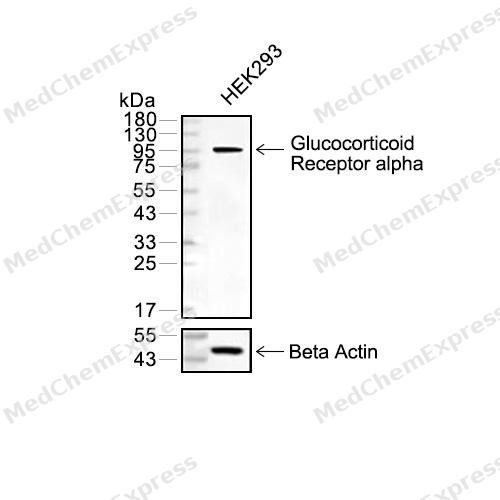 Western blot analysis of extracts from HEK293(lane 2(20μg) using Glucocorticoid Receptor alpha(HY-P80143) Mouse mAb. Proteins were transferred to a PVDF membrane and blocked with 5% non-fat milk in TBST for 2 hour at room temperature. The primary antibody (1/1000) and Loading control antibody (Beta Actin, HY-P80438, 1/10000) was used in 5% non-fat milk in TBST at 4°C overnight. Goat Anti-Mouse IgG-HRP Secondary Antibody (1/10000) was used for 1 hour at room temperature.
 -
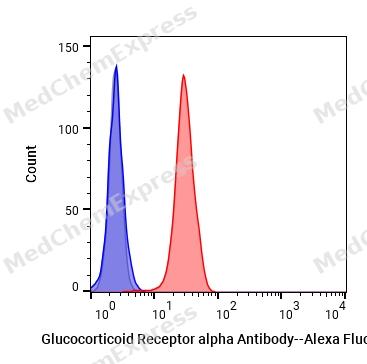 Flow cytometric analysis of 1X10^6 A549 cells labeling Glucocorticoid Receptor alpha Antibody(HY-P80143, red). Cells were fixed with 4% paraformaldehyde. Then stained with the primary antibody at 1/50 dilution for an hour at 4℃. Alexa Fluor® 488-conjugated AffiniPure Goat Anti-Mouse IgG H&L (HY-P8005) was used as the secondary antibody at 1/1,000 dilution for 30 minutes at 4℃. Mouse IgG Isotype Control (HY-P80757, blue) was used as the isotype control, cells without incubation with primary antibody were used as the unlabeled control (black).
 -
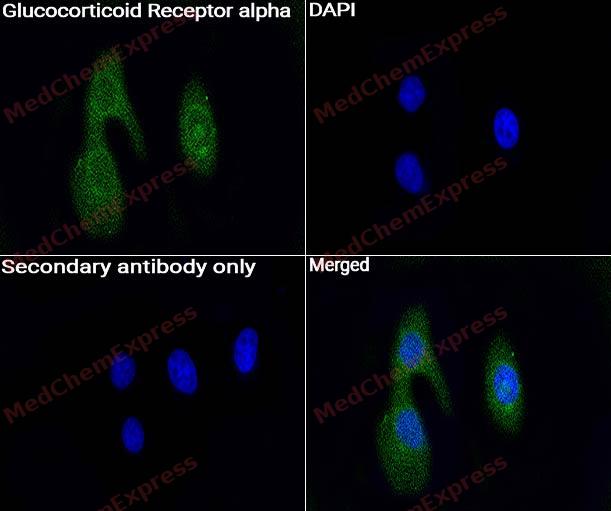 Immunocytochemistry analysis of Hela cells labeling Glucocorticoid Receptor alpha with Glucocorticoid Receptor alpha Antibody (HY-P80143) at 1:50 dilution. Cells were fixed in 4% paraformaldehyde for 15 minutes at room temperature, permeabilized with 0.1% Triton X-100 in PBS for 15 minutes at room temperature, then blocked with quick block buffer for 10 minutes at room temperature. Cells were then incubated with Glucocorticoid Receptor alpha Antibody (HY-P80143) at 1:50 dilution in quick block buffer overnight at 4 ℃. AF488-conjugated Goat Anti-Rabbit IgG H&L(HY-P8002, Green) was used as the secondary antibody at 1/1,000 dilution. PBS instead of the primary antibody was used as the secondary antibody only control. The Nuclear counterstain was DAPI (Blue).
 -
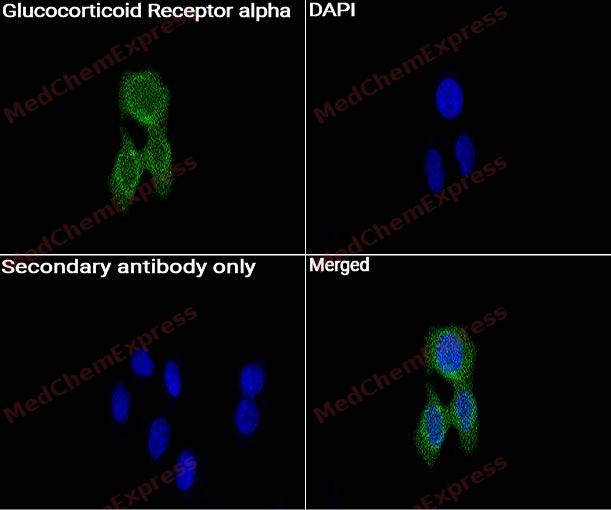 Immunocytochemistry analysis of HepG2 cells labeling Glucocorticoid Receptor alpha with Glucocorticoid Receptor alpha Antibody (HY-P80143) at 1:50 dilution. Cells were fixed in 4% paraformaldehyde for 15 minutes at room temperature, permeabilized with 0.1% Triton X-100 in PBS for 15 minutes at room temperature, then blocked with quick block buffer for 10 minutes at room temperature. Cells were then incubated with Glucocorticoid Receptor alpha Antibody (HY-P80143) at 1:50 dilution in quick block buffer overnight at 4 ℃. AF488-conjugated Goat Anti-Rabbit IgG H&L(HY-P8002, Green) was used as the secondary antibody at 1/1,000 dilution. PBS instead of the primary antibody was used as the secondary antibody only control. The Nuclear counterstain was DAPI (Blue).


Background
-
Function
Glucocorticoid Receptor alpha receptor for glucocorticoids (GC). Has a dual mode of action: as a transcription factor that binds to glucocorticoid response elements (GRE), both for nuclear and mitochondrial DNA, and as a modulator of other transcription factors. Affects inflammatory responses, cellular proliferation and differentiation in target tissues. Involved in chromatin remodeling. Plays a role in rapid mRNA degradation by binding to the 5' UTR of target mRNAs and interacting with PNRC2 in a ligand-dependent manner which recruits the RNA helicase UPF1 and the mRNA-decapping enzyme DCP1A, leading to RNA decay. Could act as a coactivator for STAT5-dependent transcription upon growth hormone (GH) stimulation and could reveal an essential role of hepatic GR in the control of body growth; Has transcriptional activation and repression activity. Mediates glucocorticoid-induced apoptosis. Promotes accurate chromosome segregation during mitosis. May act as a tumor suppressor. May play a negative role in adipogenesis through the regulation of lipolytic and antilipogenic gene expression; Acts as a dominant negative inhibitor of isoform Alpha. Has intrinsic transcriptional activity independent of isoform Alpha when both isoforms are coexpressed. Loses this transcription modulator function on its own. Has no hormone-binding activity. May play a role in controlling glucose metabolism by maintaining insulin sensitivity. Reduces hepatic gluconeogenesis through down-regulation of PEPCK in an isoform Alpha-dependent manner. Directly regulates STAT1 expression in isoform Alpha-independent manner; Has lower transcriptional activation activity than isoform Alpha. Exerts a dominant negative effect on isoform Alpha trans-repression mechanism; Increases activity of isoform Alpha; More effective than isoform Alpha in transcriptional activation, but not repression activity; Has transcriptional activation activity; Has transcriptional activation activity; Has transcriptional activation activity; Has highest transcriptional activation activity of all isoforms created by alternative initiation. Has transcriptional repression activity. Mediates glucocorticoid-induced apoptosis; Has transcriptional activation activity; Has transcriptional activation activity; Has lowest transcriptional activation activity of all isoforms created by alternative initiation. Has transcriptional repression activity[1][2][3][4][5][6][7][8][9][10][11][12][13][14][15][16][17][18][19].
-
Subcellular Localization
Cytoplasm; Nucleus; Mitochondrion; Cytoplasm, cytoskeleton, spindle; Cytoplasm, cytoskeleton, microtubule organizing center, centrosome; Chromosome; Nucleus, nucleoplasm; Nucleus; Cytoplasm; Nucleus; Cytoplasm
-
Expression
Tissue_specificity:It is widely expressed in tissues such as bone, stomach, lung, liver, colon, breast, ovary, pancreas, and kidney (PubMed: 25847991) . In the heart, it can be detected in the left atrium, right atrium, left ventricle, right ventricle, aorta, apex, interventricular septum, and atrioventricular node, as well as in the human heart (PubMed: 10902803) ; it is also widely expressed in tissues such as brain, bone marrow, thymus, spleen, liver, kidney, pancreas, lung, fat, skeletal muscle, heart, placenta, and blood leukocytes.
Induction:Induced by TNF (at protein level) ; Induced by TNF and becomes the predominant isoform which may lead to glucocorticoid resistance (at protein level) -
Subunit
Heteromultimeric cytoplasmic complex with HSP90AA1, HSPA1A/HSPA1B, and FKBP5 or another immunophilin such as PPID, STIP1, or the immunophilin homolog PPP5C (PubMed:21730050). Upon ligand binding FKBP5 dissociates from the complex and FKBP4 takes its place, thereby linking the complex to dynein and mediating transport to the nucleus, where the complex dissociates (By similarity). Probably forms a complex composed of chaperones HSP90 and HSP70, co-chaperones CDC37, PPP5C, TSC1 and client protein TSC2, CDK4, AKT, RAF1 and NR3C1; this complex does not contain co-chaperones STIP1/HOP and PTGES3/p23 (PubMed:29127155). Directly interacts with UNC45A (PubMed:16478993). Binds to DNA as a homodimer, and as heterodimer with NR3C2 or the retinoid X receptor. Binds STAT5A and STAT5B homodimers and heterodimers (By similarity). Interacts with NRIP1, POU2F1, POU2F2 and TRIM28 (By similarity). Interacts with several coactivator complexes, including the SMARCA4 complex, CREBBP/EP300, TADA2L (Ada complex) and p160 coactivators such as NCOA2 and NCOA6 (PubMed:10866662, PubMed:12151000, PubMed:12686538, PubMed:9154805, PubMed:9590696). Interaction with BAG1 inhibits transactivation (PubMed:10477749). Interacts with HEXIM1 and TGFB1I1 (PubMed:12415108, PubMed:15211577, PubMed:15941832). Interacts with NCOA1 (PubMed:9590696). Interacts with NCOA3, SMARCA4, SMARCC1, SMARCD1, and SMARCE1 (By similarity). Interacts with CLOCK, CRY1 and CRY2 in a ligand-dependent fashion (PubMed:19141540, PubMed:21980503, PubMed:22170608). Interacts with CIART (By similarity). Interacts with RWDD3 (By similarity). Interacts with UBE2I/UBC9 and this interaction is enhanced in the presence of RWDD3 (By similarity). Interacts with GRIP1 (PubMed:15769988, PubMed:17635946). Interacts with NR4A3 (via nuclear receptor DNA-binding domain), represses transcription activity of NR4A3 on the POMC promoter Nur response element (NurRE) (PubMed:15591535). Directly interacts with PNRC2 to attract and form a complex with UPF1 and DCP1A; the interaction leads to rapid mRNA degradation (PubMed:25775514). Interacts with GSK3B (PubMed:18838540). Interacts with FNIP1 and FNIP2 (PubMed:27353360). Interacts (via C-terminus) with HNRNPU (via C-terminus) (PubMed:9353307). Interacts with MCM3AP (PubMed:16914116). Interacts (via domain NR LBD) with HSP90AA1 and HSP90AB1 (By similarity). In the absence of hormonal ligand, interacts with TACC1 (PubMed:20078863). Interacts (via NR LBD domain) with ZNF764 (via KRAB domain); the interaction regulates transcription factor activity of NR3C1 by directing its actions toward certain biologic pathways (PubMed:28139699)
-
SwissProt ID
-
Synonyms
GRL, NR3C1, Glucocorticoid receptor, GR, Nuclear receptor subfamily 3 group C member 1
-
Research Field
Epigenetics and Nuclear Signaling


Documentation
-
Data Sheet (264 KB)
-
SDS (313 KB)
- English - EN (313 KB)
- Français - FR (313 KB)
- Deutsch - DE (313 KB)
- Norwegian - NO (313 KB)
- Español - ES (313 KB)
- Swedish - SV (313 KB)
- Italian - IT (313 KB)
- Korean - KR (313 KB)
- Portuguese - PT (313 KB)
-
User Guide for Antibodies (1077 KB)
References
[1]. Vitellius G, et al. Three Novel Heterozygous Point Mutations of NR3C1 Causing Glucocorticoid Resistance. Hum Mutat. 2016 Aug;37(8):794-803. [Content Brief]
[2]. Tsai JM, et al. UBR5 forms ligand-dependent complexes on chromatin to regulate nuclear hormone receptor stability. Mol Cell. 2023 Aug 3;83(15):2753-2767.e10. [Content Brief]
[3]. Fadda A, et al. Genome-wide Regulatory Roles of the C2H2-type Zinc Finger Protein ZNF764 on the Glucocorticoid Receptor. Sci Rep. 2017 Jan 31;7:41598. [Content Brief]
[4]. Fryer CJ, et al. Chromatin remodelling by the glucocorticoid receptor requires the BRG1 complex. Nature. 1998 May 7;393(6680):88-91. [Content Brief]
[5]. Cho H, et al. Glucocorticoid receptor interacts with PNRC2 in a ligand-dependent manner to recruit UPF1 for rapid mRNA degradation. Proc Natl Acad Sci U S A. 2015 Mar 31;112(13):E1540-9. [Content Brief]
[6]. Yudt MR, et al. Molecular identification and characterization of a and b forms of the glucocorticoid receptor. Mol Endocrinol. 2001 Jul;15(7):1093-103. [Content Brief]
[7]. Charmandari E, et al. A novel point mutation in the ligand-binding domain (LBD) of the human glucocorticoid receptor (hGR) causing generalized glucocorticoid resistance: the importance of the C terminus of hGR LBD in conferring transactivational activity. J Clin Endocrinol Metab. 2005 Jun;90(6):3696-705. [Content Brief]
[8]. Lu NZ, et al. Translational regulatory mechanisms generate N-terminal glucocorticoid receptor isoforms with unique transcriptional target genes. Mol Cell. 2005 Apr 29;18(3):331-42. [Content Brief]
[9]. Charmandari E, et al. A novel point mutation in helix 11 of the ligand-binding domain of the human glucocorticoid receptor gene causing generalized glucocorticoid resistance. J Clin Endocrinol Metab. 2007 Oct;92(10):3986-90. [Content Brief]
[10]. Nader N, et al. Circadian rhythm transcription factor CLOCK regulates the transcriptional activity of the glucocorticoid receptor by acetylating its hinge region lysine cluster: potential physiological implications. FASEB J. 2009 May;23(5):1572-83. [Content Brief]
[11]. Kino T, et al. Glucocorticoid receptor (GR) beta has intrinsic, GRalpha-independent transcriptional activity. Biochem Biophys Res Commun. 2009 Apr 17;381(4):671-5. [Content Brief]
[12]. Taniguchi Y, et al. Glucocorticoid receptor-beta and receptor-gamma exert dominant negative effect on gene repression but not on gene induction. Endocrinology. 2010 Jul;151(7):3204-13. [Content Brief]
[13]. Psarra AM, et al. Glucocorticoids induce mitochondrial gene transcription in HepG2 cells: role of the mitochondrial glucocorticoid receptor. Biochim Biophys Acta. 2011 Oct;1813(10):1814-21. [Content Brief]
[14]. Bender IK, et al. Determinants of the heightened activity of glucocorticoid receptor translational isoforms. Mol Endocrinol. 2013 Sep;27(9):1577-87. [Content Brief]
[15]. Wu I, et al. Selective glucocorticoid receptor translational isoforms reveal glucocorticoid-induced apoptotic transcriptomes. Cell Death Dis. 2013 Jan 10;4(1):e453. [Content Brief]
[16]. Matthews LC, et al. Glucocorticoid receptor regulates accurate chromosome segregation and is associated with malignancy. Proc Natl Acad Sci U S A. 2015 Apr 28;112(17):5479-84. [Content Brief]
[17]. Bamberger CM, et al. Glucocorticoid receptor beta, a potential endogenous inhibitor of glucocorticoid action in humans. J Clin Invest. 1995 Jun;95(6):2435-41. [Content Brief]
[18]. Oakley RH, et al. The human glucocorticoid receptor beta isoform. Expression, biochemical properties, and putative function. J Biol Chem. 1996 Apr 19;271(16):9550-9. [Content Brief]
[19]. He B, et al. Human Glucocorticoid Receptor β Regulates Gluconeogenesis and Inflammation in Mouse Liver. Mol Cell Biol. 2015 Dec 28;36(5):714-30. [Content Brief]

 Powered by Bioz
