



PHD3 Antibody (YA1612)
(Synonyms: PHD3; HIFPH3; HIFP4H3)
Based on 1 Customer Validation
PHD3 Antibody (YA1612) is a Rabbit-derived and non-conjugated IgG monoclonal antibody, targeting to PHD3.
-
Host:
Rabbit
-
Isotype:
IgG
-
Application:
WB, IHC-P, IP
-
Reactivity :
Human, Mouse, Rat
-
Formulation:
Supplied in 50mM Tris-Glycine(pH 7.4), 0.15M NaCl, 40% Glycerol, 0.01% Sodium azide and 0.05% BSA
-
Conjugation:
Non-conjugated


To place orders, for customer services and technical support, please contact: MedChemExpress USA
Tel: 609-228-6898 E-mail: [email protected] [email protected]





Applications
| Application |
WB

WB: Western Blot
|
IHC-P
IHC-P: Immunohistochemistry-Paraffin
|
IP
IP: Immunoprecipitation
|
|---|---|---|---|
| Dilution Ratio | 1:500-1:1000 | 1:50-1:100 | 1:20 |


Product Details
PHD3 Antibody (YA1612) is a Rabbit-derived and non-conjugated IgG monoclonal antibody, targeting to PHD3.
-
Host Rabbit

-
Clonality Recombinant,Monoclonal

-
Species ReactivityHuman, Mouse, Rat
-
Observed Molecular WeightObserved band size: 27 kDa
Note: Due to possible protein modifications or aggregation, the molecular weight should be confirmed by actual measurement, and the predicted value is for reference only.

-
Calculated Molecular Weight Predicted band size: 27 kDa

Entrez Gene: 112399 Human ; 112407 Mouse ; 54702 Rat
SwissProt: Q9H6Z9 Human ; Q91UZ4 Mouse ; Q62630 Rat
OMIM: 606426 Human
Recombinant protein of human PHD3 aa1-239.
Endogenous
Affinity Purified
Non-conjugated
Unmodified
IgG


Product Properties
-
Appearance
Solution
-
Formulation
Supplied in 50mM Tris-Glycine(pH 7.4), 0.15M NaCl, 40% Glycerol, 0.01% Sodium azide and 0.05% BSA
-
Concentration
Batch-dependent, Please check the COA for the concentration of each lot. Check Lot Concentration
-
Storage & Stability
Stored at -20°C for 1 year. Avoid repeated freeze / thaw cycles.
-
Shipping
Shipping with blue ice.


Verification Images
-
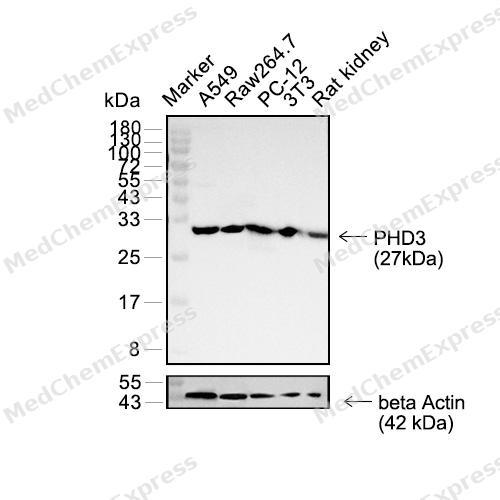 Western blot analysis of extracts from A549 (lane 2(20μg)),Raw264.7 (lane 3(20μg)),PC-12 (lane 4(20μg)) ,3T3 (lane 5(20μg)) and Rat kidney (lane 6(20μg)) using PHD3 Rabbit mAb. Proteins were transferred to a PVDF membrane and blocked with 5% non-fat milk in TBST for 2 hour at room temperature. The primary antibody (1/1000) and Loading control antibody (beta Actin, HY-P83730, 1/5000) was used in 5% non-fat milk in TBST at 4°C overnight. Goat Anti-Rabbit/Mouse IgG-HRP Secondary Antibody (1/10000) was used for 1 hour at room temperature.


Background
-
Function
PHD3 is a HIF prolyl hydroxylase that regulates HIF-1 protein levels in mammalian cells. HIF-1α prolyl hydroxylases mainly include PHD1, PHD2, and PHD3. These three enzymes have sequence-similar catalytic domains and conserve amino acid residues for coordinating Fe (II) ions. Under hypoxic conditions, due to insufficient oxygen supply, the hydroxylase activity of PHD3 decreases, leading to HIF-1α accumulation and inducing the expression of HRE-regulated target genes. Therefore, PHD is considered an intracellular oxygen sensor. PHD3 is expressed at the highest level in the heart.
-
Subcellular Localization
Nucleus; Cytoplasm
-
Expression
Tissue_specificity:Widely expressed at low levels. Expressed at higher levels in human heart (cardiac myocytes, aortic endothelial cells and coronary artery smooth muscle) , lung and placenta, and in fetal spleen, heart and skeletal muscle. Also expressed in pancreas. Localized to pancreatic acini and islet cells
Induction:Induced by hypoxia in a number of cells including neutrophils and certain cancer cell lines. Up-regulated 10-fold in pancreatic cancers -
Subunit
Interacts with BCL2 (via its BH4 domain); the interaction disrupts the BAX-BCL4 complex inhibiting the anti-apoptotic activity of BCL2 (PubMed:20849813). Interacts with WDR83; the interaction leads to almost complete elimination of HIF-mediated reporter activity (By similarity). Interacts with ADRB2; the interaction hydroxylates ADRB2 facilitating its ubiquitination by the VHL-E3 ligase complex (PubMed:19584355). Interacts with PAX2; the interaction targets PAX2 for destruction (PubMed:21575608). Interacts with PKM; the interaction hydroxylates PKM in hypoxia (PubMed:21483450, PubMed:21620138). Interacts with LIMD1, WTIP and AJUBA (PubMed:22286099)
-
SwissProt ID
-
Synonyms
PHD3; HIFPH3; HIFP4H3
-
Research Field
Cardiovascular


Documentation
-
Data Sheet (259 KB)
-
SDS (251 KB)
- English - EN (251 KB)
- Français - FR (251 KB)
- Deutsch - DE (251 KB)
- Norwegian - NO (251 KB)
- Español - ES (251 KB)
- Swedish - SV (251 KB)
- Italian - IT (251 KB)
- Korean - KR (251 KB)
- Portuguese - PT (251 KB)
-
User Guide for Antibodies (1077 KB)
References

 Powered by Bioz
