



844499-71-4
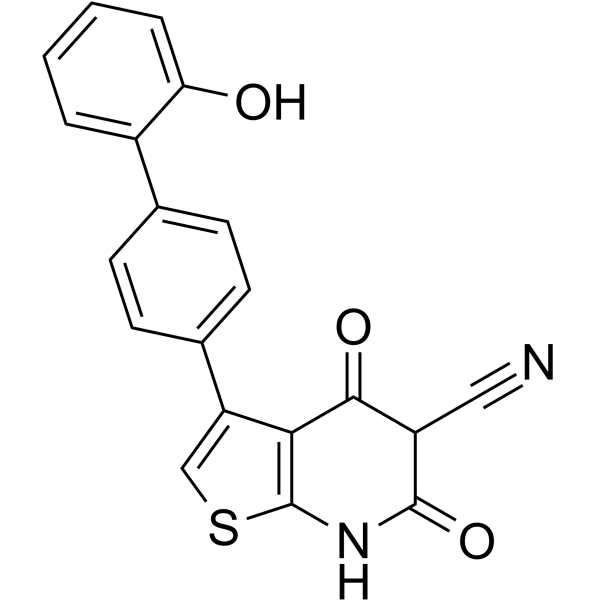
Chemical Structure
A-769662
- CAS No.: 844499-71-4
- Formula:C20H12N2O3S
- Molecular Weight:360.39
IUPAC Name: 3-(2'-hydroxy-[1,1'-biphenyl]-4-yl)-4,6-dioxo-4,5,6,7-tetrahydrothieno[2,3-b]pyridine-5-carbonitrile
InChIKey: VETSDIJERJUOJL-UHFFFAOYSA-N
SMILES: N#CC1C(C2=C(NC1=O)SC=C2C3=CC=C(C4=CC=CC=C4O)C=C3)=O
Biological Activity: A-769662 is a AMP-activated protein kinase (AMPK) activator. A-769662 inhibits the function of the 26S proteasome by an AMPK-independent mechanism and leads to cell cycle arrest. A-769662 directly stimulates partially purified rat liver AMPK (EC50 = 0.8 μM) and inhibits fatty acid synthesis in primary rat hepatocytes (IC50 = 3.2 μM). A-769662 can alleviate the symptoms of metabolic diseases such as type 2 diabetes[1][2][3][4].
| Cat. No. | Product Name | Purity | Description | Pricing | |||||||||||||||||||
|---|---|---|---|---|---|---|---|---|---|---|---|---|---|---|---|---|---|---|---|---|---|---|---|
|
|
A-769662 | 99.33% | A-769662 is a AMP-activated protein kinase (AMPK) activator. A-769662 inhibits the function of the 26S proteasome by an AMPK-independent mechanism and leads to cell cycle arrest. A-769662 directly stimulates partially purified rat liver AMPK (EC50 = 0.8 μM) and inhibits fatty acid synthesis in primary rat hepatocytes (IC50 = 3.2 μM). A-769662 can alleviate the symptoms of metabolic diseases such as type 2 diabetes. | ||||||||||||||||||||
|
loading...
/
|
|||||||||||||||||||||||
|
|
A-769662 (Standard) | ≥98% | A-769662 (Standard) is the analytical standard of A-769662 (HY-50662). This product is intended for research and analytical applications. A-769662 is a AMP-activated protein Kinase (AMPK) activator. A-769662 inhibits the function of the 26S proteasome by an AMPK-independent mechanism and leads to cell cycle arrest. A-769662 directly stimulates partially purified rat liver AMPK (EC50 = 0.8 μM) and inhibits fatty acid synthesis in primary rat hepatocytes (IC50 = 3.2 μM). A-769662 can alleviate the symptoms of metabolic diseases such as type 2 diabetes. | ||||||||||||||||||||
|
loading...
/
|
|||||||||||||||||||||||
-
Similarity Score 0.45
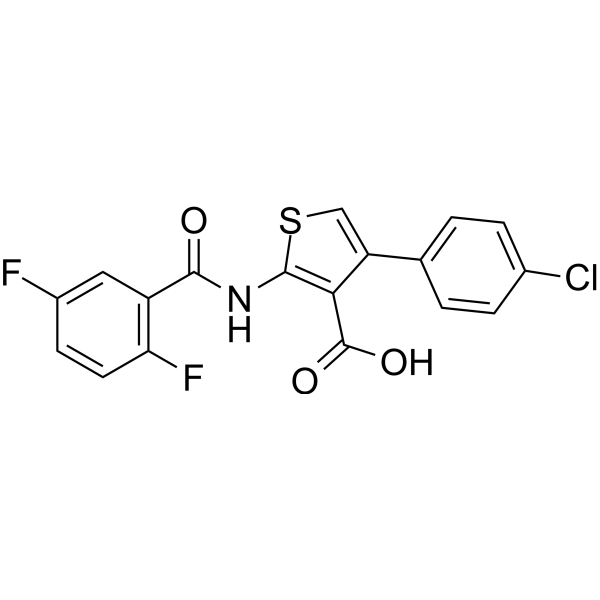 HY-146334DFBTA
-
Similarity Score 0.44
 HY-187147NMDAR modulator 3
-
Similarity Score 0.44
 HY-W1126132',5'-Dihydroxy-[1,1':4',1"-terphenyl]-4,4"-dicarboxylic acid
-
Similarity Score 0.43
 HY-W2439202'-Hydroxy-[1,1':4',1''-terphenyl]-4,4''-dicarboxylic acid
-
Similarity Score 0.43
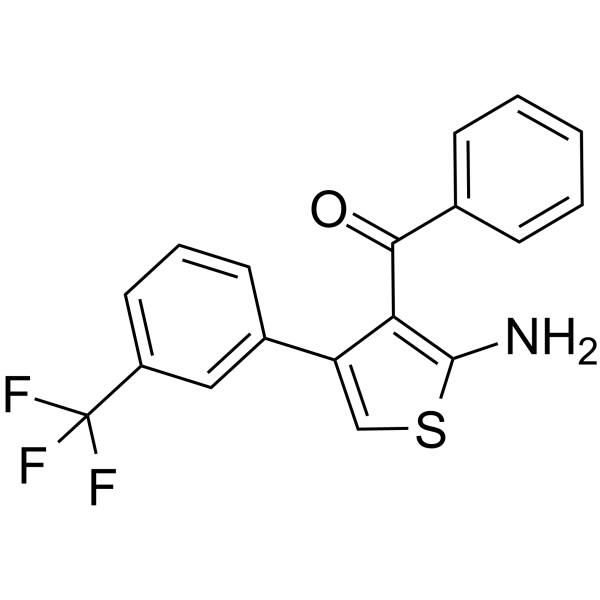 HY-113608VCP171
-
Similarity Score 0.43
 HY-W7183165,6-Chrysenedione
-
Similarity Score 0.43
 HY-169736JNK-IN-21
-
Similarity Score 0.42
 HY-W5868562,2''-Dimethoxy-[1,1':4',1''-terphenyl]-4,4''-dicarboxylic acid
-
Similarity Score 0.42
 HY-W1125293,3''-Dihydroxy-2'-methyl-[1,1':4',1''-terphenyl]-4,4''-dicarboxylic acid
-

Explore the MedChemAI to find more analogs


References
- [1]. Cool B, et al. Identification and characterization of a small molecule AMPK activator that treats key components of type 2 diabetes and the metabolic syndrome. Cell Metab, 2006, 3(6), 403-416. [Content Brief]
- [2]. Sanders MJ, et al. Defining the mechanism of activation of AMP-activated protein kinase by the small molecule A-769662, a member of the thienopyridone family. J Biol Chem, 2007, 282(45), 32539-32548. [Content Brief]
- [3]. Moreno D, et al, A769662, a novel activator of AMP-activated protein kinase, inhibits non-proteolytic components of the 26S proteasome by an AMPK-independent mechanism. FEBS Lett, 2008, 583(17), 2650-2654. [Content Brief]
- [4]. Yerra VG, et al. Adenosine Monophosphate-Activated Protein Kinase Abates Hyperglycaemia-Induced Neuronal Injury in Experimental Models of Diabetic Neuropathy: Effects on Mitochondrial Biogenesis, Autophagy and Neuroinflammation. Mol Neurobiol. 2017 Apr;54(3):2301-2312. [Content Brief]



