



Citicoline sodium
Based on 4 publication(s) in Google Scholar
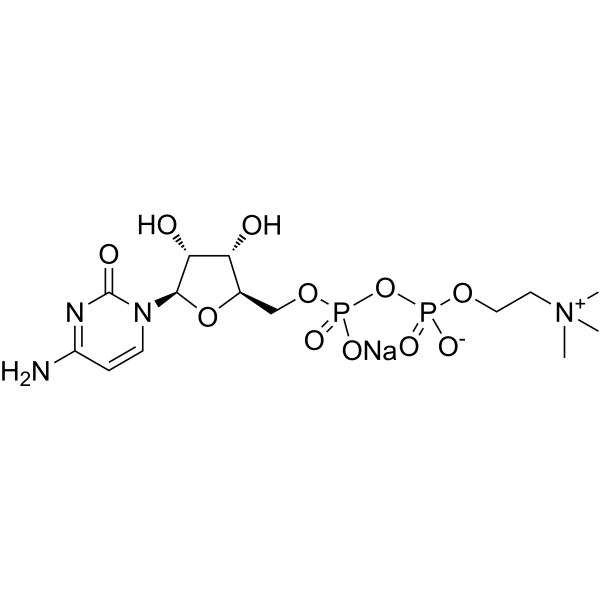
Citicoline sodium is an endogenous intermediate in the synthesis of phosphatidylcholine which is a component of cell membranes. Citicoline sodium inhibits reactive oxygen species (ROS) and apoptosis. Citicoline sodium can be used for neurological disease and hearing loss study.
Nur für Forschungszwecke. Wir verkaufen nicht an Patienten.
- Reinheit: 99.77%
- CAS. Nr.: 33818-15-4
- Formel: C14H25N4NaO11P2
- Molecular Weight:510.31
-
Speicherung:
4°C, sealed storage, away from moisture
* In solvent : -80°C, 6 months; -20°C, 1 month (sealed storage, away from moisture)


-
 Biologische Aktivität
-
Chemical Information
-
Lösungsmittel & Löslichkeit
- Reinheit & Dokumentation
- Verweise
-
 Help & FAQs
-

Apoptosis Compound Library
HY-L003
-
Immunology/Inflammation Compound Library
HY-L007
-
Metabolism/Protease Compound Library
HY-L012
-
NF-κB Signaling Compound Library
HY-L014
-
Natural Product Library
HY-L021
-
FDA-Approved Drug Library
HY-L022
-
Anti-Cancer Compound Library
HY-L025
-
Human Endogenous Metabolite Compound Library
HY-L030
-
Anti-Aging Compound Library
HY-L034
-
Drug Repurposing Compound Library
HY-L035
-
Covalent Screening Library
HY-L036
-
Oxygen Sensing Compound Library
HY-L045
-
Anti-COVID-19 Compound Library
HY-L052
-
NMPA-Approved Drug Library
HY-L053
-
Pyroptosis Compound Library
HY-L059
-
FDA Approved & Pharmacopeial Drug Library
HY-L066
-
Alkaloids Library
HY-L071
-
Microbial Metabolite Library
HY-L084
-
Neurodegenerative Disease-related Compound Library
HY-L086
-
Food-Sourced Compound Library
HY-L094
-
Rare Diseases Drug Library
HY-L102
-
Pediatric Drug Library
HY-L104
-
Anti-Cancer Natural Product Library
HY-L107
-
Plant-Sourced Natural Product Library
HY-L115
-
FDA-Approved Anticancer Drug Library
HY-L122
-
Human Metabolite Library
HY-L123
-
Off-patent Drug Library
HY-L141
-
Protease Inhibitor Library
HY-L147
-
Animal-Sourced Natural Product Library
HY-L157
-
Cell Death Library
HY-L162
-
Multi-Target Compound Library
HY-L176
-
Bioactive Compound Library Max
HY-L181
-
MCE Bioactive Compound Library
HY-L001V
-
Covalent Screening Library Plus
HY-L036P
-
Natural Product Library Plus
HY-L021P
-
Drug Repurposing Compound Library Plus
HY-L035P
-
FDA-Approved Drug Library Plus
HY-L022P
-
FDA-Approved Drug Library Mini
HY-L022M
-
Natural Product and Natural Product-Like Compound Library
HY-L021M
-
Bioactive Compound Library
HY-L001
-
Non-Alcoholic Fatty Liver Disease (NAFLD) Compound Library
HY-L199
-
High-Throughput Bioactive Compound Library
HY-L205
-
High-Throughput Natural Product Library
HY-L206
-
Mass Spectrometry Human Endogenous Metabolite Library
HY-L207
-
Mass Spectrometry Human Metabolite Library
HY-L215
-
Lactylation Compound Library
HY-L249
-
Mass Spectrometry Natural Product Library
HY-L262


Publications Citing Use of MedChemExpress (MCE) Citicoline sodium
More Customer Validation & Images

-
Others
Alle Endogenous Metabolite Isoform-spezifische Produkte anzeigen
MoreAlle Caspase Isoform-spezifische Produkte anzeigen
More

Biologische Aktivität
|
Microbial Metabolite |
Human Endogenous Metabolite |
Caspase-8 |
Caspase 3 |
Caspase-9 |
Citicoline (1-100 μM, 24 h or 24 h before glutamate treatment) sodium increases rats retinal cells viability after glutamate-induced excitotoxicity, and has synergistic effects with Tramiprosate (Homotaurine) (HY-14602)[1].
Citicoline (100 μM, 24 h before glutamate treatment and 30 min before HG treatment) sodium decreases proapoptotic effects associated with neuroretinal degeneration such as glutamate-induced excitotoxicity and high glucose (HG)-induced neurotoxicity, and has synergistic effects with Tramiprosate in rats retinal cells[1].
Citicoline (100 μM, 36-48 h) sodium reduces apoptosis in mice cochlear hair cells (HCs) and HEI-OC-1 cells after Neomycin (HY-150520) exposure, decreases the mRNA level of pro-apoptotic factor and increases anti-apoptotic factor, suppresses proapoptotic protein expression[2][3].
Citicoline (100 μM, 36-48 h) sodium attenuates oxidative stress in mice cochlear HCs and HEI-OC-1 cells after Neomycin injury[3].
MedChemExpress (MCE) has not independently confirmed the accuracy of these methods. They are for reference only.
-
Cell Line:Rat retinal cells
-
Concentration:1, 10, 100 μM
-
Incubation Time:24 h or 24 h before glutamate treatment (100 μM)
-
Result:Did not affect viability of primary retinal cultures.
Significantly increased cell viability after glutamate-induced excitotoxicity, and had synergistic effects with homotaurine.
-
Cell Line:Rat retinal cells
-
Concentration:100 μM
-
Incubation Time:24 h before glutamate treatment and 30 min before HG treatment
-
Result:Reduced apoptosis induced by administration of glutamate and HG, and had synergistic effects with homotaurine.
-
Cell Line:HEI-OC-1, mice cochlear tissue
-
Concentration:10 μM
-
Incubation Time:36 or 48 h (pretreatment for 12 h and then treated with 10 mM neomycin together for 12 and 24 h in cochlear tissue and HEI-OC-1, respectively, then allowed to recover in culture medium for another 12
-
Result:Showed significantly lower numbers of cleaved caspase 3-positive cells and TUNEL-positive cells than the neomycin-only group.
Significantly reduced the percentage of apoptosis.
The protein levels of cleaved caspase 3 were decreased compared with the Neomycin-only group.
Decreased the pro-apoptotic factor Bax, Casp3, Casp8, and Casp9, and increased anti-apoptotic factor Bcl-2 by qPT-PCR analysis.
MedChemExpress (MCE) has not independently confirmed the accuracy of these methods. They are for reference only.
-
Animal Model:Male C57Bl/6 mice (23-27 g) (The solution of convulsant pentylenetetrazole (1%) was infused intravenously at a flow rate of 0.01 ml/sec.)[2]
-
Dosage:500, 1000 mg/kg
-
Administration:Intraperitoneal injection (i.p.); 1 h before test
-
Result:Increased the threshold of clonic seizures and tonic phase of seizures with lethal outcome in a dose of 500 mg/kg.
The anticonvulsant effect was most pronounced in a dose of 1000 mg/kg.
| NCT Number | Sponsor | Condition | Start Date |
Phase

|
|---|---|---|---|---|
| NCT01329991 | Plexxikon| | 2011-05 | PHASE1 |


Chemical Information
-
CAS. Nr. 33818-15-4
-
Appearance Solid
-
Molecular Weight 510.31
-
Formel C14H25N4NaO11P2
-
Color White to off-white
-
SMILES
NC(C=CN1[C@H]2[C@H](O)[C@H](O)[C@@H](COP(OP(OCC[N+](C)(C)C)([O-])=O)(O[Na])=O)O2)=NC1=O
-
Synonyms
Cytidine diphosphate-choline sodium; CDP-Choline sodium; Cytidine 5'-diphosphocholine sodium
-
Structure Classification
-
Initial Source
-
Versand
Room temperature in continental US; may vary elsewhere.
-
Speicherung
4°C, sealed storage, away from moisture
* In solvent : -80°C, 6 months; -20°C, 1 month (sealed storage, away from moisture)


Publications (4)
-
Journal Impact Factor
-
Most Recent
-
Nat Neurosci
2023 Apr;26(4):542-554. PMID: 36941428
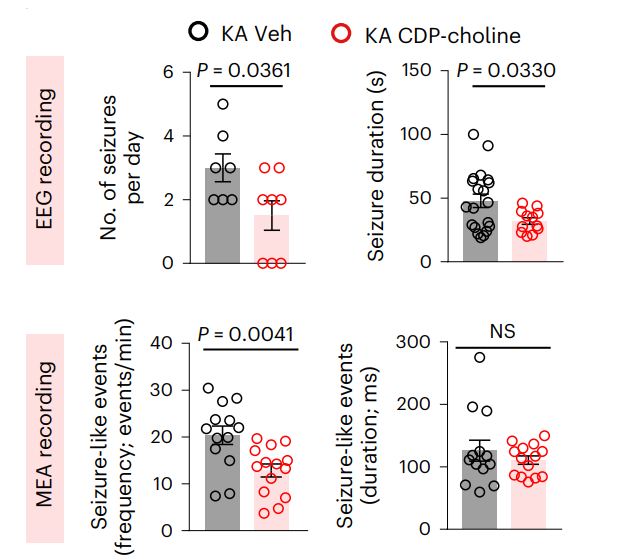
Citicoline sodium purchased from MedChemExpress. Usage Cited in: Nat Neurosci. 2023 Apr;26(4):542-554. [Abstract]
In vivo EEG and ex vivo MEA recordings of KA epileptic mice treated with CDP-choline (Citicoline: 100 mg/kg) or vehicle control.
-
Int J Biol Macromol
2025 Jan 5:139536. PMID: 39765299 -
-


Lösungsmittel & Löslichkeit
H2O : ≥ 100 mg/mL (195.96 mM)
DMSO : < 1 mg/mL (insoluble or slightly soluble)
* "≥" means soluble, but saturation unknown.
Please refer to the solubility information to select the appropriate solvent. Once prepared, please aliquot and store the solution to prevent product inactivation from repeated freeze-thaw cycles.
Storage method and period of stock solution: -80°C, 6 months; -20°C, 1 month (sealed storage, away from moisture). When stored at -80°C, please use it within 6 months. When stored at -20°C, please use it within 1 month.
* Note: If you choose water as the stock solution, please dilute it to the working solution, then filter and sterilize it with a 0.22 μm filter before use.
Please refer to the solubility information to select the appropriate solvent. Once prepared, please aliquot and store the solution to prevent product inactivation from repeated freeze-thaw cycles.
Storage method and period of stock solution: -80°C, 6 months; -20°C, 1 month (sealed storage, away from moisture). When stored at -80°C, please use it within 6 months. When stored at -20°C, please use it within 1 month.
* Note: If you choose water as the stock solution, please dilute it to the working solution, then filter and sterilize it with a 0.22 μm filter before use.
Konzentration (Stammlösung) × Volumen (Stammlösung) = Konzentration (Ziellösung) × Volumen (Ziellösung)
For the following dissolution methods, please prepare the working solution directly:
It is recommended to prepare fresh solutions and use them promptly within a short period of time.
The percentages shown for the solvents indicate their volumetric ratio in the final prepared solution. If precipitation or phase separation occurs during preparation, heat and/or sonication can be used to aid dissolution.
Add each solvent one by one: PBS
Solubility: 100 mg/mL (195.96 mM); Clear solution; Need ultrasonic


Reinheit & Dokumentation
-
Data Sheet (280 KB)
-
SDS (393 KB)
- English - EN (393 KB)
- Français - FR (393 KB)
- Deutsch - DE (393 KB)
- Norwegian - NO (393 KB)
- Español - ES (393 KB)
- Swedish - SV (393 KB)
- Italian - IT (393 KB)
- Portuguese - PT (393 KB)
-
Handling Instructions (2659 KB)
Verweise
[1]. Davinelli S, et al. Cytoprotective Effects of Citicoline and Homotaurine against Glutamate and High Glucose Neurotoxicity in Primary Cultured Retinal Cells. Oxid Med Cell Longev. 2017;2017:2825703. [Content Brief]
[2]. Karpova MN, et al. Increase of the seizure threshold in C57BL/6 mice after citicoline administration. Bull Exp Biol Med. 2015 Jan;158(3):315-7. [Content Brief]
[3]. Zhong Z, et al. Citicoline Protects Auditory Hair Cells Against Neomycin-Induced Damage. Front Cell Dev Biol. 2020 Aug 31;8:712. [Content Brief]


Complete Stock Solution Preparation Table
Please refer to the solubility information to select the appropriate solvent. Once prepared, please aliquot and store the solution to prevent product inactivation from repeated freeze-thaw cycles.
Storage method and period of stock solution: -80°C, 6 months; -20°C, 1 month (sealed storage, away from moisture). When stored at -80°C, please use it within 6 months. When stored at -20°C, please use it within 1 month.
| Optional Solvent | Concentration Solvent Mass | 1 mg | 5 mg | 10 mg | 25 mg |
|---|---|---|---|---|---|
| H2O | 1 mM | 1.9596 mL | 9.7980 mL | 19.5959 mL | 48.9898 mL |
| 5 mM | 0.3919 mL | 1.9596 mL | 3.9192 mL | 9.7980 mL | |
| 10 mM | 0.1960 mL | 0.9798 mL | 1.9596 mL | 4.8990 mL | |
| 15 mM | 0.1306 mL | 0.6532 mL | 1.3064 mL | 3.2660 mL | |
| 20 mM | 0.0980 mL | 0.4899 mL | 0.9798 mL | 2.4495 mL | |
| 25 mM | 0.0784 mL | 0.3919 mL | 0.7838 mL | 1.9596 mL | |
| 30 mM | 0.0653 mL | 0.3266 mL | 0.6532 mL | 1.6330 mL | |
| 40 mM | 0.0490 mL | 0.2449 mL | 0.4899 mL | 1.2247 mL | |
| 50 mM | 0.0392 mL | 0.1960 mL | 0.3919 mL | 0.9798 mL | |
| 60 mM | 0.0327 mL | 0.1633 mL | 0.3266 mL | 0.8165 mL | |
| 80 mM | 0.0245 mL | 0.1225 mL | 0.2449 mL | 0.6124 mL | |
| 100 mM | 0.0196 mL | 0.0980 mL | 0.1960 mL | 0.4899 mL |
* Note: If you choose water as the stock solution, please dilute it to the working solution, then filter and sterilize it with a 0.22 μm filter before use.


 Powered by Bioz