



ONO-2952
Based on 1 publication(s) in Google Scholar
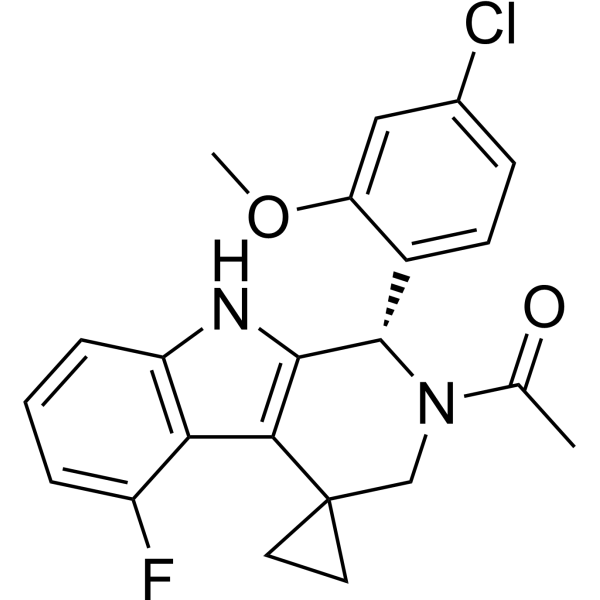
ONO-2952 is a potent, selective and orally active translocator protein 18 kDa (TSPO) antagonist with Ki of 0.33-9.30 nM for rat and human TSPO. ONO-2952 is more selective for TSPO than other receptors, transporters, ion channels and enzymes. ONO-2952 exerts its anti-stress effects through inhibition of excessive activation of noradrenergic system in the brain without the amnesic effect. ONO-2952 has the potential for irritable bowel syndrome treatment.
For research use only. We do not sell to patients.
- Purity: 99.51%
- CAS No.: 895169-20-7
- Formula: C22H20ClFN2O2
- Molecular Weight:398.86
-
Storage:Powder -20°C, 3 years , 4°C, 2 years ; In solvent -80°C, 6 months , -20°C, 1 month

To place orders, for customer services and technical support, please contact: MedChemExpress USA
Tel: 609-228-6898 E-mail: [email protected] [email protected]


-
 Biological Activity
-
Chemical Information
-
Solvent & Solubility
- Purity & Documentation
- References
-
 Help & FAQs


Publications Citing Use of MedChemExpress (MCE) ONO-2952
MoreAll Adrenergic Receptor Isoforms
More

Biological Activity
Description
IC50 & Target
Ki: 0.33-9.30 nM (Rat and human TSPO)[1]
In Vitro
As for its selectivity for TSPO, ONO-2952 at a concentration of 10 μM showed good selectivity for TSPO against 98 off-targets (<50% inhibition). Determination of ONO-2952 Ki or IC50 values for the remaining 35 targets (50% inhibition at 10 μM) reveal Ki values of less than 1 μM only for 3 receptors, i.e. melatonin 2, progesterone B, and adrenergic α2C. The affinity of ONO-2952 for these receptors is at least 59 times lower than that for TSPO. ONO-2952 Ki value for the GABAA receptor is more than 600 times higher than that for TSPO[1].
MedChemExpress (MCE) has not independently confirmed the accuracy of these methods. They are for reference only.
In Vivo
ONO-2952 inhibits both neurosteroid accumulation and noradrenaline release in the brain of rats exposed to acute stress[1].
MedChemExpress (MCE) has not independently confirmed the accuracy of these methods. They are for reference only.
-
Animal Model:Male Sprague Dawley rats (8 weeks old) under conditioned fear stress test[1]
-
Dosage:0.03 mg/kg, 0.1 mg/kg, 0.3 mg/kg, 1 mg/kg, 3 mg/kg
-
Administration:Oral administration
-
Result:Dose-dependently suppressed restraint stress-induced defecation in rats. And suppressed conditioned fear stress-induced freezing behavior in rats.
Clinical Trial
| NCT Number | Sponsor | Condition | Start Date |
Phase

|
|---|---|---|---|---|
| NCT01329991 | Plexxikon| | 2011-05 | PHASE1 |


Chemical Information
-
CAS No. 895169-20-7
-
Appearance Solid
-
Molecular Weight 398.86
-
Formula C22H20ClFN2O2
-
Color White to off-white
-
SMILES
CC(N([C@H]1C2=CC=C(Cl)C=C2OC)CC3(C4=C1NC5=C4C(F)=CC=C5)CC3)=O
-
Shipping
Room temperature in continental US; may vary elsewhere.
-
Storage
Powder -20°C 3 years 4°C 2 years In solvent -80°C 6 months -20°C 1 month


Publications (1)
-
Journal Impact Factor
-
Most Recent
-
Phytomedicine
Mechanism of Dihydroartemisinin in activating macrophages to enhance host resistance to malaria. [Abstract]2025 Jul 25:143:156913. PMID: 40450979


Solvent & Solubility
In Vitro:
DMSO : 180 mg/mL (451.29 mM; Need ultrasonic; Hygroscopic DMSO has a significant impact on the solubility of product, please use newly opened DMSO)
Please refer to the solubility information to select the appropriate solvent. Once prepared, please aliquot and store the solution to prevent product inactivation from repeated freeze-thaw cycles.
Storage method and period of stock solution: -80°C, 6 months; -20°C, 1 month. When stored at -80°C, please use it within 6 months. When stored at -20°C, please use it within 1 month.
Please refer to the solubility information to select the appropriate solvent. Once prepared, please aliquot and store the solution to prevent product inactivation from repeated freeze-thaw cycles.
Storage method and period of stock solution: -80°C, 6 months; -20°C, 1 month. When stored at -80°C, please use it within 6 months. When stored at -20°C, please use it within 1 month.
Concentration (start) × Volume (start) = Concentration (final) × Volume (final)
In Vivo:
Select the appropriate dissolution method based on your experimental animal and administration route.
- For the following dissolution methods, please ensure to first prepare a clear stock solution using an In Vitro approach and then sequentially add co-solvents:
- To ensure reliable experimental results, the clarified stock solution can be appropriately stored based on storage conditions. As for the working solution for In Vivo experiments, it is recommended to prepare freshly and use it on the same day.
- The percentages shown for the solvents indicate their volumetric ratio in the final prepared solution. If precipitation or phase separation occurs during preparation, heat and/or sonication can be used to aid dissolution.
Add each solvent one by one: 10% DMSO 40% PEG300 5% Tween-80 45% Saline
Solubility: 4.5 mg/mL (11.28 mM); Suspended solution; Need ultrasonic
This protocol yields a suspended solution of 4.5 mg/mL. Suspended solution can be used for oral and intraperitoneal injection.
Taking 1 mL working solution as an example, add 100 μL DMSO stock solution (45.0 mg/mL) to 400 μL PEG300, and mix evenly; then add 50 μL Tween-80 and mix evenly; then add 450 μL Saline to adjust the volume to 1 mL.
Preparation of Saline: Dissolve 0.9 g sodium chloride in ddH₂O and dilute to 100 mL to obtain a clear Saline solution.
In Vivo Dissolution Calculator
Please enter the basic information of animal experiments:
-
-
-
-
Recommended: Prepare an additional quantity of animals to account for potential losses during experiments.
Please enter your animal formula composition:
-
%DMSO +
Recommended: Keep the proportion of DMSO in working solution below 2% if your animal is weak.
-
%+
-
+%Tween-80 + +
-
%Saline +
The co-solvents required include: DMSO, . All of co-solvents are available by MedChemExpress (MCE). , Tween 80. All of co-solvents are available by MedChemExpress (MCE).
Working solution concentration: 0.22 mg/mL
Method for preparing stock solution: mg drug dissolved in μL DMSO. Stock solution concentration: mg/mL.
1. Take μL DMSO stock solution;
2. Add μL .
μL , mix evenly;
3. Then add μL Tween 80, mix evenly;
4. Then add μL
Please ensure that the stock solution in the first step is dissolved to a clear state, and add co-solvents in sequence. You can use ultrasonic heating (ultrasonic cleaner, recommended frequency 20-40 kHz), vortexing, etc. to assist dissolution.


Purity & Documentation
-
Data Sheet (285 KB)
-
SDS (251 KB)
- English - EN (251 KB)
- Français - FR (251 KB)
- Deutsch - DE (251 KB)
- Norwegian - NO (251 KB)
- Español - ES (251 KB)
- Swedish - SV (251 KB)
- Italian - IT (251 KB)
- Korean - KR (251 KB)
- Portuguese - PT (251 KB)
-
Handling Instructions (2659 KB)
References
[1]. Mitsui K, et al. Anti-stress effects of ONO-2952, a novel translocator protein 18 kDa antagonist, in rats. Neuropharmacology. 2015 Dec;99:51-66. [Content Brief]
[2]. Whitehead WE, et al. Randomised clinical trial: exploratory phase 2 study of ONO-2952 in diarrhoea-predominant irritable bowel syndrome. Aliment Pharmacol Ther. 2017 Jan;45(1):14-26. [Content Brief]


Complete Stock Solution Preparation Table
Please refer to the solubility information to select the appropriate solvent. Once prepared, please aliquot and store the solution to prevent product inactivation from repeated freeze-thaw cycles.
Storage method and period of stock solution: -80°C, 6 months; -20°C, 1 month. When stored at -80°C, please use it within 6 months. When stored at -20°C, please use it within 1 month.
| Optional Solvent | Concentration Solvent Mass | 1 mg | 5 mg | 10 mg | 25 mg |
|---|---|---|---|---|---|
| DMSO | 1 mM | 2.5071 mL | 12.5357 mL | 25.0715 mL | 62.6786 mL |
| 5 mM | 0.5014 mL | 2.5071 mL | 5.0143 mL | 12.5357 mL | |
| 10 mM | 0.2507 mL | 1.2536 mL | 2.5071 mL | 6.2679 mL | |
| 15 mM | 0.1671 mL | 0.8357 mL | 1.6714 mL | 4.1786 mL | |
| 20 mM | 0.1254 mL | 0.6268 mL | 1.2536 mL | 3.1339 mL | |
| 25 mM | 0.1003 mL | 0.5014 mL | 1.0029 mL | 2.5071 mL | |
| 30 mM | 0.0836 mL | 0.4179 mL | 0.8357 mL | 2.0893 mL | |
| 40 mM | 0.0627 mL | 0.3134 mL | 0.6268 mL | 1.5670 mL | |
| 50 mM | 0.0501 mL | 0.2507 mL | 0.5014 mL | 1.2536 mL | |
| 60 mM | 0.0418 mL | 0.2089 mL | 0.4179 mL | 1.0446 mL | |
| 80 mM | 0.0313 mL | 0.1567 mL | 0.3134 mL | 0.7835 mL | |
| 100 mM | 0.0251 mL | 0.1254 mL | 0.2507 mL | 0.6268 mL |


ONO-2952 Related Classifications
HY-111191 Related Classifications
 Powered by Bioz