



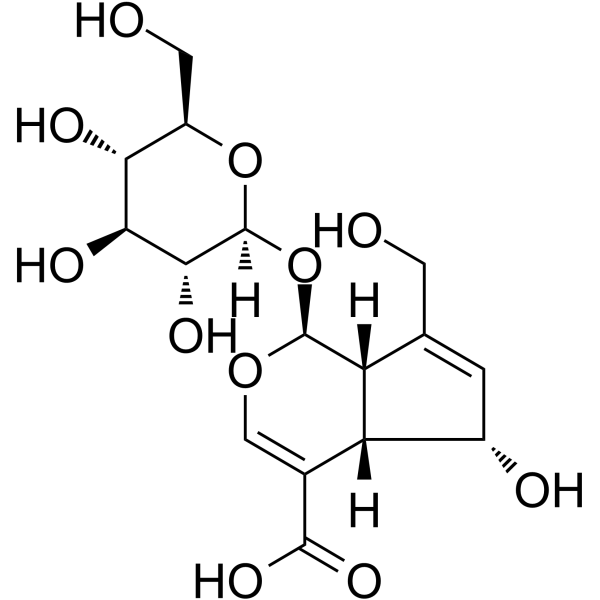
Deacetylasperulosidic Acid

Based on 1 Customer Validation
Deacetylasperulosidic Acid is an orally active antioxidant. Deacetylasperulosidic Acid exerts a definite in vivo antioxidant effect and alleviates oxidative stress injury by enhancing SOD activity. In atopic dermatitis models, Deacetylasperulosidic Acid corrects Th2-skewed immune imbalance and reduces allergy-related factors; in immunosuppression models, it activates cellular immunity, enhances NK cell activity and IL-2 production. Deacetylasperulosidic Acid can be used in the research of atopic dermatitis.
For research use only. We do not sell to patients.
- Purity : 99.44%
- CAS No.: 14259-55-3
- Formula: C16H22O11
- Molecular Weight:390.34
-
Storage:
-20°C, protect from light
* In solvent : -80°C, 6 months; -20°C, 1 month (protect from light)

To place orders, for customer services and technical support, please contact: MedChemExpress USA
Tel: 609-228-6898 E-mail: [email protected] [email protected]


-
 Biological Activity
-
Chemical Information
-
Solvent & Solubility
- Protocols
- Purity & Documentation
- References
-
 Help & FAQs





Biological Activity
Description
IC50 & Target
|
IL-2 |
In Vitro
Deacetylasperulosidic Acid reduced 4-nitroquinoline 1-oxide-induced genotoxicity by 98.96%[1].
Deacetylasperulosidic Acid inhibited low-density lipoprotein oxidation[1].
Deacetylasperulosidic Acid inhibited release of tumor necrosis factor-alpha[1].
Deacetylasperulosidic Acid suppressed the induction of chromosome aberrations[1].
Deacetylasperulosidic Acid demonstrates anti-atopic activity in human HaCaT keratinocytes, HMC-1 mast cells, and EOL-1 eosinophils by supporting immune balance and skin barrier function[3].
MedChemExpress (MCE) has not independently confirmed the accuracy of these methods. They are for reference only.
In Vivo
Deacetylasperulosidic Acid (30-100 mg/kg; p.o.; daily; 14 days) at 100 mg/kg inhibits EC50-induced reduction of IL-2 production, while 30 mg/kg and 100 mg/kg increase NK cell cytotoxicity to 12% and 21%, respectively, with no impact on splenic lymphocyte subpopulations[2].
Deacetylasperulosidic acid (3-12 mg/kg; p.o.; daily; 4 weeks) alleviates atopic dermatitis in DNCB-induced NC/Nga mice in a dose-dependent manner by reducing pruritus, restoring immune balance, and repairing skin barrier function, with the 12 mg/kg dose achieving near-normal levels for most measured parameters[3].
MedChemExpress (MCE) has not independently confirmed the accuracy of these methods. They are for reference only.
-
Animal Model:Wistar rats (male and female, 180-200 g)[1]
-
Dosage:15 mg/kg; 30 mg/kg; 60 mg/kg
-
Administration:p.o.; daily; 7 days
-
Result:Caused non-significant reduction in mean serum malondialdehyde (MDA) and 10% increase in mean serum superoxide dismutase (SOD) activity at 15 mg/kg.
Induced significant 19.7% reduction in mean serum MDA and significant 11.3% increase in mean serum SOD activity at 30 mg/kg.
Induced significant 22.6% reduction in mean serum MDA and significant 13.0% increase in mean serum SOD activity at 60 mg/kg.
Did not significantly alter serum glutathione peroxidase (GPx) activity at any tested dose.
-
Animal Model:ICR (female, 6 weeks old)[2]
-
Dosage:30 mg/kg; 100 mg/kg
-
Administration:p.o.; daily; 7-14 days
-
Result:Inhibited the reduction of ear swelling by 55%.
Inhibited the reduction of ear swelling by 52%.
Inhibited the reduction of IL-2 production in EC-sup-treated mice.
Increased NK cell cytotoxicity to 12%.
Increased NK cell cytotoxicity to 21%.
Had no effect on splenic lymphocyte subpopulations (CD3+, CD4+, CD8+, B220+, CD49b+ cell percentages).
-
Animal Model:BALB/c (female, 6 weeks old)[2]
-
Dosage:30 mg/kg; 100 mg/kg
-
Administration:p.o.; daily; 14 days
-
Result:Resulted in a non-statistically significant increasing trend in IL-2 production and non-statistically significant decreasing trends in IL-4 and IL-10 production.
Had no effect on splenic lymphocyte subpopulations (CD3+, CD4+, CD8+, B220+, CD49b+ cell percentages).
-
Animal Model:NC/Nga (male, 4 weeks old, DNCB-induced atopic dermatitis)[3]
-
Dosage:3 mg/kg; 6 mg/kg; 12 mg/kg
-
Administration:p.o.; daily; 4 weeks
-
Result:Reduced dermatitis scores, scratching behavior, and ear thickness in a dose-dependent manner, with 12 mg/kg showing greater efficacy than prednisolone for ear thickness by week 14.
Reduced epidermal thickness and the number of infiltrated mast cells and eosinophils in dorsal skin in a dose-dependent manner; 12 mg/kg achieved epidermal thickness (14.7 μm) and inflammatory cell counts similar to normal mice.
Reduced serum IgE and histamine levels in a dose-dependent manner, with all doses showing greater inhibition than prednisolone.
Reduced serum IgG1 levels and increased serum IgG2a levels in a dose-dependent manner, normalizing the IgG1/IgG2a ratio; 12 mg/kg restored the ratio to near-normal levels.
Reduced serum levels of Th2 (IL-4, IL-10, TSLP), pro-inflammatory (IL-1β, IL-6, TNF-α), and chemokine (TARC, MDC, RANTES) factors, and restored serum levels of Th1 (IL-12, IFN-γ) factors in a dose-dependent manner; 12 mg/kg restored IL-12 and IFN-γ to normal levels.
Reduced splenocyte secretion of Th2 (IL-4, IL-5, IL-10, IL-13, IL-31, IL-33, TSLP), pro-inflammatory (IL-1β, IL-6, TNF-α), Th9/Th17/Th22 (IL-9, IL-17, IL-22), and chemokine (TARC, MDC, RANTES) factors, and restored splenocyte secretion of Th1 (IL-12, IFN-γ) factors in a dose-dependent manner; 12 mg/kg restored IL-12 and IFN-γ to normal levels.
Reduced dorsal skin gene expression of Th2 activation-related factors (CCR4, IL-25, IL-33, TSLP, TARC, MDC, RANTES), Th2 (IL-4, IL-5, IL-10, IL-13, IL-31), pro-inflammatory (IL-1β, IL-6, TNF-α), and Th9/Th17/Th22 (IL-9, IL-17, IL-22) factors, and restored dorsal skin gene expression of Th1 (IL-12, IFN-γ) factors in a dose-dependent manner; 12 mg/kg restored IL-12 and IFN-γ to normal levels.
Increased dorsal skin pro-filaggrin gene expression and skin barrier-related protein (filaggrin, involucrin, loricrin) levels in a dose-dependent manner; 12 mg/kg restored these to levels similar to normal mice, with greater efficacy than prednisolone.


Chemical Information
-
CAS No. 14259-55-3
-
Appearance Solid
-
Molecular Weight 390.34
-
Formula C16H22O11
-
Color White to off-white
-
SMILES
O[C@H]([C@@H](O)[C@@H]1O)[C@](O[C@@H]1CO)([H])O[C@H]2[C@@](C(CO)=C[C@@H]3O)([H])[C@@]3([H])C(C(O)=O)=CO2
-
Structure Classification
-
Initial Source
-
Shipping
Room temperature in continental US; may vary elsewhere.
-
Storage
-20°C, protect from light
* In solvent : -80°C, 6 months; -20°C, 1 month (protect from light)


Solvent & Solubility
In Vitro:
DMSO : 100 mg/mL (256.19 mM; Need ultrasonic; Hygroscopic DMSO has a significant impact on the solubility of product, please use newly opened DMSO)
H2O : 50 mg/mL (128.09 mM; Need ultrasonic)
Please refer to the solubility information to select the appropriate solvent. Once prepared, please aliquot and store the solution to prevent product inactivation from repeated freeze-thaw cycles.
Storage method and period of stock solution: -80°C, 6 months; -20°C, 1 month (protect from light). When stored at -80°C, please use it within 6 months. When stored at -20°C, please use it within 1 month.
* Note: If you choose water as the stock solution, please dilute it to the working solution, then filter and sterilize it with a 0.22 μm filter before use.
Please refer to the solubility information to select the appropriate solvent. Once prepared, please aliquot and store the solution to prevent product inactivation from repeated freeze-thaw cycles.
Storage method and period of stock solution: -80°C, 6 months; -20°C, 1 month (protect from light). When stored at -80°C, please use it within 6 months. When stored at -20°C, please use it within 1 month.
* Note: If you choose water as the stock solution, please dilute it to the working solution, then filter and sterilize it with a 0.22 μm filter before use.
Concentration (start) × Volume (start) = Concentration (final) × Volume (final)
In Vivo:
Select the appropriate dissolution method based on your experimental animal and administration route.
- For the following dissolution methods, please ensure to first prepare a clear stock solution using an In Vitro approach and then sequentially add co-solvents:
- To ensure reliable experimental results, the clarified stock solution can be appropriately stored based on storage conditions. As for the working solution for In Vivo experiments, it is recommended to prepare freshly and use it on the same day.
- The percentages shown for the solvents indicate their volumetric ratio in the final prepared solution. If precipitation or phase separation occurs during preparation, heat and/or sonication can be used to aid dissolution.
Add each solvent one by one: 10% DMSO 40% PEG300 5% Tween-80 45% Saline
Solubility: ≥ 2.5 mg/mL (6.40 mM); Clear solution
This protocol yields a clear solution of ≥ 2.5 mg/mL (saturation unknown).
Taking 1 mL working solution as an example, add 100 μL DMSO stock solution (25.0 mg/mL) to 400 μL PEG300, and mix evenly; then add 50 μL Tween-80 and mix evenly; then add 450 μL Saline to adjust the volume to 1 mL.
Preparation of Saline: Dissolve 0.9 g sodium chloride in ddH₂O and dilute to 100 mL to obtain a clear Saline solution.
Add each solvent one by one: 10% DMSO 90% (20% SBE-β-CD in Saline)
Solubility: ≥ 2.5 mg/mL (6.40 mM); Clear solution
This protocol yields a clear solution of ≥ 2.5 mg/mL (saturation unknown).
Taking 1 mL working solution as an example, add 100 μL DMSO stock solution (25.0 mg/mL) to 900 μL 20% SBE-β-CD in Saline, and mix evenly.
Preparation of 20% SBE-β-CD in Saline (4°C, storage for one week): 2 g SBE-β-CD powder is dissolved in 10 mL Saline, completely dissolve until clear.
In Vivo Dissolution Calculator
Please enter the basic information of animal experiments:
-
-
-
-
Recommended: Prepare an additional quantity of animals to account for potential losses during experiments.
Working solution concentration: 0.22 mg/mL
This product has good water solubility, please refer to the measured solubility data in water/PBS/Saline for details.


Purity & Documentation
-
Data Sheet (289 KB)
-
SDS (393 KB)
- English - EN (393 KB)
- Français - FR (393 KB)
- Deutsch - DE (393 KB)
- Norwegian - NO (393 KB)
- Español - ES (393 KB)
- Swedish - SV (393 KB)
- Italian - IT (393 KB)
- Korean - KR (393 KB)
- Portuguese - PT (393 KB)
-
Handling Instructions (2659 KB)
References
[1]. Ma DL, et al. In vivo antioxidant activity of deacetylasperulosidic Acid in noni. J Anal Methods Chem. 2013;2013:804504. [Content Brief]
[2]. Murata K, et al. Activation of cell-mediated immunity by Morinda citrifolia fruit extract and its constituents. Nat Prod Commun. 2014;9(4):445-450. [Content Brief]
[3]. Oh JS, et al. Deacetylasperulosidic Acid Ameliorates Pruritus, Immune Imbalance, and Skin Barrier Dysfunction in 2,4-Dinitrochlorobenzene-Induced Atopic Dermatitis NC/Nga Mice. Int J Mol Sci. 2021;23(1):226. Published 2021 Dec 25. [Content Brief]


Complete Stock Solution Preparation Table
Please refer to the solubility information to select the appropriate solvent. Once prepared, please aliquot and store the solution to prevent product inactivation from repeated freeze-thaw cycles.
Storage method and period of stock solution: -80°C, 6 months; -20°C, 1 month (protect from light). When stored at -80°C, please use it within 6 months. When stored at -20°C, please use it within 1 month.
| Optional Solvent | Concentration Solvent Mass | 1 mg | 5 mg | 10 mg | 25 mg |
|---|---|---|---|---|---|
| H2O / DMSO | 1 mM | 2.5619 mL | 12.8093 mL | 25.6187 mL | 64.0467 mL |
| 5 mM | 0.5124 mL | 2.5619 mL | 5.1237 mL | 12.8093 mL | |
| 10 mM | 0.2562 mL | 1.2809 mL | 2.5619 mL | 6.4047 mL | |
| 15 mM | 0.1708 mL | 0.8540 mL | 1.7079 mL | 4.2698 mL | |
| 20 mM | 0.1281 mL | 0.6405 mL | 1.2809 mL | 3.2023 mL | |
| 25 mM | 0.1025 mL | 0.5124 mL | 1.0247 mL | 2.5619 mL | |
| 30 mM | 0.0854 mL | 0.4270 mL | 0.8540 mL | 2.1349 mL | |
| 40 mM | 0.0640 mL | 0.3202 mL | 0.6405 mL | 1.6012 mL | |
| 50 mM | 0.0512 mL | 0.2562 mL | 0.5124 mL | 1.2809 mL | |
| 60 mM | 0.0427 mL | 0.2135 mL | 0.4270 mL | 1.0674 mL | |
| 80 mM | 0.0320 mL | 0.1601 mL | 0.3202 mL | 0.8006 mL | |
| 100 mM | 0.0256 mL | 0.1281 mL | 0.2562 mL | 0.6405 mL |
* Note: If you choose water as the stock solution, please dilute it to the working solution, then filter and sterilize it with a 0.22 μm filter before use.


Deacetylasperulosidic Acid Related Classifications
HY-N0594 Related Classifications
 Powered by Bioz