



Deucravacitinib (hydrochloride)
Based on 36 publication(s) in Google Scholar
Deucravacitinib (BMS-986165) hydrochloride is an orally active allosteric inhibitor of tyrosine kinase 2 (TYK2), with an IC50 of 0.2 nM and a Ki of 0.02 nM against the JH2 domain of TYK2, and it exhibits selectivity over other JAK subtypes and most of the kinome. Deucravacitinib hydrochloride blocks IL-23, IL-12, p-STAT1/3 and Type I IFN signaling, and inhibits Th17/Th1-mediated psoriasis inflammation. Deucravacitinib hydrochloride can be used in research related to moderate-to-severe plaque psoriasis, inflammatory bowel disease and systemic lupus erythematosus.
For research use only. We do not sell to patients.
- CAS No.: 1609392-28-0
- Formula: C20H20D3ClN8O3
- Molecular Weight:461.92
-
Storage:
Please store the product under the recommended conditions in the Certificate of Analysis.


To place orders, for customer services and technical support, please contact: MedChemExpress USA
Tel: 609-228-6898 E-mail: [email protected] [email protected]


-
 Biological Activity
-
Chemical Information
- Protocols
- Purity & Documentation
- References
-
 Help & FAQs


Publications Citing Use of MedChemExpress (MCE) Deucravacitinib (hydrochloride)
More- Ann Rheum Dis. 2025 Sep 25:S0003-4967(25)04383-3. [Abstract]
- Nat Commun. 2025 Jul 29;16(1):6972. [Abstract]
- J Adv Res. 2026 Apr 24:S2090-1232(26)00358-9. [Abstract]
- Nat Chem Biol. 2022 Dec;18(12):1388-1398. [Abstract]
- Cell Rep Med. 2025 Feb 18;6(2):101970. [Abstract]
- Cell Death Differ. 2021 Feb;28(2):748-763. [Abstract]
- Phytomedicine. 2026 Sep:159:158587.
- Clin Cancer Res. 2023 Apr 14;29(8):1592-1604. [Abstract]
- J Invest Dermatol. 2025 May 27:S0022-202X(25)00531-7. [Abstract]
- J Invest Dermatol. 2025 Apr 8:S0022-202X(25)00393-8. [Abstract]
- Mol Syst Biol. 2024 Jan;20(1):28-55. [Abstract]
- Int J Mol Sci. 2023 May 25;24(11):9243. [Abstract]
- Int J Mol Sci. 2022 May 1;23(9):5040. [Abstract]
- Inflamm Bowel Dis. 2021 Oct 18;27(10):1674-1683. [Abstract]
- Arthritis Res Ther. 2021 Apr 19;23(1):120. [Abstract]
- iScience. 2024 Dec 10;28(1):111563. [Abstract]
- iScience. 2021 May 3;24(6):102498. [Abstract]
- J Biol Chem. 2022 May;298(5):101938. [Abstract]
- J Biotechnol. 2025 Mar:399:9-18. [Abstract]
- Med Microbiol Immunol. 2025 Nov 14;214(1):50. [Abstract]
- PLoS One. 2024 Nov 1;19(11):e0308647. [Abstract]
- Anticancer Drugs. 2025 Apr 1;36(4):280-289. [Abstract]
- Iran J Immunol. 2024 Sep 25;21(3). [Abstract]
- bioRxiv. 2026 May 29.
- Res Sq. 2026 Jan 6.
- bioRxiv. 2025 Oct 15.
- bioRxiv. 2025 Aug 16.
- Patent. US20250235450A1.
- medRxiv. 2025 Mar 01.
- Immune Sys. 2024;0:1–13
- bioRxiv. 2024 Jun 6:2024.06.04.595773. [Abstract]
- bioRxiv. 2024 May 9:2024.03.20.585925. [Abstract]
- bioRxiv. 2023 Jul 1.
- Patent. US20230147873A1.
- Patent. US20220339151A1.
- Patent. US20200345731A1.
 Customer Validation & Images

-
IHC

-
Cell Proliferation/Viability Assay
-
In Vivo Efficacy Study
-
WB
-
WB


Biological Activity
Description
In Vitro
Deucravacitinib hydrochloride potently inhibits TYK2-dependent IFNα-induced STAT5 phosphorylation in human CD3+ T cells, with an IC50 of 2 nM[2].
Deucravacitinib hydrochloride potently inhibits TYK2-dependent IL-23-induced STAT3 phosphorylation in human CD161+ CD3+ T cells, with an IC50 of 9 nM[2].
Deucravacitinib hydrochloride potently inhibits TYK2-dependent IFNα-induced STAT5 phosphorylation in human whole blood with an IC50 of 13 nM, while exhibiting high functional selectivity for signaling pathways dependent on JAK2, JAK1 and JAK3[2].
MedChemExpress (MCE) has not independently confirmed the accuracy of these methods. They are for reference only. Further protocols information, click here.
In Vivo
Deucravacitinib (50 mg/kg; p.o.; twice daily) hydrochloride almost completely inhibits body weight loss and significantly reduces histological damage in a mouse model of anti-CD40-induced colitis[2].
Deucravacitinib (30 mg/kg; p.o.; once daily; for 3 consecutive months) hydrochloride is well tolerated in a mouse lupus model and exerts significant efficacy in preventing nephritis[2].
MedChemExpress (MCE) has not independently confirmed the accuracy of these methods. They are for reference only.
-
Animal Model:C57BL/6 (PK studies; IL-23-driven acanthosis psoriasis model)[2]
-
Dosage:7.5 mg/kg; 15 mg/kg; 30 mg/kg
-
Administration:p.o.; twice daily; 9 days
-
Result:Reduced ear thickness increase relative to vehicle, inhibited epidermal hyperplasia and inflammatory cellular infiltration, and dose-dependently reduced relative gene expression of IL-17a, IL-21, IL-23a, IL-23R, IL-12 (p35), and IL-12 (p40) in skin biopsies at 7.5 mg/kg twice daily.
Maintained drug levels at or above mouse whole blood IC50 (100 nM) for 19 hours at 7.5 mg/kg twice daily.
Achieved ear thickness inhibition equivalent to the anti-IL-23 adnectin positive control, reduced epidermal hyperplasia and inflammatory cellular infiltration, showed greater reduction of cytokine gene expression than the 7.5 mg/kg dose, and maintained drug levels at or above mouse whole blood IC50 for 21 hours at 15 mg/kg twice daily.
Provided greater ear thickness protection than the anti-IL-23 adnectin, more effectively inhibited epidermal hyperplasia and inflammatory cellular infiltration than the positive control, showed the greatest reduction of cytokine gene expression across all doses, and maintained drug levels at or above mouse whole blood IC50 for 24 hours at 30 mg/kg twice daily.
-
Animal Model:NZB/W (spontaneous lupus-prone nephritis model; treated for three months)[2]
-
Dosage:30 mg/kg
-
Administration:p.o.; once daily; three months
-
Result:Was well-tolerated, highly efficacious in protecting against nephritis, inhibited type I IFN-dependent gene expression in whole blood and kidneys, and was at least as effective as a blocking anti-IFNαR antibody control; efficacy correlated with coverage of the whole blood IC50 over dosing intervals.
Application
1. This compound can be used as a tracer
2. This compound can be used as an internal standard for quantitative analysis by NMR, GC-MS, or LC-MS.


Chemical Information
-
CAS No. 1609392-28-0
-
Molecular Weight 461.92
-
Formula C20H20D3ClN8O3
-
SMILES
COC1=C(C2=NN(C)C=N2)C=CC=C1NC3=C(N=NC(NC(C4CC4)=O)=C3)C(NC([2H])([2H])[2H])=O.Cl
-
Synonyms
BMS-986165 (hydrochloride)
-
Shipping
Room temperature in continental US; may vary elsewhere.
-
Storage
Please store the product under the recommended conditions in the Certificate of Analysis.


Publications (36)
-
Journal Impact Factor
-
Most Recent
-
Ann Rheum Dis
Augmentation of immunothrombosis as a key mechanism underlying JAK inhibition associated hypercoagulability in rheumatoid arthritis. [Abstract]2025 Sep 25:S0003-4967(25)04383-3. PMID: 41006174 -
Nat Commun
Autocrine interferon poisoning mediates ADAR1-dependent synthetic lethality in BRCA1/2-mutant cancers. [Abstract]2025 Jul 29;16(1):6972. PMID: 40730818 -
J Adv Res
Long noncoding RNA AFAP1-AS1 aggravates immunotherapy resistance in NSCLC by enhancing JAK2 and TYK2 translation. [Abstract]2026 Apr 24:S2090-1232(26)00358-9. PMID: 42035912 -
Nat Chem Biol
2022 Dec;18(12):1388-1398. PMID: 36097295
Deucravacitinib (hydrochloride) purchased from MedChemExpress. Usage Cited in: Nat Chem Biol. 2022 Dec;18(12):1388-1398. [Abstract]
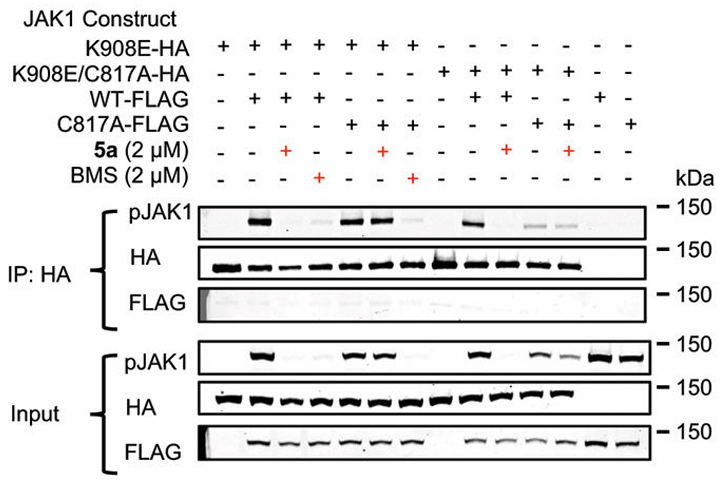
Western blots measuring effects of VVD-118313 (5a) and BMS-986165 (BMS) (2 µM, 2 h) on JAK1 phosphorylation (pJAK1).
-
Cell Rep Med
2025 Feb 18;6(2):101970. PMID: 39938523 -
Cell Death Differ
2021 Feb;28(2):748-763. PMID: 32929218
Deucravacitinib (hydrochloride) purchased from MedChemExpress. Usage Cited in: Cell Death Differ. 2021 Feb;28(2):748-763. [Abstract]
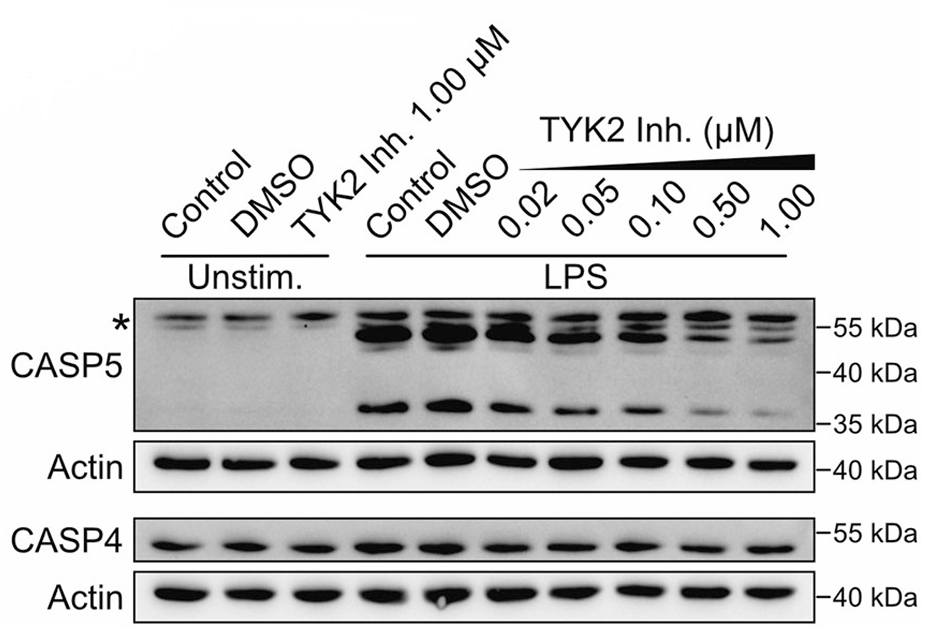
BMS-986165 (0.02-1 μM; 18 h).Cells are treated with the allosteric TYK2 inhibitor BMS-986165 (TYK2 Inh.). BMS-986165 dose-dependently inhibits upregulation of CASP5 in response to LPS in U937 macrophages.
-
-
Clin Cancer Res
MEK Inhibition Synergizes with TYK2 Inhibitors in NF1-Associated Malignant Peripheral Nerve Sheath Tumors. [Abstract]2023 Apr 14;29(8):1592-1604. PMID: 36799629
Deucravacitinib (hydrochloride) purchased from MedChemExpress. Usage Cited in: Clin Cancer Res. 2023 Apr 14;29(8):1592-1604. [Abstract]
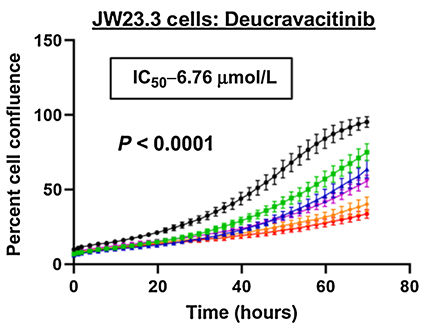
Deucravacitinib (5-80 μM; 0-72 h). The specific TYK2 inhibitor deucravacitinib (BMS-986165) decreases MPNST cell proliferation at lower doses.
Deucravacitinib (hydrochloride) purchased from MedChemExpress. Usage Cited in: Clin Cancer Res. 2023 Apr 14;29(8):1592-1604. [Abstract]
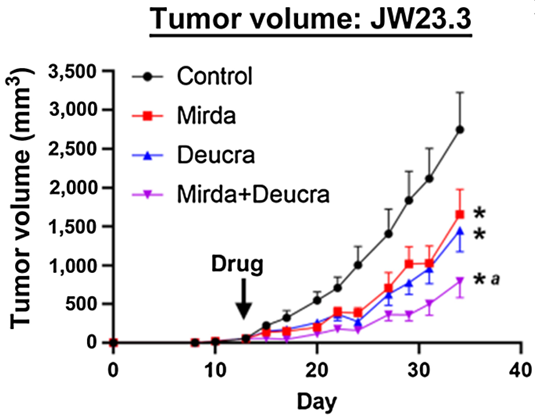
The combination of drugs inhibiting TYK2 and MEK block MPNST tumor growth in mice. Mice with JW23.3 MPNST xenograft tumors were treated daily with 30 mg/kg deucravacitinib (Deucra, BMS-986165), the combination of drugs, or vehicle control for 3 weeks or until tumors reached the maximum allowed volume.
-
J Invest Dermatol
Pharmacological Characterization of Zasocitinib (TAK-279): An Oral, Highly Selective, and Potent Allosteric TYK2 Inhibitor. [Abstract]2025 May 27:S0022-202X(25)00531-7. PMID: 40441292 -
J Invest Dermatol
2025 Apr 8:S0022-202X(25)00393-8. PMID: 40210114
Deucravacitinib (hydrochloride) purchased from MedChemExpress. Usage Cited in: J Invest Dermatol. 2025 Apr 8:S0022-202X(25)00393-8. [Abstract]
BMS-986165 (10 mg/kg; Oral). Representative images of histopathology images taken from each experimental group.
-
Mol Syst Biol
Illuminating phenotypic drug responses of sarcoma cells to kinase inhibitors by phosphoproteomics. [Abstract]2024 Jan;20(1):28-55. PMID: 38177929 -
Int J Mol Sci
JAK Signaling Is Critically Important in Cytokine-Induced Viral Susceptibility of Keratinocytes. [Abstract]2023 May 25;24(11):9243. PMID: 37298195 -
Int J Mol Sci
In Vitro Assays to Identify Metabolism-Disrupting Chemicals with Diabetogenic Activity in a Human Pancreatic β-Cell Model. [Abstract]2022 May 1;23(9):5040. PMID: 35563431 -
Inflamm Bowel Dis
2021 Oct 18;27(10):1674-1683. PMID: 33295611 -
Arthritis Res Ther
Mitochondrial protein CMPK2 regulates IFN alpha-enhanced foam cell formation, potentially contributing to premature atherosclerosis in SLE. [Abstract]2021 Apr 19;23(1):120. PMID: 33874983 -
iScience
2024 Dec 10;28(1):111563. PMID: 39868044 -
iScience
Mitochondrial CMPK2 mediates immunomodulatory and antiviral activities through IFN-dependent and IFN-independent pathways. [Abstract]2021 May 3;24(6):102498. PMID: 34142025 -
J Biol Chem
Mitogen-activated protein kinase phosphatase-1 controls PD-L1 expression by regulating type I interferon during systemic Escherichia coli infection. [Abstract]2022 May;298(5):101938. PMID: 35429501 -
J Biotechnol
2025 Mar:399:9-18. PMID: 39824361 -
Med Microbiol Immunol
Furamidine enhances IL-23-mediated autophagic response through IL-23R-TYK2-STAT3-dependent regulation of intracellular Ca²⁺ level to facilitate mycobacterial clearance in human macrophages. [Abstract]2025 Nov 14;214(1):50. PMID: 41236630 -
PLoS One
A novel small molecule screening assay using normal human chondrocytes toward osteoarthritis drug discovery. [Abstract]2024 Nov 1;19(11):e0308647. PMID: 39485774 -
Anticancer Drugs
Dual inhibition of TYK2 and PD-L1 boosts immune response in triple negative breast cancer. [Abstract]2025 Apr 1;36(4):280-289. PMID: 39774369 -
Iran J Immunol
2024 Sep 25;21(3). PMID: 39319693 -
-
-
-
-
-
-
-
bioRxiv
2024 Jun 6:2024.06.04.595773. PMID: 38895380 -
bioRxiv
Pharmacological inhibition of tyrosine protein-kinase 2 reduces islet inflammation and delays type 1 diabetes onset in mice. [Abstract]2024 May 9:2024.03.20.585925. PMID: 38766166 -
-
-
-

Protocols
-
Cell Cytotoxicity Assay
Cytotoxicity assays are usually based on the assessment of cell membrane damage, which can also be indirectly detected by measuring cell viability. Detection methods include MTT assay, CKK-8 assay, LDH assay and ATP assay, etc.
-
Naïve CD4+ T-cell subset differentiation/polarization
Naïve CD4+ T-cell subset differentiation/polarization is an in vitro assay in which purified naïve CD4+ T cells are activated through TCR and CD28 costimulation and cultured with defined cytokines and neutralizing antibodies to generate Th0, Th1, Th2, Th17, or induced Treg-like populations. Differentiation is detected by subset-associated cytokines and transcription factors: IFN-γ/T-bet for Th1, IL-4/GATA3 for Th2, IL-17A/RORγt for Th17, and Foxp3 for induced Treg cells. The assay readout is usually generated by intracellular cytokine staining after restimulation, transcription-factor staining by flow cytometry, ELISA of secreted cytokines, or gene-expression analysis. The result reflects cytokine-directed lineage commitment or polarization rather than antigen-specific immune protection by itself.
-
Imiquimod-Induced Psoriasiform Dermatitis
Imiquimod (IMQ)-induced psoriasiform dermatitis is a widely used murine model in which topical application of IMQ, a Toll-like receptor 7 (TLR7) agonist, triggers innate immune activation in the skin and induces a psoriasis-like inflammatory cascade characterized by epidermal hyperplasia, immune cell infiltration, and cytokine production dominated by the IL-23/IL-17 axis. This inflammatory response is mediated through activation of dendritic cells and downstream induction of IL-23, IL-17A, IL-22, and related pro-inflammatory mediators, recapitulating key features of human plaque psoriasis and enabling mechanistic and therapeutic studies. The model is commonly induced using Aldara (5% IMQ cream) applied topically to murine skin, resulting in rapid onset of erythema, scaling, and thickening that can be quantified as disease severity indices and validated histologically.
-
DSS-Induced Colitis
Dextran sulfate sodium (DSS)-induced colitis is generated by administering DSS in mouse drinking water, producing epithelial injury, barrier disruption, weight loss, diarrhea, fecal blood, colon shortening, histologic mucosal damage, and inflammatory mediator changes; the model is mainly used to study acute or chronic intestinal inflammation resembling selected features of ulcerative colitis. DSS injury is interpreted through clinical and tissue readouts rather than a single molecular endpoint: daily body weight, stool consistency, and bleeding are combined into a disease activity index, while colon length, histology, cytokines, myeloperoxidase activity, intestinal permeability, and tight-junction markers provide complementary measures of inflammation and barrier damage.
-
TNBS-Induced Colitis
TNBS-induced colitis is produced by intrarectal delivery of 2,4,6-trinitrobenzene sulfonic acid in ethanol, where ethanol disrupts the mucosal barrier and TNBS haptenates colonic proteins, generating immune-mediated colonic inflammation with weight loss, diarrhea, ulceration, transmural injury, inflammatory-cell infiltration, and cytokine responses. The model is used as an experimental intestinal inflammation model with Crohn’s disease–like features, especially when Th1-type responses, IL-12–dependent inflammation, chronic relapsing inflammation, or fibrosis-related endpoints are studied.
-
Research Protocol for Inflammation-related Diseases
The NLRP3 inflammasome is a cytosolic innate immune signaling platform that integrates priming signals and danger-signal activation to promote caspase-1 activation, maturation of IL-1β and IL-18, and gasdermin D-mediated pyroptotic cell death. The core experimental logic is to determine whether inflammatory disease phenotypes are driven by increased NLRP3 expression, ASC-containing inflammasome assembly, caspase-1 cleavage, GSDMD cleavage, and extracellular release of IL-1β/IL-18 rather than by nonspecific cell injury alone. The pathway is strongly linked to inflammation-related disease phenotypes because monosodium urate crystals activate NALP3/NLRP3 inflammasome signaling in gout-like crystal inflammation, cholesterol crystals activate NLRP3 inflammasomes in atherogenesis models, and DSS-induced intestinal inflammation has been reported to involve NLRP3 inflammasome activity. However, experimental colitis studies also show context-dependent protective effects of NLRP3 inflammasome co


Purity & Documentation
References
[1]. Armstrong AW, et al. Deucravacitinib versus placebo and apremilast in moderate to severe plaque psoriasis: Efficacy and safety results from the 52-week, randomized, double-blinded, placebo-controlled phase 3 POETYK PSO-1 trial. J Am Acad Dermatol. 2023;88(1):29-39. [Content Brief]
[2]. Wrobleski ST, et al. Highly Selective Inhibition of Tyrosine Kinase 2 (TYK2) for the Treatment of Autoimmune Diseases: Discovery of the Allosteric Inhibitor BMS-986165. J Med Chem. 2019;62(20):8973-8995. [Content Brief]

Calculators
Concentration (start) × Volume (start) = Concentration (final) × Volume (final)


Deucravacitinib (hydrochloride) Related Classifications
HY-117287A Related Classifications
 Powered by Bioz