



AZ 12216052
Based on 1 publication(s) in Google Scholar
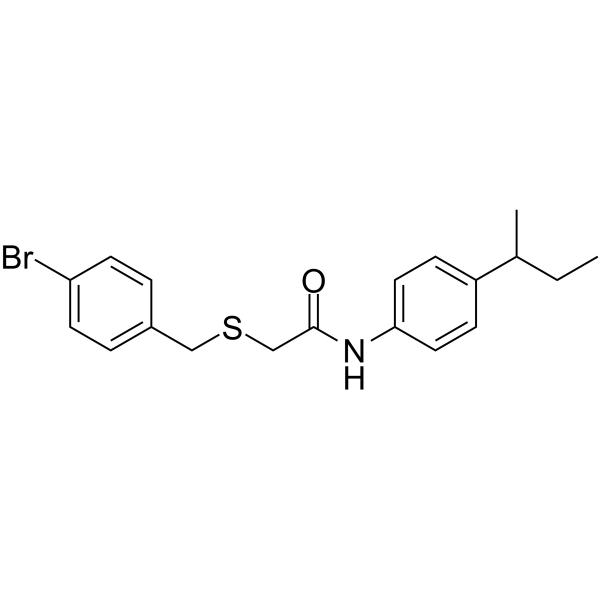
AZ 12216052 is a mGluR8 positive allosteric modulator, and helps mGluR8 modulate signaling inputing to retinal ganglion cells. AZ 12216052 exhibits antianxiety effect.
For research use only. We do not sell to patients.
- Purity: 98.73%
- CAS No.: 1290628-31-7
- Formula: C19H22BrNOS
- Molecular Weight:392.35
-
Storage:Powder -20°C, 3 years , 4°C, 2 years ; In solvent -80°C, 6 months , -20°C, 1 month

To place orders, for customer services and technical support, please contact: MedChemExpress USA
Tel: 609-228-6898 E-mail: [email protected] [email protected]


-
 Biological Activity
-
Chemical Information
-
Solvent & Solubility
- Purity & Documentation
- References
-
 Help & FAQs
-


GPCR/G Protein Compound Library
HY-L006
-
Neuronal Signaling Compound Library
HY-L013
-
Neurotransmitter Receptor Compound Library
HY-L062
-
Membrane Protein-targeted Compound Library
HY-L149
-
Membrane Receptor-targeted Compound Library
HY-L150
-
Allosteric Modulators (AMs) Compound Library
HY-L170
-
Bioactive Compound Library Max
HY-L181
-
MCE Bioactive Compound Library
HY-L001V
-
Bioactive Compound Library
HY-L001
-
High-Throughput Bioactive Compound Library
HY-L205
-
Lactylation Compound Library
HY-L249


Publications Citing Use of MedChemExpress (MCE) AZ 12216052
More

Biological Activity
|
mGlu8 |
mGluR8 may modulates the synaptic inputs to retinal ganglion cells[1].
AZ 12216052 (10 μM) enhances the peak excitatory currents of ON-, OFF- currents in ON-OFF-ganglion cells, with a dependent way on the intensity of the light stimuli[1].
AZ 12216052 shows impact of cell differentiation and (0.01-1 μM; 24-48 h) reduces Dox-induced human neuroblastoma SH-SY5Y cell damage partially[2].
AZ 12216052 stimulates proliferation and attenuates staurosporine (St)- and doxorubicin (Dox)-induced toxicity in UN-SH-SY5Y cells[2].
AZ12216052 (10 μM) enhances glutamate activity of human mGluR8b receptor expressed in GHEK cells[3].
MedChemExpress (MCE) has not independently confirmed the accuracy of these methods. They are for reference only.
-
Cell Line:UN- and RA-SH-SY5Y cells
-
Concentration:0.01-1 μM
-
Incubation Time:48 hours
-
Result:Increased cell viability at 0.1 μM, and protected undifferentiated neuroblastoma cells against damaging effects of Iri or Cis.
AZ12216052 (10 mg/kg; i.p.; single dose) exhibits remaining anxiolytic effects, might involve mGluR4 in mGluR8 / mice, as the mGluR4 PAM (Positive Allosteric Modulator) VU 0155041 also reduces measures of anxiety in wild-type mice[4].
MedChemExpress (MCE) has not independently confirmed the accuracy of these methods. They are for reference only.
-
Animal Model:WT and Apolipoprotein E-deficient (Apoe−/−) mice (C57BL/6J, 2-month-old) in the elevated zero maze[3]
-
Dosage:10 mg/kg
-
Administration:Intraperitoneal injection; singel dose, 2 h prior to testing
-
Result:Reduced measures of anxiety in the elevated zero maze without affecting the velocity of the mice.
Reduced the acoustic startle response.


Chemical Information
-
CAS No. 1290628-31-7
-
Appearance Solid
-
Molecular Weight 392.35
-
Formula C19H22BrNOS
-
Color White to off-white
-
SMILES
O=C(CSCC1=CC=C(C=C1)Br)NC2=CC=C(C(CC)C)C=C2
-
Shipping
Room temperature in continental US; may vary elsewhere.
-
Storage
Powder -20°C 3 years 4°C 2 years In solvent -80°C 6 months -20°C 1 month


Publications (1)
-
Journal Impact Factor
-
Most Recent
-
J Integr Neurosci
Metabotropic Glutamate Receptor 8 Suppresses M1 Polarization in Microglia by Alleviating Endoplasmic Reticulum Stress and Mitochondrial Dysfunction. [Abstract]2024 Feb 2;23(2):26. PMID: 38419440


Solvent & Solubility
DMSO : 100 mg/mL (254.87 mM; Need ultrasonic; Hygroscopic DMSO has a significant impact on the solubility of product, please use newly opened DMSO)
Please refer to the solubility information to select the appropriate solvent. Once prepared, please aliquot and store the solution to prevent product inactivation from repeated freeze-thaw cycles.
Storage method and period of stock solution: -80°C, 6 months; -20°C, 1 month. When stored at -80°C, please use it within 6 months. When stored at -20°C, please use it within 1 month.
Please refer to the solubility information to select the appropriate solvent. Once prepared, please aliquot and store the solution to prevent product inactivation from repeated freeze-thaw cycles.
Storage method and period of stock solution: -80°C, 6 months; -20°C, 1 month. When stored at -80°C, please use it within 6 months. When stored at -20°C, please use it within 1 month.
Concentration (start) × Volume (start) = Concentration (final) × Volume (final)
Select the appropriate dissolution method based on your experimental animal and administration route.
- For the following dissolution methods, please ensure to first prepare a clear stock solution using an In Vitro approach and then sequentially add co-solvents:
- To ensure reliable experimental results, the clarified stock solution can be appropriately stored based on storage conditions. As for the working solution for In Vivo experiments, it is recommended to prepare freshly and use it on the same day.
- The percentages shown for the solvents indicate their volumetric ratio in the final prepared solution. If precipitation or phase separation occurs during preparation, heat and/or sonication can be used to aid dissolution.
Add each solvent one by one: 10% DMSO 90% (20% SBE-β-CD in Saline)
Solubility: ≥ 2.5 mg/mL (6.37 mM); Clear solution
This protocol yields a clear solution of ≥ 2.5 mg/mL (saturation unknown).
Taking 1 mL working solution as an example, add 100 μL DMSO stock solution (25.0 mg/mL) to 900 μL 20% SBE-β-CD in Saline, and mix evenly.
Preparation of 20% SBE-β-CD in Saline (4°C, storage for one week): 2 g SBE-β-CD powder is dissolved in 10 mL Saline, completely dissolve until clear.
Please enter the basic information of animal experiments:
-
-
-
-
Recommended: Prepare an additional quantity of animals to account for potential losses during experiments.
Please enter your animal formula composition:
-
%DMSO +
Recommended: Keep the proportion of DMSO in working solution below 2% if your animal is weak.
-
%+
-
+%Tween-80 + +
-
%Saline +
The co-solvents required include: DMSO, . All of co-solvents are available by MedChemExpress (MCE). , Tween 80. All of co-solvents are available by MedChemExpress (MCE).
Working solution concentration: 0.22 mg/mL
Method for preparing stock solution: mg drug dissolved in μL DMSO. Stock solution concentration: mg/mL.
1. Take μL DMSO stock solution;
2. Add μL .
μL , mix evenly;
3. Then add μL Tween 80, mix evenly;
4. Then add μL
Please ensure that the stock solution in the first step is dissolved to a clear state, and add co-solvents in sequence. You can use ultrasonic heating (ultrasonic cleaner, recommended frequency 20-40 kHz), vortexing, etc. to assist dissolution.


Purity & Documentation
-
Data Sheet (275 KB)
-
SDS (251 KB)
- English - EN (251 KB)
- Français - FR (251 KB)
- Deutsch - DE (251 KB)
- Norwegian - NO (251 KB)
- Español - ES (251 KB)
- Swedish - SV (251 KB)
- Italian - IT (251 KB)
- Korean - KR (251 KB)
- Portuguese - PT (251 KB)
-
Handling Instructions (2659 KB)
References
[1]. Reed BT, et al. Differential modulation of retinal ganglion cell light responses by orthosteric and allosteric metabotropic glutamate receptor 8 compounds. Neuropharmacology. 2013 Apr;67:88-94. [Content Brief]
[2]. Jantas D, et al. Allosteric and Orthosteric Activators of mGluR8 Differentially Affect the Chemotherapeutic-Induced Human Neuroblastoma SH-SY5Y Cell Damage: The Impact of Cell Differentiation State. Basic Clin Pharmacol Toxicol. 2018 Oct;123(4):443-451. [Content Brief]
[3]. Duvoisin RM, et al. Acute pharmacological modulation of mGluR8 reduces measures of anxiety. Behav Brain Res. 2010 Oct 15;212(2):168-73. [Content Brief]
[4]. Duvoisin RM, et al. Opposing roles of mGluR8 in measures of anxiety involving non-social and social challenges. Behav Brain Res. 2011 Aug 1;221(1):50-4. [Content Brief]


Complete Stock Solution Preparation Table
Please refer to the solubility information to select the appropriate solvent. Once prepared, please aliquot and store the solution to prevent product inactivation from repeated freeze-thaw cycles.
Storage method and period of stock solution: -80°C, 6 months; -20°C, 1 month. When stored at -80°C, please use it within 6 months. When stored at -20°C, please use it within 1 month.
| Optional Solvent | Concentration Solvent Mass | 1 mg | 5 mg | 10 mg | 25 mg |
|---|---|---|---|---|---|
| DMSO | 1 mM | 2.5487 mL | 12.7437 mL | 25.4874 mL | 63.7186 mL |
| 5 mM | 0.5097 mL | 2.5487 mL | 5.0975 mL | 12.7437 mL | |
| 10 mM | 0.2549 mL | 1.2744 mL | 2.5487 mL | 6.3719 mL | |
| 15 mM | 0.1699 mL | 0.8496 mL | 1.6992 mL | 4.2479 mL | |
| 20 mM | 0.1274 mL | 0.6372 mL | 1.2744 mL | 3.1859 mL | |
| 25 mM | 0.1019 mL | 0.5097 mL | 1.0195 mL | 2.5487 mL | |
| 30 mM | 0.0850 mL | 0.4248 mL | 0.8496 mL | 2.1240 mL | |
| 40 mM | 0.0637 mL | 0.3186 mL | 0.6372 mL | 1.5930 mL | |
| 50 mM | 0.0510 mL | 0.2549 mL | 0.5097 mL | 1.2744 mL | |
| 60 mM | 0.0425 mL | 0.2124 mL | 0.4248 mL | 1.0620 mL | |
| 80 mM | 0.0319 mL | 0.1593 mL | 0.3186 mL | 0.7965 mL | |
| 100 mM | 0.0255 mL | 0.1274 mL | 0.2549 mL | 0.6372 mL |


AZ 12216052 Related Classifications
HY-110122 Related Classifications
 Powered by Bioz