



RORβ
RORβ (retinoic acid receptor-related orphan receptor beta; RORB) is a member of the NR1 family of nuclear receptors and functions as a DNA-binding transcription factor that regulates gene expression through hormone response elements[1]. RORβ is highly enriched in the central nervous system, particularly in the cerebral cortex, retina, pineal gland, and suprachiasmatic nucleus, linking its transcriptional activity to neuronal differentiation, sensory circuit organization, retinal development, and circadian rhythm regulation[2][3][4]. Mechanistically, RORβ contributes to the establishment of cortical layer 4 identity and the development of specialized neuronal architectures, indicating a central role in neural circuit formation and maturation[3]. Experimental studies further demonstrate that disruption of Rorb alters circadian behavior and causes retinal degeneration, establishing valuable animal models for investigating neurodevelopmental and neurophysiological processes[1]. In disease-relevant contexts, aberrant circadian regulation mediated by RORβ has been discussed in relation to tumorigenesis and disease progression, while RORβ-dependent transcriptional programs remain an active area of mechanistic investigation[4]. Compared with the related isoforms RORα and RORγ, RORβ displays a more restricted expression pattern that is largely confined to the brain and retina, supporting distinct functions in neural and sensory systems rather than the broader metabolic or immune activities associated with other ROR family members[1]. For experimental applications, all-trans retinoic acid has been identified as a ligand that modulates RORβ transcriptional activity, providing a useful pharmacological tool for studying RORβ-regulated signaling pathways and target genes[5].
References:
- [1]. Wikipedia.
- [2]. Jia L, et al. Retinoid-related orphan nuclear receptor RORbeta is an early-acting factor in rod photoreceptor development. Proc Natl Acad Sci U S A. 2009 Oct 13;106(41):17534-9. [Content Brief]
- [3]. Clark EA, et al. Cortical RORβ is required for layer 4 transcriptional identity and barrel integrity. Elife. 2020 Aug 27;9:e52370. [Content Brief]
- [4]. Feng S, et al. Retinoic acid-related orphan receptor RORβ, circadian rhythm abnormalities and tumorigenesis (Review). Int J Mol Med. 2015 Jun;35(6):1493-500. [Content Brief]
- [5]. Wikipedia.
- [6]. Stehlin-Gaon, et al. All-trans retinoic acid is a ligand for the orphan nuclear receptor RORβ. Nat Struct Mol Biol 10, 820-825 (2003).
All Product Categories
-
RORβ Related Products (1)
Related Products (1)

-
BMS-986251
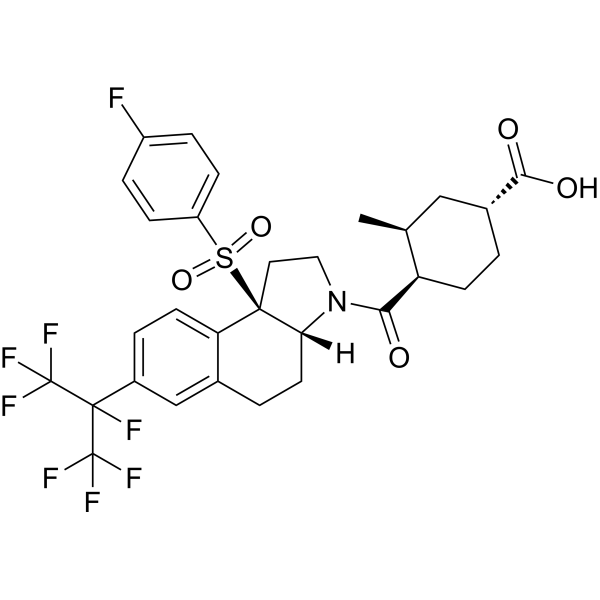 0 ImagesCat. No.: HY-136527CAS No.: 2460133-35-9BMS-986251 is an orally active and selective RORγt inverse agonist with an EC50 of 12 nM for RORγt GAL4. BMS-986251 inhibits IL-17 with an EC50 of 24 nM in human whole blood assay. BMS-986251 demonstrates robust efficacy in mouse acanthosis and Imiquimod-induced (HY-B0180) models (preclinical models of psoriasis).



