



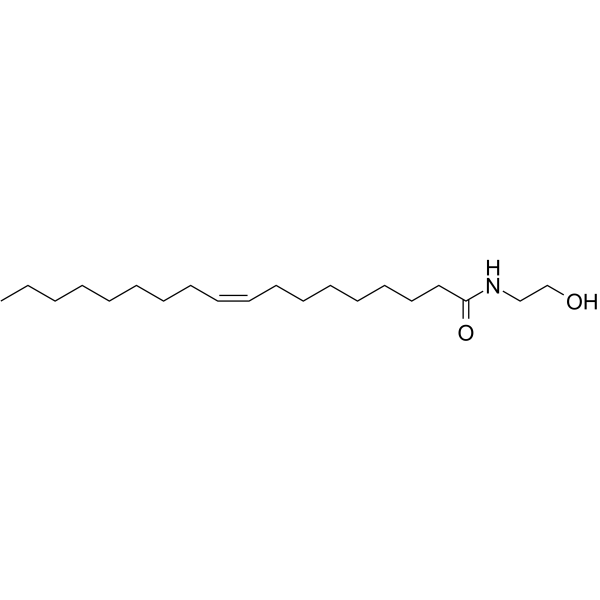
Oleoylethanolamide
Based on 3 publication(s) in Google Scholar
Oleoylethanolamide is a high affinity endogenous PPAR-α agonist, which plays an important role in the treatment of obesity and arteriosclerosis.
Para uso exclusivo en investigación. No vendemos a pacientes.
- Pureza: 98.19%
- No. CAS: 111-58-0
- Fòrmula: C20H39NO2
- Peso molecular:325.53
-
Almacenamiento:Powder -20°C, 3 years ; In solvent -80°C, 6 months , -20°C, 1 month

To place orders, for customer services and technical support, please contact: MedChemExpress USA
Tel: 609-228-6898 E-mail: [email protected] [email protected]


-
 Actividad biológica
-
Chemical Information
-
Solvente y solubilidad
- Protocolo
- Pureza y Documentación
- Referencias
-
 Help & FAQs



Publications Citing Use of MedChemExpress (MCE) Oleoylethanolamide
More Customer Validation & Images

-
Bio/Physico-chemical Assay
-
WB
-
WB
Ver todos los productos específicos de isoformas Endogenous Metabolite
More

Actividad biológica
|
Human Endogenous Metabolite |
PPAR-α |
|
Cell Line

|
Type | Value | Description | References |
|---|---|---|---|---|
| 786-0 | GI50 |
35.4 μg/mL
Compound: 4c
|
Antiproliferative activity against human 786-0 cells after 48 hrs by sulforhodamine B assay
Antiproliferative activity against human 786-0 cells after 48 hrs by sulforhodamine B assay
|
[PMID: 25510639] |
| HEK293 | EC50 |
0.89 μM
Compound: 2a, OEA
|
Agonist activity on human recombinant TRPV1-mediated enhancement of intracellular calcium concentration in HEK293 cells
Agonist activity on human recombinant TRPV1-mediated enhancement of intracellular calcium concentration in HEK293 cells
|
[PMID: 16570929] |
| HEK293 | EC50 |
2.2 μM
Compound: OEA
|
Agonist activity at human GPR119 expressed in HEK293 cells assessed as cAMP accumulation after 60 mins
Agonist activity at human GPR119 expressed in HEK293 cells assessed as cAMP accumulation after 60 mins
|
[PMID: 23357035] |
| HEK293 | EC50 |
2.2 μM
Compound: OEA
|
Agonist activity at human GPR119 expressed in HEK293 cells assessed as stimulation of cAMP level measured after 60 mins by HTRF assay
Agonist activity at human GPR119 expressed in HEK293 cells assessed as stimulation of cAMP level measured after 60 mins by HTRF assay
|
[PMID: 27825553] |
| HEK293 | EC50 |
2.2 μM
Compound: OEA
|
Agonist activity at human GPR119 expressed in HEK293 cells assessed as increase in cAMP stimulation measured after 60 mins by TR-FRET assay
Agonist activity at human GPR119 expressed in HEK293 cells assessed as increase in cAMP stimulation measured after 60 mins by TR-FRET assay
|
[PMID: 28408218] |
| HEK293 | EC50 |
2200 nM
Compound: OEA
|
Agonist activity at human GPR119 transfected in HEK293 cells assessed as concentration for 50 % cAMP stimulation of oleylethanolamine
Agonist activity at human GPR119 transfected in HEK293 cells assessed as concentration for 50 % cAMP stimulation of oleylethanolamine
|
[PMID: 23374864] |
| HEK293 | EC50 |
3.65 μM
Compound: 3b, OEA
|
Agonist activity at human recombinant TRPV1 expressed in HEK293 cells assessed as increase in intracellular calcium level
Agonist activity at human recombinant TRPV1 expressed in HEK293 cells assessed as increase in intracellular calcium level
|
[PMID: 19361197] |
| HeLa | EC50 |
0.12 μM
Compound: OEA
|
Transactivation of human Gal4 fused PPARalpha LBD transfected in human HeLa cells after 7 hrs by dual-luciferase reporter gene assay
Transactivation of human Gal4 fused PPARalpha LBD transfected in human HeLa cells after 7 hrs by dual-luciferase reporter gene assay
|
[PMID: 27622746] |
| HeLa | EC50 |
1.1 μM
Compound: OEA
|
Transactivation of human Gal4 fused PPARdelta LBD transfected in human HeLa cells after 7 hrs by dual-luciferase reporter gene assay
Transactivation of human Gal4 fused PPARdelta LBD transfected in human HeLa cells after 7 hrs by dual-luciferase reporter gene assay
|
[PMID: 27622746] |
| MCF7 | EC50 |
152 nM
Compound: OEA
|
Agonist activity at human PPARalpha expressed in MCF7 cells co-transfected CPTI DR1-type RE after 16 hrs by luciferase reporter gene assay
Agonist activity at human PPARalpha expressed in MCF7 cells co-transfected CPTI DR1-type RE after 16 hrs by luciferase reporter gene assay
|
[PMID: 24936232] |
| MCF7 | EC50 |
152 nM
Compound: OEA
|
Agonist activity at human PPARalpha transfected in human MCF7 cells after 16 hrs by luciferase reporter gene assay
Agonist activity at human PPARalpha transfected in human MCF7 cells after 16 hrs by luciferase reporter gene assay
|
[PMID: 26226490] |
| MCF7 | EC50 |
185 nM
Compound: OEA
|
Agonist activity at human PPARalpha expressed in MCF7 cells co-transfected CPTI DR1-type RE after 6 hrs by luciferase reporter gene assay
Agonist activity at human PPARalpha expressed in MCF7 cells co-transfected CPTI DR1-type RE after 6 hrs by luciferase reporter gene assay
|
[PMID: 24936232] |
| MCF7 | GI50 |
25.9 μg/mL
Compound: 4c
|
Antiproliferative activity against human MCF7 cells after 48 hrs by sulforhodamine B assay
Antiproliferative activity against human MCF7 cells after 48 hrs by sulforhodamine B assay
|
[PMID: 25510639] |
| NCI/ADR-RES | GI50 |
9.1 μg/mL
Compound: 4c
|
Antiproliferative activity against human NCI/ADR-RES cells after 48 hrs by sulforhodamine B assay
Antiproliferative activity against human NCI/ADR-RES cells after 48 hrs by sulforhodamine B assay
|
[PMID: 25510639] |
| NCI-H460 | GI50 |
36.5 μg/mL
Compound: 4c
|
Antiproliferative activity against human NCI-H460 cells after 48 hrs by sulforhodamine B assay
Antiproliferative activity against human NCI-H460 cells after 48 hrs by sulforhodamine B assay
|
[PMID: 25510639] |
| OVCAR-3 | GI50 |
35.4 μg/mL
Compound: 4c
|
Antiproliferative activity against human OVCAR3 cells after 48 hrs by sulforhodamine B assay
Antiproliferative activity against human OVCAR3 cells after 48 hrs by sulforhodamine B assay
|
[PMID: 25510639] |
| PC-3 | GI50 |
16.9 μg/mL
Compound: 4c
|
Antiproliferative activity against human PC3 cells after 48 hrs by sulforhodamine B assay
Antiproliferative activity against human PC3 cells after 48 hrs by sulforhodamine B assay
|
[PMID: 25510639] |
| RBL-2H3 | IC50 |
>50 μM
Compound: 10
|
Antiallergic activity in rat RBL2H3 cells assessed as inhibition of DNP-HSA-mediated degranulation by measuring decrease in beta-hexosaminidase activity preincubated for 30 mins followed by DNP-HSA stimulation and measured after 30 mins by 4-nitrophenyl 2
Antiallergic activity in rat RBL2H3 cells assessed as inhibition of DNP-HSA-mediated degranulation by measuring decrease in beta-hexosaminidase activity preincubated for 30 mins followed by DNP-HSA stimulation and measured after 30 mins by 4-nitrophenyl 2
|
[PMID: 31618024] |
| RBL-2H3 | IC50 |
20 μM
Compound: 2a, OEA
|
Inhibition of AEA uptake in RBL2H3 cells
Inhibition of AEA uptake in RBL2H3 cells
|
[PMID: 16570929] |
| SK-OV-3 | IC50 |
24 μM
Compound: N-oleylethanolamine
|
Inhibition of ceramidase in human SKOV3 cells assessed as hydrolysis of N-((2S,3R)-1,3-dihydroxy-5-((2-oxo-2H-chromen-7- yl)oxy)pentan-2-yl)palmitamide at 16 uM after 24 hrs at 37 degC by HPLC
Inhibition of ceramidase in human SKOV3 cells assessed as hydrolysis of N-((2S,3R)-1,3-dihydroxy-5-((2-oxo-2H-chromen-7- yl)oxy)pentan-2-yl)palmitamide at 16 uM after 24 hrs at 37 degC by HPLC
|
[PMID: 20085856] |
| SK-OV-3 | IC50 |
28 μM
Compound: N-oleylethanolamine
|
Inhibition of ceramidase in human SKOV3 cells assessed as hydrolysis of N-((2S,3R)-1,3-dihydroxy-5-((2-oxo-2H-chromen-7- yl)oxy)pentan-2-yl)palmitamide at 16 uM after 24 hrs at 37 degC by umbelliferone formation based fluorescence intensity assay
Inhibition of ceramidase in human SKOV3 cells assessed as hydrolysis of N-((2S,3R)-1,3-dihydroxy-5-((2-oxo-2H-chromen-7- yl)oxy)pentan-2-yl)palmitamide at 16 uM after 24 hrs at 37 degC by umbelliferone formation based fluorescence intensity assay
|
[PMID: 20085856] |
| U-251 | GI50 |
27.3 μg/mL
Compound: 4c
|
Antiproliferative activity against human U251 cells after 48 hrs by sulforhodamine B assay
Antiproliferative activity against human U251 cells after 48 hrs by sulforhodamine B assay
|
[PMID: 25510639] |
Oleoylethanolamide (OEA), an endogenous PPAR-α ligand, attenuates liver fibrosis targeting hepatic stellate cells. Oleoylethanolamide suppresses TGF-β1 induced hepatic stellate cells (HSCs) activation in vitro via PPAR-α. To assess the impact of Oleoylethanolamide on HSCs activation, the expression levels of α-SMA and Col1a in TGF-β1-stimulated HSCs are examined by qPCR. The mRNA levels of α-SMA and Col1a are markedly induced in the group of CFSC cells with TGF-β1 (5 ng/mL) stimulation for 48h, while the mRNA levels are suppressed when treated with Oleoylethanolamide in a dose-dependent manner. Immunofluorescence and western blot results show that Oleoylethanolamide treatment dose-dependently inhibits the protein expression of α-SMA, the marker of HSC activation. The inhibitory effects of Oleoylethanolamide on HSCs activation are completely blocked by PPAR-α antagonist MK886 (10 μM). Moreover, the mRNA and protein expression levels of PPAR-α are down-regulated with TGF-β1 stimulation, while Oleoylethanolamide treatment restores these changes in dose-dependent manner. In addition, the phosphorylation of Smad 2/3 is upregulated in the presence of TGF-β1 stimulation, consistent with the observed effects on HSC activation, while Oleoylethanolamide (10 μM) reduces the phosphorylation of Smad2/3 in CFSC simulated with TGF-β1[1].
MedChemExpress (MCE) has not independently confirmed the accuracy of these methods. They are for reference only.
MedChemExpress (MCE) has not independently confirmed the accuracy of these methods. They are for reference only.
| NCT Number | Sponsor | Condition | Start Date |
Phase
|
|---|---|---|---|---|
| NCT01329991 | Plexxikon| | 2011-05 | PHASE1 |


Chemical Information
-
No. CAS 111-58-0
-
Appearance Solid
-
Peso molecular 325.53
-
Fòrmula C20H39NO2
-
Color White to light yellow
-
SMILES
CCCCCCCC/C=C\CCCCCCCC(NCCO)=O
-
Synonyms
N-Oleoylethanolamide; Oleamide MEA; Oleic acid monoethanolamide
-
Structure Classification
-
Initial Source
-
Envío
Room temperature in continental US; may vary elsewhere.
-
Almacenamiento
Powder -20°C 3 years In solvent -80°C 6 months -20°C 1 month


Publications (3)
-
Journal Impact Factor
-
Most Recent
-
Autophagy
Mitophagy-mediated S1P facilitates muscle adaptive responses to endurance exercise through SPHK1-S1PR1/S1PR2 in slow-twitch myofibers. [Abstract]2025 Apr 3. PMID: 40181214
Oleoylethanolamide purchased from MedChemExpress. Usage Cited in: Autophagy. 2025 Apr 3. [Abstract]
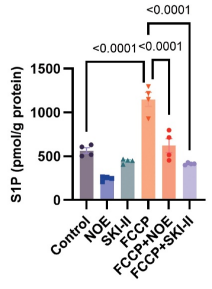
Quantification of S1P concentrations in C2C12 myotubes treated with 10 μM FCCP for 4 h with/without 50 μM NOE or 5 μM SKI-II pre-treatment (n = 4).
Oleoylethanolamide purchased from MedChemExpress. Usage Cited in: Autophagy. 2025 Apr 3. [Abstract]
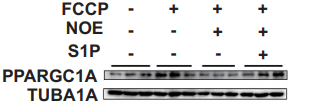
PPARGC1A protein levels in the C2C12 myotubes 48 h after the stimulation of 10 μM FCCP with/without 50 μM NOE (24 h) in the absence or presence of 5 μM S1P (n = 3).
-
J Agric Food Chem
Exposure to Succinate Leads to Steatosis in Non-Obese Non-Alcoholic Fatty Liver Disease by Inhibiting AMPK/PPARα/FGF21-Dependent Fatty Acid Oxidation. [Abstract]2024 Sep 25;72(38):21052-21064. PMID: 39268842
Oleoylethanolamide purchased from MedChemExpress. Usage Cited in: J Agric Food Chem. 2024 Sep 25;72(38):21052-21064. [Abstract]
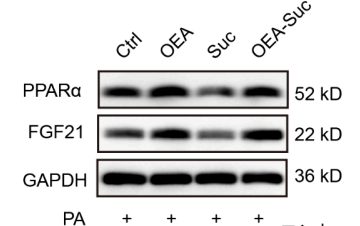
The PPARα and FGF21 protein expression levels was detected using Western blot after treatment with OEA (10 μM) for 48 h in PA-treated HepG2 cells.
-
Structure
Native mass spectrometry prescreening of G protein-coupled receptor complexes for cryo-EM structure determination. [Abstract]2024 Dec 5;32(12):2206-2219.e4. PMID: 39471802


Solvente y solubilidad
DMSO : 20.83 mg/mL (63.99 mM; Need ultrasonic; Hygroscopic DMSO has a significant impact on the solubility of product, please use newly opened DMSO)
Please refer to the solubility information to select the appropriate solvent. Once prepared, please aliquot and store the solution to prevent product inactivation from repeated freeze-thaw cycles.
Storage method and period of stock solution: -80°C, 6 months; -20°C, 1 month. When stored at -80°C, please use it within 6 months. When stored at -20°C, please use it within 1 month.
Please refer to the solubility information to select the appropriate solvent. Once prepared, please aliquot and store the solution to prevent product inactivation from repeated freeze-thaw cycles.
Storage method and period of stock solution: -80°C, 6 months; -20°C, 1 month. When stored at -80°C, please use it within 6 months. When stored at -20°C, please use it within 1 month.
Concentration (start) × Volume (start) = Concentration (final) × Volume (final)
Select the appropriate dissolution method based on your experimental animal and administration route.
- For the following dissolution methods, please ensure to first prepare a clear stock solution using an In Vitro approach and then sequentially add co-solvents:
- To ensure reliable experimental results, the clarified stock solution can be appropriately stored based on storage conditions. As for the working solution for In Vivo experiments, it is recommended to prepare freshly and use it on the same day.
- The percentages shown for the solvents indicate their volumetric ratio in the final prepared solution. If precipitation or phase separation occurs during preparation, heat and/or sonication can be used to aid dissolution.
Add each solvent one by one: 10% DMSO 40% PEG300 5% Tween-80 45% Saline
Solubility: ≥ 2.08 mg/mL (6.39 mM); Clear solution
This protocol yields a clear solution of ≥ 2.08 mg/mL (saturation unknown).
Taking 1 mL working solution as an example, add 100 μL DMSO stock solution (20.8 mg/mL) to 400 μL PEG300, and mix evenly; then add 50 μL Tween-80 and mix evenly; then add 450 μL Saline to adjust the volume to 1 mL.
Preparation of Saline: Dissolve 0.9 g sodium chloride in ddH₂O and dilute to 100 mL to obtain a clear Saline solution.
Please enter the basic information of animal experiments:
-
-
-
-
Recommended: Prepare an additional quantity of animals to account for potential losses during experiments.
Please enter your animal formula composition:
-
%DMSO +
Recommended: Keep the proportion of DMSO in working solution below 2% if your animal is weak.
-
%+
-
+%Tween-80 + +
-
%Saline +
The co-solvents required include: DMSO, . All of co-solvents are available by MedChemExpress (MCE). , Tween 80. All of co-solvents are available by MedChemExpress (MCE).
Working solution concentration: 0.22 mg/mL
Method for preparing stock solution: mg drug dissolved in μL DMSO. Stock solution concentration: mg/mL.
1. Take μL DMSO stock solution;
2. Add μL .
μL , mix evenly;
3. Then add μL Tween 80, mix evenly;
4. Then add μL
Please ensure that the stock solution in the first step is dissolved to a clear state, and add co-solvents in sequence. You can use ultrasonic heating (ultrasonic cleaner, recommended frequency 20-40 kHz), vortexing, etc. to assist dissolution.

Protocolo
CFSC, HSC cell lines are first obtained from cirrhotic rat liver, and have a similar phenotype to that of early passage primary HSCs. CFSC cells are cultured in Dulbecco's modified Eagle's medium (DMEM) supplemented with 10% fetal bovine serum (FBS) and 1% penicillin/streptomycin. All cells are cultured in 6-well culture plates under 37°C and 5% CO2 in an incubator. The medium is replaced every two days, and the cells are harvested and diluted at a ratio of 1:3 twice a week. In experiments, HSCs are pretreated with the experimental concentration of Oleoylethanolamide (30 μM, 10 μM, 3 μM) before stimulation with 5 ng/mL TGF-β1. mRNA expression levels of α-SMA (A) and Col1a (B) are analyzed by real-time PCR[1].
MedChemExpress (MCE) has not independently confirmed the accuracy of these methods. They are for reference only.
Mice[1]
The Sv/129 mice and PPAR-α knockout mice are maintained in a room with controlled temperature (21-23°C), humidity (55-60%) and lighting (12 h light/dark cycles) and given water ad libitum. Mice are randomly divided for methionine choline-deficient (MCD) and thioacetamide (TAA) experiments. In the MCD-diet feeding experiment, wild-type Sv/129 mice and PPAR-α knockout mice are each divided into three groups (n=8 /group): (i) control group receive normal diet; (ii) fed with MCD diet and injected with the vehicle (5% Tween-80+5% PEG400+90% saline, 5 mL/kg/day, 8 weeks, intraperitoneal injection, i.p.); (iii) fed with MCD diet along with Oleoylethanolamide administration (5 mg/kg/day; 8 weeks, i.p.). In another set of experiment, all the wild-type mice and PPAR-α knockout mice are given standard chow diet, and are randomly separated into three groups: the control group is not administrated TAA or Oleoylethanolamide but is injected with the saline; the TAA group is injected with TAA (160 mg/kg, three times per week, 6 weeks, dissolved in saline, i.p.) plus the corresponding vehicle; the Oleoylethanolamide group is both injected with TAA and Oleoylethanolamide (5 mg/kg/day; 6 weeks, i.p.)[1].
MedChemExpress (MCE) has not independently confirmed the accuracy of these methods. They are for reference only.


Pureza y Documentación
-
Ficha de datos (272 KB)
-
SDS (393 KB)
- English - EN (393 KB)
- Français - FR (393 KB)
- Deutsch - DE (393 KB)
- Norwegian - NO (393 KB)
- Español - ES (393 KB)
- Swedish - SV (393 KB)
- Italian - IT (393 KB)
- Korean - KR (393 KB)
- Portuguese - PT (393 KB)
-
Instrucciones de manejo (2659 KB)
Referencias


Complete Stock Solution Preparation Table
Please refer to the solubility information to select the appropriate solvent. Once prepared, please aliquot and store the solution to prevent product inactivation from repeated freeze-thaw cycles.
Storage method and period of stock solution: -80°C, 6 months; -20°C, 1 month. When stored at -80°C, please use it within 6 months. When stored at -20°C, please use it within 1 month.
| Optional Solvent | Concentration Solvent Mass | 1 mg | 5 mg | 10 mg | 25 mg |
|---|---|---|---|---|---|
| DMSO | 1 mM | 3.0719 mL | 15.3596 mL | 30.7191 mL | 76.7978 mL |
| 5 mM | 0.6144 mL | 3.0719 mL | 6.1438 mL | 15.3596 mL | |
| 10 mM | 0.3072 mL | 1.5360 mL | 3.0719 mL | 7.6798 mL | |
| 15 mM | 0.2048 mL | 1.0240 mL | 2.0479 mL | 5.1199 mL | |
| 20 mM | 0.1536 mL | 0.7680 mL | 1.5360 mL | 3.8399 mL | |
| 25 mM | 0.1229 mL | 0.6144 mL | 1.2288 mL | 3.0719 mL | |
| 30 mM | 0.1024 mL | 0.5120 mL | 1.0240 mL | 2.5599 mL | |
| 40 mM | 0.0768 mL | 0.3840 mL | 0.7680 mL | 1.9199 mL | |
| 50 mM | 0.0614 mL | 0.3072 mL | 0.6144 mL | 1.5360 mL | |
| 60 mM | 0.0512 mL | 0.2560 mL | 0.5120 mL | 1.2800 mL |


Oleoylethanolamide Related Classifications
HY-107542 Related Classifications
 Powered by Bioz