



Genistein 7-β-D-Glucuronide

Based on 1 Customer Validation
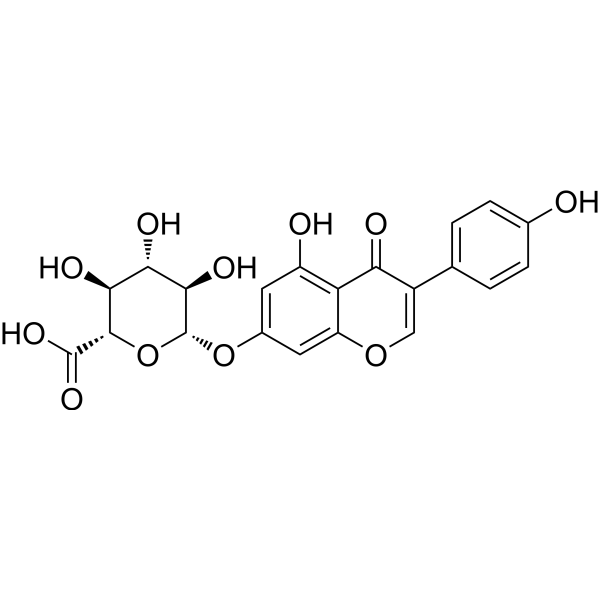
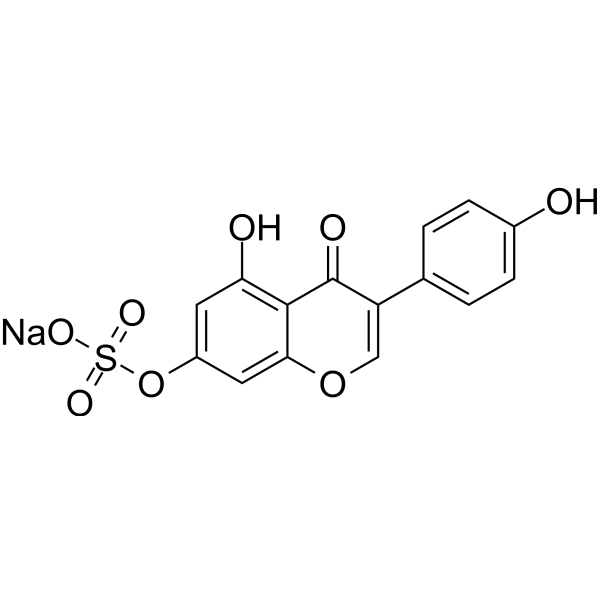
Genistein 7-β-D-Glucuronide (Genistein 7-O-glucuronide) is the primary phase II metabolite of Genistein (HY-14596) in human and rat hepatocytes. Genistein 7-β-D-Glucuronide undergoes distinct deconjugation in different functional assays. Genistein 7-β-D-Glucuronide is produced via hepatic microsomal glucuronidation and shows a mild age-related increase in intrinsic clearance in male F344 rats. Genistein 7-β-D-Glucuronide can be used for research on metabolism.
For research use only. We do not sell to patients.
- Purity : 98.76%
- CAS No.: 38482-81-4
- Formula: C21H18O11
- Molecular Weight:446.36
-
Storage:
4°C, sealed storage, away from moisture
* In solvent : -80°C, 6 months; -20°C, 1 month (sealed storage, away from moisture)

To place orders, for customer services and technical support, please contact: MedChemExpress USA
Tel: 609-228-6898 E-mail: [email protected] [email protected]


-
 Biological Activity
-
Chemical Information
-
Solvent & Solubility
- Purity & Documentation
- References
-
 Help & FAQs




Biological Activity
Description
In Vitro
Genistein 7-β-D-Glucuronide (10 μM) exerts no inhibitory effects on either tubulogenesis or migration in primary human aortic endothelial cells (HAECs)[1].
Genistein 7-β-D-Glucuronide undergoes partial deconjugation to free Genistein in primary human aortic endothelial cells (HAECs), with significantly more deconjugation occurring in tubulogenesis assay conditions (~3.77 μM free genistein) than in migration assay conditions (~0.11 μM free genistein) after 24 hours of incubation[1].
Genistein 7-β-D-Glucuronide (15 μM 14C-genistein; 2 h) is produced as the predominant metabolite by incubation of Genistein with cryopreserved human and rat hepatocytes, accounting for over 50% of the incubated dose in both species with no significant difference in production rates[2].
MedChemExpress (MCE) has not independently confirmed the accuracy of these methods. They are for reference only.
In Vivo
MedChemExpress (MCE) has not independently confirmed the accuracy of these methods. They are for reference only.


Chemical Information
-
CAS No. 38482-81-4
-
Appearance Solid
-
Molecular Weight 446.36
-
Formula C21H18O11
-
Color White to light yellow
-
SMILES
O=C1C(C(OC=C1C(C=C2)=CC=C2O)=CC(O[C@@H]([C@@H]([C@H]3O)O)O[C@@H]([C@H]3O)C(O)=O)=C4)=C4O
-
Synonyms
Genistein 7-O-glucuronide
-
Shipping
Room temperature in continental US; may vary elsewhere.
-
Storage
4°C, sealed storage, away from moisture
* In solvent : -80°C, 6 months; -20°C, 1 month (sealed storage, away from moisture)


Solvent & Solubility
In Vitro:
DMSO : 100 mg/mL (224.03 mM; Need ultrasonic; Hygroscopic DMSO has a significant impact on the solubility of product, please use newly opened DMSO)
Please refer to the solubility information to select the appropriate solvent. Once prepared, please aliquot and store the solution to prevent product inactivation from repeated freeze-thaw cycles.
Storage method and period of stock solution: -80°C, 6 months; -20°C, 1 month (sealed storage, away from moisture). When stored at -80°C, please use it within 6 months. When stored at -20°C, please use it within 1 month.
Please refer to the solubility information to select the appropriate solvent. Once prepared, please aliquot and store the solution to prevent product inactivation from repeated freeze-thaw cycles.
Storage method and period of stock solution: -80°C, 6 months; -20°C, 1 month (sealed storage, away from moisture). When stored at -80°C, please use it within 6 months. When stored at -20°C, please use it within 1 month.
Concentration (start) × Volume (start) = Concentration (final) × Volume (final)
In Vivo:
Select the appropriate dissolution method based on your experimental animal and administration route.
- For the following dissolution methods, please ensure to first prepare a clear stock solution using an In Vitro approach and then sequentially add co-solvents:
- To ensure reliable experimental results, the clarified stock solution can be appropriately stored based on storage conditions. As for the working solution for In Vivo experiments, it is recommended to prepare freshly and use it on the same day.
- The percentages shown for the solvents indicate their volumetric ratio in the final prepared solution. If precipitation or phase separation occurs during preparation, heat and/or sonication can be used to aid dissolution.
Add each solvent one by one: 10% DMSO 40% PEG300 5% Tween-80 45% Saline
Solubility: ≥ 5 mg/mL (11.20 mM); Clear solution
This protocol yields a clear solution of ≥ 5 mg/mL (saturation unknown).
Taking 1 mL working solution as an example, add 100 μL DMSO stock solution (50.0 mg/mL) to 400 μL PEG300, and mix evenly; then add 50 μL Tween-80 and mix evenly; then add 450 μL Saline to adjust the volume to 1 mL.
Preparation of Saline: Dissolve 0.9 g sodium chloride in ddH₂O and dilute to 100 mL to obtain a clear Saline solution.
Add each solvent one by one: 10% DMSO 90% (20% SBE-β-CD in Saline)
Solubility: ≥ 5 mg/mL (11.20 mM); Clear solution
This protocol yields a clear solution of ≥ 5 mg/mL (saturation unknown).
Taking 1 mL working solution as an example, add 100 μL DMSO stock solution (50.0 mg/mL) to 900 μL 20% SBE-β-CD in Saline, and mix evenly.
Preparation of 20% SBE-β-CD in Saline (4°C, storage for one week): 2 g SBE-β-CD powder is dissolved in 10 mL Saline, completely dissolve until clear.
In Vivo Dissolution Calculator
Please enter the basic information of animal experiments:
-
-
-
-
Recommended: Prepare an additional quantity of animals to account for potential losses during experiments.
Please enter your animal formula composition:
-
%DMSO +
Recommended: Keep the proportion of DMSO in working solution below 2% if your animal is weak.
-
%+
-
+%Tween-80 + +
-
%Saline +
The co-solvents required include: DMSO, . All of co-solvents are available by MedChemExpress (MCE). , Tween 80. All of co-solvents are available by MedChemExpress (MCE).
Working solution concentration: 0.22 mg/mL
Method for preparing stock solution: mg drug dissolved in μL DMSO. Stock solution concentration: mg/mL. * In solvent : -80°C, 6 months; -20°C, 1 month (sealed storage, away from moisture)
1. Take μL DMSO stock solution;
2. Add μL .
μL , mix evenly;
3. Then add μL Tween 80, mix evenly;
4. Then add μL
Please ensure that the stock solution in the first step is dissolved to a clear state, and add co-solvents in sequence. You can use ultrasonic heating (ultrasonic cleaner, recommended frequency 20-40 kHz), vortexing, etc. to assist dissolution.


Purity & Documentation
-
Data Sheet (274 KB)
-
SDS (252 KB)
- English - EN (252 KB)
- Français - FR (252 KB)
- Deutsch - DE (252 KB)
- Norwegian - NO (252 KB)
- Español - ES (252 KB)
- Swedish - SV (252 KB)
- Italian - IT (252 KB)
- Korean - KR (252 KB)
- Portuguese - PT (252 KB)
-
Handling Instructions (2659 KB)
References
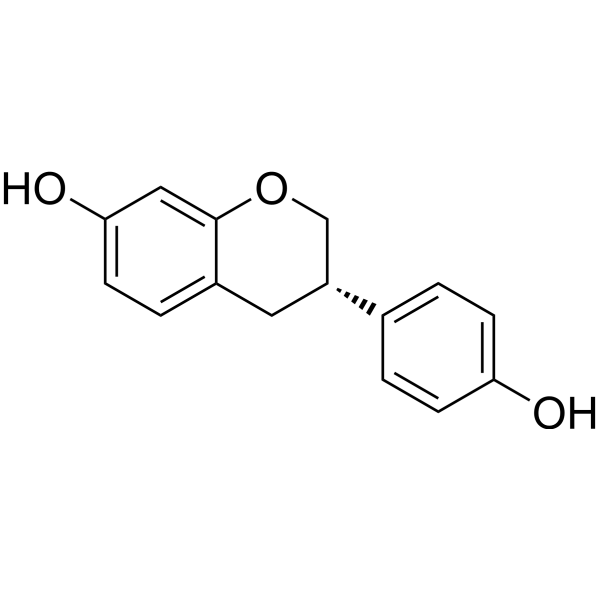
[1]. Giménez-Bastida JA, et al. (R,S)-Equol 7-β-D-glucuronide, but not other circulating isoflavone metabolites, modulates migration and tubulogenesis in human aortic endothelial cells targeting the VEGF pathway. Food Funct. 2024;15(14):7387-7399. Published 2024 Jul 15. [Content Brief]
[2]. Bursztyka J, et al. Comparison of genistein metabolism in rats and humans using liver microsomes and hepatocytes. Food Chem Toxicol. 2008;46(3):939-948. [Content Brief]
[3]. Bolling BW, et al. The kinetic basis for age-associated changes in quercetin and genistein glucuronidation by rat liver microsomes. J Nutr Biochem. 2010;21(6):498-503. [Content Brief]


Complete Stock Solution Preparation Table
Please refer to the solubility information to select the appropriate solvent. Once prepared, please aliquot and store the solution to prevent product inactivation from repeated freeze-thaw cycles.
Storage method and period of stock solution: -80°C, 6 months; -20°C, 1 month (sealed storage, away from moisture). When stored at -80°C, please use it within 6 months. When stored at -20°C, please use it within 1 month.
| Optional Solvent | Concentration Solvent Mass | 1 mg | 5 mg | 10 mg | 25 mg |
|---|---|---|---|---|---|
| DMSO | 1 mM | 2.2403 mL | 11.2017 mL | 22.4034 mL | 56.0086 mL |
| 5 mM | 0.4481 mL | 2.2403 mL | 4.4807 mL | 11.2017 mL | |
| 10 mM | 0.2240 mL | 1.1202 mL | 2.2403 mL | 5.6009 mL | |
| 15 mM | 0.1494 mL | 0.7468 mL | 1.4936 mL | 3.7339 mL | |
| 20 mM | 0.1120 mL | 0.5601 mL | 1.1202 mL | 2.8004 mL | |
| 25 mM | 0.0896 mL | 0.4481 mL | 0.8961 mL | 2.2403 mL | |
| 30 mM | 0.0747 mL | 0.3734 mL | 0.7468 mL | 1.8670 mL | |
| 40 mM | 0.0560 mL | 0.2800 mL | 0.5601 mL | 1.4002 mL | |
| 50 mM | 0.0448 mL | 0.2240 mL | 0.4481 mL | 1.1202 mL | |
| 60 mM | 0.0373 mL | 0.1867 mL | 0.3734 mL | 0.9335 mL | |
| 80 mM | 0.0280 mL | 0.1400 mL | 0.2800 mL | 0.7001 mL | |
| 100 mM | 0.0224 mL | 0.1120 mL | 0.2240 mL | 0.5601 mL |


Genistein 7-β-D-Glucuronide Related Classifications
HY-137967 Related Classifications
 Powered by Bioz