



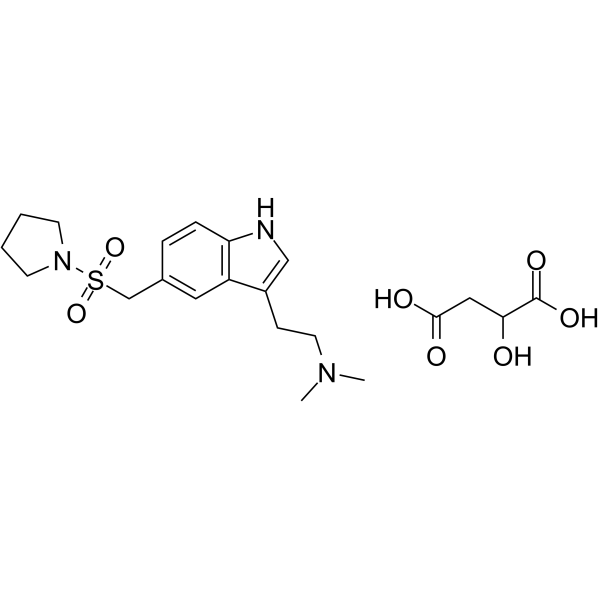
Almotriptan malate

Based on 1 Customer Validation
Almotriptan malate (PNU180638) is an orally active, highly selective agonist of the 5-HT1B/1D receptor (5-HT1B/1D receptor), with EC50 values of 1.6 nM and 3.1 nM, respectively. Almotriptan malate shows moderate affinity for the 5-HT1F receptor, and weak affinity for the 5-HT1A, 5-HT6 and 5-HT7 receptors. Almotriptan malate induces intracranial vasoconstriction, inhibits nociceptive neurotransmission in the trigeminocervical complex, and suppresses the release of vasoactive peptides from trigeminal nerve endings. Almotriptan malate can be used in research related to migraine.
연구목적의 판매만을 진행합니다. 환자를 대상으로 한 판매는 하지 않습니다.
- Purity : 99.53%
- CAS No.: 181183-52-8
- 화학식: C21H31N3O7S
- 분자량:469.55
-
보관:
4°C, sealed storage, away from moisture
* In solvent : -80°C, 6 months; -20°C, 1 month (sealed storage, away from moisture)

To place orders, for customer services and technical support, please contact: MedChemExpress USA
Tel: 609-228-6898 E-mail: [email protected] [email protected]


-
 Biological Activity
-
Chemical Information
-
용액&용해도
- 순도&문서
- References
-
 Help & FAQs


-
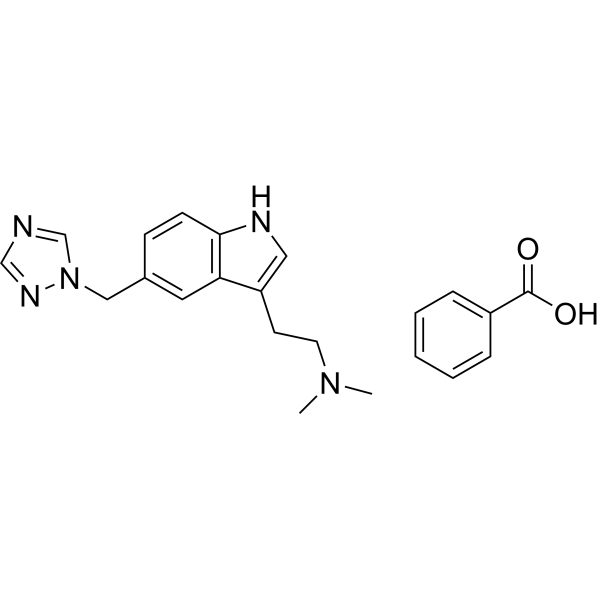
HY-B0206
Rizatriptan benzoate5-HT1 Agonist -
HY-B0383R
Almotriptan malate (Standard)Analytical Standard -
HY-B0121
Sumatriptan succinate5-HT1 Receptor Agonist -
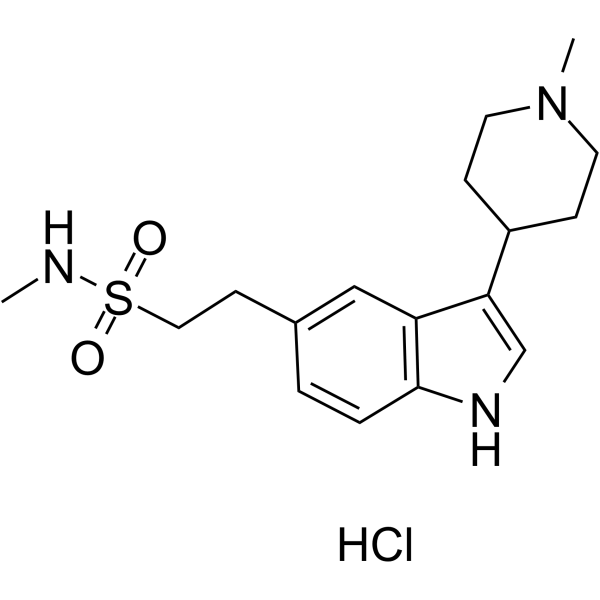
HY-B0197A
Naratriptan hydrochloride5-HT(1B/1D) Receptor Agonist -
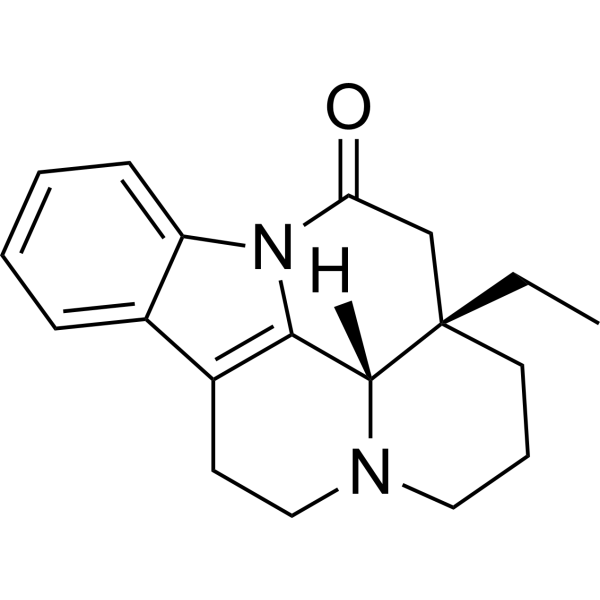
HY-B1180
VinburnineP38/MAPK Activator -
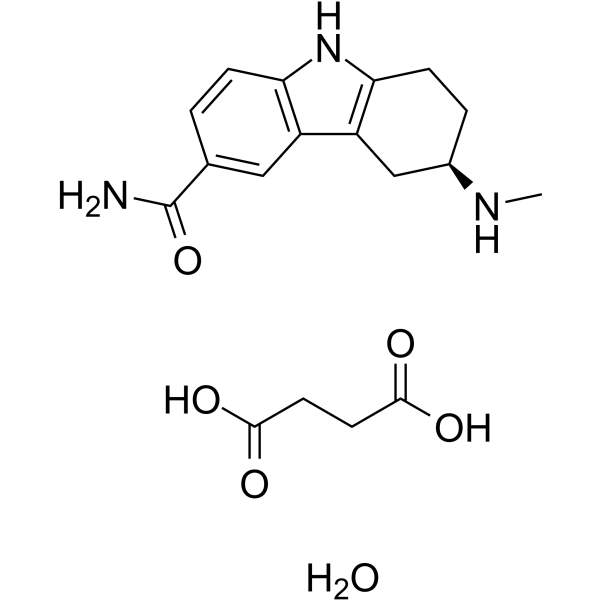
HY-B1658A
Frovatriptan succinate hydrate5-HT1B/1D Receptor Agonist -

HY-B0121R
Sumatriptan succinate (Standard)5-HT1 Receptor Agonist -
HY-B0206R
Rizatriptan benzoate (Standard)5-HT1 Agonist -

HY-B0197AR
Naratriptan hydrochloride (Standard)5-HT(1B/1D) Receptor Agonist -

HY-B1658AR
Frovatriptan succinate hydrate (Standard)5-HT1B/1D Receptor Agonist -

HY-B1180R
Vinburnine (Standard)Reference Standard
All 5-HT Receptor Isoforms
More

Biological Activity
제품 설명
IC50 & Target
[2]|
5-HT1B Receptor 1.6 nM (EC50) |
5-HT1D Receptor 3.1 nM (EC50) |
In Vitro
Almotriptan malate acts as a full agonist to induce potent concentration-dependent contractions in canine isolated saphenous veins, with an EC50 of 394 nM, via 5-HT1B/1D receptors[2].
Almotriptan malate induces vasoconstriction in human isolated meningeal, superficial temporal, and basilar arteries, with EC50 values of 0.7 μM (superficial temporal) and 3.7 μM (basilar), and greater potency than Sumatriptan (HY-B0121B) in meningeal arteries[2].
Almotriptan malate is metabolized by multiple human liver microsomal enzymes, including MAO-A, FMO, aldehyde dehydrogenase, CYP2D6, and CYP3A4, and only weakly inhibits CYP2D6 with no significant inhibition of MAO-A or MAO-B[2].
MedChemExpress (MCE) has not independently confirmed the accuracy of these methods. They are for reference only.
Parmacokinetics
| Species | Dose | Route | Note | Tmax | Cmax | AUC | T1/2 | Vz | CL | F |
|---|---|---|---|---|---|---|---|---|---|---|
| Rat[2] | 10 mg/kg | i.v. | male | 0.1 h | 3.43 μg/mL | 1.69 μg·h/mL | 0.8 h | 6.4 L/kg | 5.9 L/h/kg | / |
| Rat[2] | 10 mg/kg | i.v. | female | 0.1 h | 3.60 μg/mL | 1.82 μg·h/mL | 0.7 h | 5.3 L/kg | 5.5 L/h/kg | / |
| Rat[2] | 10 mg/kg | s.c. | male | 0.5 h | 1.55 μg/mL | 1.75 μg·h/mL | 0.6 h | 4.9 L/kg | 5.7 L/h/kg | 104 % |
| Rat[2] | 10 mg/kg | s.c. | female | 0.5 h | 1.58 μg/mL | 1.99 μg·h/mL | 0.8 h | 5.5 L/kg | 5.0 L/h/kg | 109 % |
| Rat[2] | 10 mg/kg | p.o. | male | 0.25 h | 0.57 μg/mL | 0.62 μg·h/mL | 2.0 h | / | / | 37 % |
| Rat[2] | 10 mg/kg | p.o. | female | 0.25 h | 0.45 μg/mL | 0.64 μg·h/mL | 1.2 h | / | / | 35 % |
| Dog[2] | 5 mg/kg | i.v. | / | 0.1 h | 1.95 μg/mL | 4.39 μg·h/mL | 2.3 h | 3.7 L/kg | 1.2 L/h/kg | / |
| Dog[2] | 5 mg/kg | s.c. | / | 0.5 h | 1.6 μg/mL | 5.14 μg·h/mL | 2.8 h | / | / | 118 % |
| Dog[2] | 5 mg/kg | p.o. | / | 0.8 h | 0.92 μg/mL | 3.60 μg·h/mL | 2.4 h | / | / | 82 % |
| Cynomolgus Monkey[2] | 10 mg/kg | i.v. | / | 0.08 h | 5.18 μg/mL | 4.32 μg·h/mL | 1.3 h | 4.4 L/kg | 2.4 L/h/kg | / |
| Cynomolgus Monkey[2] | 10 mg/kg | p.o. | / | 3.5 h | 0.20 μg/mL | 0.79 μg·h/mL | 1.7 h | / | / | 19 % |
In Vivo
Almotriptan (0-1 mg/kg; intravenous injection; single dose; maximum 0.3 mg/kg; intravenous injection; single dose; 30 μg/min; intracoronary infusion; 1 h) malate increases carotid vascular resistance in beagle dogs, and exhibits better carotid-femoral artery selectivity than Sumatriptan. At the tested doses, this agent has favorable cardiovascular safety, with no cardiac inhibitory effect or QTc interval change[2].
Almotriptan (10 mg/kg; subcutaneous injection; single dose) malate inhibits trigeminal ganglion-induced meningeal vascular extravasation in anesthetized guinea pigs, and at a subcutaneous dose of 10 mg/kg, it causes no hypothermia or bronchospasm in conscious guinea pigs[2].
Almotriptan (oral administration; single dose) malate does not alter cardiovascular parameters or diuretic effects in normotensive Wistar rats at the tested oral doses[2].
Almotriptan (1-3 mg/kg; subcutaneous injection; single administration) malate exerts no cardiovascular effects at the dose of 1 mg/kg s.c. in conscious cynomolgus monkeys, while the 3 mg/kg s.c. dose only induces mild, transient effects without electrocardiogram changes[2].
Almotriptan (up to 300 mg/kg; p.o.; single administration) malate shows no central nervous system-related behavioral or motor function effects in mice at oral doses up to 300 mg/kg[2].
Almotriptan malate slightly alleviates apomorphine (HY-12723)-induced vomiting responses in dogs[2].
MedChemExpress (MCE) has not independently confirmed the accuracy of these methods. They are for reference only.
-
Animal Model:Domestic cat (anesthetized)[2]
-
Dosage:9 μg/kg (i.v.); 0.01-3000 μg/kg (i.v.); unspecified (i.d.)
-
Administration:i.v.; single dose; i.d.; single dose
-
Result:Increased carotid vascular resistance by 100%.
Produced statistically significant increases in carotid vascular resistance at doses ≥10 μg/kg i.v..
Showed effective enteric absorption via i.d.
administration, increasing carotid vascular resistance with potency and efficacy equivalent to sumatriptan.
Acted mainly on carotid arteriovenous anastomoses, had a tendency to increase cerebral blood flow in absolute and relative terms, and did not decrease the component of brain blood flow supplied by the carotid artery.
Carotid vasoconstrictor effects were almost completely reversed by methiothepin, a 5-HT1 receptor antagonist.
-
Animal Model:Beagle dog (anesthetized, conscious)[2]
-
Dosage:unspecified (carotid effect); 1 mg/kg; up to 0.3 mg/kg; 30 μg/min
-
Administration:i.v.; single dose; intracoronary infusion; 1 hour
-
Result:Increased carotid vascular resistance and showed greater selectivity for carotid versus femoral vascular beds compared to sumatriptan.
At 1 mg/kg i.v., produced a moderate increase in renal blood flow and a transient increase in diuresis and natriuresis, with no effect on glomerular filtration rate or filtration fraction.
At doses up to 0.3 mg/kg i.v.
in conscious dogs, had no effect on coronary blood flow or coronary vascular resistance, and produced no changes in evaluated ECG intervals.
Intracoronary infusion at 30 μg/min for 1 hour did not alter the QTc interval.
Did not induce a cardiodepressant effect (fall in heart rate and dP/dt_max) in open-chest anesthetized dogs, unlike sumatriptan.
-
Animal Model:Guinea pig (anesthetized, conscious)[2]
-
Dosage:10 mg/kg
-
Administration:s.c.; single dose
-
Result:Inhibited meningeal extravasation produced by electrical stimulation of the trigeminal ganglion in anesthetized guinea pigs.
Did not induce hypothermia in conscious guinea pigs.
Did not cause bronchospasm in conscious guinea pigs.
-
Animal Model:Cynomolgus monkey (conscious)[2]
-
Dosage:1 mg/kg; 3 mg/kg
-
Administration:s.c.; single dose
-
Result:Had no effect on cardiovascular parameters at 1 mg/kg s.c.
Produced modest, transitory cardiovascular effects with no morphological ECG alterations at 3 mg/kg s.c.
Clinical Trial
| NCT Number | Sponsor | Condition | Start Date |
Phase

|
|---|---|---|---|---|
| NCT01329991 | 2011-05 | PHASE1 |


Chemical Information
-
CAS No. 181183-52-8
-
Appearance Solid
-
분자량 469.55
-
화학식 C21H31N3O7S
-
Color White to off-white
-
SMILES
O=C(O)C(O)CC(O)=O.O=S(CC1=CC2=C(NC=C2CCN(C)C)C=C1)(N3CCCC3)=O
-
Synonyms
PNU180638
-
선적
Room temperature in continental US; may vary elsewhere.
-
보관
4°C, sealed storage, away from moisture
* In solvent : -80°C, 6 months; -20°C, 1 month (sealed storage, away from moisture)


용액&용해도
In Vitro:
DMSO : 100 mg/mL (212.97 mM; Need ultrasonic; Hygroscopic DMSO has a significant impact on the solubility of product, please use newly opened DMSO)
H2O : 33.33 mg/mL (70.98 mM; Need ultrasonic)
Please refer to the solubility information to select the appropriate solvent. Once prepared, please aliquot and store the solution to prevent product inactivation from repeated freeze-thaw cycles.
Storage method and period of stock solution: -80°C, 6 months; -20°C, 1 month (sealed storage, away from moisture). When stored at -80°C, please use it within 6 months. When stored at -20°C, please use it within 1 month.
* Note: If you choose water as the stock solution, please dilute it to the working solution, then filter and sterilize it with a 0.22 μm filter before use.
Please refer to the solubility information to select the appropriate solvent. Once prepared, please aliquot and store the solution to prevent product inactivation from repeated freeze-thaw cycles.
Storage method and period of stock solution: -80°C, 6 months; -20°C, 1 month (sealed storage, away from moisture). When stored at -80°C, please use it within 6 months. When stored at -20°C, please use it within 1 month.
* Note: If you choose water as the stock solution, please dilute it to the working solution, then filter and sterilize it with a 0.22 μm filter before use.
Concentration (start) × Volume (start) = Concentration (final) × Volume (final)
In Vivo:
Select the appropriate dissolution method based on your experimental animal and administration route.
- For the following dissolution methods, please ensure to first prepare a clear stock solution using an In Vitro approach and then sequentially add co-solvents:
- To ensure reliable experimental results, the clarified stock solution can be appropriately stored based on storage conditions. As for the working solution for In Vivo experiments, it is recommended to prepare freshly and use it on the same day.
- The percentages shown for the solvents indicate their volumetric ratio in the final prepared solution. If precipitation or phase separation occurs during preparation, heat and/or sonication can be used to aid dissolution.
Add each solvent one by one: 10% DMSO 40% PEG300 5% Tween-80 45% Saline
Solubility: ≥ 2.5 mg/mL (5.32 mM); Clear solution
This protocol yields a clear solution of ≥ 2.5 mg/mL (saturation unknown).
Taking 1 mL working solution as an example, add 100 μL DMSO stock solution (25.0 mg/mL) to 400 μL PEG300, and mix evenly; then add 50 μL Tween-80 and mix evenly; then add 450 μL Saline to adjust the volume to 1 mL.
Preparation of Saline: Dissolve 0.9 g sodium chloride in ddH₂O and dilute to 100 mL to obtain a clear Saline solution.
Add each solvent one by one: 10% DMSO 90% (20% SBE-β-CD in Saline)
Solubility: ≥ 2.5 mg/mL (5.32 mM); Clear solution
This protocol yields a clear solution of ≥ 2.5 mg/mL (saturation unknown).
Taking 1 mL working solution as an example, add 100 μL DMSO stock solution (25.0 mg/mL) to 900 μL 20% SBE-β-CD in Saline, and mix evenly.
Preparation of 20% SBE-β-CD in Saline (4°C, storage for one week): 2 g SBE-β-CD powder is dissolved in 10 mL Saline, completely dissolve until clear.
For the following dissolution methods, please prepare the working solution directly:
It is recommended to prepare fresh solutions and use them promptly within a short period of time.
The percentages shown for the solvents indicate their volumetric ratio in the final prepared solution. If precipitation or phase separation occurs during preparation, heat and/or sonication can be used to aid dissolution.
Add each solvent one by one: PBS
Solubility: 50 mg/mL (106.48 mM); Clear solution; Need ultrasonic
In Vivo Dissolution Calculator
Please enter the basic information of animal experiments:
-
-
-
-
Recommended: Prepare an additional quantity of animals to account for potential losses during experiments.
Working solution concentration: 0.22 mg/mL
This product has good water solubility, please refer to the measured solubility data in water/PBS/Saline for details.


순도&문서
-
Data Sheet (278 KB)
-
SDS (394 KB)
- English - EN (394 KB)
- Français - FR (394 KB)
- Deutsch - DE (394 KB)
- Norwegian - NO (394 KB)
- Español - ES (394 KB)
- Swedish - SV (394 KB)
- Italian - IT (394 KB)
- Korean - KR (394 KB)
- Portuguese - PT (394 KB)
-
Handling Instructions (2659 KB)
References


Complete Stock Solution Preparation Table
Please refer to the solubility information to select the appropriate solvent. Once prepared, please aliquot and store the solution to prevent product inactivation from repeated freeze-thaw cycles.
Storage method and period of stock solution: -80°C, 6 months; -20°C, 1 month (sealed storage, away from moisture). When stored at -80°C, please use it within 6 months. When stored at -20°C, please use it within 1 month.
| Optional Solvent | Concentration Solvent Mass | 1 mg | 5 mg | 10 mg | 25 mg |
|---|---|---|---|---|---|
| H2O / DMSO | 1 mM | 2.1297 mL | 10.6485 mL | 21.2970 mL | 53.2425 mL |
| 5 mM | 0.4259 mL | 2.1297 mL | 4.2594 mL | 10.6485 mL | |
| 10 mM | 0.2130 mL | 1.0648 mL | 2.1297 mL | 5.3242 mL | |
| 15 mM | 0.1420 mL | 0.7099 mL | 1.4198 mL | 3.5495 mL | |
| 20 mM | 0.1065 mL | 0.5324 mL | 1.0648 mL | 2.6621 mL | |
| 25 mM | 0.0852 mL | 0.4259 mL | 0.8519 mL | 2.1297 mL | |
| 30 mM | 0.0710 mL | 0.3549 mL | 0.7099 mL | 1.7747 mL | |
| 40 mM | 0.0532 mL | 0.2662 mL | 0.5324 mL | 1.3311 mL | |
| 50 mM | 0.0426 mL | 0.2130 mL | 0.4259 mL | 1.0648 mL | |
| 60 mM | 0.0355 mL | 0.1775 mL | 0.3549 mL | 0.8874 mL | |
| DMSO | 80 mM | 0.0266 mL | 0.1331 mL | 0.2662 mL | 0.6655 mL |
| 100 mM | 0.0213 mL | 0.1065 mL | 0.2130 mL | 0.5324 mL |
* Note: If you choose water as the stock solution, please dilute it to the working solution, then filter and sterilize it with a 0.22 μm filter before use.


Almotriptan malate Related Classifications
HY-B0383 Related Classifications
 Powered by Bioz