



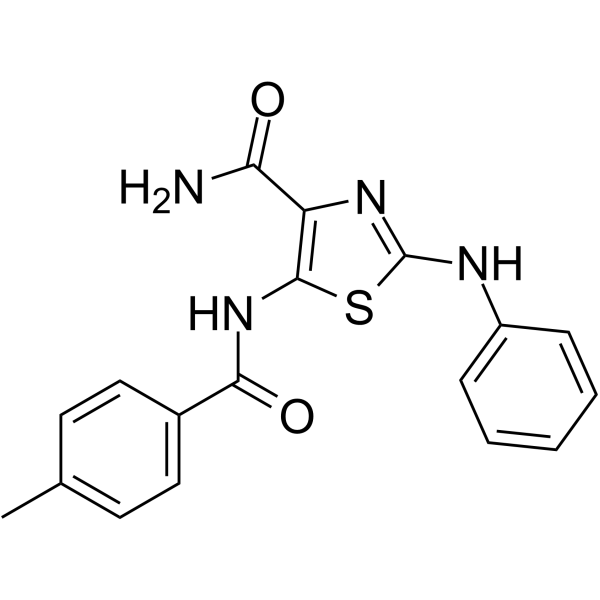
KY-05009
Based on 1 publication(s) in Google Scholar
KY-05009 is an ATP-competitive Traf2- and Nck-interacting kinase (TNIK) inhibitor with a Ki of 100 nM. KY-05009 pharmacologically inhibits TGF-β1-induced epithelial-to-mesenchymal transition (EMT) in human lung adenocarcinoma cells. KY-05009 inhibits the protein expression of TNIK and transcriptional activity of Wnt target genes and induces apoptosis in cancer cells. KY-05009 exerts anti-cancer activity.
Nos produits utilisent uniquement pour la recherche. Nous ne vendons pas aux patients.
- Pureté : 99.88%
- CAS No.: 1228280-29-2
- Formule: C18H16N4O2S
- Masse moléculaire:352.41
-
Stockage:Powder -20°C, 3 years , 4°C, 2 years ; In solvent -80°C, 2 years , -20°C, 1 year

To place orders, for customer services and technical support, please contact: MedChemExpress USA
Tel: 609-228-6898 E-mail: [email protected] [email protected]


-
 Activité biologique
-
Chemical Information
-
Solvant et solubilité
- Protocole
- Pureté et documentation
- Références
-
 Help & FAQs


-
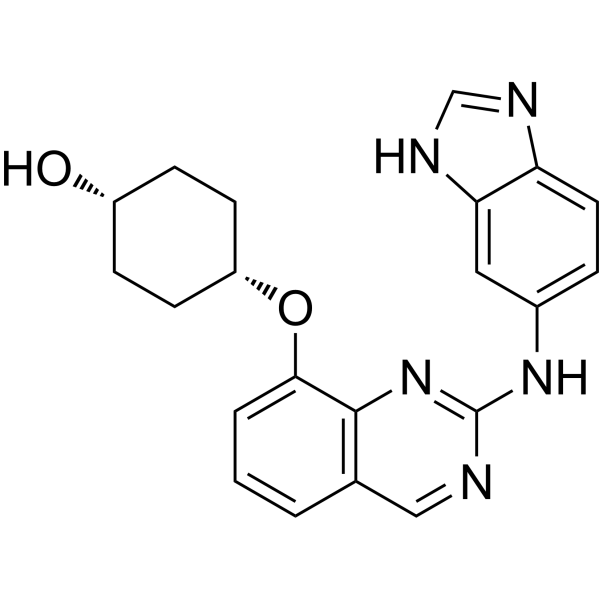
HY-100830
NCB-0846TRAF2- and NCK-interacting Inhibitor -
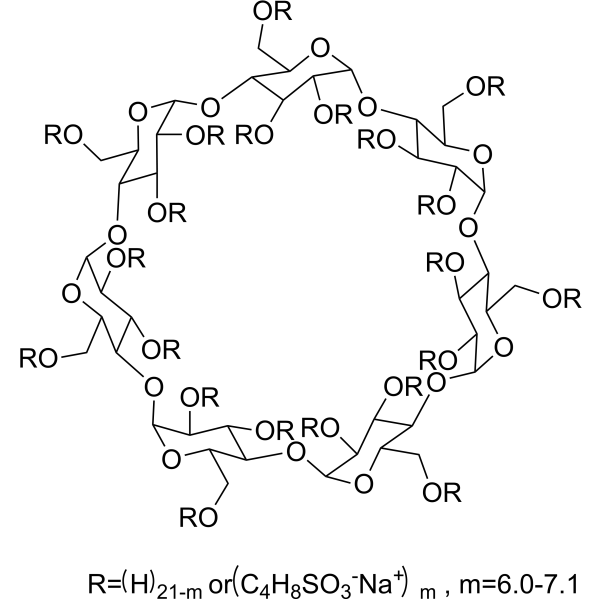
HY-17031
SBE-β-CDExcipient -
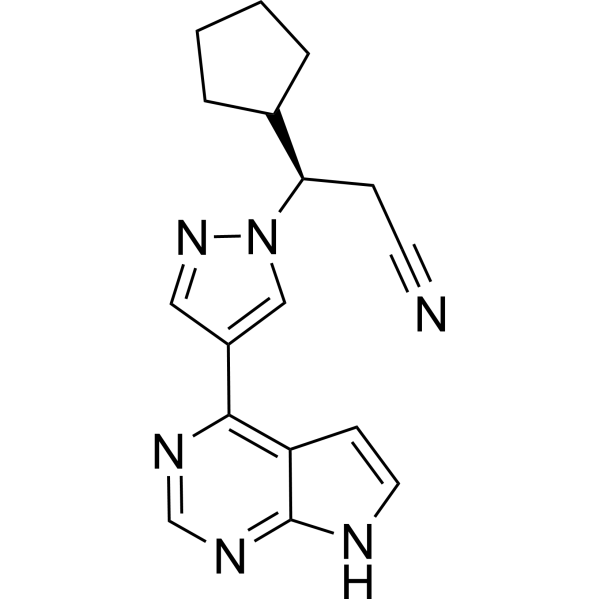
HY-50856
RuxolitinibJAK1/2 Inhibitor -
HY-100579
Ferrostatin-1Ferroptosis Inhibitor -
HY-34386
6(5H)-PhenanthridinonePARP-1 Inhibitor -
HY-13491
GNF-5837Trk Receptor Inhibitor -
HY-12805
ML171NADPH Oxidase Inhibitor -
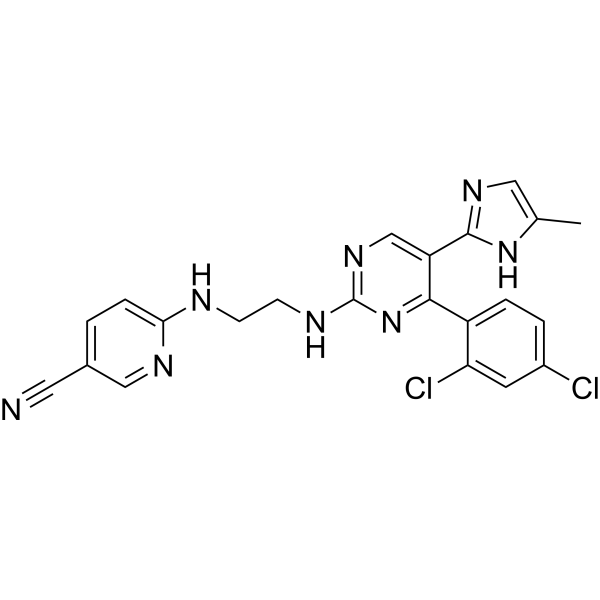
HY-10182
LaduviglusibGSK-3 Inhibitor -
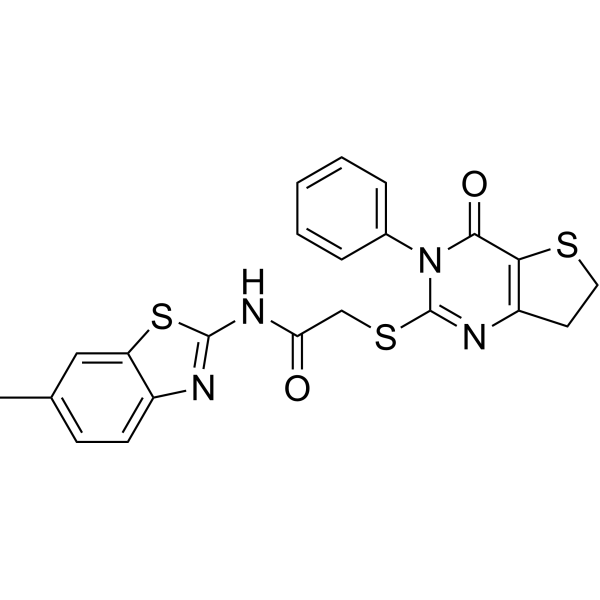
HY-13912
IWP-2Wnt Production Inhibitor -
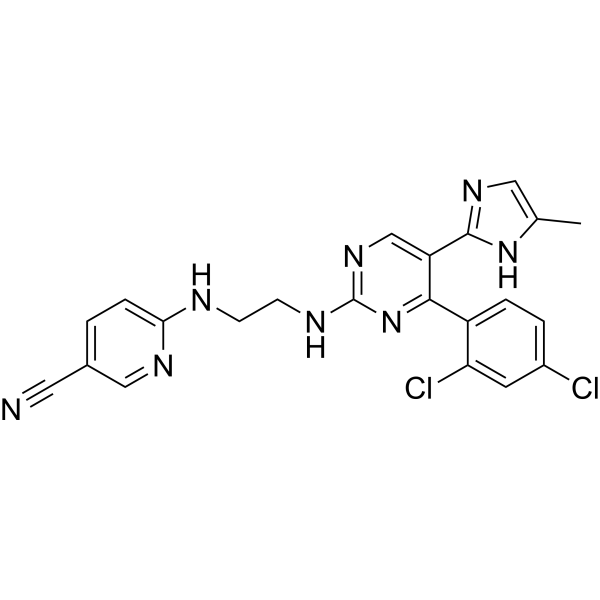
HY-10182G
Laduviglusib (GMP)GSK-3α/β Inhibitor (GMP) -
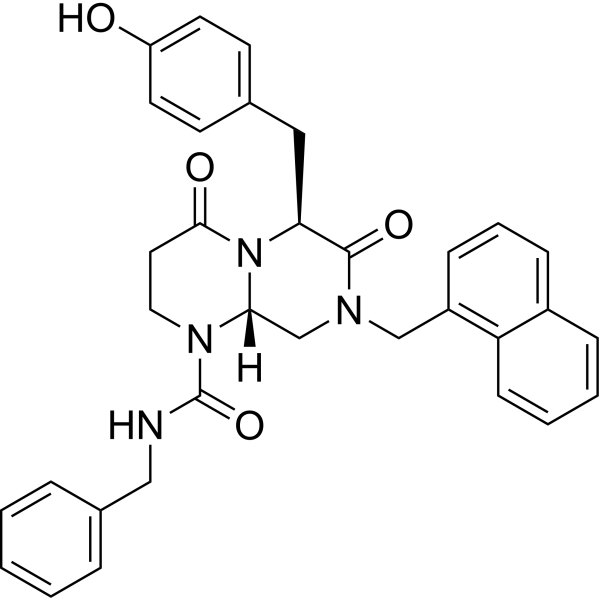
HY-14428
ICG-001Apoptosis Inducer -
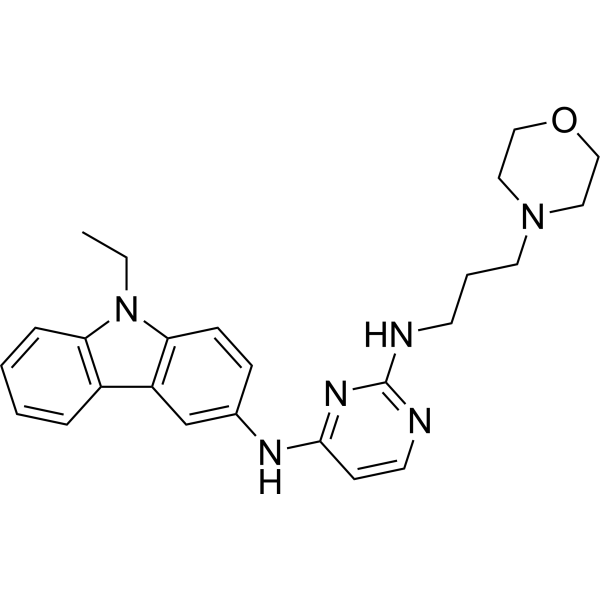
HY-12810
EHop-016Rac1/Rac3 Inhibitor
Publications Citing Use of MedChemExpress (MCE) KY-05009
MoreVoir tous les produits spécifiques à Isoform MAP4K
More

Activité biologique
Description
IC50 & Target
[1]|
TNIK 100 nM (Ki) |
In Vitro
KY-05009 (0.1-30 μM; 24 hours; RPMI8226 cells) treatment inhibits the proliferation of RPMI8226 cells in a dose-dependent manner[1].
KY-05009 (1-3 μM; 48-72 hours; RPMI8226 cells) treatment induces caspase-dependent apoptosis in RPMI8226 cells in a dose-dependent manner[1].
KY-05009 (3 μM; 1 hour; RPMI8226 cells) treatment suppresses the transcriptional activity of Wnt signaling-related genes, including TNIK, CTNNB1, TCF7, and TCF4[1].
. KY-05009 (3 μM; 9 hours; RPMI8226 cells) treatment inhibits the IL-6-induced interaction between TCF4 and β-catenin and the phosphorylation of TCF4[1].
MedChemExpress (MCE) has not independently confirmed the accuracy of these methods. They are for reference only.
-
Cell Line:RPMI8226 cells
-
Concentration:0.1 μM, 0.3 μM, 1 μM, 3 μM, 10 μM, 30 μM
-
Incubation Time:24 hours
-
Result:Inhibited the proliferation of RPMI8226 cells.
-
Cell Line:RPMI8226 cells
-
Concentration:1 μM, 3 μM, 10 μM
-
Incubation Time:48 hours, 72 hours
-
Result:Induced the binding of fluorescent Annexin V and 7-amino-actinomycin D (7-AAD) uptake.
-
Cell Line:RPMI8226 cells
-
Concentration:3 μM
-
Incubation Time:1 hour
-
Result:Suppressed the transcriptional activity of Wnt signaling-related genes, including TNIK, CTNNB1, TCF7, and TCF4.
-
Cell Line:RPMI8226 cells
-
Concentration:3 μM
-
Incubation Time:9 hours
-
Result:The IL-6-induced interaction between TCF4 and β-catenin and the phosphorylation of TCF4 were inhibited.


Chemical Information
-
CAS No. 1228280-29-2
-
Appearance Solid
-
Masse moléculaire 352.41
-
Formule C18H16N4O2S
-
Color Light yellow to yellow
-
SMILES
O=C(C1=C(NC(C2=CC=C(C)C=C2)=O)SC(NC3=CC=CC=C3)=N1)N
-
Livraison
Room temperature in continental US; may vary elsewhere.
-
Stockage
Powder -20°C 3 years 4°C 2 years In solvent -80°C 2 years -20°C 1 year


Publications (1)
-
Journal Impact Factor
-
Most Recent
-
bioRxiv
Human-chimpanzee tetraploid system defines mechanisms of species-specific neural gene regulation. [Abstract]2025 Mar 31:2025.03.31.646367. PMID: 40236112


Solvant et solubilité
In Vitro:
DMSO : 83.33 mg/mL (236.46 mM; Need ultrasonic; Hygroscopic DMSO has a significant impact on the solubility of product, please use newly opened DMSO)
Please refer to the solubility information to select the appropriate solvent. Once prepared, please aliquot and store the solution to prevent product inactivation from repeated freeze-thaw cycles.
Storage method and period of stock solution: -80°C, 2 years; -20°C, 1 year. When stored at -80°C, please use it within 2 years. When stored at -20°C, please use it within 1 year.
Please refer to the solubility information to select the appropriate solvent. Once prepared, please aliquot and store the solution to prevent product inactivation from repeated freeze-thaw cycles.
Storage method and period of stock solution: -80°C, 2 years; -20°C, 1 year. When stored at -80°C, please use it within 2 years. When stored at -20°C, please use it within 1 year.
Concentration (start) × Volume (start) = Concentration (final) × Volume (final)
In Vivo:
Select the appropriate dissolution method based on your experimental animal and administration route.
- For the following dissolution methods, please ensure to first prepare a clear stock solution using an In Vitro approach and then sequentially add co-solvents:
- To ensure reliable experimental results, the clarified stock solution can be appropriately stored based on storage conditions. As for the working solution for In Vivo experiments, it is recommended to prepare freshly and use it on the same day.
- The percentages shown for the solvents indicate their volumetric ratio in the final prepared solution. If precipitation or phase separation occurs during preparation, heat and/or sonication can be used to aid dissolution.
Add each solvent one by one: 10% DMSO 40% PEG300 5% Tween-80 45% Saline
Solubility: ≥ 2.08 mg/mL (5.90 mM); Clear solution
This protocol yields a clear solution of ≥ 2.08 mg/mL (saturation unknown).
Taking 1 mL working solution as an example, add 100 μL DMSO stock solution (20.8 mg/mL) to 400 μL PEG300, and mix evenly; then add 50 μL Tween-80 and mix evenly; then add 450 μL Saline to adjust the volume to 1 mL.
Preparation of Saline: Dissolve 0.9 g sodium chloride in ddH₂O and dilute to 100 mL to obtain a clear Saline solution.
For the following dissolution methods, please prepare the working solution directly:
It is recommended to prepare fresh solutions and use them promptly within a short period of time.
The percentages shown for the solvents indicate their volumetric ratio in the final prepared solution. If precipitation or phase separation occurs during preparation, heat and/or sonication can be used to aid dissolution.
Add each solvent one by one: 50% PEG300 50% Saline
Solubility: 12.5 mg/mL (35.47 mM); Suspended solution; Need ultrasonic
In Vivo Dissolution Calculator
Please enter the basic information of animal experiments:
-
-
-
-
Recommended: Prepare an additional quantity of animals to account for potential losses during experiments.
Please enter your animal formula composition:
-
%DMSO +
Recommended: Keep the proportion of DMSO in working solution below 2% if your animal is weak.
-
%+
-
+%Tween-80 + +
-
%Saline +
The co-solvents required include: DMSO, . All of co-solvents are available by MedChemExpress (MCE). , Tween 80. All of co-solvents are available by MedChemExpress (MCE).
Working solution concentration: 0.22 mg/mL
Method for preparing stock solution: mg drug dissolved in μL DMSO. Stock solution concentration: mg/mL.
1. Take μL DMSO stock solution;
2. Add μL .
μL , mix evenly;
3. Then add μL Tween 80, mix evenly;
4. Then add μL
Please ensure that the stock solution in the first step is dissolved to a clear state, and add co-solvents in sequence. You can use ultrasonic heating (ultrasonic cleaner, recommended frequency 20-40 kHz), vortexing, etc. to assist dissolution.


Pureté et documentation
-
Fiche technique (282 KB)
-
SDS (393 KB)
- English - EN (393 KB)
- Français - FR (393 KB)
- Deutsch - DE (393 KB)
- Norwegian - NO (393 KB)
- Español - ES (393 KB)
- Swedish - SV (393 KB)
- Italian - IT (393 KB)
- Korean - KR (393 KB)
- Portuguese - PT (393 KB)
-
Instruction de manipulation (2659 KB)
Références


Complete Stock Solution Preparation Table
Please refer to the solubility information to select the appropriate solvent. Once prepared, please aliquot and store the solution to prevent product inactivation from repeated freeze-thaw cycles.
Storage method and period of stock solution: -80°C, 2 years; -20°C, 1 year. When stored at -80°C, please use it within 2 years. When stored at -20°C, please use it within 1 year.
| Optional Solvent | Concentration Solvent Mass | 1 mg | 5 mg | 10 mg | 25 mg |
|---|---|---|---|---|---|
| DMSO | 1 mM | 2.8376 mL | 14.1880 mL | 28.3760 mL | 70.9401 mL |
| 5 mM | 0.5675 mL | 2.8376 mL | 5.6752 mL | 14.1880 mL | |
| 10 mM | 0.2838 mL | 1.4188 mL | 2.8376 mL | 7.0940 mL | |
| 15 mM | 0.1892 mL | 0.9459 mL | 1.8917 mL | 4.7293 mL | |
| 20 mM | 0.1419 mL | 0.7094 mL | 1.4188 mL | 3.5470 mL | |
| 25 mM | 0.1135 mL | 0.5675 mL | 1.1350 mL | 2.8376 mL | |
| 30 mM | 0.0946 mL | 0.4729 mL | 0.9459 mL | 2.3647 mL | |
| 40 mM | 0.0709 mL | 0.3547 mL | 0.7094 mL | 1.7735 mL | |
| 50 mM | 0.0568 mL | 0.2838 mL | 0.5675 mL | 1.4188 mL | |
| 60 mM | 0.0473 mL | 0.2365 mL | 0.4729 mL | 1.1823 mL | |
| 80 mM | 0.0355 mL | 0.1774 mL | 0.3547 mL | 0.8868 mL | |
| 100 mM | 0.0284 mL | 0.1419 mL | 0.2838 mL | 0.7094 mL |


KY-05009 Related Classifications
HY-124745 Related Classifications
 Powered by Bioz