



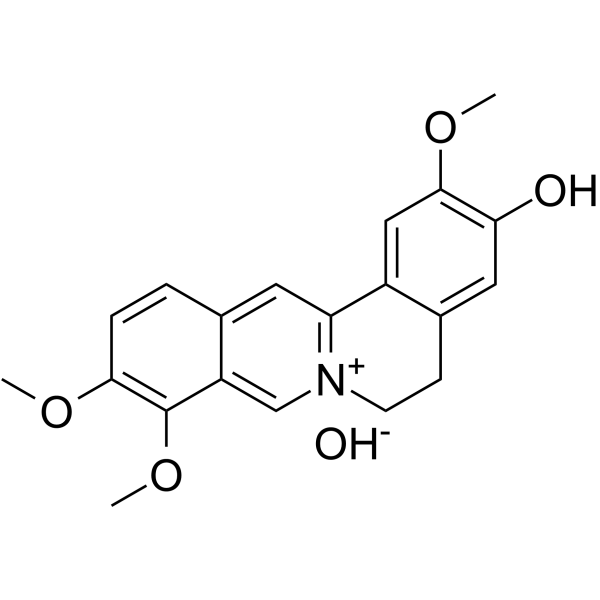
Jatrorrhizine hydroxide
Based on 3 publication(s) in Google Scholar
Jatrorrhizine hydroxide is an alkaloid isolated from Coptis chinensis with neuroprotective, antimicrobial, antiplasmodial and antioxidant activities. Jatrorrhizine hydroxide is a potent and orally active inhibitor of AChE (IC50=872 nM) over >115-fold selectivity for BuChE. Jatrorrhizine hydroxide reduces uptake of serotonin (5-HT) and norepinephrine (NE) via inhibition of uptake-2 transporters.
For research use only. We do not sell to patients.
- Purity: 98.06%
- CAS No.: 483-43-2
- Formula: C20H21NO5
- Molecular Weight:355.38
-
Storage:
4°C, protect from light
* In solvent : -80°C, 6 months; -20°C, 1 month (protect from light)


-
 Biological Activity
-
Chemical Information
-
Solvent & Solubility
- Purity & Documentation
- References
-
 Help & FAQs
-

Anti-Infection Compound Library
HY-L002
-
GPCR/G Protein Compound Library
HY-L006
-
Immunology/Inflammation Compound Library
HY-L007
-
Neuronal Signaling Compound Library
HY-L013
-
Natural Product Library
HY-L021
-
CNS-Penetrant Compound Library
HY-L028
-
Antioxidant Compound Library
HY-L037
-
Antibacterial Compound Library
HY-L049
-
Phenols Library
HY-L057
-
Neurotransmitter Receptor Compound Library
HY-L062
-
Traditional Chinese Medicine Active Compound Library
HY-L065
-
Anti-Alzheimer's Disease Compound Library
HY-L069
-
Neuroprotective Compound Library
HY-L070
-
Alkaloids Library
HY-L071
-
Anti-Parkinson's Disease Compound Library
HY-L085
-
Neurodegenerative Disease-related Compound Library
HY-L086
-
Anti-inflammatory Traditional Chinese Medicine Active Compound Library
HY-L114
-
Plant-Sourced Natural Product Library
HY-L115
-
5-HT Receptor Compound Library
HY-L121
-
Coagulation and Anti-coagulation Compound Library
HY-L136
-
Heterocyclic Compound Library
HY-L138
-
Membrane Protein-targeted Compound Library
HY-L149
-
Membrane Receptor-targeted Compound Library
HY-L150
-
Multi-Target Compound Library
HY-L176
-
Radioprotector Library
HY-L178
-
Bioactive Compound Library Max
HY-L181
-
MCE Bioactive Compound Library
HY-L001V
-
Natural Product Library Plus
HY-L021P
-
Natural Product and Natural Product-Like Compound Library
HY-L021M
-
Bioactive Compound Library
HY-L001
-
Anti-Fibrosis Compound Library
HY-L185
-
Heat-Clearing and Detoxification Traditional Chinese Medicine Compound Library
HY-L194
-
RO5 Drug-like Natural Product Library
HY-L200
-
High-Throughput Bioactive Compound Library
HY-L205
-
High-Throughput Natural Product Library
HY-L206
-
Ancient Chinese Classical Formulas Traditional Chinese Medicine Active Compound Library
HY-L209
-
Diarrhea-Related Traditional Chinese Medicine Active Compound Library
HY-L224
-
Mongolian Medicine Compound Library
HY-L238
-
Lactylation Compound Library
HY-L249
-
Mass Spectrometry Natural Product Library
HY-L262


Publications Citing Use of MedChemExpress (MCE) Jatrorrhizine hydroxide
MoreAll 5-HT Receptor Isoforms
More

Biological Activity
|
AChE |
Jatrorrhizine has antiplasmodial and antiamoebic activity, it against Plasmodium falciparum and E. histolytica with IC50 values of 3.15 and 82.7 µM, respectively[1].The hOCT2 (organic cation transporter 2), hOCT3, and PMAT (plasma membrane monoamine transporter) are capable of transporting monoamine neurotransmitters in the brain[3]. Jatrorrhizine has the inhibitory potency of jatrorrhizine on 5-HT and NE uptake in hOCT2-, hOCT3-, and PMAT-transfected cells. Jatrorrhizine strongly inhibits PMAT-mediated MPP+ uptake with an IC50 value of 1.05 μM and reduces 5-HT and NE uptake mediated by hOCT2, hOCT3, and hPMAT with IC50 values of 0.1-1 μM (for OCT2 and OCT3) and 1-10 μM (for PMAT)[3].Clearance of neurotransmitters released into the synaptic cleft is defined by two distinct processes. Uptake-1, the common target of current applied antidepressants, is comprised of the serotonin transporter (SERT), the “SERT”, had a high affinity but low capacity to take up [3H]5-HT. Uptake-2 transporters are an important supplementary regulation system in monoamine clearancethought to be the “NET”, has low affinity but high capacity to take up [3H]5-HT into brain slices. Jatrorrhizine significantly inhibited 5-HT and NE uptake in synaptosomes at 25 μM and 50 μM[3].
MedChemExpress (MCE) has not independently confirmed the accuracy of these methods. They are for reference only.
MedChemExpress (MCE) has not independently confirmed the accuracy of these methods. They are for reference only.
-
Animal Model:Male ICR albino mice[2]
-
Dosage:5, 10, 20 mg/kg
-
Administration:Intraperitoneal injection; 5, 10, 20 mg/kg
-
Result:Reduced immobility period in tail suspension test.


Chemical Information
-
CAS No. 483-43-2
-
Appearance Solid
-
Molecular Weight 355.38
-
Formula C20H21NO5
-
Color Brown to black
-
SMILES
COC1=C(OC)C2=C[N+]3=C(C4=CC(OC)=C(O)C=C4CC3)C=C2C=C1.[OH-]
-
Structure Classification
-
Initial Source
-
Shipping
Room temperature in continental US; may vary elsewhere.
-
Storage
4°C, protect from light
* In solvent : -80°C, 6 months; -20°C, 1 month (protect from light)


Publications (3)
-
Journal Impact Factor
-
Most Recent
-
Molecules
Discovery of Nine Dipeptidyl Peptidase-4 Inhibitors from Coptis chinensis Using Virtual Screening, Bioactivity Evaluation, and Binding Studies. [Abstract]2024 May 14;29(10):2304. PMID: 38792165 -
Vet Microbiol
The Chinese medicine monomer Schisandrin C inhibits PRRSV infection by regulating the OGT-PI3K/AKT/mTOR signaling pathway. [Abstract]2026 May:316:110992. PMID: 41865607 -
Arch Microbiol
Jatrorrhizine attenuates inflammatory response in Helicobacter pylori-induced gastritis by suppressing NLRP3 inflammasomes and NF-κB signaling pathway. [Abstract]2025 Jun 17;207(8):177. PMID: 40526168


Solvent & Solubility
DMSO : 3.33 mg/mL (9.37 mM; Need ultrasonic; Hygroscopic DMSO has a significant impact on the solubility of product, please use newly opened DMSO)
H2O : 2.5 mg/mL (7.03 mM; Need ultrasonic)
Please refer to the solubility information to select the appropriate solvent. Once prepared, please aliquot and store the solution to prevent product inactivation from repeated freeze-thaw cycles.
Storage method and period of stock solution: -80°C, 6 months; -20°C, 1 month (protect from light). When stored at -80°C, please use it within 6 months. When stored at -20°C, please use it within 1 month.
* Note: If you choose water as the stock solution, please dilute it to the working solution, then filter and sterilize it with a 0.22 μm filter before use.
Please refer to the solubility information to select the appropriate solvent. Once prepared, please aliquot and store the solution to prevent product inactivation from repeated freeze-thaw cycles.
Storage method and period of stock solution: -80°C, 6 months; -20°C, 1 month (protect from light). When stored at -80°C, please use it within 6 months. When stored at -20°C, please use it within 1 month.
* Note: If you choose water as the stock solution, please dilute it to the working solution, then filter and sterilize it with a 0.22 μm filter before use.
Concentration (start) × Volume (start) = Concentration (final) × Volume (final)
For the following dissolution methods, please prepare the working solution directly:
It is recommended to prepare fresh solutions and use them promptly within a short period of time.
The percentages shown for the solvents indicate their volumetric ratio in the final prepared solution. If precipitation or phase separation occurs during preparation, heat and/or sonication can be used to aid dissolution.
Add each solvent one by one: Saline
Solubility: 0.71 mg/mL (2.00 mM); Clear solution; Need ultrasonic and warming and heat to 60°C
Please enter the basic information of animal experiments:
-
-
-
-
Recommended: Prepare an additional quantity of animals to account for potential losses during experiments.
Working solution concentration: 0.22 mg/mL


Purity & Documentation
-
Data Sheet (278 KB)
-
SDS (252 KB)
- English - EN (252 KB)
- Français - FR (252 KB)
- Deutsch - DE (252 KB)
- Norwegian - NO (252 KB)
- Español - ES (252 KB)
- Swedish - SV (252 KB)
- Italian - IT (252 KB)
- Portuguese - PT (252 KB)
-
Handling Instructions (2659 KB)
References
[1]. Sun S, et al. Jatrorrhizine reduces 5-HT and NE uptake via inhibition of uptake-2 transporters and produces antidepressant-like action in mice. Xenobiotica. 2019 Oct;49(10):1237-1243. [Content Brief]
[3]. C W Wright, et al. In vitro antiplasmodial, antiamoebic, and cytotoxic activities of some monomeric isoquinoline alkaloids. J Nat Prod. 2000 Dec;63(12):1638-40. [Content Brief]


Complete Stock Solution Preparation Table
Please refer to the solubility information to select the appropriate solvent. Once prepared, please aliquot and store the solution to prevent product inactivation from repeated freeze-thaw cycles.
Storage method and period of stock solution: -80°C, 6 months; -20°C, 1 month (protect from light). When stored at -80°C, please use it within 6 months. When stored at -20°C, please use it within 1 month.
| Optional Solvent | Concentration Solvent Mass | 1 mg | 5 mg | 10 mg | 25 mg |
|---|---|---|---|---|---|
| H2O / DMSO | 1 mM | 2.8139 mL | 14.0694 mL | 28.1389 mL | 70.3472 mL |
| 5 mM | 0.5628 mL | 2.8139 mL | 5.6278 mL | 14.0694 mL |
* Note: If you choose water as the stock solution, please dilute it to the working solution, then filter and sterilize it with a 0.22 μm filter before use.


 Powered by Bioz