



NecroX-7
Based on 2 publication(s) in Google Scholar
NecroX-7 is a potent free radical scavenger and a HMGB1 (high-mobility group box 1) inhibitor. NecroX-7 can be used as an antidote to acetaminophen toxicity. NecroX-7 exerts a protective effect by preventing the release of HMGB1 in ischemia/reperfusion injury. NecroX-7 inhibits the HMGB1-induced release of TNF and IL-6, as well as the expression of TLR-4 and receptor for advanced glycation end products. NecroX-7 can be used graft-versus-host disease (GVHD) research.
Nur für Forschungszwecke. Wir verkaufen nicht an Patienten.
- Reinheit : 99.69%
- CAS. Nr.: 1120332-55-9
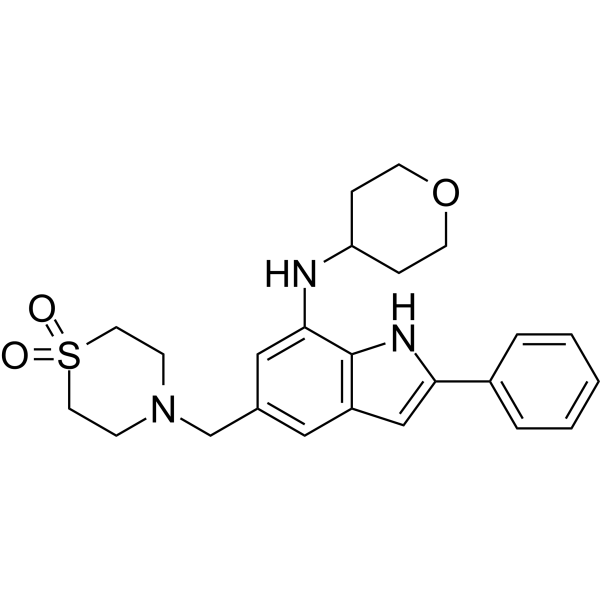
- Formel: C24H29N3O3S
- Molecular Weight:439.57
-
Speicherung:Powder -20°C, 3 years , 4°C, 2 years ; In solvent -80°C, 6 months , -20°C, 1 month

To place orders, for customer services and technical support, please contact: MedChemExpress USA
Tel: 609-228-6898 E-mail: [email protected] [email protected]


-
 Biologische Aktivität
-
Chemical Information
-
Lösungsmittel & Löslichkeit
- Protokoll
- Reinheit & Dokumentation
- Verweise
-
 Help & FAQs


Publications Citing Use of MedChemExpress (MCE) NecroX-7
MoreAlle TNF Receptor Isoform-spezifische Produkte anzeigen
More

Biologische Aktivität
Beschreibung
IC50 & Target
|
IL-6 |
TLR4 |
Cellular Effect
|
Cell Line

|
Type | Value | Description | References |
|---|---|---|---|---|
| HT-1080 | IC50 |
6 μM
Compound: Necrox-7
|
Anti-ferroptotic activity against Erastin-induced human HT-1080 cells assessed as inhibition of ferroptosis incubated for 72 hrs by CCK-8 assay
Anti-ferroptotic activity against Erastin-induced human HT-1080 cells assessed as inhibition of ferroptosis incubated for 72 hrs by CCK-8 assay
|
[PMID: 38996382] |
In Vitro
NecroX-7 (0-40 μM, 3-4 d) suppresses activated or proliferating T cells without causing apoptosis[1].
NecroX-7 (0-40 μM) markedly reduces HMGB1 levels in a dose-dependent manner[1].
NecroX-7 inhibits formation of mitochondria-specific ROS/reactive nitrogen species in H9C2 cells and hepatocytes after induction by tert-butyl hydroperoxide or doxorubicin[1].
NecroX-7 increased regulatory T cell numbers, which may be associated with regulation of differentiation signals independent of HMGB1[1].
MedChemExpress (MCE) has not independently confirmed the accuracy of these methods. They are for reference only.
-
Cell Line:CD4 T cells
-
Concentration:0, 0.625, 1.25, 2.5, 5, 10, 20, and 40 μM
-
Incubation Time:3-4 d
-
Result:Showed a marked reduction in splenocyte proliferation, in a dose-dependent manner. Modulated alloreactive T cell responses.
In Vivo
NecroX-7 protects mice against lethal GVHD by reciprocal regulation of regulatory T/Th1 cells, attenuating systemic HMGB1 accumulation and inhibiting HMGB1-mediated inflammatory response[1].
MedChemExpress (MCE) has not independently confirmed the accuracy of these methods. They are for reference only.
-
Animal Model:Female BALB/c and C57BL/6 mice (Eight-week-old, with GVHD)[1]
-
Dosage:0.03, 0.1, and 0.3 mg/kg
-
Administration:IV, once injection at 2-d intervals, for 2 weeks
-
Result:Observed statistically significant prolonged survival at doses ≥0.1 mg/kg: 30–60% of mice in these treatment groups survived for >50 d. Significantly improved clinical signs and prolonged survival, and the mice showed a reduction in clinical manifestations of acute GVHD, including weight loss, hunched posture, diarrhea, and ruffled fur.


Chemical Information
-
CAS. Nr. 1120332-55-9
-
Appearance Solid
-
Molecular Weight 439.57
-
Formel C24H29N3O3S
-
Color Off-white to yellow
-
SMILES
O=S1(CCN(CC1)CC2=CC3=C(C(NC4CCOCC4)=C2)NC(C5=CC=CC=C5)=C3)=O
-
Versand
Room temperature in continental US; may vary elsewhere.
-
Speicherung
Powder -20°C 3 years 4°C 2 years In solvent -80°C 6 months -20°C 1 month


Publications (2)


Lösungsmittel & Löslichkeit
In Vitro:
DMSO : 100 mg/mL (227.50 mM; Need ultrasonic; Hygroscopic DMSO has a significant impact on the solubility of product, please use newly opened DMSO)
Please refer to the solubility information to select the appropriate solvent. Once prepared, please aliquot and store the solution to prevent product inactivation from repeated freeze-thaw cycles.
Storage method and period of stock solution: -80°C, 6 months; -20°C, 1 month. When stored at -80°C, please use it within 6 months. When stored at -20°C, please use it within 1 month.
Please refer to the solubility information to select the appropriate solvent. Once prepared, please aliquot and store the solution to prevent product inactivation from repeated freeze-thaw cycles.
Storage method and period of stock solution: -80°C, 6 months; -20°C, 1 month. When stored at -80°C, please use it within 6 months. When stored at -20°C, please use it within 1 month.
Konzentration (Stammlösung) × Volumen (Stammlösung) = Konzentration (Ziellösung) × Volumen (Ziellösung)
In Vivo:
Select the appropriate dissolution method based on your experimental animal and administration route.
- For the following dissolution methods, please ensure to first prepare a clear stock solution using an In Vitro approach and then sequentially add co-solvents:
- To ensure reliable experimental results, the clarified stock solution can be appropriately stored based on storage conditions. As for the working solution for In Vivo experiments, it is recommended to prepare freshly and use it on the same day.
- The percentages shown for the solvents indicate their volumetric ratio in the final prepared solution. If precipitation or phase separation occurs during preparation, heat and/or sonication can be used to aid dissolution.
Add each solvent one by one: 10% DMSO 40% PEG300 5% Tween-80 45% Saline
Solubility: ≥ 2.5 mg/mL (5.69 mM); Clear solution
This protocol yields a clear solution of ≥ 2.5 mg/mL (saturation unknown).
Taking 1 mL working solution as an example, add 100 μL DMSO stock solution (25.0 mg/mL) to 400 μL PEG300, and mix evenly; then add 50 μL Tween-80 and mix evenly; then add 450 μL Saline to adjust the volume to 1 mL.
Preparation of Saline: Dissolve 0.9 g sodium chloride in ddH₂O and dilute to 100 mL to obtain a clear Saline solution.
Add each solvent one by one: 10% DMSO 90% (20% SBE-β-CD in Saline)
Solubility: ≥ 2.5 mg/mL (5.69 mM); Clear solution
This protocol yields a clear solution of ≥ 2.5 mg/mL (saturation unknown).
Taking 1 mL working solution as an example, add 100 μL DMSO stock solution (25.0 mg/mL) to 900 μL 20% SBE-β-CD in Saline, and mix evenly.
Preparation of 20% SBE-β-CD in Saline (4°C, storage for one week): 2 g SBE-β-CD powder is dissolved in 10 mL Saline, completely dissolve until clear.
In Vivo Dissolution Calculator
Please enter the basic information of animal experiments:
-
-
-
-
Recommended: Prepare an additional quantity of animals to account for potential losses during experiments.
Please enter your animal formula composition:
-
%DMSO +
Recommended: Keep the proportion of DMSO in working solution below 2% if your animal is weak.
-
%+
-
+%Tween-80 + +
-
%Saline +
The co-solvents required include: DMSO, . All of co-solvents are available by MedChemExpress (MCE). , Tween 80. All of co-solvents are available by MedChemExpress (MCE).
Working solution concentration: 0.22 mg/mL
Method for preparing stock solution: mg drug dissolved in μL DMSO. Stock solution concentration: mg/mL.
1. Take μL DMSO stock solution;
2. Add μL .
μL , mix evenly;
3. Then add μL Tween 80, mix evenly;
4. Then add μL
Please ensure that the stock solution in the first step is dissolved to a clear state, and add co-solvents in sequence. You can use ultrasonic heating (ultrasonic cleaner, recommended frequency 20-40 kHz), vortexing, etc. to assist dissolution.


Reinheit & Dokumentation
-
Data Sheet (280 KB)
-
SDS (254 KB)
- English - EN (254 KB)
- Français - FR (254 KB)
- Deutsch - DE (254 KB)
- Norwegian - NO (254 KB)
- Español - ES (254 KB)
- Swedish - SV (254 KB)
- Italian - IT (254 KB)
- Korean - KR (254 KB)
- Portuguese - PT (254 KB)
-
Handling Instructions (2659 KB)
Verweise


Complete Stock Solution Preparation Table
Please refer to the solubility information to select the appropriate solvent. Once prepared, please aliquot and store the solution to prevent product inactivation from repeated freeze-thaw cycles.
Storage method and period of stock solution: -80°C, 6 months; -20°C, 1 month. When stored at -80°C, please use it within 6 months. When stored at -20°C, please use it within 1 month.
| Optional Solvent | Concentration Solvent Mass | 1 mg | 5 mg | 10 mg | 25 mg |
|---|---|---|---|---|---|
| DMSO | 1 mM | 2.2750 mL | 11.3748 mL | 22.7495 mL | 56.8738 mL |
| 5 mM | 0.4550 mL | 2.2750 mL | 4.5499 mL | 11.3748 mL | |
| 10 mM | 0.2275 mL | 1.1375 mL | 2.2750 mL | 5.6874 mL | |
| 15 mM | 0.1517 mL | 0.7583 mL | 1.5166 mL | 3.7916 mL | |
| 20 mM | 0.1137 mL | 0.5687 mL | 1.1375 mL | 2.8437 mL | |
| 25 mM | 0.0910 mL | 0.4550 mL | 0.9100 mL | 2.2750 mL | |
| 30 mM | 0.0758 mL | 0.3792 mL | 0.7583 mL | 1.8958 mL | |
| 40 mM | 0.0569 mL | 0.2844 mL | 0.5687 mL | 1.4218 mL | |
| 50 mM | 0.0455 mL | 0.2275 mL | 0.4550 mL | 1.1375 mL | |
| 60 mM | 0.0379 mL | 0.1896 mL | 0.3792 mL | 0.9479 mL | |
| 80 mM | 0.0284 mL | 0.1422 mL | 0.2844 mL | 0.7109 mL | |
| 100 mM | 0.0227 mL | 0.1137 mL | 0.2275 mL | 0.5687 mL |


NecroX-7 Related Classifications
HY-124750 Related Classifications
 Powered by Bioz
Keywords