



Quinclorac

Based on 1 Customer Validation
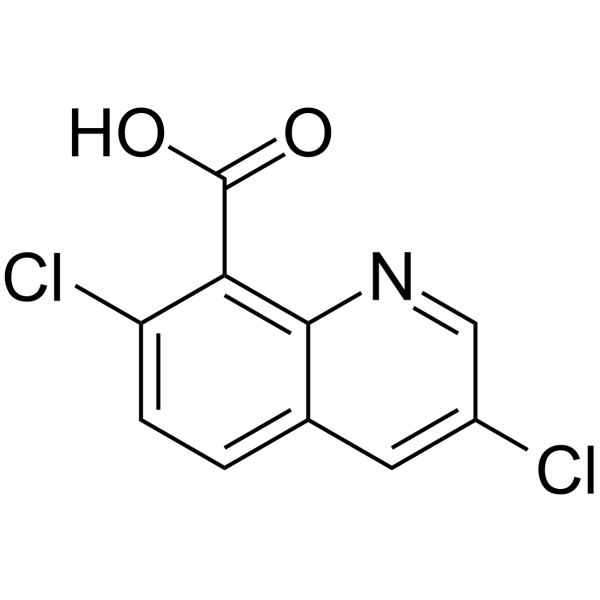
Quinclorac is a highly selective quinoline carboxylic acid synthetic auxin herbicide. Quinclorac weakly inhibits HPPD, accompanied by a transient decrease in carotenoids. Quinclorac upregulates ACC synthase (ACS), leading to the co-accumulation of ethylene and cyanide, while increasing the ABA/IAA ratio, which induces ROS burst, membrane lipid peroxidation (MDA) and lethal growth inhibition. Residual Quinclorac in soil can cause abnormal growth of subsequent tobacco crops. In calli of Phaseolus vulgaris, Quinclorac induces oxidative stress (increased MDA and decreased RGR), but cells after stepwise pressurized acclimation acquire a constitutive antioxidant state, which remains stable after de-acclimation and tolerates oxidative damage caused by Quinclorac. Quinclorac can be used in studies related to herbicide action mechanisms, bioremediation of soil residues, and adaptive responses of plant cells to oxidative stress.
For research use only. We do not sell to patients.
- Purity: 98.14%
- CAS No.: 84087-01-4
- Formula: C10H5Cl2NO2
- Molecular Weight:242.06
-
Storage:Powder -20°C, 3 years , 4°C, 2 years ; In solvent -80°C, 6 months , -20°C, 1 month

To place orders, for customer services and technical support, please contact: MedChemExpress USA
Tel: 609-228-6898 E-mail: [email protected] [email protected]


-
 Biological Activity
-
Chemical Information
-
Solvent & Solubility
- Purity & Documentation
- References
-
 Help & FAQs




Biological Activity
Description
In Vitro
Quinclorac (18.75-600 g a.i. ha-1; 3 weeks) inhibits the growth of Echinochloa crusgalli var. zelayensis in a dose-dependent manner[1].
Quinclorac (600 g a.i. ha-1; 24-72 h) significantly increases ethylene production, abscisic acid content and indole-3-acetic acid content in barnyard grass seedlings, and all three hormones reach their peak levels at 24 h after treatment[1].
Quinclorac (active ingredient at 600 g/ha; 24-120 h post-treatment) reduces carotenoid content in the leaves of barnyard grass[1].
Quinclorac (0.2-5 μM; 10 min) weakly inhibits the activity of recombinant Arabidopsis HPPD in vitro, with an inhibition rate of 20.3% at high doses[1].
Strain J5, isolated from the rhizosphere soil of a rice-tobacco rotation field, degrades 23.7% of quinclorac (5 µg/mL; 5 d) in MSM[2].
Quinclorac (5 µg/mL; 48 h) upregulates the expression of 4-hydroxyphenylacetate 3-monooxygenase (HPMO) in the J5 bacterial isolate[2].
Quinclorac (10-30 μM; 30 days) reduces the relative growth rate of callus culture cells from non-acclimated common bean (Phaseolus vulgaris L.) while increasing lipid peroxidation (MDA); Q30 cells acclimated to 30 μM exhibit milder growth inhibition over the same 30-day period[3].
Quinclorac (600 g a.i. ha-1; 24-72 h) induces lipid peroxidation in the aboveground parts of barnyard grass, resulting in a significant increase in malondialdehyde content after treatment[1].
Quinclorac (10-30 μM; 30 days) increases the level of lipid peroxidation in untamed Phaseolus vulgaris callus culture cells by more than 3-fold; in contrast, the lipid peroxidation level in acclimated cells decreases significantly[3].
Exposure to Quinclorac (10-30 μM; 30 days) increases the activity of class III peroxidase in unadapted callus culture cells of common bean; in contrast, constitutive glutathione reductase activity is significantly elevated in Quinclorac-adapted cells, and cells adapted to 30 μM also exhibit increased superoxide dismutase and class III peroxidase activities. These enhanced antioxidant activities are retained in de-adapted cells[3].
Acclimation with Quinclorac (10-30 μM; 30 days) alters the peroxidase isoenzyme profile in cultured callus cells of common bean. Specifically, the staining intensity of two detected peroxidase isoenzymes increases in cells acclimated with 30 μM Quinclorac and in cells treated with 30 μM quinclorac after acclimation at a low concentration, and this enhanced staining effect remains in de-acclimated cells[3].
MedChemExpress (MCE) has not independently confirmed the accuracy of these methods. They are for reference only.
-
Cell Line:Klebsiella variicola J5 cells
-
Concentration:5 µg/mL
-
Incubation Time:48 h
-
Result:Up-regulated the mRNA expression of hpaB (encoding 4-hydroxyphenylacetate 3-monooxygenase, HPMO) with a fold change of 1.351 vs. methanol-control, quantified by relative RT-qPCR (2−ΔΔCt) using rpoD as reference gene; result consistent with TMT-proteomics showing HPMO protein up-regulation.


Chemical Information
-
CAS No. 84087-01-4
-
Appearance Solid
-
Molecular Weight 242.06
-
Formula C10H5Cl2NO2
-
Color Off-white to light yellow
-
SMILES
O=C(C1=C2N=CC(Cl)=CC2=CC=C1Cl)O
-
Shipping
Room temperature in continental US; may vary elsewhere.
-
Storage
Powder -20°C 3 years 4°C 2 years In solvent -80°C 6 months -20°C 1 month


Solvent & Solubility
In Vitro:
DMSO : 125 mg/mL (516.40 mM; ultrasonic and warming and heat to 60°C; Hygroscopic DMSO has a significant impact on the solubility of product, please use newly opened DMSO)
Please refer to the solubility information to select the appropriate solvent. Once prepared, please aliquot and store the solution to prevent product inactivation from repeated freeze-thaw cycles.
Storage method and period of stock solution: -80°C, 6 months; -20°C, 1 month. When stored at -80°C, please use it within 6 months. When stored at -20°C, please use it within 1 month.
Please refer to the solubility information to select the appropriate solvent. Once prepared, please aliquot and store the solution to prevent product inactivation from repeated freeze-thaw cycles.
Storage method and period of stock solution: -80°C, 6 months; -20°C, 1 month. When stored at -80°C, please use it within 6 months. When stored at -20°C, please use it within 1 month.
Concentration (start) × Volume (start) = Concentration (final) × Volume (final)


Purity & Documentation
-
Data Sheet (290 KB)
-
SDS (393 KB)
- English - EN (393 KB)
- Français - FR (393 KB)
- Deutsch - DE (393 KB)
- Norwegian - NO (393 KB)
- Español - ES (393 KB)
- Swedish - SV (393 KB)
- Italian - IT (393 KB)
- Korean - KR (393 KB)
- Portuguese - PT (393 KB)
-
Handling Instructions (2659 KB)
References
[1]. Wang Z, et al. Comparison of quintrione and quinclorac on mechanism of action. Pesticide biochemistry and physiology. 2022 Feb;181:105007. [Content Brief]
[2]. Li L, et al. Bioremediation of quinclorac injury on tobacco by a rhizosphere bacterium. World journal of microbiology & biotechnology. 2022 Jul 01;38(9):147. [Content Brief]
[3]. Largo-Gosens A, et al. Quinclorac-habituation of bean (Phaseolus vulgaris) cultured cells is related to an increase in their antioxidant capacity. Plant physiology and biochemistry : PPB. 2016 Oct;107:257-263. [Content Brief]


Complete Stock Solution Preparation Table
Please refer to the solubility information to select the appropriate solvent. Once prepared, please aliquot and store the solution to prevent product inactivation from repeated freeze-thaw cycles.
Storage method and period of stock solution: -80°C, 6 months; -20°C, 1 month. When stored at -80°C, please use it within 6 months. When stored at -20°C, please use it within 1 month.
| Optional Solvent | Concentration Solvent Mass | 1 mg | 5 mg | 10 mg | 25 mg |
|---|---|---|---|---|---|
| DMSO | 1 mM | 4.1312 mL | 20.6560 mL | 41.3121 mL | 103.2802 mL |
| 5 mM | 0.8262 mL | 4.1312 mL | 8.2624 mL | 20.6560 mL | |
| 10 mM | 0.4131 mL | 2.0656 mL | 4.1312 mL | 10.3280 mL | |
| 15 mM | 0.2754 mL | 1.3771 mL | 2.7541 mL | 6.8853 mL | |
| 20 mM | 0.2066 mL | 1.0328 mL | 2.0656 mL | 5.1640 mL | |
| 25 mM | 0.1652 mL | 0.8262 mL | 1.6525 mL | 4.1312 mL | |
| 30 mM | 0.1377 mL | 0.6885 mL | 1.3771 mL | 3.4427 mL | |
| 40 mM | 0.1033 mL | 0.5164 mL | 1.0328 mL | 2.5820 mL | |
| 50 mM | 0.0826 mL | 0.4131 mL | 0.8262 mL | 2.0656 mL | |
| 60 mM | 0.0689 mL | 0.3443 mL | 0.6885 mL | 1.7213 mL | |
| 80 mM | 0.0516 mL | 0.2582 mL | 0.5164 mL | 1.2910 mL | |
| 100 mM | 0.0413 mL | 0.2066 mL | 0.4131 mL | 1.0328 mL |


Quinclorac Related Classifications
HY-B0871 Related Classifications
 Powered by Bioz