



Urease
Urease
Urease, a nickel-containing amidohydrolase, exhibits a broad distribution across both eukaryotes and prokaryotes. It can be found in diverse organisms including invertebrates, bacteria, plants, algae, and fungi. Functionally, urease plays a crucial role in catalyzing the hydrolysis of urea, converting it into ammonia and carbon dioxide. In the context of the stomach environment, an increased ammonia content, which is a direct result of urease activity, provides favorable conditions for the survival of Helicobacter pylori. Moreover, when urease is overly active, it leads to abnormally high concentrations of ammonia. This, in turn, causes a rise in the pH of the stomach and may precipitate a series of health implications. These can range from the formation of kidney stones and the onset of pyelonephritis, to the occurrence of hepatic coma, as well as the development of peptic and gastric ulcers. Fortunately, urease inhibitors offer a potential solution as they have the capacity to mitigate the gastrointestinal problems that stem from excessive urease activity[1].
All Product Categories
-
Urease Related Products (20)
Related Products (20)

- 1
-
Flurofamide
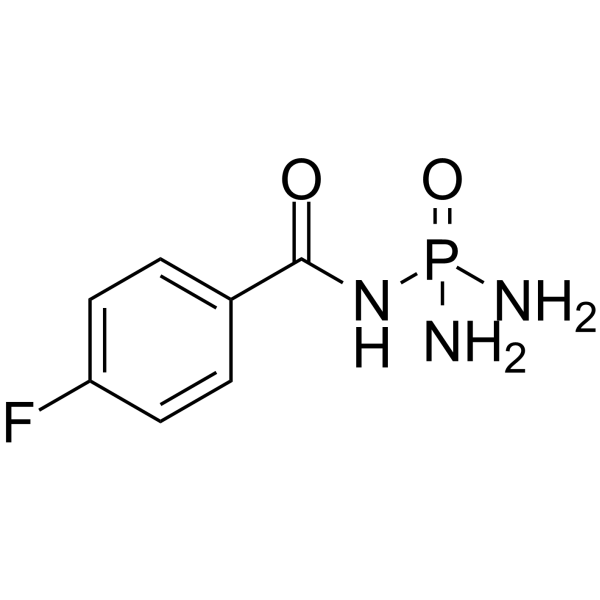 0 ImagesFlurofamide is an effective bacterial urease inhibitor and antibacterial agent. Flurofamide inhibits urease and partially inhibits the chemotactic activity of Helicobacter pylori strain CPY3401. Flurofamide inhibits the growth of Ureaplasma urealyticum. Flurofamide reduces blood ammonia. Flurofamide can be used in the research of infectious urinary stones.


-
Urease-IN-3
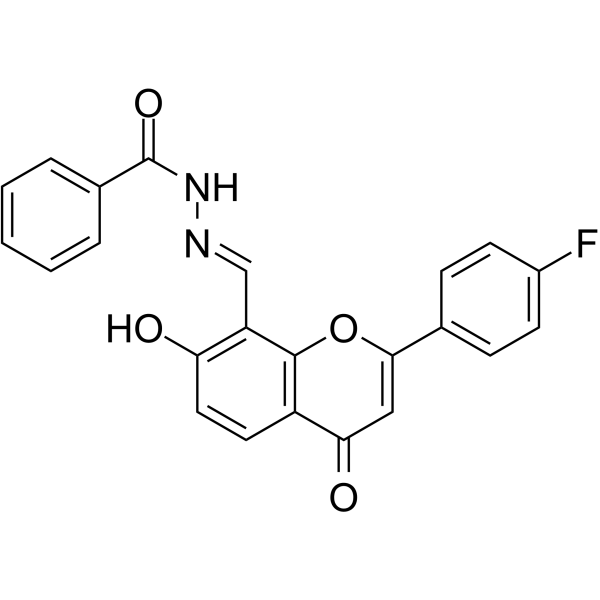 0 ImagesCat. No.: HY-147787CAS No.: 2543651-72-3Urease-IN-3 (Compound L12) is a potent inhibitor of Urease with an IC50 of 1.449 μM. Urease-IN-3 is a flavonoid analogue compound.

-
Urease-IN-25
 0 ImagesCat. No.: HY-187186CAS No.: 115037-71-3Urease-IN-25 (Compound 10a) is a urease inhibitor with an IC50 value of 0.50 μM against jack bean urease. Urease-IN-25 can be used in the research of Helicobacter pylori infection, chronic gastritis, peptic ulcer disease, gastric cancer, mucosa-associated lymphoid tissue lymphoma, and other conditions.
-
Urease-IN-24
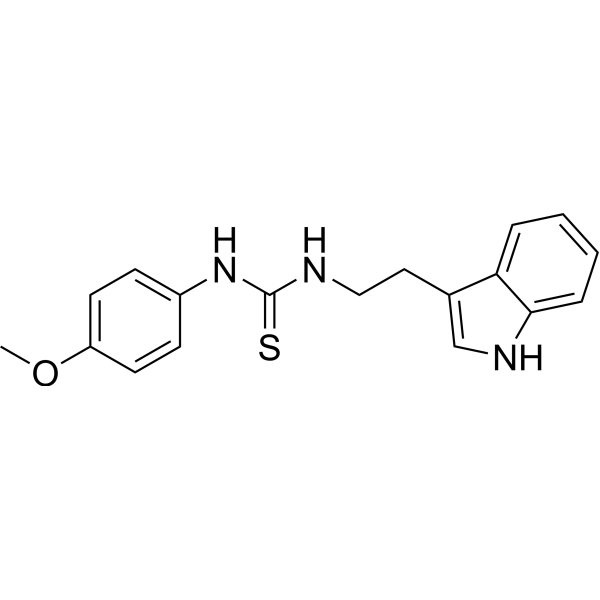
 0 ImagesCat. No.: HY-184981CAS No.: 2243516-99-4Urease-IN-24 is a cryptococcal urease inhibitor with a IC50 of 89.96 nM and a Ki of 64.3 nM. Urease-IN-24 acts as a competitive nickel-coordinating inhibitor that coordinates with the nickel center at the catalytic site of the enzyme via its carbonyl group. Urease-IN-24 reduces the capsule thickness of Cryptococcus neoformans and Cryptococcus gattii, increases cell membrane permeability, and inhibits melanin production. Urease-IN-24 exhibits fungicidal activity against Cryptococcus species. Urease-IN-24 can be used in the research of cryptococcosis.
-
Antimicrobial agent-54
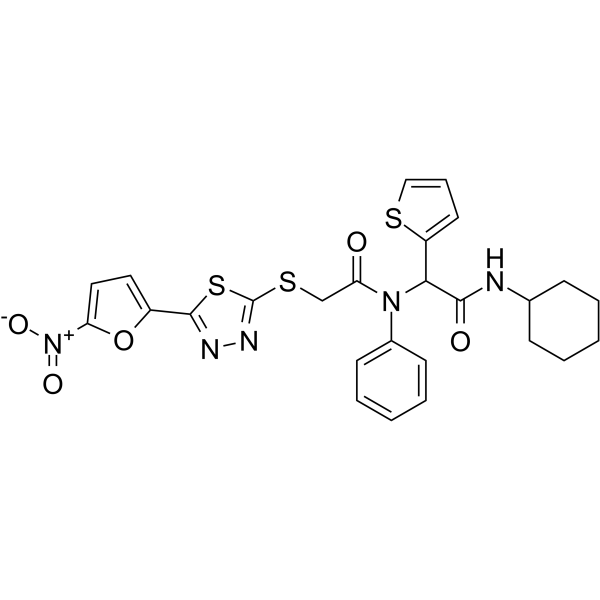
 0 ImagesCat. No.: HY-187201Antimicrobial agent-54 is a ciprofloxacin-derived multi-target antimicrobial agent that inhibits E. coli DNA gyrase, S. aureus topoisomerase IV, LpxC and urease with IC50 values of 0.182, 3.501, 0.052 and 6.254 μM, respectively. The MIC of Antimicrobial agent-54 against E. coli ATCC 8739 is 0.20 μM. Antimicrobial agent-54 interferes with bacterial cell division, causes transient membrane disruption in Gram-positive bacteria, and induces aberrant penicillin-binding protein activity in Gram-negative bacteria. Antimicrobial agent-54 can be used in the research of bacterial infections, including multidrug-resistant bacterial infections and mycobacterial infections.
-
Urease-IN-23
 0 ImagesCat. No.: HY-184980CAS No.: 2180967-88-6Urease-IN-23 is a cryptococcal urease inhibitor with antifungal activity. AF55 exhibits mixed-type inhibition against cryptococcal urease, binds to both the nickel ion site at the enzyme's catalytic center and the allosteric site, impairs urease catalytic efficiency, simultaneously disrupts fungal virulence structures and damages cell membrane integrity. The IC50 and Ki values of Urease-IN-23 against cryptococcal urease are 54.92 nM and 149.1 nM, respectively. Urease-IN-23 significantly reduces the capsule thickness of Cryptococcus neoformans and Cryptococcus gattii, increases fungal cell membrane permeability, and completely blocks melanin synthesis. Urease-IN-23 shows no toxicity in the Galleria mellonella larval model. Urease-IN-23 can be used in studies related to fungal infections.
-
Urease-IN-14
 0 ImagesCat. No.: HY-W357738CAS No.: 74901-20-5


-
Urease/thymidine phosphorylase-IN-1
 0 ImagesCat. No.: HY-181149Urease/thymidine phosphorylase-IN-1 (compound 8) is a urease and thymidine phosphorylase inhibitor with a urease IC50 of 8.20 μM, thymidine phosphorylase IC50 of 9.29 μM. Urease/thymidine phosphorylase-IN-1 can be used for the research of helicobacter pylori infection, proteus mirabilis infection, cancer.
-
Urease-IN-16
 0 ImagesCat. No.: HY-161998CAS No.: 1203704-26-0Urease-IN-16 (compound 4e) is a urease inhibitor, with an IC50 value of 132 μmol/L. Urease-IN-16 can coordinate with the nickel atom through the oxygen atoms of carbonyl or boronic acid groups. Urease-IN-16 shows great potential as an additive in the development of efficient fertilizers and medical applications.
-
Urease-IN-22
 0 ImagesCat. No.: HY-175644Urease-IN-22 (Compound 9L) is a Urease inhibitor with an IC50 of 0.15 μM. Urease-IN-22 is a piperazine-based derivative of Benzimidazole (HY-Y1825).
-
Urease-IN-10
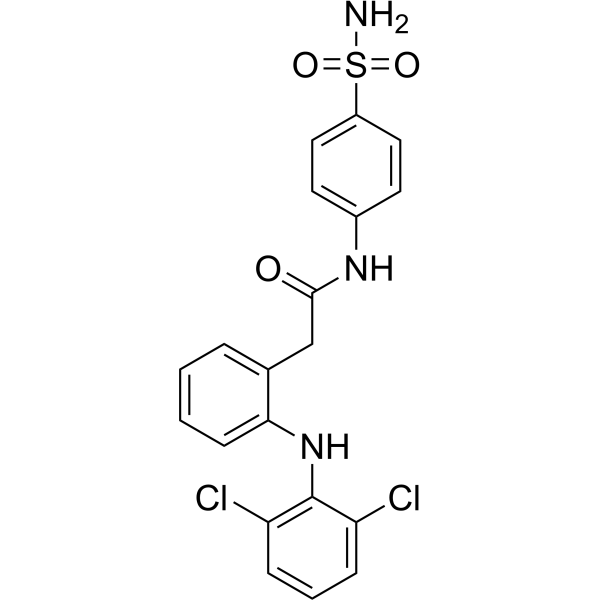 0 ImagesCat. No.: HY-149775CAS No.: 1012205-70-7Urease-IN-10 (Conjugate 4) is a competitive Urease inhibitor, with an IC50 of 3.59±0.07 μM and a Ki of 7.45 μM. Urease-IN-10 is a conjugate consisting of Diclofenac (HY-15036) and Sulfanilamide (HY-B0242). Diclofenac-sulfanilamide inhibits the Jack bean urease(JBU) in a competitive manner.
-
N-Butylthiophosphoric triamide (Standard)
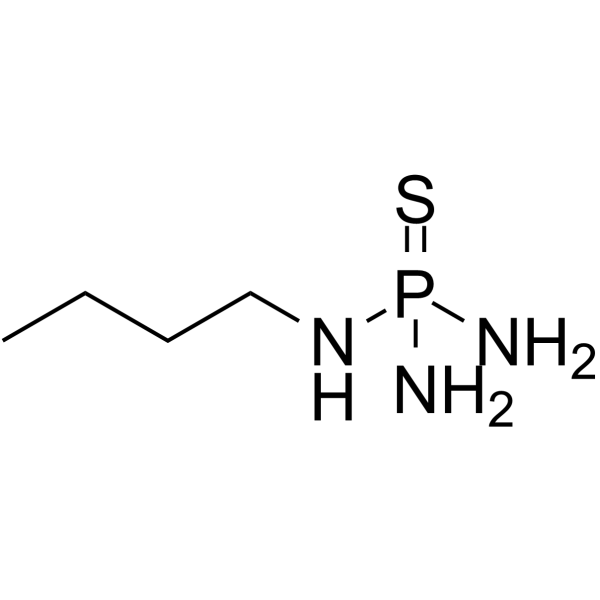
 0 ImagesCat. No.: HY-107199RCAS No.: 94317-64-3Synonyms: NBPT (Standard)N-Butylthiophosphoric triamide (Standard) (NBPT (Standard)) is the analytical standard of N-Butylthiophosphoric triamide (HY-107199). This product is intended for research and analytical applications. N-Butylthiophosphoric triamide (NBPT) is a potent urease inhibitor. Butylthiophosphoric triamide inhibits nitrification and reduces the conversion of urea to NH3 gas.
- 1



