
8 Results for "

B6C3F1 mice

" in MedChemExpress (MCE) Product Catalog:
Products (8)

8 Results for "B6C3F1 mice" in MCE Product Catalog:

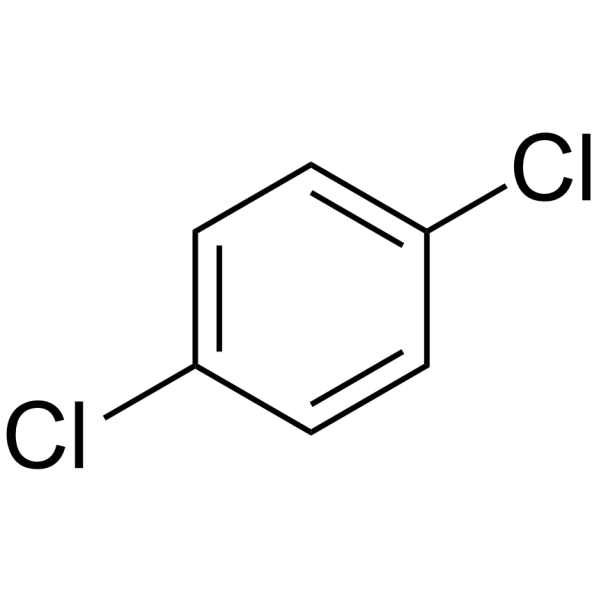
Cat. No.: HY-Y0496
CAS No.: 106-46-7
Research Areas:  

Cancer

1,4-Dichlorobenzene is a non-genotoxic, orally active mitogenic/tumor-promoting carcinogen that is also widely used as a dye, resin intermediate, and deodorant, moth repellent/insecticide. 1,4-Dichlorobenzene induces liver tumors in mice and promotes the growth of spontaneous precancerous lesions, but shows no liver tumor-inducing activity in F344 rats. Exposure to 1,4-dichlorobenzene leads to elevated leukocyte counts, serum alanine aminotransferase, and blood urea nitrogen levels. Due to the hepatotoxic characteristics, 1,4-Dichlorobenzene is applicable to liver cancer-related research .
loading...
    loading...
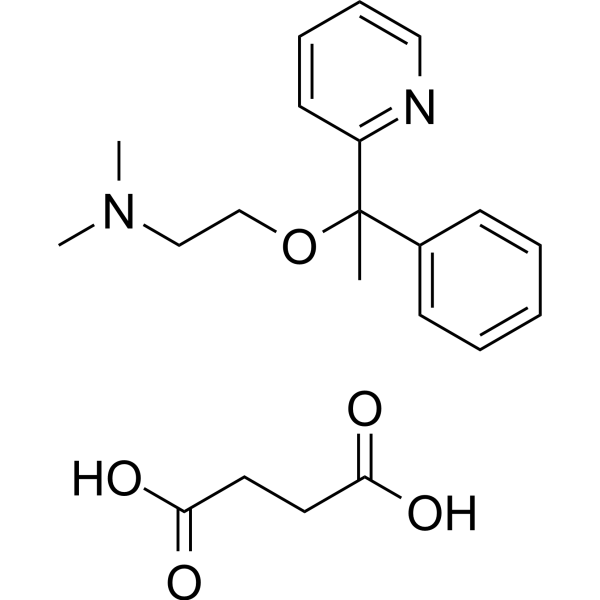
Cat. No.: HY-A0069
CAS No.: 562-10-7
Doxylamine succinate is a first-generation antihistamine and acts as a histamine H1 receptor antagonist. Doxylamine succinate is orally active, possessing analgesic and hypnotic activities. Doxylamine succinate enhances the activities of CYP2B, CYP2A, CYP3A and thyroxine-glucuronosyltransferase via promoting substrate hydroxylation and thyroxine metabolic pathways. Doxylamine succinate decreases serum thyroxine (T4) level and elevates serum thyroid-stimulating hormone (TSH) level. Doxylamine succinate induces liver enlargement and increases the activities of hepatic microsomal cytochrome P450, cytochrome b5 and NADPH-cytochrome c reductase. Doxylamine succinate can be used for the research of nausea, allergy, insomnia .
loading...
    loading...
Cat. No.: HY-21197
CAS No.: 375-85-9
Synonyms: Perfluoroheptanoic acid; Tridecafluoroheptanoic acid; PFHpA
Perfluoroenanthic acid (Perfluoroheptanoic acid) is a kind of perfluoroalkyl carboxylic acid organic pollutant. Perfluoroenanthic acid has environmental persistence and bioaccumulation, and exposure can occur via oral, dermal and other routes. Perfluoroenanthic acid exhibits reproductive toxicity, neurotoxicity, hepatotoxicity, immunotoxicity and endocrine-disrupting effects. Perfluoroenanthic acid exerts definite adverse effects on development, spermatogenesis, neuronal activity and liver tissue .
loading...
    loading...
Cat. No.: HY-W250121
CAS No.: 9000-65-1
Tragacanth gum is an orally active anionic composite polysaccharide and multifunctional biomaterial. Tragacanth gum exhibits biocompatibility, mucoadhesion and renoprotective effects, and effectively promotes wound closure and tissue healing. Tragacanth gum can be isolated from Astragalus gummifer. Tragacanth gum acts as an emulsifier and drug delivery carrier, and is also widely used in fields such as 3D scaffolds, tissue engineering and green nanoparticle preparation. High doses of Tragacanth gum may induce reversible forestomach squamous epithelial hyperplasia in mice, but show no mutagenic or carcinogenic activity. Tragacanth gum is commonly used in studies related to diseases including systemic candidiasis, rheumatoid arthritis and osteosarcoma .
loading...
    loading...
Cat. No.: HY-A0069A
CAS No.: 469-21-6
Doxylamine is a first-generation antihistamine and acts as a histamine H1 receptor antagonist. Doxylamine is orally active, possessing analgesic and hypnotic activities. Doxylamine enhances the activities of CYP2B, CYP2A, CYP3A and thyroxine-glucuronosyltransferase via promoting substrate hydroxylation and thyroxine metabolic pathways. Doxylamine decreases serum thyroxine (T4) level and elevates serum thyroid-stimulating hormone (TSH) level. Doxylamine induces liver enlargement and increases the activities of hepatic microsomal cytochrome P450, cytochrome b5 and NADPH-cytochrome c reductase. Doxylamine can be used for the research of nausea, allergy, insomnia .
loading...
    loading...
Cat. No.: HY-A0069R
CAS No.: 562-10-7
Doxylamine succinate (Standard) is the analytical standard of Doxylamine succinate (HY-A0069). This product is intended for research and analytical applications. Doxylamine succinate is a first-generation antihistamine and acts as a histamine H1 receptor antagonist. Doxylamine succinate is orally active, possessing analgesic and hypnotic activities. Doxylamine succinate enhances the activities of CYP2B, CYP2A, CYP3A and thyroxine-glucuronosyltransferase via promoting substrate hydroxylation and thyroxine metabolic pathways. Doxylamine succinate decreases serum thyroxine (T4) level and elevates serum thyroid-stimulating hormone (TSH) level. Doxylamine succinate induces liver enlargement and increases the activities of hepatic microsomal cytochrome P450, cytochrome b5 and NADPH-cytochrome c reductase. Doxylamine succinate can be used for the research of nausea, allergy, insomnia .
loading...
    loading...
Cat. No.: HY-W133921
CAS No.: 25265-71-8
Research Areas:  

Others

Dipropylene glycol is a mixture of three structural isomers (2-(2-hydroxypropoxy)-1-propanol, 1,1'-oxybis (2-propanol), and 2,2'-oxybis (1-propanol)). Dipropylene glycol induces liver and kidney damage as well as reproductive toxicity in rodents. Dipropylene glycol can be used in chemical industry-related research, such as for plasticizers, polyester resins, cosmetics, fragrances, polyurethane polyols, and alkyd resins .
loading...
    loading...
Cat. No.: HY-76737
CAS No.: 7005-72-3
Synonyms: 4-CDE
Target:  

Estrogen Receptor/ERR

Research Areas:  

Endocrinology

4-Chlorodiphenyl ether (4-CDE) is an estrogen-mimicking active compound. 4-Chlorodiphenyl ether maintains the survival of endometriotic cysts and exhibits estrogenic activity associated with the growth of endometriotic implants. 4-Chlorodiphenyl ether can be used in research related to endometriosis .
loading...
    loading...

