1. Search Result
Search Result
Results for "

CuI

" in MedChemExpress (MCE) Product Catalog:

12

Inhibitors & Agonists

2

Fluorescent Dye

1

Biochemical Assay Reagents

Cat. No. Product Name Target Research Areas Chemical Structure
  • HY-Y0032
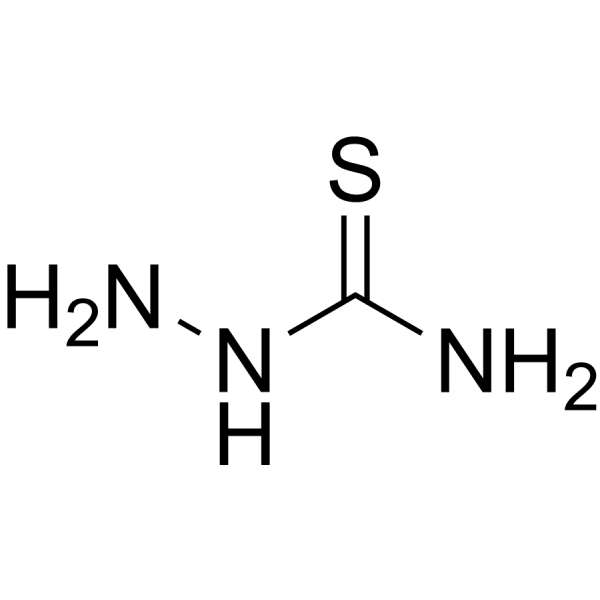
    Thiosemicarbazide
    1 Publications Verification

    Orthopoxvirus Infection Others Cancer
    Thiosemicarbazide is a vitamin B6 antagonist with anti-acne activity. Thiosemicarbazide is also a well-known source in the synthesis of heterocycles, and its derivatives have potential anticancer activity. Thiosemicarbazide (TSC: HL1) reacts with metal salts, urea (U), to prepare Co(II) and Cu(I) metal complexes. Thiosemicarbazide is also used in the fields of media communications and optical storage, and in the spectrophotometric detection of metals .
    Thiosemicarbazide
  • HY-153419

    Biochemical Assay Reagents Others
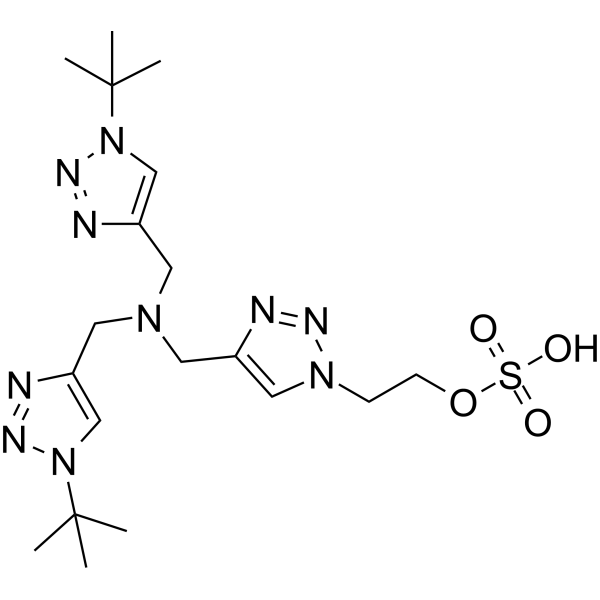
    BTTES is a tris(triazolylmethyl)amine-based ligand for Cu(I) without apparent toxicity. BTTES IMPROVES the cycloaddition reaction rapidly in living systems .
    BTTES
  • HY-W753658

    Fluorescent Dye Others
    Coppersensor-3 (CS3) is a bright small-molecule fluorescent probe for selective Cu(I) detection. Coppersensor-3 is selective and sensitive enough to image labile copper pools in living cells at endogenous, basal levels. Coppersensor-3 can be used for the cell biology of copper research .
    Coppersensor-3
  • HY-W054259

    N,N'-Difurfuryloxamide; N1,N2-Bis(furan-2-ylmethyl)oxalamide

    Biochemical Assay Reagents Others
    BFMO (N,N'-Difurfuryloxamide) is an oxamide derivative and a bidentate ligand. BFMO exhibits plant growth regulatory activity and root growth inhibitory activity. BFMO can promote the copper-catalyzed N-arylation reaction between aniline compounds and cyclic secondary amines, realizing the coupling of (hetero) aryl bromides with (hetero) aryl amines and cyclic secondary amines .
    BFMO
  • HY-161181

    Biochemical Assay Reagents Others
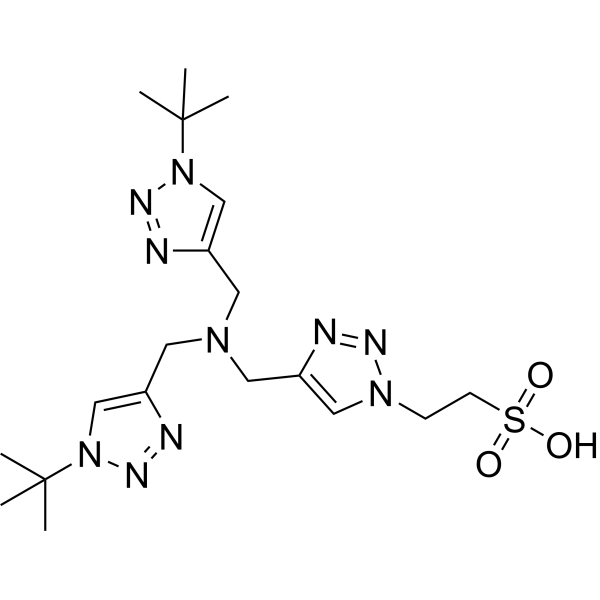
    BTTES-acid is an analog of BTTES. BTTES is a tris(triazolylmethyl)amine-based ligand for Cu(I) without apparent toxicity. BTTES improves the cycloaddition reaction rapidly in living systems .
    BTTES-acid
  • HY-163200

    Cuproptosis Neurological Disease
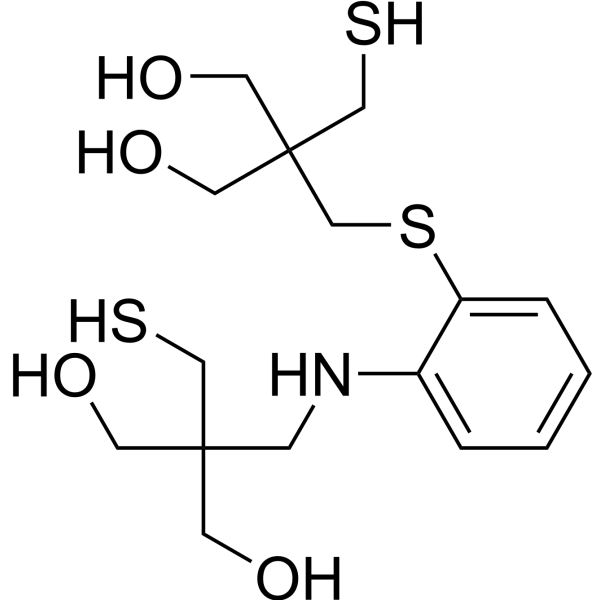
    Cu(I) chelator 1 (Compound LH2) is a chelator which targets the Cu(I) redox state. Cu(I) chelator 1 prevents ROS production .
    Cu(I) chelator 1
  • HY-Y0032R

    Orthopoxvirus Reference Standards Infection Others Cancer
    Thiosemicarbazide is a vitamin B6 antagonist with anti-acne activity. Thiosemicarbazide is also a well-known source in the synthesis of heterocycles, and its derivatives have potential anticancer activity. Thiosemicarbazide (TSC: HL1) reacts with metal salts, urea (U), to prepare Co(II) and Cu(I) metal complexes. Thiosemicarbazide is also used in the fields of media communications and optical storage, and in the spectrophotometric detection of metals .
    Thiosemicarbazide (Standard)
  • HY-161436

    Small Interfering RNA (siRNA) Others
    TPA-dT is a thymidine analog with a tris[(2-pyridyl)methyl]amine (TPA) group. TPA-dT can be used to modify siRNAs. The TPA-modified siRNAs remain functionally inactive and is incapable of silencing gene expression until the TPA moiety is removed upon exposure to Cu(I) .
    TPA-dT
  • HY-W800697

    Fluorescent Dye Others
    BP Fluor 430 Picolyl Azide is an advanced fluorescent probe that incorporatess a copper-chelating motif to raise the effective concentration of Cu(I) at the reaction site. The rate of the CuAAC reaction depends on the concentrations of all reagents, including copper, therefore raising the effective copper concentration at the reaction site will dramatically increase the rate of CuAAC reaction without the need to increase concentration of azide reagent or copper. In addition, the use of BP Fluor 430 Picolyl Azide instead of conventional BP Fluor 430 Azide allows for at least a tenfold reduction in the concentration of the copper catalyst without sacrificing the efficiency of labeling. In summary, the introduction of a picolyl moiety into an azide probe leads to a substantial increase in the sensitivity of alkyne detection. This is of special value for the detection of low abundance targets or where significant increase in signal intensity is desired.
    BP Fluor 430 picolyl azide
  • HY-W1049767

    MOFs Others
    TIFSIX-2-Cu-i is a metal-organic framework (MOF).
    TIFSIX-2-Cu-i
  • HY-W1049774

    MOFs Others
    SIFSIX-14-Cu-i is a metal-organic framework (MOF).
    SIFSIX-14-Cu-i
  • HY-W800693

    Fluorescent Dye Others
    BP Fluor 405 Picolyl Azide is an advanced fluorescent probe that incorporatess a copper-chelating motif to raise the effective concentration of Cu(I) at the reaction site. The rate of the CuAAC reaction depends on the concentrations of all reagents, including copper, therefore raising the effective copper concentration at the reaction site dramatically increases the rate of CuAAC reaction without increasing the concentrations of azide reagent or copper. In addition, the use of picolyl azide instead of conventional azides allows for at least a tenfold reduction in the concentration of the copper catalyst without sacrificing the efficiency of labeling. In summary, the introduction of a picolyl moiety into an azide probe leads to a substantial increase in the sensitivity of alkyne detection. This is of special value for the detection of low abundance targets or where significant increase in signal intensity is desired.
    BP Fluor 405 picolyl azide

Inquiry Online

Your information is safe with us. * Required Fields.

Salutation


Country or Region *

Applicant Name *


Organization Name *

Department *


Email Address *


Product Name *

Cat. No.


Requested quantity *

Phone Number *


Remarks

Inquiry Online

Inquiry Information

Product Name:
Cat. No.:
Quantity:
MCE Japan Authorized Agent:

