15 Results for "

DBCO-Palmitic

" in MedChemExpress (MCE) Product Catalog:
Products (15)

15 Results for "DBCO-Palmitic" in MCE Product Catalog:

Cat. No.: HY-W879064
CAS No.: 2247286-94-6
Research Areas:  

Others

DBCO-Palmitic is a click chemical organic compound. DBCO-Palmitic can be used in the azide-alkyne cycloaddition (SPAAC) reaction.
loading...
    loading...
1
1 Cited Publications
Cat. No.: HY-P10441A
Target:  

Peptides

Research Areas:  

Inflammation/Immunology

S-palm P0(180–199) (TFA) is a peptide that enhances MHC II-restricted responses. S-palm P0(180–199) (TFA) can be used to establish models of chronic inflammatory demyelinating polyneuropathy (CIDP) and chronic experimental autoimmune neuritis (c-EAN). S-palm P0(180–199) (TFA) is used for studying autoimmune-mediated neuroinflammatory diseases .
loading...
    loading...
Cat. No.: HY-P0064
CAS No.: 221227-05-0
Synonyms: Palmitoyl Tetrapeptide-7
Target:  

Interleukin Related

Research Areas:  

Inflammation/Immunology

Palmitoyl Tetrapeptide-3 (Palmitoyl Tetrapeptide-7) is a synthetic peptide corresponding to amino acids 341-344 of the human immunoglobulin heavy chain, with the ability to stimulate phagocytosis. Palmitoyl tetrapeptide-3 reduces interleukin-6 (IL-6) secretion in keratinocytes and inhibits the UVB radiation-exposure inflammatory response of skin. Palmitoyl tetrapeptide-3 It also has anti-inflammatory and anti-aging effects, reducing skin wrinkles by promoting the production of elastic fibers in the papillary dermis .
loading...
    loading...
Cat. No.: HY-P10932A
Research Areas:  

Neurological Disease

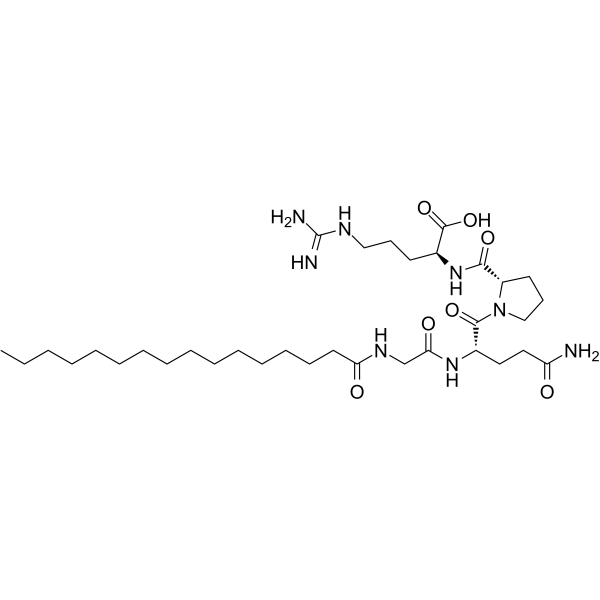
pGk13a TFA is an azide (azide group can be combined with fluorophore)-containing amphiphilic membrane labeling probe. pGk13a TFA enables high-resolution imaging of cell membranes in the ultrastructural membrane expansion microscopy (umExM) technique, facilitating the observation of membrane-associated structures and proteins. pGk13a TFA can be used for neuronal structural studies .
loading...
    loading...
Cat. No.: HY-P10031
Target:  

GLP Receptor GCGR

Research Areas:  

Metabolic Disease

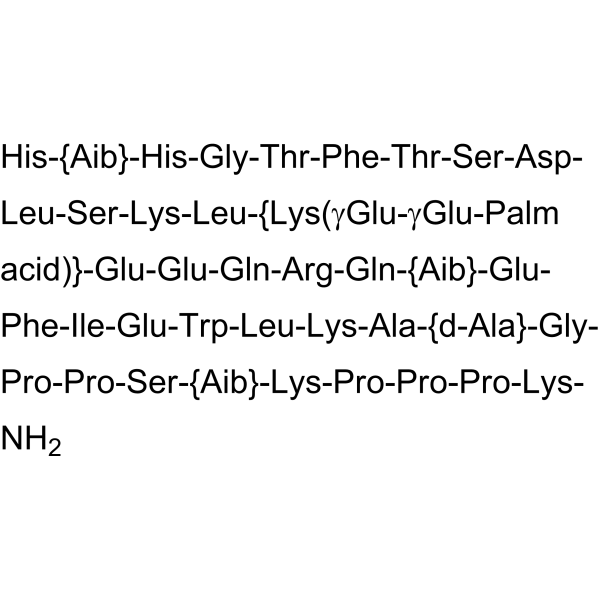
SAR441255 is a GLP-1R/GCGR/GIPR agonist, with human EC50 values of 1.03 pM, 1.01 pM, and 0.73 pM, respectively. SAR441255 stimulates receptor activity and drives cAMP accumulation. SAR441255 can be used for the research of type 2 diabetes, obesity .
loading...
    loading...
Cat. No.: HY-P10932
Research Areas:  

Neurological Disease

pGk13a is an amphipathic membrane-labeling probe containing an azide group, which can bind to fluorophores. pGk13a enables high-resolution imaging of cell membranes in the ultrastructure expansion microscopy (umExM) technique, facilitating the observation of membrane-associated structures and proteins. pGk13a is applicable to neuronal structure research .
loading...
    loading...
Cat. No.: HY-169089
Target:  

Drug Derivative

Research Areas:  

Cancer

RP-182-PEG3-K palmitic acid-NH2 (Compound 1a) is a fatty acid derivative of the immunomodulatory peptide RP-182. RP-182-PEG3-K palmitic acid-NH2 inhibits CD206 high M2-like macrophage (IC50 of 3.2 μM) and induces phagocytosis. RP-182-PEG3-K palmitic acid-NH2 exhibits antitumor efficacy in mouse B16 melanoma allografts .
loading...
    loading...
Cat. No.: HY-P10380
palm11-PrRP31 is a lipidized endogenous appetite inhibitory neuropeptide (PrRP) analogue. palm11-PrRP31 is GPR10 (EC50=39 pM) and NPFF-R2 effective dual agonists. palm11-PrRP31 is able to mimic the natural function of PrRP by binding to these receptors to reduce food intake. palm11-PrRP31 can be used as a potential anti-obesity agent and for the study of neuropeptide-receptor interaction .
loading...
    loading...
Cat. No.: HY-P10031A
Target:  

GLP Receptor GCGR

Research Areas:  

Metabolic Disease

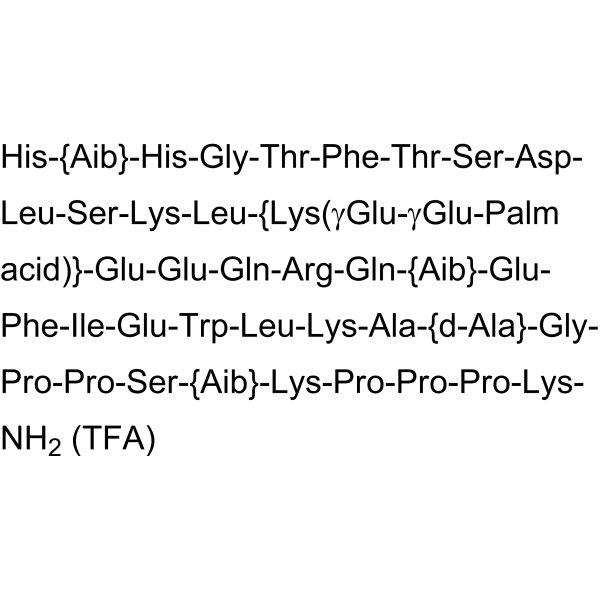
SAR441255 TFA is a GLP-1R/GCGR/GIPR agonist, with human EC50 values of 1.03 pM, 1.01 pM, and 0.73 pM, respectively. SAR441255 TFA stimulates receptor activity and drives cAMP accumulation. SAR441255 TFA can be used for the research of type 2 diabetes, obesity .
loading...
    loading...
Cat. No.: HY-P11428
CAS No.: 2425606-55-7
Research Areas:  

Others

DBCO-cyclo (RGDfK) is a clickable DBCO-modified cyclic RGD peptide, and also a DBCO derivative of cyclo (RGDfK) (HY-P0023). DBCO-cyclo (RGDfK) is synthesized via an amide coupling reaction between DBCO-NHS ester and cyclo (RGDfK). DBCO-cyclo (RGDfK) can react with azide groups through copper-free click chemistry (SPAAC) to immobilize RGD peptides onto biomaterials or hydrogels. The RGD sequence in DBCO-cyclo (RGDfK) is recognizable by cellular integrins and promotes cell adhesion. DBCO-cyclo (RGDfK) can be used in studies related to tissue engineering, 3D cell culture, and surface functionalization of biomaterials .
loading...
    loading...
Cat. No.: HY-169089A
Target:  

Drug Derivative

Research Areas:  

Cancer

RP-182-PEG3-K(palmitic acid)-NH2 (Compound 1a) TFA is a fatty acid derivative of the immunomodulatory peptide RP-182. RP-182-PEG3-K(palmitic acid)-NH2 TFA inhibits CD206 high M2-like macrophage (IC50 of 3.2 μM) and induces phagocytosis. RP-182-PEG3-K(palmitic acid)-NH2 TFA exhibits antitumor efficacy in mouse B16 melanoma allografts .
loading...
    loading...
Cat. No.: HY-P10380A
palm11-PrRP31 TFA is a lipidized endogenous appetite inhibitory neuropeptide (PrRP) analogue. palm11-PrRP31 TFA is GPR10 (EC50=39 pM) and NPFF-R2 effective dual agonists. palm11-PrRP31 TFA is able to mimic the natural function of PrRP by binding to these receptors to reduce food intake. palm11-PrRP31 TFA can be used as a potential anti-obesity agent and for the study of neuropeptide-receptor interaction .
loading...
    loading...
Cat. No.: HY-P10441
CAS No.: 1240687-76-6
Target:  

Peptides

Research Areas:  

Inflammation/Immunology

S-palm P0(180-199) is a polypeptide that increases MHC Class II limiting reactions. S-palm P0(180-199) can be used to establish a model of chronic inflammatory demyelinating multiple radiculopathy (CIDP) .
loading...
    loading...
Cat. No.: HY-P10379
Research Areas:  

Others Neurological Disease

palm-PrRP31 is a potent dual receptor agonist for both GPR10 (EC50=72 pM) and NPFF-R2. palm-PrRP31 activates downstream signaling pathways through binding to its receptors, GPR10 and NPFF-R2, which results in reduced appetite and increased energy expenditure. Utilizing palm-PrRP31 facilitates the study of the mechanism of action in the nervous system, thereby elucidating the complex biological processes that regulate appetite and energy expenditure .
loading...
    loading...
Cat. No.: HY-P10381
Target:  

Peptides

Research Areas:  

Others

palm11-TTDS-PrRP31 is a strong agonist of GPR10 (EC50: 84 pM). palm11-TTDS-PrRP31 has long-lasting anorexigenic effects .
loading...
    loading...
  • 1

