3 Results for "

DKK proteins

" in MedChemExpress (MCE) Product Catalog:
Products (3)

3 Results for "DKK proteins" in MCE Product Catalog:

5
5 Cited Publications
Cat. No.: HY-N5124
CAS No.: 60767-80-8
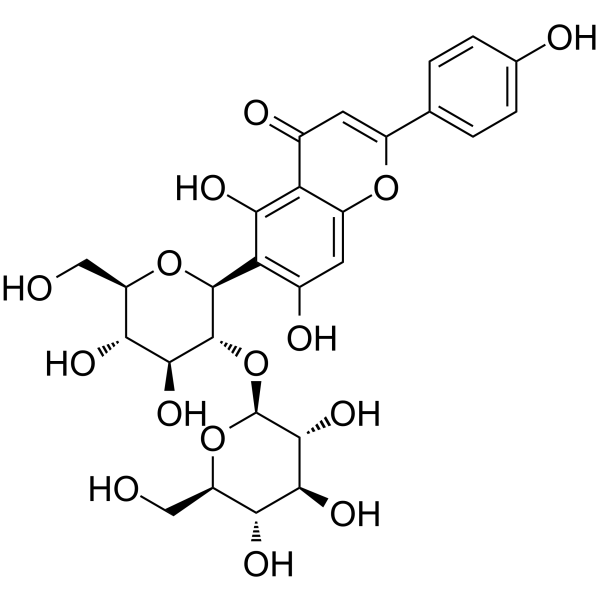
Synonyms: Isovitexin 2''-O-glucoside; Isovitexin 2''-O-β-D-glucoside
Meloside A (Isovitexin 2''-O-glucoside) is a flavonoid with antioxidant activity. Meloside A can inhibit cell apoptosis and ROS production. Meloside A can inhibit androgen receptor (AR) nuclear translocation and AR protein expression. Meloside A can reduce IL-6, TGF-β1 and DKK-1 levels. Meloside A can be used for the researches of inflammation and endocrinology, such as hair loss .
loading...
    loading...
Cat. No.: HY-W107409
CAS No.: 213473-00-8
Meridianin C is a marine natural product with anticancer activity. Meridianin C has significant inhibitory effects on four different human tongue cancer cells (YD-8, YD-10B, YD-38 and HSC-3). Meridianin C most strongly reduced the growth of YD-10B cells, the most aggressive and tumorigenic of the cell lines tested. Meridianin C also induced significant accumulation of large vesicles in YD-10B cells, validating its function through macrophagocytosis. Meridianin C reduces cellular levels of Dickkopf-related protein-3 (DKK-3), a known negative regulator of macrophagy. Meridianin C affects macrophagocytosis by downregulating DKK-3, thereby affecting cell proliferation .
loading...
    loading...
Cat. No.: HY-124841
CAS No.: 524-26-5
Synonyms: NCI8642
Target:  

Wnt β-catenin

Gallocyanine (NCI8642) is a DKK/LRP interaction inhibitor and Wnt/β-catenin signaling pathway activator. Gallocyanine binds to the YWTD repeat domains of LRP5/6, competitively blocks the interaction between DKK and LRP5/6, with an IC50 of approximately 3 μM for inhibiting DKK1 binding to LRP5, an IC50 of 6.38 μM for inhibiting DKK1 binding to LRP6, and a Ki of 14 μM for inhibiting the DKK2C/LRP6-E3E4 interaction. Gallocyanine reverses the inhibitory effect of DKK1 on WNT3A signaling, with an EC50 of approximately 5 μM. Gallocyanine can be used in studies related to Alzheimer's disease, bone formation and glucose metabolism .
loading...
    loading...

