1. Search Result
Search Result
Results for "

DNA-binding agent

" in MedChemExpress (MCE) Product Catalog:

17

Inhibitors & Agonists

1

Biochemical Assay Reagents

1

Natural
Products

1

Oligonucleotides

Cat. No. Product Name Target Research Areas Chemical Structure
  • HY-U00447

    MDM-2/p53 DNA Alkylator/Crosslinker Cancer
    PK11000 is an alkylating agent, and stabilizes the DNA-binding domain of both WT and mutant p53 proteins by covalent cysteine modification without compromising DNA binding. PK11000 has anti-tumor activities .
    PK11000
  • HY-W112938

    DNA Alkylator/Crosslinker Photosensitizer Infection Cancer
    TMPyP tetrachloride is a DNA-binding agent, singlet oxygen Sensitizer and photobleaching agent. TMPyP tetrachloride binds to DNA via intercalation or external groove complexation; irradiation induces its photoinduced release from DNA. TMPyP tetrachloride sensitizes the generation of singlet molecular oxygen upon irradiation, and prolonged irradiation leads to photobleaching. TMPyP tetrachloride initially localizes preferentially in neuronal nuclei and cytoplasm, and irradiation triggers its subcellular relocalization. TMPyP tetrachloride binds to K + -free single-molecule G4-DNA nanowires via intercalation, and binds to K + -type variants via non-intercalation. TMPyP tetrachloride can be used in studies related to cancer, HIV infection and bacterial infection .
    TMPyP tetrachloride
  • HY-153118

    ctDNA sodium, Type I, fibers; DNA sodium, from calf thymus, Type I, fibers; Thymonucleic acid sodium, Type I, fibers

    Biochemical Assay Reagents Others Cancer
    Deoxyribonucleic acid sodium, from calf thymus, Type I, fibers is the sodium salts form of Calf thymus DNA (HY-109517). Calf thymus DNA is a double-stranded template DNA isolated from calf thymus. It can be used to study the interaction between DNA and DNA binding agents, as well as the structure and function of DNA, for DNA quantification and used as a substrate for DNA polymerase analysis, etc​ .
    Deoxyribonucleic acid sodium, from calf thymus, Type I, fibers
  • HY-13620

    LU 79553

    Topoisomerase Cancer
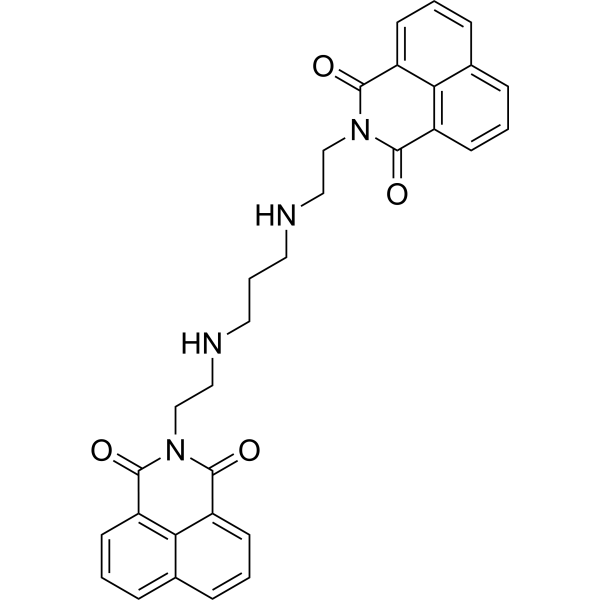
    Elinafide is an anticancer agent with a naphthalimide structure that targets DNA. Elinafide interferes with cell metabolism by inserting a planar ring into the DNA double helix and interacting with enzymes through its side chain.LU-79553 is a DNA-binding topoisomerase II inhibitor. The IC50 value of Elinafide for HT-29 cells is 0.014 μM .
    Elinafide
  • HY-43058

    5'-O-DMT-N2-isobutyrylguanosine

    Nucleoside Antimetabolite/Analog Phosphoramidites Drug Intermediate Cancer
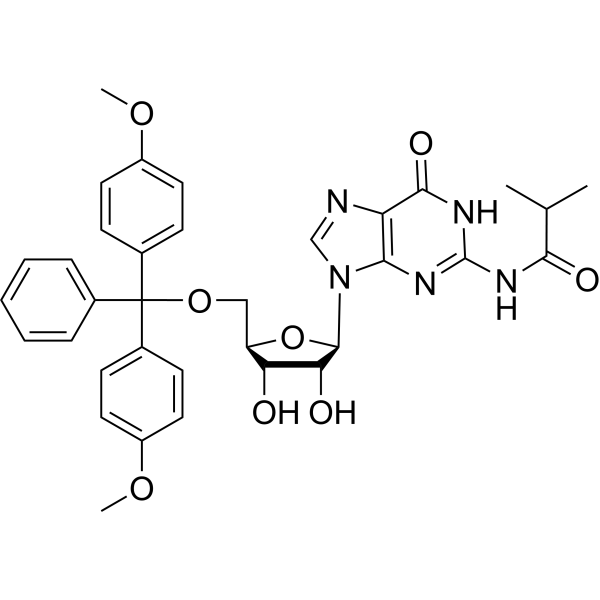
    5'-O-DMT-ibu-rG (5'-O-DMT-N2-isobutyrylguanosine) is a chemically modified guanosine derivative that can be used as a novel DNA-binding molecule for the development of effective and selective anti-cancer agents.
    5'-O-DMT-ibu-rG
  • HY-160129

    ML-970; AS-I-145; NSC 716970

    Nucleoside Antimetabolite/Analog Cancer
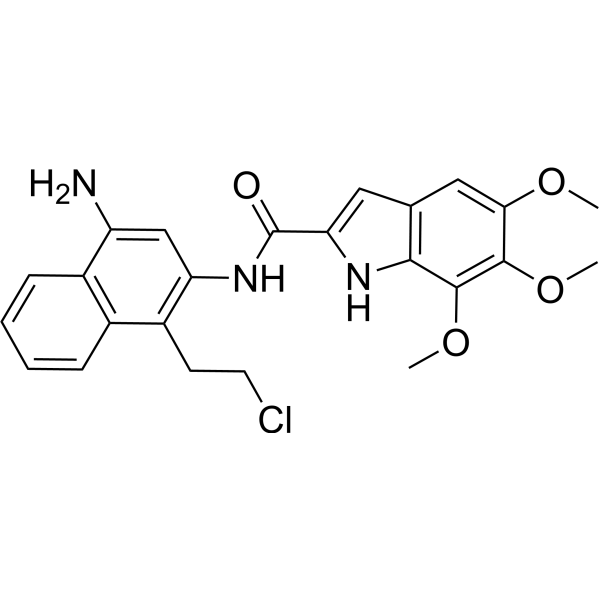
    Centanamycin (ML-970; AS-I-145; NSC 716970) is a novel DNA-binding agent, and shows cytotoxic activity, with an average GI50 of 34 nM in NCI-60 cell line screening .
    Centanamycin
  • HY-W341997

    PPAR Metabolic Disease
    9-Octadecynoic acid is a DNA binding agent with a dissociation constant of 1.8 mM. 9-Octadecynoic acid is also an agonist for peroxisome proliferator-activated receptor γ (PPARγ) .
    9-Octadecynoic acid
  • HY-121352

    Drug Derivative Cancer
    Kibdelone C is a hexacyclic tetrahydroxanthone natural product and anticancer agent with sub-nanomolar GI50 activity against human SR leukemia and SN12C renal carcinoma cell lines. Kibdelone C disrupts the actin cytoskeleton in human cancer cells, leading to cell contraction and actin stress fiber formation, without direct actin binding, actin polymerization effects, topoisomerase I/II inhibition, or DNA binding. Kibdelone C can be used for the research of leukemia, and renal cell carcinoma .
    Kibdelone C
  • HY-106091B

    CI 941 hydrochloride; DUP 94 hydrochloride

    DNA Alkylator/Crosslinker Cancer
    Losoxantrone hydrochloride (CI 941 hydrochloride) is a DNA-binding agent. Losoxantrone hydrochloride has broad-spectrum antitumour activity. Losoxantrone hydrochloride induces dose-dependent leukopenia .
    Losoxantrone hydrochloride
  • HY-170965

    CDK DNA/RNA Synthesis Cancer
    Anticancer agent 264 (Compound 5w) is an anticancer agent that exhibits significant antiproliferative activity across tumor cell lines, with an IC50 range of 7.5-33.67 μM. Anticancer agent 264 significantly induces G2/M phase arrest in MDA-MB-231, MIA PaCa-2, and DU-145 cell lines. Anticancer agent 264 reduces the expression of key cell cycle proteins, including CDK1, CDK2, and Cyclin B1, in a dose-dependent manner, and shows strong binding affinity with inhibitor of differentiation (ID) proteins and DNA-binding proteins. Anticancer agent 264 can be used for research in the field of cancer-related diseases .
    Anticancer agent 264
  • HY-122069

    NSC 1

    Bacterial Infection Neurological Disease Cancer
    NSC177365 (NSC 1) is a CcrM inhibitor. NSC177365 is a competitive DNA inhibitor and disrupts DNA binding. NSC177365 has antibacterial activity, with IC50s of 2.3 and 14.6 μM for C. crescentus and M. lincolnii respectively. NSC177365 reverses several neurodegenerative disorders and serve as an anticancer agent .
    NSC177365
  • HY-162775

    Bacterial Antibiotic Infection
    TST1N-224 is a potent response regulator VraRC inhibitor. TST1N-224 can disrupt VraRC-DNA complex formation (IC50=60.2 μM). TST1N-224 exhibits interference with VraRC binding to its cognate DNA through a fast-on-fast-off binding mechanism (KD=23.4 μM). TST1N-224 predominantly interacts with the α9- and α10-helixes of the DNA-binding domain of VraR. TST1N-224 inhibits the growths of S. aureus (SA; MIC>126 μM), Methicillin-resistant S. aureus (MRSA; MIC>126 μM), and Vancomycin-intermediate S. aureus (VISA; MIC=63 μM). TST1N-224, an antimicrobial agent, evidently enhances the susceptibility of VISA to both Vancomycin (HY-B0671) and Methicillin (HY-B0974) .
    TST1N-224
  • HY-106091

    CI 941; DuP-941; Biantrazole

    DNA Alkylator/Crosslinker Cancer
    Losoxantrone (CI 941) is a DNA-binding agent. Losoxantrone has broad-spectrum antitumour activity. Losoxantrone induces dose-dependent leukopenia .
    Losoxantrone
  • HY-180839

    DNA Alkylator/Crosslinker Caspase Apoptosis Mitochondrial Metabolism Reactive Oxygen Species (ROS) Cancer
    anti-TNBC agent-14 (Compound 4l) is a selective anti-TNBC agent. anti-TNBC agent-14 is a potent and selective DNA-binding agent. anti-TNBC agent-14 induces caspase-3-dependent Apoptosis, mitochondrial ROS generation .
    anti-TNBC agent-14
  • HY-119228

    DNA Alkylator/Crosslinker Topoisomerase MDM-2/p53 Cancer
    SN-28049 is a new DNA-binding topoisomerase II-directed antitumor agent. SN-28049 activates the p53 pathway. SN-28049 exhibits anticancer activity against colorectal cancer .
    SN-28049
  • HY-133240

    DNA Alkylator/Crosslinker Calcium Channel Potassium Channel Sodium Channel Infection
    trans-AzoTAB is a photoresponsive potassium/sodium/calcium channel modulator and DNA-binding agent. trans-AzoTAB undergoes trans-cis isomerization driven by light, with variable polarity and DNA affinity. trans-AzoTAB also enhances voltage-gated potassium currents and inhibits sodium and calcium currents in cardiomyocytes, thereby reducing spontaneous electrical activity and excitation conduction velocity. In addition, trans-AzoTAB induces compaction and frozen conformation of λ-phage DNA, and non-sequence-dependently inhibits transcription and translation processes in the dark; its activity can be reversed and restored by visible light after activation with ultraviolet irradiation. trans-AzoTAB can serve as a probe for two-photon optical regulation of myocardial excitability, and is used to construct photoresponsive interfacial polymer structures .
    trans-AzoTAB
  • HY-181966

    Bacterial DNA/RNA Synthesis Potassium Channel Infection
    Sideromycin 7 is an antibacterial agent. Sideromycin 7 forms a 7-Bi 3+ coordination complex with bismuth citrate, exerting a three-pronged antibacterial mode of action: direct DNA binding to induce damage and arrest replication, suppression of KdpC synthesis to block KdpFABC-mediated potas-sium transport, and inhibition of ATP production. Sideromycin 7 exhibits potent antibacterial activity against Ciprofloxacin (HY-B0356)-resistant Pseudomonas aeruginosa strains. Sideromycin 7 exerts antibiofilm activity against Pseudomonas aeruginosa. Sideromycin 7 can be used for the research of ciprofloxacin-resistant Pseudomonas aeruginosa infection .
    Sideromycin 7

Inquiry Online

Your information is safe with us. * Required Fields.

Salutation


Country or Region *

Applicant Name *


Organization Name *

Department *


Email Address *


Product Name *

Cat. No.


Requested quantity *

Phone Number *


Remarks

Inquiry Online

Inquiry Information

Product Name:
Cat. No.:
Quantity:
MCE Japan Authorized Agent:

