8 Results for "

G9a PROTACs degrader

" in MedChemExpress (MCE) Product Catalog:
Products (8)

8 Results for "G9a PROTACs degrader" in MCE Product Catalog:

Cat. No.: HY-162362
CAS No.: 3060730-06-2
Research Areas:  

Cancer

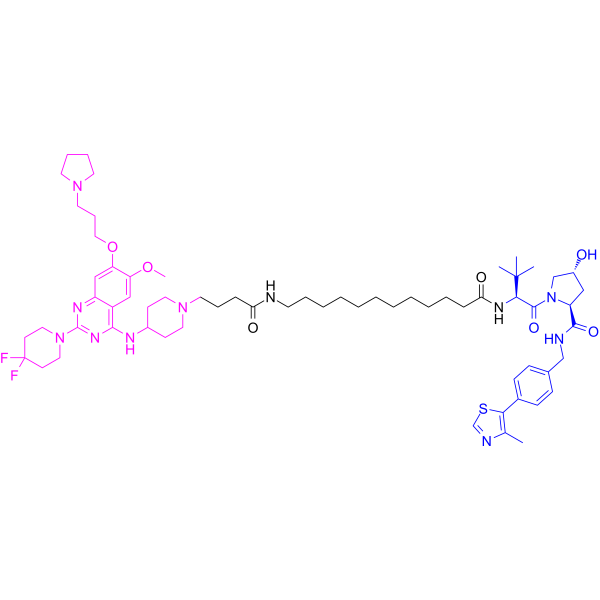
MS8709 is a PROTAC degrader that induces the degradation of G9a (EHMT2)/GLP (EHMT1) by recruiting VHL. MS8709 induces G9a/GLP protein degradation via a mechanism that simultaneously depends on G9a/GLP target protein binding, VHL recruitment, and the ubiquitin-proteasome system (UPS), while the mRNA levels of G9a and GLP do not show significant changes, indicating that the effect occurs primarily at the protein level rather than the transcriptional level. MS8709 retains the inhibitory effect on G9a/GLP methyltransferase activity and reduces H3K9me2 levels, thereby simultaneously affecting the catalytic and non-catalytic functions of G9a/GLP. MS8709 can be used for studies related to G9a/GLP biology, prostate cancer, lung cancer, and other relevant fields .
loading...
    loading...
Cat. No.: HY-162749A
Research Areas:  

Cancer

G9D-4 TFA is a G9a PROTAC degrader. G9D-4 TFA induces G9a degradation, reduces H3K9me2 levels, and prevents GLP interference via the CRBN ternary complex, proteasome and ubiquitin-like modification-dependent pathways. G9D-4 TFA exerts antiproliferative activity and induces Apoptosis in pancreatic cancer cells. G9D-4 TFA can be used for research on pancreatic cancer .
loading...
    loading...
Cat. No.: HY-162749
CAS No.: 3097803-96-5
Research Areas:  

Cancer

G9D-4 is a G9a PROTAC degrader. G9D-4 induces G9a degradation, reduces H3K9me2 levels, and prevents GLP interference via the CRBN ternary complex, proteasome and ubiquitin-like modification-dependent pathways. G9D-4 exerts antiproliferative activity and induces Apoptosis in pancreatic cancer cells. G9D-4 can be used for research on pancreatic cancer .
loading...
    loading...
Cat. No.: HY-178065
Research Areas:  

Cancer

PROTAC G9a/GLP degrader 1 is a PROTAC degrader targeting G9a/GLP histone methyltransferases, with DC50 values of 336 nM and 988 nM against G9a and GLP, respectively. PROTAC G9a/GLP degrader 1 reduces H3K9me2 levels, inhibits breast cancer cell migration, and has no effect on cell viability. PROTAC G9a/GLP degrader 1 can be used in breast cancer-related research .
loading...
    loading...
Cat. No.: HY-187215
CAS No.: 2514847-74-4
G9a ligand-1 is a target protein ligand that targets G9a, and it can be used in PROTAC-related research, such as serving as the PROTAC target protein ligand for PROTAC G9a degrader-1 (HY-187214) .
loading...
    loading...
Cat. No.: HY-187214
PROTAC G9a degrader-1 is a selective and orally active G9a PROTAC degrader with a DC50 of 1.29 μM. PROTAC G9a degrader-1 inhibits the NF-κB signaling pathway, suppresses the proliferation and migration of cancer cells, promotes apoptosis and cell cycle arrest, and reduces the expression level of H3K9me2. In in vivo models, PROTAC G9a degrader-1 alleviates skin inflammation, reduces epidermal hyperplasia, and decreases Ki67 expression. PROTAC G9a degrader-1 can be used for the research of triple-negative breast cancer and psoriasis .
loading...
    loading...
Cat. No.: HY-178069
CAS No.: 2493430-80-9
Research Areas:  

Cancer

(S,R,S)-AHPC-CO-PEG3-NHBoc is a synthesized E3 ligase ligand-linker conjugate that can be used to synthesize PROTAC G9a/GLP degrader 1 (HY-178065). PROTAC G9a/GLP degrader 1 is a potent G9a/GLP PROTAC degrader with anti-cancer activity .
loading...
    loading...
Cat. No.: HY-187216
Thalidomide-4-O-C10-piperidine-NHBoc is an intermediate in the synthesis of G9a-targeting PROTAC, and serves as the E3 ligase ligand-linker conjugate moiety for PROTAC G9a degrader-1 (HY-187214) .
loading...
    loading...

