9 Results for "

G9a-IN-1

" in MedChemExpress (MCE) Product Catalog:
Products (9)

9 Results for "G9a-IN-1" in MCE Product Catalog:

Cat. No.: HY-44062
CAS No.: 1350752-07-6
Research Areas:  

Inflammation/Immunology Cancer

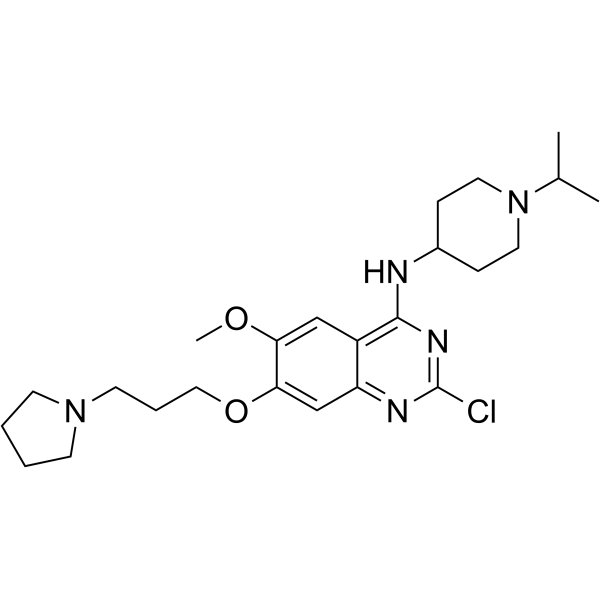
G9a-IN-1 (Compound 113) is a G9a protein inhibitor. G9A/EHMT2 is a nuclear histone lysine methyltransferase that catalyzes histone H3 lysine 9 dimethylation (H3K9me2), which is a reversible modification generally associated with transcriptional gene silencing. G9a-IN-1 can be used for the research of autoimmune disorders or cancer .
loading...
    loading...
3
3 Cited Publications
Cat. No.: HY-101925
CAS No.: 1846570-31-7
Purity:  98.70%
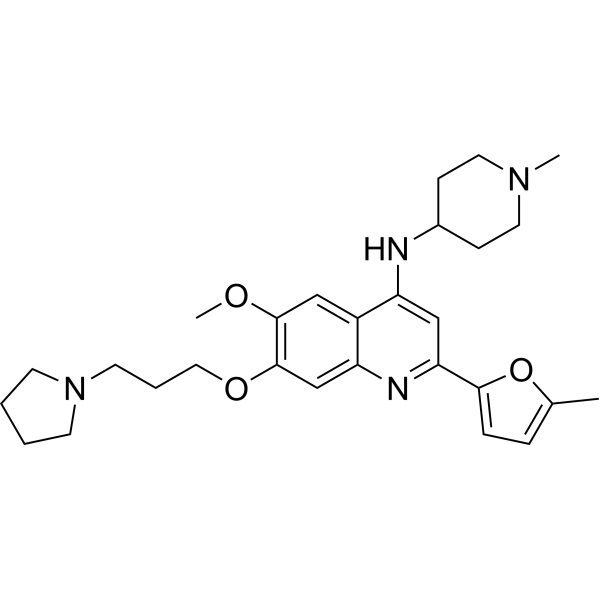
CM-272 is a first-in-class, potent, selective, substrate-competitive and reversible dual G9a/DNA methyltransferases (DNMTs) inhibitor with antitumor activities. CM-272 inhibits G9a, DNMT1, DNMT3A, DNMT3B and GLP with IC50s of 8 nM, 382 nM, 85 nM, 1200 nM and 2 nM, respectively. CM-272 inhibits cell proliferation and promotes apoptosis, inducing IFN-stimulated genes and immunogenic cell death .
loading...
    loading...
Cat. No.: HY-120444
CAS No.: 1197196-63-6
Purity:  99.79%
Research Areas:  

Cancer

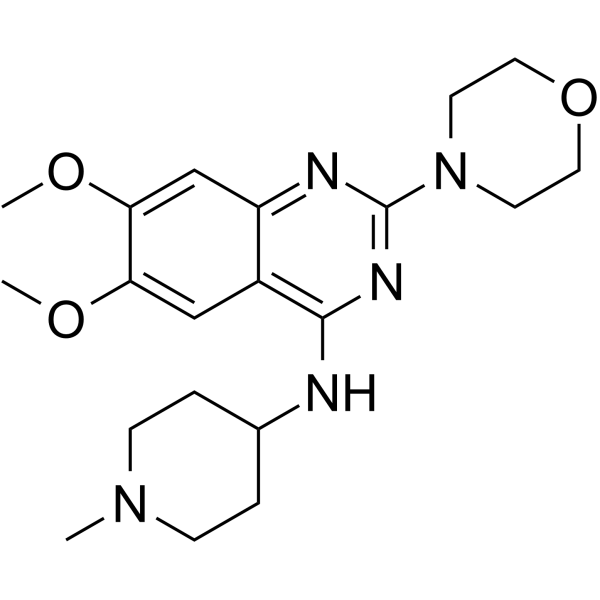
MS0124 is a potent selective G9a-like protein (GLP) inhibitor with IC50 values of 13±4 nM and 440±63 nM for GLP and G9a,respectively .
loading...
    loading...
Cat. No.: HY-W657887
CAS No.: 154866-92-9
GSK-3β/G9a-IN-1 (Compound T2) is an orally active, selective, blood-brain-barrier permeable, competitive G9a (substrate-competitive, IC50: 1.1 μM) and GSK-3β (ATP competitive, IC50: 0.8 μM) inhibitor. GSK-3β/G9a-IN-1 is a potent H3K9me2 inhibitor that reshapes chromatin landscape. GSK-3β/G9a-IN-1 lowers tau phosphorylation, reduces aggregation. GSK-3β/G9a-IN-1 displays inhibition toward glucocorticoid receptor, androgen receptor, and alpha-2A adrenergic receptor. GSK-3β/G9a-IN-1 also upregulates SAGA complex members such as Eny2 and Sgf29. GSK-3β/G9a-IN-1 markedly improves memory, restores social behaviors, and increases synaptic complexity in late-onset Alzheimer’s disease .
loading...
    loading...
Cat. No.: HY-187215
CAS No.: 2514847-74-4
G9a ligand-1 is a target protein ligand that targets G9a, and it can be used in PROTAC-related research, such as serving as the PROTAC target protein ligand for PROTAC G9a degrader-1 (HY-187214) .
loading...
    loading...
Cat. No.: HY-187214
PROTAC G9a degrader-1 is a selective and orally active G9a PROTAC degrader with a DC50 of 1.29 μM. PROTAC G9a degrader-1 inhibits the NF-κB signaling pathway, suppresses the proliferation and migration of cancer cells, promotes apoptosis and cell cycle arrest, and reduces the expression level of H3K9me2. In in vivo models, PROTAC G9a degrader-1 alleviates skin inflammation, reduces epidermal hyperplasia, and decreases Ki67 expression. PROTAC G9a degrader-1 can be used for the research of triple-negative breast cancer and psoriasis .
loading...
    loading...
Cat. No.: HY-187216
Thalidomide-4-O-C10-piperidine-NHBoc is an intermediate in the synthesis of G9a-targeting PROTAC, and serves as the E3 ligase ligand-linker conjugate moiety for PROTAC G9a degrader-1 (HY-187214) .
loading...
    loading...
Cat. No.: HY-133567
CAS No.: 2567886-53-5
SET7-IN-DC21 is a selective, potent SET7 inhibitor (IC50 = 15.93 μM; KD = 18.00 μM). SET7-IN-DC21 has good selectivity for several other epigenetic targets, such as SUV39H1, G9a, NSD1, DOT1L and MOF. SET7-IN-DC21 can be used for the researches of cancer, infection, inflammation, metabolic and cardiovascular disease, such as breast cancer .
loading...
    loading...
Cat. No.: HY-101925R
CAS No.: 1846570-31-7
CM-272 (Standard) is the analytical standard of CM-272 (HY-101925). This product is intended for research and analytical applications. CM-272 is a first-in-class, potent, selective, substrate-competitive and reversible dual G9a/DNA methyltransferases (DNMTs) inhibitor with antitumor activities. CM-272 inhibits G9a, DNMT1, DNMT3A, DNMT3B and GLP with IC50s of 8 nM, 382 nM, 85 nM, 1200 nM and 2 nM, respectively. CM-272 inhibits cell proliferation and promotes apoptosis, inducing IFN-stimulated genes and immunogenic cell death .
loading...
    loading...

