1. Search Result
Search Result
Results for "

Iron(II)

" in MedChemExpress (MCE) Product Catalog:

17

Inhibitors & Agonists

5

Biochemical Assay Reagents

2

Natural
Products

Cat. No. Product Name Target Research Areas Chemical Structure
  • HY-Y1103
    Iron(II) sulfate heptahydrate, 99%
    1 Publications Verification

    Ferrous sulfate heptahydrate, 99%

    Environmental Pollutants Biochemical Assay Reagents Cardiovascular Disease Cancer
    Iron(II) sulfate heptahydrate, 99% (Ferrous sulfate heptahydrate, 99%) is an orally active iron salt. Iron(II) sulfate heptahydrate, 99% replaces iron found in hemoglobin and myoglobin, allowing for the transportation of oxygen via hemoglobin. Iron(II) sulfate heptahydrate, 99% is mainly used for the prevention of iron-deficiency anemia. Iron(II) sulfate heptahydrate, 99% also has anti-tumor effects on chronic myeloid leukemia and breast cancer .
    Iron(II) sulfate heptahydrate, 99%
  • HY-B1651

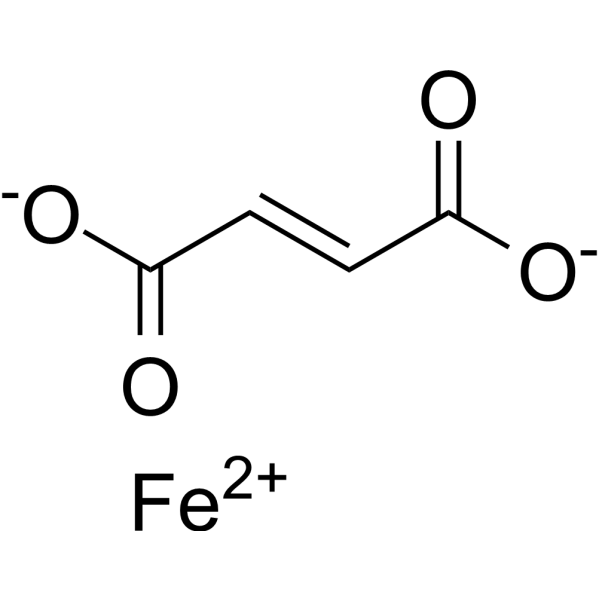
    Ferrous fumarate

    Transferrin Receptor Metabolic Disease Cancer
    Iron (II) fumarate is an orally effective active dietary supplement. Iron (II) fumarate can alleviate metabolic damage and damage to silkworms caused by cypermethrin (HY-123178). Iron (II) fumarate can be used for research on iron deficiency anemia .
    Iron(II) fumarate
  • HY-Y1103A

    Ferrous sulfate heptahydrate, for cell culture, 99%

    Environmental Pollutants Biochemical Assay Reagents Cardiovascular Disease Cancer
    Iron(II) sulfate heptahydrate, for cell culture, 99% (Ferrous sulfate heptahydrate, for cell culture, 99%) is an orally active iron salt. Iron(II) sulfate heptahydrate, for cell culture, 99% replaces iron found in hemoglobin and myoglobin, allowing for the transportation of oxygen via hemoglobin. Iron(II) sulfate heptahydrate, for cell culture, 99% is mainly used for the prevention of iron-deficiency anemia. Iron(II) sulfate heptahydrate, for cell culture, 99% also has anti-tumor effects on chronic myeloid leukemia and breast cancer .
    Iron(II) sulfate heptahydrate, for cell culture, 99%
  • HY-W015816

    2,6-DMBQ

    Photosystem II Others
    2,6-Dimethylbenzoquinone (2,6-DMBQ) is a benzoquinone derivative. 2,6-Dimethylbenzoquinone promotes Photosystem II-mediated photoelectrochemical water oxidation via electron transfer between spinach chloroplast Photosystem II membranes and carbon paste electrodes, and accepts electrons from Photosystem II during oxygen evolution assays. 2,6-Dimethylbenzoquinone undergoes direct photolysis in aqueous solution under 365 nm conditions, producing 2,6-dimethylhydroquinone and 3-hydroxy-2,6-dimethylbenzoquinone .
    2,6-Dimethylbenzoquinone
  • HY-W105875

    D-Gluconic acid Iron(II) salt dihydrate, 98%

    Biochemical Assay Reagents Others
    Iron(II) D-gluconate dihydrate, 98% is used for blood coagulation.
    Iron(II) D-gluconate dihydrate, 98%
  • HY-159569
    TfR-1-IN-1
    1 Publications Verification

    Transferrin Receptor Ferroptosis Apoptosis Necroptosis Cancer
    TfR-1-IN-1 is a transferrin receptor-1 (TfR-1) inhibitor with tumor cell-specific activity. TfR-1-IN-1 reduces TfR-1 expression, impairs mitochondrial function, induces cell apoptosis, necroptosis and ferroptosis, and increases intracellular iron (II) levels. TfR-1-IN-1 decreases the metabolic activity of cancer cells. TfR-1-IN-1 can be used for the research of ovarian cancer, breast cancer and acute myeloid leukemia .
    TfR-1-IN-1
  • HY-W115721

    Sodium rhodizonate dibasic

    Reactive Oxygen Species (ROS) DNA/RNA Synthesis Others
    Rhodizonic acid disodium (Sodium rhodizonate dibasic) is a transition metal-dependent pro-oxidant and lead detection agent that induces reactive oxygen species generation, DNA damage, and inhibits Aconitase activity. Rhodizonic acid disodium generates superoxide anion radicals in an iron (II)-dependent manner, leading to aconitase inactivation. Rhodizonic acid disodium also triggers hydroxyl radical-mediated DNA strand breaks and 8-OHdG formation via copper ion reduction. Rhodizonic acid disodium reacts with lead to form a scarlet precipitate, with the color intensity proportional to lead content, enabling qualitative or quantitative analysis of lead. Rhodizonic acid disodium can also be used for real-time visualization of the dynamic process of lead sequestration in the plant rhizosphere and evaluation of the effects of environmental factors such as soil type on the stability of lead-sequestering structures .
    Rhodizonic acid disodium
  • HY-B1651R

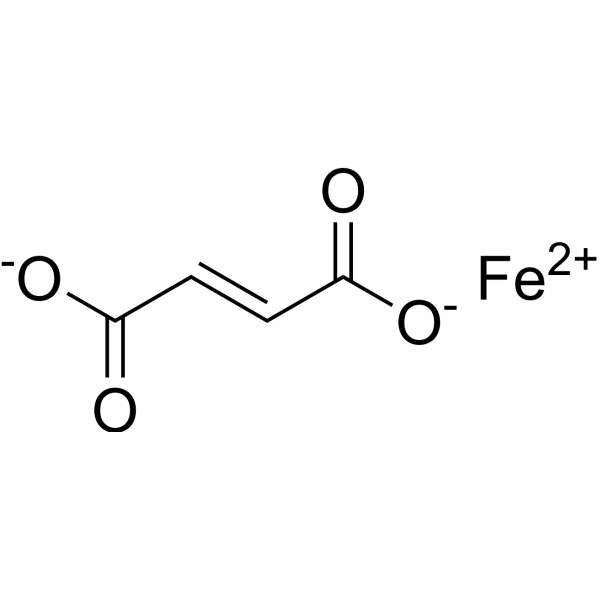
    Ferrous fumarate (Standard)

    Transferrin Receptor Reference Standards Metabolic Disease Cancer
    Iron(II) fumarate (Standard) is the analytical standard of Iron(II) fumarate. This product is intended for research and analytical applications. Iron(II) fumarate (Ferrous fumarate) is the iron(II) salt of fumaric acid. Iron(II) fumarate is an orally active dietary supplement and has the potential for iron deficiency anemia treatment .
    Iron(II) fumarate (Standard)
  • HY-W698286

    Biochemical Assay Reagents
    Iron(II) gluconate is a kind of biochemical reagent.
    Iron(II) gluconate
  • HY-W581820

    Ferrous succinate

    Biochemical Assay Reagents Cardiovascular Disease
    Iron(II) succinate (Ferrous succinate) is an orally active and organic acid iron supplement (ferrous salt). Iron(II) succinate improves hematological parameters in iron-deficiency anemia rats, including hemoglobin, red blood cells, hematocrit, mean corpuscular volume, mean corpuscular hemoglobin, and mean corpuscular hemoglobin concentration. Iron(II) succinate increases serum ferritin, serum iron levels, and transferrin saturation, while decreasing total iron-binding capacity in iron-deficiency anemia rats. Iron(II) succinate reduces the elevated heart, spleen, and kidney coefficients, and increases the decreased liver coefficient in iron-deficiency anemia rats. Iron(II) succinate replenishes the depleted iron content in the liver and spleen of iron-deficiency anemia rats. Iron(II) succinate can be used for the research of iron-deficiency anemia .
    Iron(II) succinate
  • HY-122369

    Carboxypeptidase Metabolic Disease
    Histargin is a selective carboxypeptidase B inhibitor with an IC50 of 17 μg/mL and a Ki of 30 μM. Histargin exerts competitive inhibition with substrate, with inhibitory activity abolished by metal cations. Histargin shows no significant inhibitory activity against carboxypeptidase A, aminopeptidase A, or aminopeptidase B .
    Histargin
  • HY-W072992

    Phthalocyanine Iron(II) (purified by sublimation)

    MOFs Others
    Iron(II) phthalocyanine (Phthalocyanine Iron(II) (purified by sublimation)) is a metal-organic framework (MOF).
    Iron(II) phthalocyanine
  • HY-W581798

    Biochemical Assay Reagents Metabolic Disease Cancer
    Iron(II) sulfate hydrate is an iron(II) salt with oral activity, acting as an iron supplier, and is easily oxidized to iron(III) in water. Iron(II) sulfate hydrate induces apoptotic morphological changes in cancer cells, and promotes dose‑dependent iron accumulation in rats. Iron(II) sulfate hydrate can be used in studies of leukemia, breast cancer, iron deficiency, anemia, and restless legs syndrome .
    Iron(II) sulfate hydrate
  • HY-W019888

    Ferrofloc

    Environmental Pollutants Others
    Iron (II) chloride (Ferrofloc) is an active radical polymerization initiator, which is a transition metal chloride composed of Fe 2+ and Cl ions. The ion association constant logKFeCl2 of Iron (II) chloride is −0.89. In acidic aqueous solutions, Iron (II) chloride forms solvated Fe 2++2Cl ions as well as FeCl ++Cl ion pairs. Without the addition of aluminum compounds, Iron (II) chloride drives the living radical polymerization of methyl methacrylate by generating transient radical growing species through homolytic reversible cleavage of the carbon-halogen end groups of organic halide initiators .
    Iron(II) chloride
  • HY-N8707

    Parasite HDAC NF-κB Infection Inflammation/Immunology Cancer
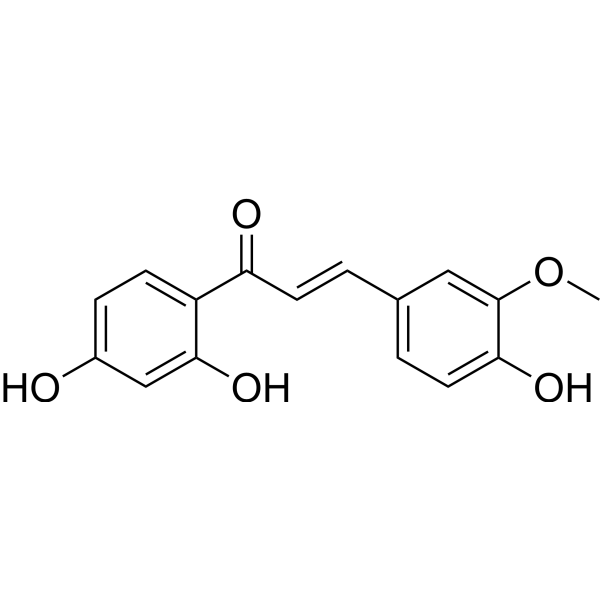
    Homobutein a natural chalcones (can be found in many medicinal plants, fruits, vegetables, spices and nuts), is a potent HDACs/NF-κB dual inhibitor with IC50s of 190 and 38 μM, respectively. Homobutein also a chelator of iron (II and III) cations, shows various activities, including anticancer, anti-inflammatory, antiparasite and antioxidation .
    Homobutein
  • HY-182604

    Heme Oxygenase (HO) Cancer
    QC-308 is a HO-1/HO-2 inhibitor with an HO-1 IC50 of 0.27 μM and an HO-2 IC50 of 0.46 μM. QC-308 coordinates heme iron(II) to disrupt catalysis. QC-308 can be used for research of HO-1 inhibition mechanisms in cancer .
    QC-308
  • HY-186196

    Ferroptosis Reactive Oxygen Species (ROS) Cancer
    Fentomycin-1 is a ferroptosis inducer. Fentomycin-1 activates lysosomal iron 2+ under acidic conditions with hydrogen peroxide to form a reactive iron-oxo species, which induces oxidative degradation, oxidation, and lipolysis of membrane phospholipids, triggering ferroptosis. Fentomycin-1 can be used for the research of pancreatic ductal adenocarcinoma, breast cancer metastasis, and melanoma .
    Fentomycin-1

Inquiry Online

Your information is safe with us. * Required Fields.

Salutation


Country or Region *

Applicant Name *


Organization Name *

Department *


Email Address *


Product Name *

Cat. No.


Requested quantity *

Phone Number *


Remarks

Inquiry Online

Inquiry Information

Product Name:
Cat. No.:
Quantity:
MCE Japan Authorized Agent:

