4 Results for "

NPM-ALK fusion protein

" in MedChemExpress (MCE) Product Catalog:
Products (4)

4 Results for "NPM-ALK fusion protein" in MCE Product Catalog:

4
4 Cited Publications
Cat. No.: HY-112155
CAS No.: 2229036-62-6
Purity:  99.72%
Research Areas:  

Cancer

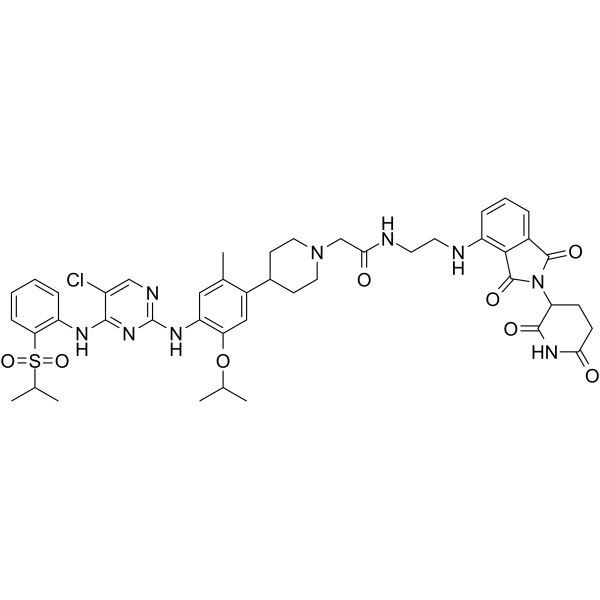
MS4078 is a ALK PROTAC degrader with a DC50 of 11 nM in SU-DHL-1 cells and a DC50 of 59 nM in NCI-H2228 cells, and its Kd value for ALK binding is 19 nM. MS4078 induces ALK degradation via the ubiquitin-proteasome pathway by recruiting cereblon, and inhibits the phosphorylation of ALK and STAT3, thereby suppressing cancer cell proliferation. MS4078 is applicable for the research of non-small cell lung cancer and anaplastic large cell non-Hodgkin's lymphoma .
loading...
    loading...
Cat. No.: HY-177945
CAS No.: 3055593-63-7
Synonyms: Gal-MS99
Research Areas:  

Cancer

MS99-β-Gal (Gal-MS99) is a galactose-modified NPM-ALK PROTAC degrader. MS99-β-Gal is only hydrolyzed by SA-β-gal and esterase in senescent cancer cells, releasing MS99, which specifically degrades the NPM-ALK fusion protein. MS99-β-Gal shows an IC50 of 454.8 nM for aging Karpas 299 cells, significantly lower than that of normal Karpas 299 cells (IC50 = 2.162 μM). MS99-β-Gal can be used for the research of cancer .
loading...
    loading...
Cat. No.: HY-168551
Research Areas:  

Cancer

PROTAC ALK degrader-3 is an orally active ALK PROTAC degrader with a DC50 of 119.33 nM in Karpas 299 cells. PROTAC ALK degrader-3 induces the degradation of ALK fusion proteins via the ubiquitin-proteasome system. PROTAC ALK degrader-3 induces NPM-ALK degradation and inhibits the expression of p-ALK and p-STAT3. PROTAC ALK degrader-3 inhibits cancer cell proliferation and suppresses the growth of xenografts in vivo. PROTAC ALK degrader-3 can be used for the research of ALK-positive cancers (e.g., anaplastic large cell lymphoma) .
loading...
    loading...
Cat. No.: HY-180970
CAS No.: 2162120-55-8
Research Areas:  

Cancer

TD-004 is a potent ALK PROTAC degrader. TD-004 exhibits anti-ALK inhibitory activity with an IC50 of 0.11 µM and selectively inhibits the proliferation of SU-DHL-1 and H3122 cells (ALK-positive cancer cells) with IC50s of 0.058 µM and 0.28 µM, respectively. TD-004 induces degradation of ALK fusion proteins (NPM-ALK and EML4-ALK) via recruitment of the VHL E3 ligase and the proteasome pathway. TD-004 demonstrates significant tumor growth inhibition with a favorable safety profile in vivo. TD-004 can be used for the research of anaplastic large cell lymphoma and non-small cell lung cancer .
loading...
    loading...

