7 Results for "

chikungunya fever

" in MedChemExpress (MCE) Product Catalog:
Products (7)

7 Results for "chikungunya fever" in MCE Product Catalog:

  • Targets Recommended:
2
2 Cited Publications
Cat. No.: HY-B1120
CAS No.: 3383-96-8
Synonyms: Temefos
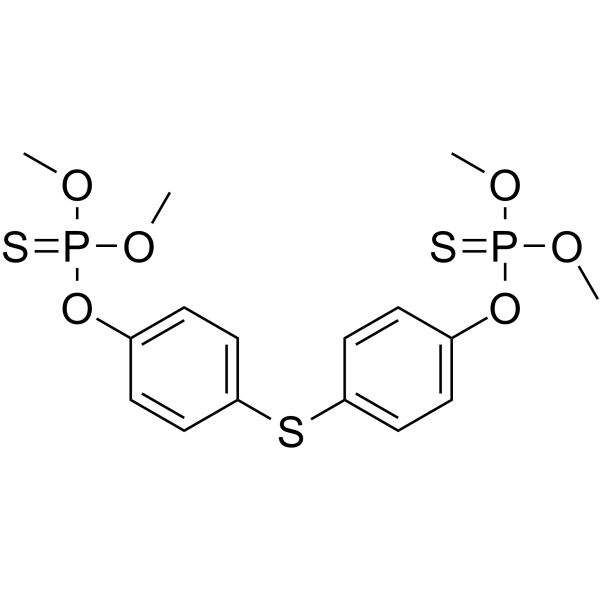
Temephos (Temefos) is an orally active, blood-brain barrier-permeable organophosphate insecticide and AChE inhibitor. By irreversibly inhibiting AChE to induce cholinergic overactivation, Temephos effectively blocks larval development of Aedes aegypti (yellow fever mosquito) and Aedes albopictus (Asian tiger mosquito), and is commonly used in studies related to Dengue Virus, Zika Virus and other relevant pathogens. Temephos exhibits genotoxicity and neurodevelopmental toxicity, and may also cause liver injury, reproductive system abnormalities and cholinergic poisoning symptoms in mammals. Temephos tends to accumulate in adipose tissues and aquatic organisms, and is excreted via feces after metabolism through oxidation and hydrolysis. Note that CYP-mediated metabolic detoxification may reduce the actual larvicidal efficacy of Temephos against some mosquito species. Temephos can be used in research related to dengue fever, Zika virus disease, chikungunya and dracunculiasis .
loading...
    loading...
Cat. No.: HY-P10862
Target:  

Exosomes Virus Protease

Research Areas:  

Infection Cancer

AH-D peptide is a brain-penetrant antiviral agent disrupting highly curved lipid membranes. AH-D peptide exhibits broad-spectrum antiviral activity against ZIKV, Dengue virus, Chikungunya virus, yellow fever virus and Japanese encephalitis virus, with
IC50
values of 11.9, 12.5, 35.7, 206 and 136 nM, respectively. AH-D peptide reduces the viral load in the brain, suppresses inflammation, protects neurons, and does not damage the blood brain barrier. AH-D peptide restores antitumor immunity by decreasing circulating PD-L1 + exosomes, reducing intratumoral immunosuppressive cells (regulatory T cells, myeloid-derived suppressor cells), and enhancing T cell function. AH-D peptide inhibits membrane-enveloped viruses and cancer cell metastasis in vivo. AH-D peptide exhibits no immunogenicity and has negligible effects on normal tissues. AH-D peptide can be used for research in Zika virus and other mosquito-borne viruses, cancer immunotherapy and metastasis .
loading...
    loading...
Cat. No.: HY-P11922
Target:  

Virus Protease

Research Areas:  

Infection

VMPWDEWLTKRKPELP is a chikungunya virus (CHIKV) nsP2 protease inhibitor with a IC50 of 4.6 μM and a Kd of 1.39 μM. VMPWDEWLTKRKPELP can be used for the research of chikungunya fever .
loading...
    loading...
Cat. No.: HY-B1120R
CAS No.: 3383-96-8
Synonyms: Temefos (Standard)
Temephos (Standard) is the analytical standard of Temephos. This product is intended for research and analytical applications. Temephos (Temefos) is an orally active, blood-brain barrier-permeable organophosphate insecticide and AChE inhibitor. By irreversibly inhibiting AChE to induce cholinergic overactivation, Temephos effectively blocks larval development of Aedes aegypti (yellow fever mosquito) and Aedes albopictus (Asian tiger mosquito), and is commonly used in studies related to Dengue Virus, Zika Virus and other relevant pathogens. Temephos exhibits genotoxicity and neurodevelopmental toxicity, and may also cause liver injury, reproductive system abnormalities and cholinergic poisoning symptoms in mammals. Temephos tends to accumulate in adipose tissues and aquatic organisms, and is excreted via feces after metabolism through oxidation and hydrolysis. Note that CYP-mediated metabolic detoxification may reduce the actual larvicidal efficacy of Temephos against some mosquito species. Temephos can be used in research related to dengue fever, Zika virus disease, chikungunya and dracunculiasis .
loading...
    loading...
Cat. No.: HY-B1120S
CAS No.: 1219795-39-7
Synonyms: Temefos-d12
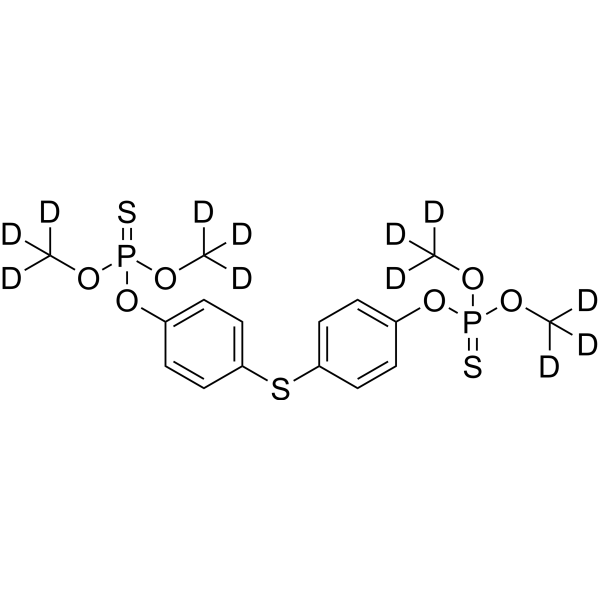
Temephos-d12 is the deuterium labeled Temephos. Temephos (Temefos) is an orally active, blood-brain barrier-permeable organophosphate insecticide and AChE inhibitor. By irreversibly inhibiting AChE to induce cholinergic overactivation, Temephos effectively blocks larval development of Aedes aegypti (yellow fever mosquito) and Aedes albopictus (Asian tiger mosquito), and is commonly used in studies related to Dengue Virus, Zika Virus and other relevant pathogens. Temephos exhibits genotoxicity and neurodevelopmental toxicity, and may also cause liver injury, reproductive system abnormalities and cholinergic poisoning symptoms in mammals. Temephos tends to accumulate in adipose tissues and aquatic organisms, and is excreted via feces after metabolism through oxidation and hydrolysis. Note that CYP-mediated metabolic detoxification may reduce the actual larvicidal efficacy of Temephos against some mosquito species. Temephos can be used in research related to dengue fever, Zika virus disease, chikungunya and dracunculiasis .
loading...
    loading...
Cat. No.: HY-184264
CAS No.: 1309199-94-7
Target:  

CHIKV

Research Areas:  

Infection

CHVB-066 is an alphavirus non-structural protein nsP1 inhibitor that exhibits varying degrees of inhibitory activity against nsP1 of CHIKV and VEEV. CHVB-066 inhibits MTase and GTase activities and disrupts the capping process of viral RNA, including inhibiting CHIKV replication, reducing progeny viruses, and preventing cytopathic effects. It shows varying degrees of inhibitory activity against nsP1 of CHIKV and VEEV but lacks anti-SFV replication activity, displays cross-resistance with MADTP series compounds, and requires nsP2/nsP3 mutations to develop complete drug resistance. This inhibitor with varying inhibitory activity against nsP1 of CHIKV and VEEV can be widely applied to relevant studies on chikungunya virus infection and chikungunya fever .
loading...
    loading...
Cat. No.: HY-184263
CAS No.: 1309199-66-3
Target:  

DNA/RNA Synthesis CHIKV

Research Areas:  

Infection

CHVB-032 is an antiviral agent and SFV nsP1 inhibitor. CHVB-032 inhibits the methyltransferase and guanylyltransferase activities of nsP1, blocks viral RNA capping process, and suppresses post-entry steps in CHIKV replication. CHVB-032 inhibits CHIKV replication across different isolates, but shows no activity against other alphaviruses. CHVB-032 can be used in research related to chikungunya fever and CHIKV infection .
loading...
    loading...

