10 Results for "

cobalt ions

" in MedChemExpress (MCE) Product Catalog:
Products (10)

10 Results for "cobalt ions" in MCE Product Catalog:

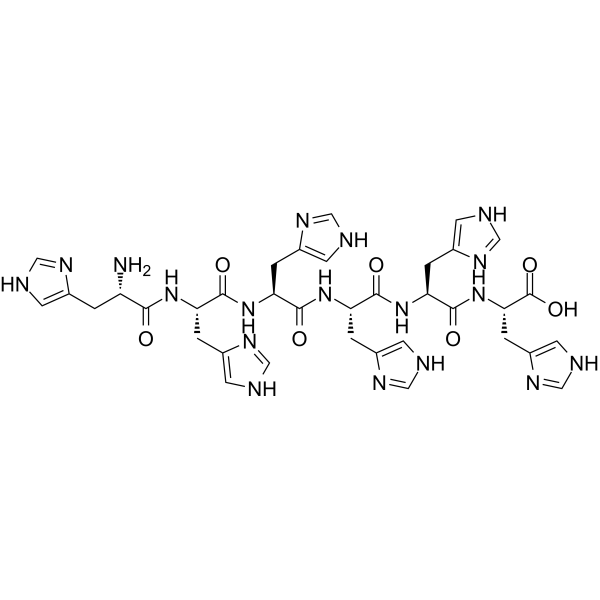
Cat. No.: HY-P0294
CAS No.: 64134-30-1
Synonyms: 6X His Tag
Research Areas:  

Others

Hexa-His (6X His Tag) is a commonly used affinity tag made up of six histidine residues. HEXA-HIS can bind to affinity chromatography media containing transition metal ions like nickel (Ni 2+) or cobalt (Co 2+), making it useful for protein purification .
loading...
    loading...
Cat. No.: HY-D2775
CAS No.: 3047612-66-5
Cobalt(II) ions probe 1 (Compound L) is a fluorescent sensor for Co 2+ detecting in biological environments. Cobalt(II) ions probe 1 can selectively bind with Co 2+ in the presence of other metal ions (Ex: 380 nm) .
loading...
    loading...
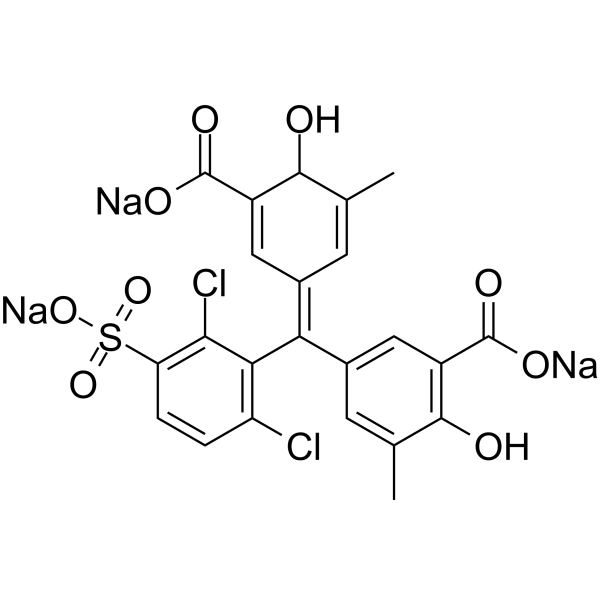
Cat. No.: HY-D0800
CAS No.: 1667-99-8
Chromeazurol S is a compound belonging to the class of azo dyes. It is often used as an indicator in analytical chemistry to detect metal ions such as copper, nickel, and cobalt. Chromeazurol S turns from yellow to blue in the presence of metal ions, allowing them to be detected and quantified. It can be applied to a test strip or added directly to a solution for analysis.
loading...
    loading...
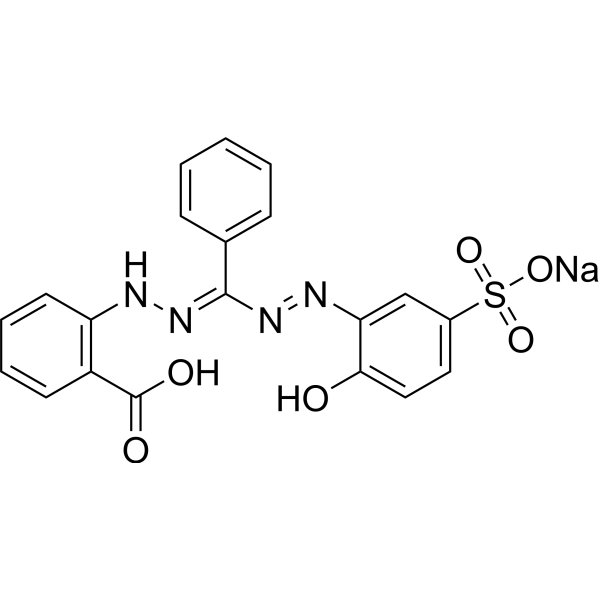
Cat. No.: HY-D0813
CAS No.: 62625-22-3
Zincon sodium is an excellent colorimetric reagent for the detection of zinc and copper ions in aqueous solution. Zincon sodium can be used for the determination of zinc, copper, and cobalt ions in metalloproteins .
loading...
    loading...
Cat. No.: HY-B2220B
CAS No.: 9012-54-8
Research Areas:  

Others

Thermostable cellulase recombinant is a cellulose hydrolase present in hyperthermophiles, which catalyzes the hydrolysis of β-1,4 glycosidic bonds in cellulose. Thermostable cellulase recombinant targets carboxymethyl cellulose (CMC) as its primary substrate, and retains high residual activity even after incubation at high temperatures. The activity of Thermostable cellulase recombinant is inhibited by ionic and non-ionic detergents, and can be enhanced by cobalt ions. Thermostable cellulase recombinant can be applied in the paper industry .
loading...
    loading...
Cat. No.: HY-122330
CAS No.: 36499-65-7
Purity:  99.93%
Synonyms: Kelocyanor
Target:  

Cytochrome P450

Research Areas:  

Others

Dicobalt edetate (Kelocyanor) is a cobalt compound that is an antidote for hydrocyanic acid (cyanide) poisoning. Dicobalt edetate can form a stable complex with cyanide ions, thereby reducing the binding of cyanide ions to cytochrome oxidase, thereby preventing cyanide from inhibiting cellular respiration .
loading...
    loading...
Cat. No.: HY-W088188
CAS No.: 14024-48-7
Synonyms: cobalt(II) acetylacetonate
Research Areas:  

Others

Co (acac)2 is an organometallic compound with catalytic activity, in which the central cobalt ion is chelated with acetylacetonate ligands. Co (acac)2 can serve as a precursor for thin films and nanomaterials, and is applicable to researches in organic synthesis, materials science, industrial applications, and other fields .
loading...
    loading...
Cat. No.: HY-183876
CAS No.: 661482-39-9
Target:  

Aminopeptidase

Research Areas:  

Others

LAF-153 is a Methionine Aminopeptidase-2 (MetAP-2) inhibitor with human IC50 values of 0.074 μM and 0.16 μM.LAF-153 has a t-butyl group extending into the innermost portion of the MetAP-2 cleft, a lactam ring coordinated in the enzyme’s shallow surface pocket, and three hydroxyl groups coordinating to the two cobalt ions in the enzyme’s active site .
loading...
    loading...
Cat. No.: HY-D3247
Cobalt (II) plant dye (Compound 3) is a Cobalt (II) probe. Cobalt (II) plant dye is used for the selective detection of bioaccumulated Cobalt (II) ions in root and stem tissues of Hybanthus enneaspermus plants .
loading...
    loading...
Cat. No.: HY-K0615

MCE ATPase Staining Kit for Muscle Fibers (Calcium Activation Method) is based on the hydrolysis of ATP by ATPase, which generates ADP and inorganic phosphate. Phosphate combines with calcium ions to form colorless calcium phosphate precipitates. Calcium phosphate is then treated with cobalt chloride to form cobalt phosphate, which, after treatment with sulfide solution, results in the formation of brown-black cobalt sulfide precipitates at the enzyme activity sites.

loading...
    loading...

