



64134-30-1
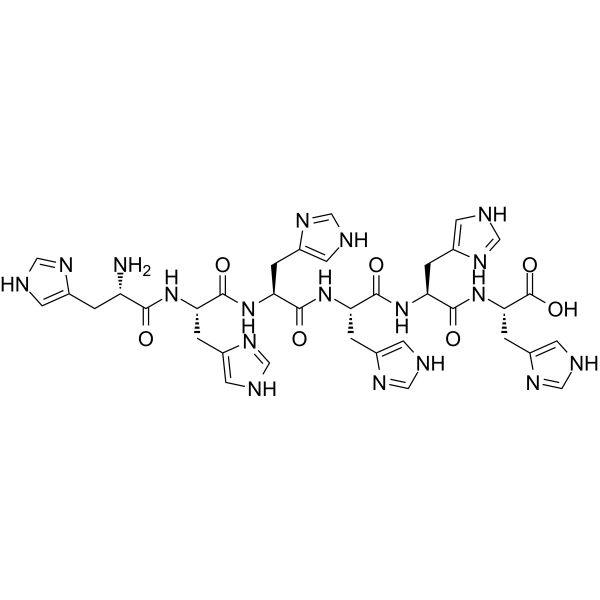
Chemical Structure
Hexa-His
Synonym(s): 6X His Tag
- CAS No.: 64134-30-1
- Formula:C36H44N18O7
- Molecular Weight:840.85
IUPAC Name: L-histidyl-L-histidyl-L-histidyl-L-histidyl-L-histidyl-L-histidine
InChIKey: XSYUPRQVAHJETO-WPMUBMLPSA-N
SMILES: O=C(O)[C@H](CC1=CNC=N1)NC([C@H](CC2=CNC=N2)NC([C@H](CC3=CNC=N3)NC([C@H](CC4=CNC=N4)NC([C@H](CC5=CNC=N5)NC([C@H](CC6=CNC=N6)N)=O)=O)=O)=O)=O
Biological Activity: Hexa-His (6X His Tag) is a commonly used affinity tag made up of six histidine residues. HEXA-HIS can bind to affinity chromatography media containing transition metal ions like nickel (Ni2+) or cobalt (Co2+), making it useful for protein purification[1][2].
| Cat. No. | Product Name | Purity | Description | Pricing | |||||||||||||||||||
|---|---|---|---|---|---|---|---|---|---|---|---|---|---|---|---|---|---|---|---|---|---|---|---|
|
|
Hexa-His | 99.84% | Hexa-His (6X His Tag) is a commonly used affinity tag made up of six histidine residues. HEXA-HIS can bind to affinity chromatography media containing transition metal ions like nickel (Ni2+) or cobalt (Co2+), making it useful for protein purification. | ||||||||||||||||||||
|
loading...
/
|
|||||||||||||||||||||||
-
Similarity Score 0.94
 HY-P0294AHexa-His TFA
-
Similarity Score 0.92
 HY-P11421Cys-His Tag
-
Similarity Score 0.67
 HY-180346Hepta-histidine
-
Similarity Score 0.67
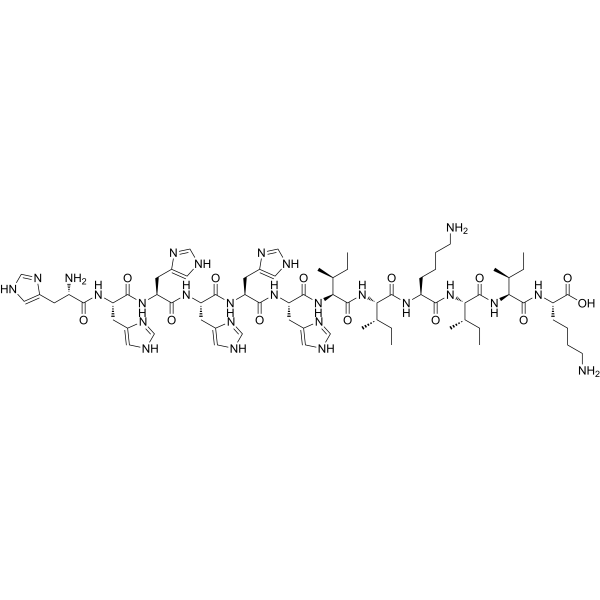 HY-P5500Peptide P1
-
Similarity Score 0.58
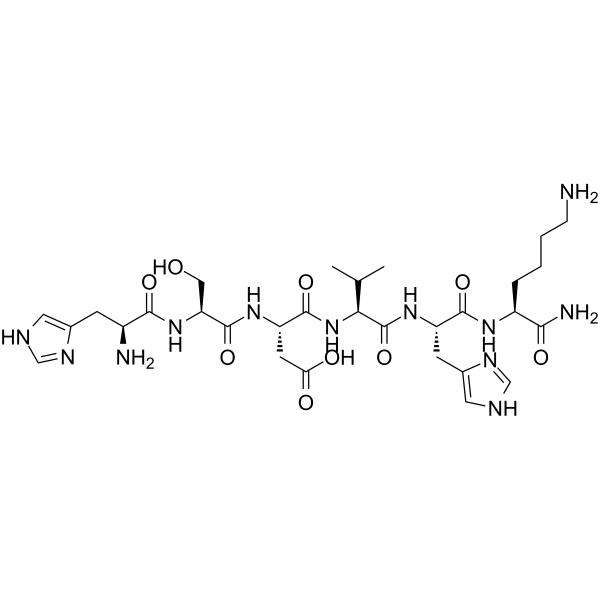 HY-P1187HSDVHK-NH2
-
Similarity Score 0.57
 HY-P11775Peptide HRH
-
Similarity Score 0.57
 HY-P2379His-Cys-Lys-Phe-Trp-Trp
-
Similarity Score 0.56
 HY-P5758His 11
-
Similarity Score 0.56
 HY-105390Renin-IN-4
-

Explore the MedChemAI to find more analogs


References
- [1]. Watly J, et al. Insight into the coordination and the binding sites of Cu(2+) by the histidyl-6-tag using experimental and computational tools. Inorg Chem. 2014 Jul 7;53(13):6675-83. [Content Brief]
- [2]. Ana Paula de Mattos Arêas, et al. Synthesis of cholera toxin B subunit gene: cloning and expression of a functional 6XHis-tagged protein in Escherichia coli.Protein Expr Purif.2002 Aug;25(3):481-7. [Content Brief]



